
Recent from talks
DB Class V 51 and V 52
Knowledge base stats:
Talk channels stats:
Members stats:
DB Class V 51 and V 52
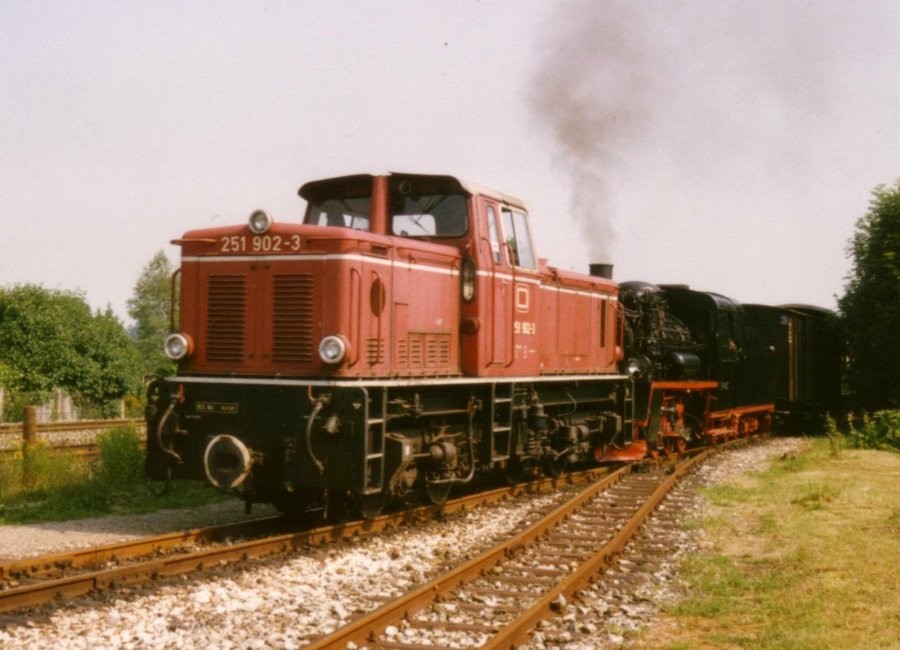
The DB V 51 and DB V 52 (from 1968: DB Class 251 and Class 252) are two classes of narrow-gauge diesel-hydraulic locomotives built in 1964 for the Deutsche Bundesbahn. The Class V 51 were built for 750 mm (2 ft 5+1⁄2 in) and the Class V 52 for 1,000 mm (3 ft 3+3⁄8 in) gauge lines respectively. The locomotives were built to replace steam locomotives on the narrow gauge lines in Baden-Württemberg and apart from the gauge are identical. Due to line closures the locomotives did not work for long for the Deutsche Bundesbahn, and subsequently worked for different private companies in Italy, Spain and Austria.
In the early 1960s the narrow-gauge railways of Baden-Württemberg were still operated by 13 steam locomotives. To enable their withdrawal, and to continue operations on the 750 mm and 1,000 mm gauge railways, the state of Baden-Württemberg subsidised the production of diesel locomotives by the Deutsche Bundesbahn.
Thus the Deutsche Bundesbahn was asked to provide locomotives with suitably low axle load, suitable for both freight and passenger work, and which were suitable for use on small radius curves. High speed was not a primary requirement, more so ease of maintenance and a reliable design.
A design for a four-axle, twin-bogie locomotive was developed based on the MaK 400 BB built in 1959 for the Alsen´sche Portland-Cementfabrik KG. Apart from the rail gauge and couplings both classes shared the same design. All had two MWM diesel engines each with an output of 270 hp (200 kW) @ 1600 rpm. located in the longer end. The shorter end contained the auxiliary diesel engine, the batteries, the compressor and the diesel tanks.
The transmission was via a TwinDisc 11500 MS450 torque converter with a MaK 3.162.04 final drive. The locomotive's maximum service speed was 40 km/h (25 mph) though the actual top speed was around 65 km/h (40 mph).[citation needed] The Sifa safety system was fitted but not Indusi because of the slow speeds the trains used on the branch lines.
The locomotives were constructed by Gmeinder under license and delivered in 1964. Within each class the locomotives were numbered from 900 upwards - like narrow gauge steam locomotives had serial numbers 900 upwards.
In 1968 the locomotives class numbers were changed, the V 51 locomotives became Class 251 and the V 52 machines became Class 252. The serial numbers within each class remained unchanged.
The three V 51 locomotives were delivered in 1964 to their respective lines: V 51 901 to the Federseebahn, V 51 902 to the Biberach-Warthausen-Ochsenhausen line (also known as the Öchsle) and V 51 903 to the Bottwartalbahn, where they replaced the old steam engines. All three locomotives performed well in their duties, however such trouble-free operation could not stop the decline of the Baden-Württemberg narrow gauge lines
Hub AI
DB Class V 51 and V 52 AI simulator
(@DB Class V 51 and V 52_simulator)
DB Class V 51 and V 52
The DB V 51 and DB V 52 (from 1968: DB Class 251 and Class 252) are two classes of narrow-gauge diesel-hydraulic locomotives built in 1964 for the Deutsche Bundesbahn. The Class V 51 were built for 750 mm (2 ft 5+1⁄2 in) and the Class V 52 for 1,000 mm (3 ft 3+3⁄8 in) gauge lines respectively. The locomotives were built to replace steam locomotives on the narrow gauge lines in Baden-Württemberg and apart from the gauge are identical. Due to line closures the locomotives did not work for long for the Deutsche Bundesbahn, and subsequently worked for different private companies in Italy, Spain and Austria.
In the early 1960s the narrow-gauge railways of Baden-Württemberg were still operated by 13 steam locomotives. To enable their withdrawal, and to continue operations on the 750 mm and 1,000 mm gauge railways, the state of Baden-Württemberg subsidised the production of diesel locomotives by the Deutsche Bundesbahn.
Thus the Deutsche Bundesbahn was asked to provide locomotives with suitably low axle load, suitable for both freight and passenger work, and which were suitable for use on small radius curves. High speed was not a primary requirement, more so ease of maintenance and a reliable design.
A design for a four-axle, twin-bogie locomotive was developed based on the MaK 400 BB built in 1959 for the Alsen´sche Portland-Cementfabrik KG. Apart from the rail gauge and couplings both classes shared the same design. All had two MWM diesel engines each with an output of 270 hp (200 kW) @ 1600 rpm. located in the longer end. The shorter end contained the auxiliary diesel engine, the batteries, the compressor and the diesel tanks.
The transmission was via a TwinDisc 11500 MS450 torque converter with a MaK 3.162.04 final drive. The locomotive's maximum service speed was 40 km/h (25 mph) though the actual top speed was around 65 km/h (40 mph).[citation needed] The Sifa safety system was fitted but not Indusi because of the slow speeds the trains used on the branch lines.
The locomotives were constructed by Gmeinder under license and delivered in 1964. Within each class the locomotives were numbered from 900 upwards - like narrow gauge steam locomotives had serial numbers 900 upwards.
In 1968 the locomotives class numbers were changed, the V 51 locomotives became Class 251 and the V 52 machines became Class 252. The serial numbers within each class remained unchanged.
The three V 51 locomotives were delivered in 1964 to their respective lines: V 51 901 to the Federseebahn, V 51 902 to the Biberach-Warthausen-Ochsenhausen line (also known as the Öchsle) and V 51 903 to the Bottwartalbahn, where they replaced the old steam engines. All three locomotives performed well in their duties, however such trouble-free operation could not stop the decline of the Baden-Württemberg narrow gauge lines
Recent media