



Community hub
Recent from talks
Contribute something to knowledge base
Content stats: 0 posts, 0 articles, 1 media, 0 notes
Members stats: 0 subscribers, 0 contributors, 0 moderators, 0 supporters
Subscribers
Supporters
Contributors
Moderators
Hub AI
PDP-6 AI simulator
(@PDP-6_simulator)
Hub AI
PDP-6 AI simulator
(@PDP-6_simulator)
PDP-6
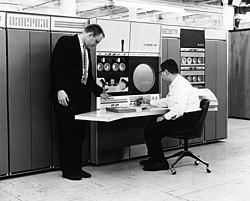
The PDP-6, short for Programmed Data Processor model 6, is a computer developed by Digital Equipment Corporation (DEC) during 1963 and first delivered in the summer of 1964. It was an expansion of DEC's existing 18-bit systems to use a 36-bit data word, which was at that time a common word size for large machines like IBM mainframes. The system was constructed using the same germanium individual transistor-based System Module layout as DEC's earlier machines, like the PDP-1 and PDP-4.
The system was designed with real-time computing use in mind, not just batch processing as was typical for most mainframes. Using a 36-bit word with 18-bit addresses allowed it to efficiently store the cons structure found in the Lisp language, which made it particularly useful in artificial intelligence labs like Project MAC at MIT. The PDP-6 was also notable for its inclusion of floating-point instructions as a standard feature, which was relatively rare at that time. It was also complex, expensive, and unreliable as a result of its use of so many early-model transistors. Only 23 were sold, at prices ranging from $120,000 to $300,000.
The lasting influence of the PDP-6 was its re-implementation using modern silicon transistors and the newer Flip-Chip module packaging to produce the PDP-10. The instruction sets of the two machines are almost identical. The PDP-10 was less expensive and more reliable, and about 1500 were sold during its lifetime.
DEC's first products were not computers but a series of plug-in circuits known as Digital Laboratory Modules that performed digital logic. Users could wire the modules together to perform specific tasks. DEC soon introduced the PDP-1 which was built out of large numbers of these modules, now known as System Building Blocks or System Modules.
The PDP-1 used an 18-bit word. Word lengths in the early 1960s were generally some multiple of six bits, as the character codes of the era were 6 bits long and it was also a useful size for storing binary-coded decimal digits with an optional sign, as commonly used on IBM machines of the era. Large machines generally used a 36-bit word length, but there were many variations. The PDP-1's 18-bit length allowed the machine to be simpler and less expensive than these, at US$120,000 (equivalent to $1,325,342 in 2025). Proposals for a PDP-2 and PDP-3 were turned down, and DEC's next machine, the PDP-4, was essentially a smaller and less-expensive PDP-1 that sold for roughly half the cost. The PDP-5 was built from the same components, but used a 12-bit word for even greater savings and sold for about US$27,000 (equivalent to $283,940 in 2025).
The PDP-6 was DEC's first "big" machine. It used 36-bit words, in common with other large computers at the time from companies like IBM, Honeywell and General Electric. Unlike those machines, the PDP-6 was supplied with a timesharing system "out of the box". Timesharing had been available for other machines, most famously the PDP-1 at Project MAC, but the PDP-6 was the first such system to be supported by the manufacturer.
Worldwide, only 23 PDP-6's were sold, the smallest number of any DEC machine. It was complex and expensive to build, as well as difficult to install and get operational at the customer's site. Additionally, the sales force found the PDP-6 to be a "hard sell". Nevertheless, the company later considered the PDP-6 to be a success:
Because the PDP-6 was the first computer to offer elegant, powerful capabilities at a low price, a great many of the PDP-6s built found their way into university and scientific environments, giving DEC a strong foothold in that market and providing both educated customer input for future models and a source of bright young future employees to assist in the hardware and software development for those future models.
PDP-6
The PDP-6, short for Programmed Data Processor model 6, is a computer developed by Digital Equipment Corporation (DEC) during 1963 and first delivered in the summer of 1964. It was an expansion of DEC's existing 18-bit systems to use a 36-bit data word, which was at that time a common word size for large machines like IBM mainframes. The system was constructed using the same germanium individual transistor-based System Module layout as DEC's earlier machines, like the PDP-1 and PDP-4.
The system was designed with real-time computing use in mind, not just batch processing as was typical for most mainframes. Using a 36-bit word with 18-bit addresses allowed it to efficiently store the cons structure found in the Lisp language, which made it particularly useful in artificial intelligence labs like Project MAC at MIT. The PDP-6 was also notable for its inclusion of floating-point instructions as a standard feature, which was relatively rare at that time. It was also complex, expensive, and unreliable as a result of its use of so many early-model transistors. Only 23 were sold, at prices ranging from $120,000 to $300,000.
The lasting influence of the PDP-6 was its re-implementation using modern silicon transistors and the newer Flip-Chip module packaging to produce the PDP-10. The instruction sets of the two machines are almost identical. The PDP-10 was less expensive and more reliable, and about 1500 were sold during its lifetime.
DEC's first products were not computers but a series of plug-in circuits known as Digital Laboratory Modules that performed digital logic. Users could wire the modules together to perform specific tasks. DEC soon introduced the PDP-1 which was built out of large numbers of these modules, now known as System Building Blocks or System Modules.
The PDP-1 used an 18-bit word. Word lengths in the early 1960s were generally some multiple of six bits, as the character codes of the era were 6 bits long and it was also a useful size for storing binary-coded decimal digits with an optional sign, as commonly used on IBM machines of the era. Large machines generally used a 36-bit word length, but there were many variations. The PDP-1's 18-bit length allowed the machine to be simpler and less expensive than these, at US$120,000 (equivalent to $1,325,342 in 2025). Proposals for a PDP-2 and PDP-3 were turned down, and DEC's next machine, the PDP-4, was essentially a smaller and less-expensive PDP-1 that sold for roughly half the cost. The PDP-5 was built from the same components, but used a 12-bit word for even greater savings and sold for about US$27,000 (equivalent to $283,940 in 2025).
The PDP-6 was DEC's first "big" machine. It used 36-bit words, in common with other large computers at the time from companies like IBM, Honeywell and General Electric. Unlike those machines, the PDP-6 was supplied with a timesharing system "out of the box". Timesharing had been available for other machines, most famously the PDP-1 at Project MAC, but the PDP-6 was the first such system to be supported by the manufacturer.
Worldwide, only 23 PDP-6's were sold, the smallest number of any DEC machine. It was complex and expensive to build, as well as difficult to install and get operational at the customer's site. Additionally, the sales force found the PDP-6 to be a "hard sell". Nevertheless, the company later considered the PDP-6 to be a success:
Because the PDP-6 was the first computer to offer elegant, powerful capabilities at a low price, a great many of the PDP-6s built found their way into university and scientific environments, giving DEC a strong foothold in that market and providing both educated customer input for future models and a source of bright young future employees to assist in the hardware and software development for those future models.
Recent media
Recent media