
Recent from talks
DNA polymerase
Knowledge base stats:
Talk channels stats:
Members stats:
DNA polymerase
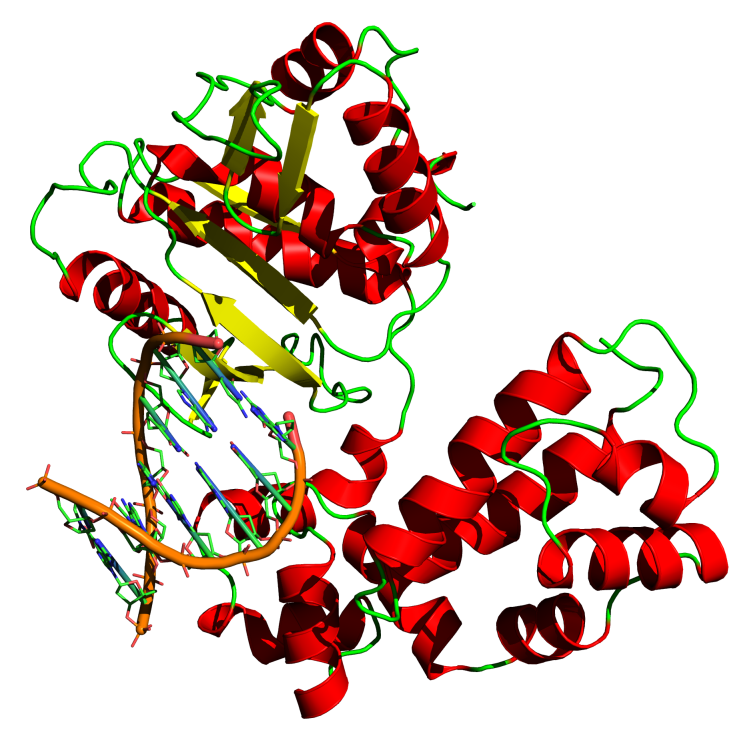
A DNA polymerase is a member of a family of enzymes that catalyze the synthesis of DNA molecules from nucleoside triphosphates, the molecular precursors of DNA. These enzymes are essential for DNA replication and usually work in groups to create two identical DNA duplexes from a single original DNA duplex. During this process, DNA polymerase "reads" the existing DNA strands to create two new strands that match the existing ones. These enzymes catalyze the chemical reaction
DNA polymerase adds nucleotides to the three prime (3')-end of a DNA strand, one nucleotide at a time. Every time a cell divides, DNA polymerases are required to duplicate the cell's DNA, so that a copy of the original DNA molecule can be passed to each daughter cell. In this way, genetic information is passed down from generation to generation.
Before replication can take place, an enzyme called helicase unwinds the DNA molecule from its tightly woven form, in the process breaking the hydrogen bonds between the nucleotide bases. This opens up or "unzips" the double-stranded DNA to give two single strands of DNA that can be used as templates for replication in the above reaction.
In 1956, Arthur Kornberg and colleagues discovered DNA polymerase I (Pol I), in Escherichia coli. They described the DNA replication process by which DNA polymerase copies the base sequence of a template DNA strand. Kornberg was later awarded the Nobel Prize in Physiology or Medicine in 1959 for this work. DNA polymerase II was discovered by Thomas Kornberg (the son of Arthur Kornberg) and Malcolm E. Gefter in 1970 while further elucidating the role of Pol I in E. coli DNA replication. Three more DNA polymerases have been found in E. coli, including DNA polymerase III (discovered in the 1970s) and DNA polymerases IV and V (discovered in 1999). From 1983 on, DNA polymerases have been used in the polymerase chain reaction (PCR), and from 1988 thermostable DNA polymerases were used instead, as they do not need to be added in every cycle of a PCR.
The main function of DNA polymerase is to synthesize DNA from deoxyribonucleotides, the building blocks of DNA. The DNA copies are created by the pairing of nucleotides to bases present on each strand of the original DNA molecule. This pairing always occurs in specific combinations, with cytosine along with guanine, and thymine along with adenine, forming two separate pairs, respectively. By contrast, RNA polymerases synthesize RNA from ribonucleotides from either RNA or DNA.
When synthesizing new DNA, DNA polymerase can add free nucleotides only to the 3' end of the newly forming strand. This results in elongation of the newly forming strand in a 5'–3' direction.
It is important to note that the directionality of the newly forming strand (the daughter strand) is opposite to the direction in which DNA polymerase moves along the template strand. Since DNA polymerase requires a free 3' OH group for initiation of synthesis, it can synthesize in only one direction by extending the 3' end of the preexisting nucleotide chain. Hence, DNA polymerase moves along the template strand in a 3'–5' direction, and the daughter strand is formed in a 5'–3' direction. This difference enables the resultant double-strand DNA formed to be composed of two DNA strands that are antiparallel to each other.
The function of DNA polymerase is not quite perfect, with the enzyme making about one mistake for every billion base pairs copied. Error correction is a property of some, but not all DNA polymerases. This process corrects mistakes in newly synthesized DNA. When an incorrect base pair is recognized, DNA polymerase moves backwards by one base pair of DNA. The 3'–5' exonuclease activity of the enzyme allows the incorrect base pair to be excised (this activity is known as proofreading). Following base excision, the polymerase can re-insert the correct base and replication can continue forwards. This preserves the integrity of the original DNA strand that is passed onto the daughter cells.
Hub AI
DNA polymerase AI simulator
(@DNA polymerase_simulator)
DNA polymerase
A DNA polymerase is a member of a family of enzymes that catalyze the synthesis of DNA molecules from nucleoside triphosphates, the molecular precursors of DNA. These enzymes are essential for DNA replication and usually work in groups to create two identical DNA duplexes from a single original DNA duplex. During this process, DNA polymerase "reads" the existing DNA strands to create two new strands that match the existing ones. These enzymes catalyze the chemical reaction
DNA polymerase adds nucleotides to the three prime (3')-end of a DNA strand, one nucleotide at a time. Every time a cell divides, DNA polymerases are required to duplicate the cell's DNA, so that a copy of the original DNA molecule can be passed to each daughter cell. In this way, genetic information is passed down from generation to generation.
Before replication can take place, an enzyme called helicase unwinds the DNA molecule from its tightly woven form, in the process breaking the hydrogen bonds between the nucleotide bases. This opens up or "unzips" the double-stranded DNA to give two single strands of DNA that can be used as templates for replication in the above reaction.
In 1956, Arthur Kornberg and colleagues discovered DNA polymerase I (Pol I), in Escherichia coli. They described the DNA replication process by which DNA polymerase copies the base sequence of a template DNA strand. Kornberg was later awarded the Nobel Prize in Physiology or Medicine in 1959 for this work. DNA polymerase II was discovered by Thomas Kornberg (the son of Arthur Kornberg) and Malcolm E. Gefter in 1970 while further elucidating the role of Pol I in E. coli DNA replication. Three more DNA polymerases have been found in E. coli, including DNA polymerase III (discovered in the 1970s) and DNA polymerases IV and V (discovered in 1999). From 1983 on, DNA polymerases have been used in the polymerase chain reaction (PCR), and from 1988 thermostable DNA polymerases were used instead, as they do not need to be added in every cycle of a PCR.
The main function of DNA polymerase is to synthesize DNA from deoxyribonucleotides, the building blocks of DNA. The DNA copies are created by the pairing of nucleotides to bases present on each strand of the original DNA molecule. This pairing always occurs in specific combinations, with cytosine along with guanine, and thymine along with adenine, forming two separate pairs, respectively. By contrast, RNA polymerases synthesize RNA from ribonucleotides from either RNA or DNA.
When synthesizing new DNA, DNA polymerase can add free nucleotides only to the 3' end of the newly forming strand. This results in elongation of the newly forming strand in a 5'–3' direction.
It is important to note that the directionality of the newly forming strand (the daughter strand) is opposite to the direction in which DNA polymerase moves along the template strand. Since DNA polymerase requires a free 3' OH group for initiation of synthesis, it can synthesize in only one direction by extending the 3' end of the preexisting nucleotide chain. Hence, DNA polymerase moves along the template strand in a 3'–5' direction, and the daughter strand is formed in a 5'–3' direction. This difference enables the resultant double-strand DNA formed to be composed of two DNA strands that are antiparallel to each other.
The function of DNA polymerase is not quite perfect, with the enzyme making about one mistake for every billion base pairs copied. Error correction is a property of some, but not all DNA polymerases. This process corrects mistakes in newly synthesized DNA. When an incorrect base pair is recognized, DNA polymerase moves backwards by one base pair of DNA. The 3'–5' exonuclease activity of the enzyme allows the incorrect base pair to be excised (this activity is known as proofreading). Following base excision, the polymerase can re-insert the correct base and replication can continue forwards. This preserves the integrity of the original DNA strand that is passed onto the daughter cells.
Recent media