
Recent from talks
Thermostable DNA polymerase
Knowledge base stats:
Talk channels stats:
Members stats:
Thermostable DNA polymerase
Thermostable DNA polymerases are DNA polymerases that originate from thermophiles, usually bacterial or archaeal species, and are therefore thermostable. They are used for the polymerase chain reaction and related methods for the amplification and modification of DNA.
Several DNA polymerases have been described with distinct properties that define their specific utilisation in a PCR, in real-time PCR or in an isothermal amplification. Being DNA polymerases, the thermostable DNA polymerases all have a 5'→3' polymerase activity, and either a 5'→3' or a 3'→5' exonuclease activity.
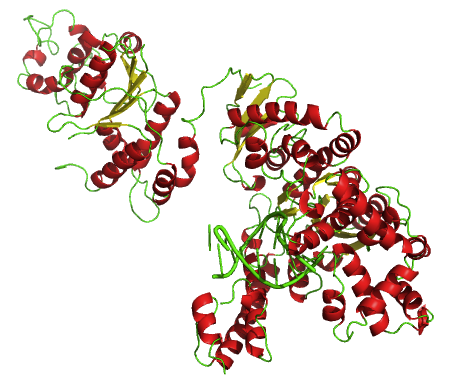
DNA polymerases are roughly shaped like a hand with a thumb, palm and fingers. The thumb is involved in binding and moving double-stranded DNA. The palm carries the polymerase active site, whereas the fingers bind substrates (template DNA and nucleoside triphosphates). The exonuclease activity is in a separate protein domain. Mg2+ is a cofactor.
The polymerase active site in the palm catalyses the prolongation of DNA, starting from a primer bound to a template DNA single strand:
Thermostable DNA polymerases of natural origin are found in thermophilic bacteria, archaea and their pathogens. Among the bacterial thermostable DNA polymerases, Taq polymerase, Tfl polymerase, Tma polymerase, Tne polymerase, Tth and Bst polymerase are used.
In addition to 5'→3' polymerase activity, the bacterial thermostable DNA polymerases (belonging to the A-type DNA polymerases) have 5'→3' exonuclease activity and generate an adenosine overhang (sticky ends) at the 3' end of the newly generated strand. The Klenow fragment of Bst (BF) has a strand displacement activity which allows for use in isothermal amplification without the necessity of denaturation of the DNA in a thermocycler, and its 5'→3' exonuclease activity is deleted for higher yield.
Frequently used B-type DNA polymerases are the Pfu polymerase, the Pwo polymerase, the KOD polymerase, the Tli polymerase (also called Vent), which originates from various archaea, the Tag polymerase, the Tce polymerase, the Tgo polymerase, the TNA1 polymerase, the Tpe polymerase, the Tthi polymerase, the Neq polymerase and the Pab polymerase.
The archaeal variants (belonging to the B-type) produce blunt ends (the Tli polymerase produces an overhang in about 30% of the products) and instead of the 5'→3' exonuclease activity have an activity for correcting synthesis errors (proof-reading), the 3'→5' exonuclease activity. In archaeal polymerases, the error rate suffers when a Klenow fragment analogue is generated, as the correcting exonuclease activity is removed in the process. Some archaeal DNA polymerases are characterised less by their suitability for standard PCR than by their reduced inhibition in the amplification of A-DNA or DNA with modified bases.
Hub AI
Thermostable DNA polymerase AI simulator
(@Thermostable DNA polymerase_simulator)
Thermostable DNA polymerase
Thermostable DNA polymerases are DNA polymerases that originate from thermophiles, usually bacterial or archaeal species, and are therefore thermostable. They are used for the polymerase chain reaction and related methods for the amplification and modification of DNA.
Several DNA polymerases have been described with distinct properties that define their specific utilisation in a PCR, in real-time PCR or in an isothermal amplification. Being DNA polymerases, the thermostable DNA polymerases all have a 5'→3' polymerase activity, and either a 5'→3' or a 3'→5' exonuclease activity.
DNA polymerases are roughly shaped like a hand with a thumb, palm and fingers. The thumb is involved in binding and moving double-stranded DNA. The palm carries the polymerase active site, whereas the fingers bind substrates (template DNA and nucleoside triphosphates). The exonuclease activity is in a separate protein domain. Mg2+ is a cofactor.
The polymerase active site in the palm catalyses the prolongation of DNA, starting from a primer bound to a template DNA single strand:
Thermostable DNA polymerases of natural origin are found in thermophilic bacteria, archaea and their pathogens. Among the bacterial thermostable DNA polymerases, Taq polymerase, Tfl polymerase, Tma polymerase, Tne polymerase, Tth and Bst polymerase are used.
In addition to 5'→3' polymerase activity, the bacterial thermostable DNA polymerases (belonging to the A-type DNA polymerases) have 5'→3' exonuclease activity and generate an adenosine overhang (sticky ends) at the 3' end of the newly generated strand. The Klenow fragment of Bst (BF) has a strand displacement activity which allows for use in isothermal amplification without the necessity of denaturation of the DNA in a thermocycler, and its 5'→3' exonuclease activity is deleted for higher yield.
Frequently used B-type DNA polymerases are the Pfu polymerase, the Pwo polymerase, the KOD polymerase, the Tli polymerase (also called Vent), which originates from various archaea, the Tag polymerase, the Tce polymerase, the Tgo polymerase, the TNA1 polymerase, the Tpe polymerase, the Tthi polymerase, the Neq polymerase and the Pab polymerase.
The archaeal variants (belonging to the B-type) produce blunt ends (the Tli polymerase produces an overhang in about 30% of the products) and instead of the 5'→3' exonuclease activity have an activity for correcting synthesis errors (proof-reading), the 3'→5' exonuclease activity. In archaeal polymerases, the error rate suffers when a Klenow fragment analogue is generated, as the correcting exonuclease activity is removed in the process. Some archaeal DNA polymerases are characterised less by their suitability for standard PCR than by their reduced inhibition in the amplification of A-DNA or DNA with modified bases.
Recent media