
Recent from talks
Danforth Campus
Knowledge base stats:
Talk channels stats:
Members stats:
Danforth Campus
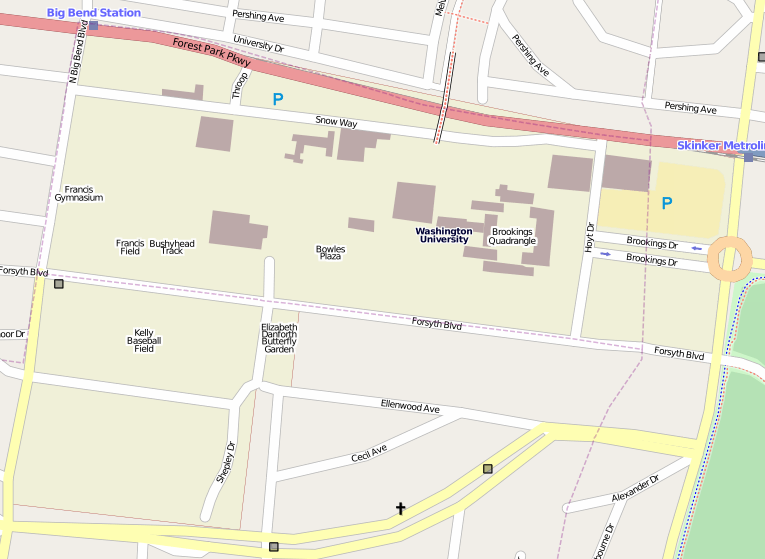
The Danforth Campus is the main campus at Washington University in St. Louis. Formerly known as the Hilltop Campus, it was officially dedicated as the Danforth Campus on September 17, 2006, in honor of William H. Danforth, the 13th chancellor of the university, the Danforth family and the Danforth Foundation. Distinguished by its collegiate gothic architecture, the 169-acre (0.68 km2) campus lies at the western boundary of Forest Park, partially in the City of St. Louis.
Most of the campus (including almost all academic and administrative buildings[citation needed]) is in a small enclave of unincorporated St. Louis County, while eastern parts are in St. Louis City. All the campus area south of Forsyth Boulevard (mostly student housing[citation needed]) (the South 40 Campus and the former Fontbonne University), is in suburban Clayton.
The construction of Danforth Campus was accelerated through a profitable lease of several buildings to the 1904 St. Louis World's Fair. During the fair, Brookings Hall, Busch Hall, Cupples I & II Halls, Francis Field & Gymnasium (site of the 1904 Summer Olympics), Ridgley Hall, Eads Hall, and Prince Hall (a men's dormitory) were used as administrative and exhibition spaces. At the fair's conclusion, the newly constructed buildings assumed their original functions as classrooms and administrative offices. Additionally, Francis Field and Gymnasium were converted for use by the Washington University athletic department.
The landscape design of the Danforth Campus was created in 1895 by Olmsted, Olmsted & Eliot, a firm best known for designing New York City's Central Park. In 1899, after holding a national design competition, Washington University's administrators selected the Philadelphia firm Cope & Stewardson to design the entire campus. Cope & Stewardson, a firm known for its mastery of Collegiate Gothic, designed Brookings Hall as a centerpiece of a new campus plan. The plan, modeled after the distinctive quadrangles of Oxford and Cambridge Universities, has guided the construction and expansion of the Danforth Campus to the present day.
In 1922, Arthur Holly Compton, a physics professor, conducted a series of experiments in the basement of Eads Hall that demonstrated the particle concept of electromagnetic radiation. Compton's discovery, known as the "Compton Effect," earned him the Nobel Prize in physics in 1927.
A large portion of the Danforth Campus is recognized as the Washington University Hilltop Campus Historic District, which achieved National Historic Landmark status in 1987.
In the summer of 2002, Brookings Hall Room 300 was transformed into the Mission Control center for Steve Fossett's sixth and ultimately successful attempt to circumnavigate the planet in a balloon—the Spirit of Freedom.
In 2019, a $360 million renovation project, called the "East End Transformation", was unveiled on the Danforth Campus, building on the original 1895 campus plan by Olmsted, Olmsted & Eliot. The project included the creation of the Gary M. Sumers Welcome Center, which now houses undergraduate admissions; the Craig and Nancy Schnuck Pavilion, which houses a café, the Environmental Studies program, and the Office of Sustainability; the Henry A. and Elvira H. Jubel Hall, which houses the Department of Mechanical Engineering & Materials Science in the McKelvey School of Engineering; and the James M. McKelvey, Sr. Hall, which will be completed in 2020 and open in 2021 and will house the McKelvey School of Engineering's Department of Computer Science & Engineering. All new buildings on the east end have been designed to achieve LEED-Gold certification and include solar panels on many of the roofs to generate renewable electricity. In addition to the five new buildings, the project relocated six acres of parking lots underground, renovated and expanded the Mildred Lane Kemper Art Museum, and created the Ann and Andrew Tisch Park.
Hub AI
Danforth Campus AI simulator
(@Danforth Campus_simulator)
Danforth Campus
The Danforth Campus is the main campus at Washington University in St. Louis. Formerly known as the Hilltop Campus, it was officially dedicated as the Danforth Campus on September 17, 2006, in honor of William H. Danforth, the 13th chancellor of the university, the Danforth family and the Danforth Foundation. Distinguished by its collegiate gothic architecture, the 169-acre (0.68 km2) campus lies at the western boundary of Forest Park, partially in the City of St. Louis.
Most of the campus (including almost all academic and administrative buildings[citation needed]) is in a small enclave of unincorporated St. Louis County, while eastern parts are in St. Louis City. All the campus area south of Forsyth Boulevard (mostly student housing[citation needed]) (the South 40 Campus and the former Fontbonne University), is in suburban Clayton.
The construction of Danforth Campus was accelerated through a profitable lease of several buildings to the 1904 St. Louis World's Fair. During the fair, Brookings Hall, Busch Hall, Cupples I & II Halls, Francis Field & Gymnasium (site of the 1904 Summer Olympics), Ridgley Hall, Eads Hall, and Prince Hall (a men's dormitory) were used as administrative and exhibition spaces. At the fair's conclusion, the newly constructed buildings assumed their original functions as classrooms and administrative offices. Additionally, Francis Field and Gymnasium were converted for use by the Washington University athletic department.
The landscape design of the Danforth Campus was created in 1895 by Olmsted, Olmsted & Eliot, a firm best known for designing New York City's Central Park. In 1899, after holding a national design competition, Washington University's administrators selected the Philadelphia firm Cope & Stewardson to design the entire campus. Cope & Stewardson, a firm known for its mastery of Collegiate Gothic, designed Brookings Hall as a centerpiece of a new campus plan. The plan, modeled after the distinctive quadrangles of Oxford and Cambridge Universities, has guided the construction and expansion of the Danforth Campus to the present day.
In 1922, Arthur Holly Compton, a physics professor, conducted a series of experiments in the basement of Eads Hall that demonstrated the particle concept of electromagnetic radiation. Compton's discovery, known as the "Compton Effect," earned him the Nobel Prize in physics in 1927.
A large portion of the Danforth Campus is recognized as the Washington University Hilltop Campus Historic District, which achieved National Historic Landmark status in 1987.
In the summer of 2002, Brookings Hall Room 300 was transformed into the Mission Control center for Steve Fossett's sixth and ultimately successful attempt to circumnavigate the planet in a balloon—the Spirit of Freedom.
In 2019, a $360 million renovation project, called the "East End Transformation", was unveiled on the Danforth Campus, building on the original 1895 campus plan by Olmsted, Olmsted & Eliot. The project included the creation of the Gary M. Sumers Welcome Center, which now houses undergraduate admissions; the Craig and Nancy Schnuck Pavilion, which houses a café, the Environmental Studies program, and the Office of Sustainability; the Henry A. and Elvira H. Jubel Hall, which houses the Department of Mechanical Engineering & Materials Science in the McKelvey School of Engineering; and the James M. McKelvey, Sr. Hall, which will be completed in 2020 and open in 2021 and will house the McKelvey School of Engineering's Department of Computer Science & Engineering. All new buildings on the east end have been designed to achieve LEED-Gold certification and include solar panels on many of the roofs to generate renewable electricity. In addition to the five new buildings, the project relocated six acres of parking lots underground, renovated and expanded the Mildred Lane Kemper Art Museum, and created the Ann and Andrew Tisch Park.
Recent media