Hubbry Logo
logo
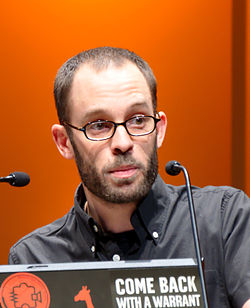
Daniel Domscheit-Berg
Community hub

Daniel Domscheit-Berg

logo
0 subscribers
Read side by side
from Wikipedia

Daniel Domscheit-Berg (German: [ˈdaːni̯eːl ˌdɔmʃaɪtˈbɛʁk, -ni̯ɛl -];  Berg; born 1978), previously known under the pseudonym Daniel Schmitt, is a German technology activist.[1] He is best known as the former spokesperson for WikiLeaks[1][2] and the author of Inside WikiLeaks: My Time with Julian Assange at the World's Most Dangerous Website (2011).[3]

Key Information

Domscheit-Berg began working with WikiLeaks after meeting Assange at the Chaos Computer Club's annual conference in 2007.[4] In August 2010, Domscheit-Berg was suspended from WikiLeaks by Assange after Domscheit-Berg challenged Assange's effectiveness as a leader.[5] In September 2010, Domscheit-Berg resigned from WikiLeaks, saying "WikiLeaks has a structural problem. I no longer want to take responsibility for it, and that's why I am leaving the project."[1]

Upon leaving WikiLeaks, Domscheit-Burg allegedly destroyed thousands of unpublished documents.[6][7][8][9]

On 17 December 2010, he announced plans to open a new website for anonymous online leaks called OpenLeaks.[10] At a Chaos Computer Club (CCC) event in August 2011, he announced its preliminary launch and invited hackers to test the security of the OpenLeaks system. The launch was a failure as it was unable to get online. The CCC criticized Domscheit-Berg for exploiting the good name of the club to promote his OpenLeaks project and expelled him from the club.[9][6] This decision was revoked in February 2012.[11] In September 2011, several news organizations cited Domscheit-Berg's split from Julian Assange and WikiLeaks as one of a series of events that led to the release that month of all 251,287 United States diplomatic cables in the Cablegate affair.[12][13][14]

In 2011, he was named by Foreign Policy magazine in its FP Top 100 Global Thinkers.[15]

WikiLeaks

[edit]

Domscheit-Berg began working with WikiLeaks after meeting Assange at the Chaos Computer Club's annual conference (24C3) in 2007.[4] During an online chat in August 2010, Julian Assange accused Domscheit-Berg of leaking information about the organization to Newsweek magazine. Assange suspended Domscheit-Berg from WikiLeaks during the chat after Domscheit-Berg wrote "you're not even fulfilling your role as a leader right now. A leader communicates and cultivates trust in himself. You are doing the exact opposite. You behave like some kind of emperor or slave trader."[5]

On 25 September 2010 Domscheit-Berg told Der Spiegel that he was resigning, saying "WikiLeaks has a structural problem. I no longer want to take responsibility for it, and that's why I am leaving the project."[1][16] When Domscheit-Berg resigned, the architect of WikiLeaks' submission platform and four other staffers also broke with Assange.[5][17]

A book about his experience with and separation[18] from WikiLeaks was released in Germany in February 2011, entitled Inside WikiLeaks: Meine Zeit bei der gefährlichsten Website der Welt ("My Time at the World's Most Dangerous Website").[19] An English translation was later released by Australian publisher Scribe Publications.[9][6][20][21] In Berg's book he criticizes Julian Assange's leadership style and handling of the Afghan War Diaries. Domscheit-Berg stated he would destroy WikiLeaks data when leaving WikiLeaks.[22] He and the other staffers leaving the project wanted to be sure that duplicates would be confirmed deleted by a notary with an affidavit.[22][7] After leaving, WikiLeaks stated that Domscheit-Berg representing OpenLeaks, negotiated for eleven months over the unpublished documents and internal organisation communications with mediation between OpenLeaks and WikiLeaks conducted and terminated by organization spokesman and board member Andy Müller-Maguhn.[23] Domscheit-Berg told weekly Der Freitag that "I took no documents from WikiLeaks with me", leading to suspension of mediations.[9][6][23] Domscheit-Berg was eventually kicked out of Chaos Computer Club by Müller-Maguhn[24] due to tension over the files and for using the name of the Chaos Computer Club to promote OpenLeaks.[9][6][12]

WikiLeaks and other sources later alleged that Domscheit-Berg had destroyed over 3500 unpublished whistleblower communications with some communications containing hundreds of documents,[9][6][7][8] including the US government's No Fly List,[25] 5 GB of Bank of America leaks,[26] insider information from 20 neo-Nazi organizations[25][27], Combat Camera footage of the Granai Airstrike[28][29], and evidence of torture and government abuse of a Latin American country.[30] Domscheit-Berg confirmed that he had destroyed the unpublished files including the No Fly list. He said that WikiLeaks' claims about the Bank of America files were "false and misleading" and that he hadn't taken them.[2][31][32] According to Domscheit-Berg, the files were lost because of an IT problem when one of WikiLeaks storage drives crashed and they lost it.[33]

OpenLeaks

[edit]

On 17 December 2010, Domscheit-Berg announced the intention to start a site named "OpenLeaks"[10][34] with the intention of being more transparent than WikiLeaks. "In these last months, the WikiLeaks organization has not been open any more. It lost its open-source promise."[10] Several other members of WikiLeaks left with Domscheit-Berg to join OpenLeaks, including a programmer known only as "The Architect" who had designed the WikiLeaks submission system.[33][35][36] OpenLeaks planned to launch a whistleblowing foundation in Germany and that would make decisions about how to operate.[37]

Instead of publishing the documents, Domscheit-Berg said that his proposed OpenLeaks process would send the leaked documents to various news entities or publishers without publishing them directly.[38][39] According to Domscheit-Berg, OpenLeaks wouldn't be able to read submissions. They would give the submissions to outlets chosen by the source, and then give others access after a certain amount of time or if the outlet refused the submission.[35] Insiders at OpenLeaks said that because of that, they planned to avoid "the kind of political pressure which WikiLeaks is under at this time."[40][39][41] Internal documents said it wanted to be a neutral intermediary "without a political agenda except from the dissemination of information to the media, the public, non-profit organizations, trade- and union organizations and other participating groups."[39][41] Analysts said OpenLeaks was a promising alternative to WikiLeaks and Lucy Dalglish, executive director of the Reporters Committee for Freedom of the Press, OpenLeaks structure would make it more of an internet service provider than a publisher.[37]

OpenLeaks aimed to start public operations in January 2011 but postponed its launch more than once.[36] In August 2011, Domscheit-Berg announced a four day test launch and invited thousands of hackers to attack the OpenLeaks site and look for security flaws during the Chaos Communications Camp.[42][43] At the event, WikiLeaks associate Jacob Appelbaum brought up rumors that OpenLeaks was connected to German intelligence. Chaos Communication Camp board member, Andy Müller-Maguhn, said OpenLeaks did not provide source protection and lacked transparency.[44] When OpenLeaks attempted to launch a test site at the event, it was unable to get online.[43] At the time, four European newspapers and one non-profit group had signed up to receive the OpenLeaks documents.[42]

In September 2011, activist American author and security state critic Glenn Greenwald wrote that OpenLeaks had not produced any disclosures and was "cashing in on a vindictive, petty, personality-based vendetta against Assange and WikiLeaks ... and ... bolstering secrecy and destroying transparency, as Domscheit-Berg did when he permanently deleted thousands of files previously leaked to WikiLeaks, including documents relating to the Bank of America".[45]

On 23 December 2012 Domscheit-Berg announced on the website that the organisation would not go ahead as previously intended and would now focus on providing technology and expertise regarding how to receive documents from anonymous sources rather than directly facilitating leaks themselves.[46]

In a July 2013 interview, Domscheit-Berg said that work on OpenLeaks would continue, but "without much public involvement."[47]

Personal life

[edit]

Domscheit-Berg is married to activist and politician Anke Domscheit-Berg.[48]

Makerspace in a disused rail station building

[edit]

As of 2020, Domscheit-Berg is engaged with the makerspace Verstehbahnhof (translated: Station of Understanding). The makerspace has re-appropriated rooms of the Fürstenberg (Havel) station, which is still in use.[49]

Inside WikiLeaks

[edit]
  • Daniel Domscheit-Berg (2011). Inside WikiLeaks: Meine Zeit bei der gefährlichsten Website der Welt (in German). Berlin: Econ Verlag. ISBN 978-3-430-20121-6.
  • Daniel Domscheit-Berg (2011). Inside WikiLeaks: my time with Julian Assange at the world's most dangerous website. Carlton North, City of Melbourne: Scribe Publications. ISBN 978-1-921844-05-8. Archived from the original on 19 February 2011. Retrieved 9 February 2011.
  • Daniel Domscheit-Berg (2011). Inside WikiLeaks: My Time with Julian Assange at the World's Most Dangerous Website. New York City: Random House. ISBN 978-0-307-95191-5. Retrieved 10 February 2011.

References

[edit]

Further reading

[edit]
[edit]
Revisions and contributorsEdit on WikipediaRead on Wikipedia
from Grokipedia
Daniel Domscheit-Berg (born 1978) is a German IT security expert and political activist recognized for his early involvement with WikiLeaks, where he helped develop the organization's secure submission system and acted as its German spokesperson under the pseudonym Daniel Schmitt from late 2007 until September 2010.[1][2] After departing amid escalating conflicts with founder Julian Assange over management, transparency in operations, and the handling of leaked materials, Domscheit-Berg co-founded OpenLeaks in December 2010 as an alternative platform designed to facilitate anonymous document submissions directly to media outlets and NGOs rather than publishing them itself.[3][4] His contributions to WikiLeaks included engineering safeguards for whistleblower submissions during a period when the site released high-profile leaks such as the Afghan War Logs and Collateral Murder video, though internal disputes led to his exit and the retention of an estimated 100 gigabytes of unpublished files on his personal server.[5][6] In 2011, Domscheit-Berg published Inside WikiLeaks: My Time with Julian Assange at the World's Most Dangerous Website, a memoir that portrayed Assange as erratic and authoritarian, prompting legal threats from WikiLeaks and public rebuttals.[7] The book and his subsequent revelation that he had deleted the held submissions—to prevent potential misuse and protect sources—intensified the rift, with Assange accusing him of sabotaging the organization.[8][6] OpenLeaks aimed to address perceived flaws in WikiLeaks' model by prioritizing source protection and partner verification, but it struggled to gain traction and ceased active operations by 2012, though Domscheit-Berg continued advocacy for digital transparency through speaking engagements and affiliations with groups like the Chaos Computer Club, from which he was later expelled.[9] His experiences highlighted tensions within the transparency movement between radical disclosure and responsible handling of sensitive information, influencing portrayals in media such as the 2013 film The Fifth Estate.[10]

Early Life and Background

Education and Initial Career

Daniel Domscheit-Berg was born in 1978 in Germany.[2] From an early professional standpoint, he developed expertise as a systems engineer with a focus on IT infrastructure.[11] Domscheit-Berg pursued studies in applied computer science at the University of Cooperative Education in Mannheim from 2002 to 2005, a dual education system combining academic training with practical work experience typical in German technical vocational programs.[12] After completing his education, he joined Electronic Data Systems (EDS) as a network engineer, working there until 2009 in roles involving the construction of large-scale networks for sectors such as automotive and transport.[12] [13] In this capacity, he specialized in network security, gaining hands-on experience in IT security protocols and software development fundamentals that underpinned his technical proficiency.[14]

Technology Activism Before WikiLeaks

Involvement with Chaos Computer Club and Early Projects

Daniel Domscheit-Berg, operating under the pseudonym Daniel Schmitt, established connections within Germany's hacking community prior to 2007, including membership in the Chaos Computer Club (CCC), an association founded in 1981 to advocate for digital civil liberties through ethical hacking and technical analysis. The CCC conducted demonstrations exposing systemic flaws in government-issued identification systems, such as the vulnerabilities in German electronic passports and biometric data handling practices during the mid-2000s, highlighting risks of unauthorized access and surveillance without relying on unsubstantiated ideological claims.[15][16] His participation in CCC activities, including preparatory involvement for events like the annual Chaos Communication Congress, focused on grassroots efforts to test and critique data security protocols, fostering an empirical approach to identifying causal weaknesses in privacy protections against state and corporate overreach. These engagements emphasized practical, open-source oriented projects aimed at bolstering individual digital autonomy, such as community-driven audits of encryption tools and network vulnerabilities, predating his WikiLeaks association. Domscheit-Berg's exposure to CCC's methodology—verifying claims through demonstrable hacks rather than abstract advocacy—shaped his emphasis on verifiable transparency mechanisms in technology activism.[17]

WikiLeaks Involvement

Key Contributions and Role

Daniel Domscheit-Berg adopted the pseudonym Daniel Schmitt upon joining WikiLeaks in late 2007, serving as its primary spokesperson and effective second-in-command to founder Julian Assange until his departure in September 2010.[1] [18] In this capacity, he handled public communications and represented the organization in media interactions, including facilitating initial partnerships with outlets like Der Spiegel starting in 2009 to verify and contextualize submissions.[19] Domscheit-Berg played a key role in building WikiLeaks' technical platform, focusing on secure systems to enable anonymous submissions from potential sources.[1] He collaborated with programmers on the encrypted submission mechanism, which routed data through multiple Tor nodes and utilized PGP encryption to anonymize uploads and shield users from traceability.[20] This infrastructure supported the influx of materials during 2008–2010, allowing the site to process whistleblower data without immediate public disclosure. Operationally, he contributed to the handling of major leaks, including logistical verification for the April 2010 "Collateral Murder" video, where he coordinated investigators' travel to Iraq for on-ground authentication of the footage depicting a U.S. helicopter strike.[7] His efforts extended to early preparations for the July 2010 Afghanistan war logs release, involving redaction reviews and coordination with media partners to manage the dataset of over 90,000 incident reports.[21] These activities aligned with WikiLeaks' operational model of phased releases, which amplified the organization's visibility through coordinated international reporting.[19]

Internal Dynamics and Departure Controversies

Daniel Domscheit-Berg announced his departure from WikiLeaks on September 27, 2010, citing escalating internal tensions with founder Julian Assange and fundamental structural flaws in the organization's operations.[22][18] He described Assange's leadership as increasingly autocratic, characterized by resistance to internal criticism and centralized control over decision-making processes, which stifled collaborative input from other members.[23][24] Domscheit-Berg's suspension in August 2010 stemmed from his direct challenge to Assange's effectiveness as a leader, highlighting disputes over technical infrastructure quality and the sustainability of WikiLeaks' publication model, which emphasized infrequent, high-volume data dumps rather than steady, verified releases.[3] Further frictions arose from Assange's handling of sensitive materials and sources, with Domscheit-Berg alleging inadequate verification protocols and risks to informant safety during 2010's major releases, such as the Afghan war logs, which he viewed as disproportionately focused on U.S. activities at the expense of broader global transparency goals.[3][25] Financial opacity compounded these issues; Domscheit-Berg claimed Assange refused to reimburse operational expenses, including costs for investigators verifying the "Collateral Murder" video authenticity, fostering perceptions of unaccountable resource allocation.[7] These power struggles reflected deeper ideological rifts, with Domscheit-Berg arguing that Assange's personal dominance transformed WikiLeaks into a vehicle for individual agenda rather than principled whistleblowing.[24][26] WikiLeaks countered these narratives by portraying Domscheit-Berg's exit as disruptive rather than principled, asserting he had been suspended for disloyalty prior to his formal resignation.[27] Assange's team accused Domscheit-Berg of sabotaging operations by removing thousands of unpublished submissions—estimated at over 3,500 documents—upon leaving, an action Domscheit-Berg later confirmed in August 2011, stating he deleted the files using secure methods to prevent potential misuse and protect sources amid concerns over Assange's reliability.[6][8] No independent evidence has verified claims of broader infrastructure damage by Domscheit-Berg, such as server sabotage, though WikiLeaks pursued legal threats against him in February 2011 over disclosures in his forthcoming book, framing them as breaches of confidentiality.[7][28] These mutual recriminations underscored the absence of formalized governance in WikiLeaks, where personal loyalties dictated operational continuity.[29]

OpenLeaks Initiative

Establishment and Operational Model

Daniel Domscheit-Berg established OpenLeaks in September 2010 following his departure from WikiLeaks amid internal disputes over centralized decision-making and handling of submissions.[30] The project aimed to create a decentralized platform that enabled anonymous whistleblower submissions to be routed directly to vetted partner organizations, such as media outlets, NGOs, and labor unions, rather than aggregating and publishing materials under a single entity's control.[31] This model contrasted with WikiLeaks' approach by positioning OpenLeaks as a neutral technical intermediary—a "safe-deposit box" for leaks—without verifying, editing, or disseminating content itself, thereby reducing risks of exposure or mishandling attributed to WikiLeaks' direct involvement.[32][3] The operational framework emphasized secure, anonymous transmission protocols, drawing on lessons from WikiLeaks' vulnerabilities, including the need for distributed responsibility to protect sources from retaliation or operational errors.[33] Collaborators, including Icelandic former WikiLeaks volunteer Herbert Snorrason, assisted in developing initial prototypes focused on partner-vetted distribution to enhance verification and contextualization by recipients experienced in journalistic standards.[34] OpenLeaks' website went live on December 13, 2010, outlining a vision of technology provision to global entities for receiving submissions without imposing a political agenda or central authority.[33] This structure sought to mitigate perceived recklessness in WikiLeaks' model by enforcing separation between submission intake and publication, prioritizing source safety through partner accountability.[35]

Failures and Dissolution

OpenLeaks faced persistent funding shortages that undermined its ability to develop and maintain a robust secure submission platform, as the initiative lacked the donation-driven model of WikiLeaks and struggled to attract institutional support in the post-2011 environment of heightened legal and financial pressures on transparency projects.[36] Low adoption rates among whistleblowers stemmed from the platform's unproven track record and the absence of high-profile publications, resulting in minimal documented submissions compared to WikiLeaks' volume of leaks during the same period.[37] Technical hurdles compounded these issues, including challenges in scaling encrypted, anonymous drop points amid evolving cybersecurity threats and the need for verifiable end-to-end security without direct organizational control over publication. Launch efforts faltered repeatedly; a planned debut in early 2011 failed to materialize fully online, and subsequent tests in 2012 exposed reliability gaps in the infrastructure.[17] Partnerships with media outlets and NGOs, intended as core to the intermediary model, largely collapsed due to hesitancy over legal risks and verification burdens, with examples like stalled collaborations highlighting the model's impracticality.[38] This over-reliance on third-party intermediaries for curation and release—contrasting WikiLeaks' direct publishing strategy, which prioritized raw dissemination despite editorial flaws—revealed structural limitations in building trust and throughput for large-scale leaks. By 2014, amid negligible activity and unresolved operational deficits, OpenLeaks ceased as a whistleblower platform, its dissolution evidencing how intermediary dependencies failed to compete with unfiltered models in attracting sources seeking guaranteed exposure.[3][39]

Publications and Public Commentary

Inside WikiLeaks: Content and Revelations

Domscheit-Berg's 2011 book delineates WikiLeaks' operational structure as a small, volunteer-driven entity reliant on encrypted submissions, yet plagued by ad hoc processes that prioritized rapid publication over verification. He recounts handling thousands of leaks, including collateral murder video footage released in April 2010 and subsequent war logs, but emphasizes how Assange's unilateral decisions often bypassed collective review, resulting in unvetted releases that exposed operational vulnerabilities. For instance, the organization's submission system, built on secure drop points, accumulated over 3,500 unpublished files by September 2010, many unprocessed due to resource constraints and internal disputes.[37][40] Central to the book's critique is Assange's leadership, portrayed as autocratic and paranoid, with decisions centralized to the point of excluding team input; Domscheit-Berg notes Assange's insistence on personal oversight of all major actions, including travel with bodyguards by mid-2010, which diverted focus from core functions and fostered resentment among volunteers. This dynamic contributed to inefficiencies, such as delayed leak verifications, as Assange reportedly dismissed harm-minimization protocols in favor of expediency. Financially, Domscheit-Berg highlights opacity in donation management, alleging Assange controlled funds without transparent accounting, leading to disputes over expenditures like legal fees and security amid growing inflows post-Collateral Murder release, which undermined trust in resource allocation for secure operations.[41][42] A pivotal revelation concerns the 2010 U.S. diplomatic cables, numbering approximately 250,000 documents; Domscheit-Berg describes learning late in the process that initial redactions for Afghan war logs—analogous to cable handling—overlooked civilian names, risking informant exposure, and extends this to cables where WikiLeaks' collaboration with media outlets like The Guardian faltered due to Assange's impatience with iterative verification. This mishandling exemplified broader chaos, as the rush to publish in November 2010 without full team consensus compromised data integrity, prompting Domscheit-Berg's post-departure action in September 2010 to delete the entire unpublished archive, including cables-related materials, to safeguard sources amid perceived lapses in WikiLeaks' protocols.[23][8][6] These disclosures underscore how interpersonal conflicts and procedural shortcuts eroded WikiLeaks' capacity to maintain submission confidentiality and leak authenticity; for example, the internal revolt culminating in Domscheit-Berg and a programmer seizing the submission system in September 2010 halted new intakes temporarily, illustrating causal breakdowns where leadership centralization precluded scalable operations. Domscheit-Berg argues this dysfunction directly impaired the platform's mission, as unverified stockpiles remained inert while public releases suffered from incomplete vetting.[20][43]

Criticisms and Counterclaims

WikiLeaks supporters and Assange allies criticized Inside WikiLeaks as a betrayal by a disgruntled former insider, portraying Domscheit-Berg's accounts of internal dysfunction as exaggerated or motivated by personal resentment rather than genuine concerns over organizational integrity.[44] The book was dismissed in some transparency advocacy circles as an attempt to undermine WikiLeaks' mission, with claims that Domscheit-Berg lacked deep insight into operations and relied on selective anecdotes to depict Assange as power-obsessed.[42] Conversely, independent reviewers highlighted the text's value in exposing WikiLeaks' cult-like atmosphere, where Assange's dominance stifled dissent and prioritized spectacle over systematic source protection, though they noted Domscheit-Berg's own role in enabling such dynamics.[23] In response to the book's February 2011 publication, WikiLeaks issued legal threats against Domscheit-Berg, accusing him of theft and sabotage for removing the organization's secure submission system and approximately 3,500 unpublished document submissions during his September 2010 departure.[7][28] Assange publicly alleged that Domscheit-Berg sought to monetize the stolen data by offering its return, framing the act as a direct threat to whistleblower safety and organizational continuity.[45] Domscheit-Berg admitted in August 2011 to destroying the files, arguing that WikiLeaks' erratic handling under Assange—evidenced by prior security lapses like unredacted cable releases—rendered the submissions vulnerable, justifying unilateral action to prevent misuse.[46] No lawsuits from WikiLeaks advanced to trial, with Domscheit-Berg publicly mocking the threats as baseless posturing amid the organization's own operational disarray.[7] Media reception in 2011 often reflected ideological leanings, with left-leaning outlets like The Guardian emphasizing Assange's victimhood from external pressures while amplifying skepticism toward Domscheit-Berg's motives, thereby downplaying evidentiary critiques of WikiLeaks' internal authoritarianism and verification shortcomings.[24] This coverage pattern aligned with broader institutional biases favoring narratives of state persecution over accountability for transparency advocates' self-inflicted errors, as seen in minimal scrutiny of Assange's control tactics despite corroborating accounts from multiple ex-members.[20] Such framing contributed to polarized discourse, where substantive operational flaws raised by the book were subordinated to defenses of WikiLeaks' disruptive ethos against establishment backlash.[28]

Later Activities and Ventures

Political Engagement

Following his departure from WikiLeaks in 2011, Domscheit-Berg joined the Pirate Party Germany in 2012, becoming a prominent early member alongside his wife Anke Domscheit-Berg.[11] The party, focused on digital rights, advocated for reforms in copyright law, internet freedom, and opposition to expansive government surveillance, aligning with Domscheit-Berg's prior advocacy through the Chaos Computer Club.[47] His involvement emphasized participatory democracy via digital tools, though the party's internal disorganization contributed to its electoral decline by 2013, with no parliamentary seats secured in the federal election that year.[48] Domscheit-Berg collaborated with Anke in public campaigns against state surveillance, particularly in response to revelations of mass data collection by agencies like the NSA, which he viewed as incompatible with individual freedoms.[47] In 2014, he supported calls for stronger data sovereignty and privacy protections, arguing that unchecked surveillance erodes civil liberties without sufficient oversight or justification.[49] He critiqued over-reliance on technology for political transparency, stressing the need for balanced policies that protect personal data while enabling accountability for powerful institutions.[15] No records indicate Domscheit-Berg pursued formal candidacies or advisory roles within the Pirate Party or other entities, with his engagement remaining centered on advocacy rather than partisan office-seeking.[11] His positions influenced broader debates on EU data privacy regulations, including precursors to the General Data Protection Regulation (GDPR), though direct legislative impacts remain unverified.[50]

Makerspace Project and Community Initiatives

In 2017, Daniel Domscheit-Berg co-founded the Verstehbahnhof makerspace in the disused railway station building in Fürstenberg/Havel, Brandenburg, Germany, converting underutilized spaces into a collaborative hub for technology enthusiasts following the dissolution of OpenLeaks.[1][51] The project re-appropriated rooms previously including a former pub area, establishing it as an open workshop emphasizing hands-on prototyping, secure systems development, and education in a rural setting with declining population trends.[52][53] Key features include equipped workshops with tools such as 3D printers and laser cutters for hacking and fabrication, a media production studio, data processing facilities, an event hall for workshops and lectures, a communal kitchen, and informal social areas designed to encourage cross-disciplinary collaboration independent of participants' socioeconomic backgrounds.[54][55] Activities focus on practical tech education, including youth hacking programs, digital literacy sessions, and prototyping secure communication tools, aiming to build independent tech communities in underserved rural regions.[56][57] Outcomes demonstrate moderate viability as an innovation outpost, with sustained operations evidenced by events attracting over 60 volunteers in a single 2024 volunteering day and recognition including the 2024 taz Panter Preis for cultural and educational impact, alongside foundation funding for expansions like the Explore 2.0 project.[58][59][60] However, as a non-governmental initiative in a rural context, it faces typical sustainability hurdles such as reliance on grants and volunteer engagement amid policy neglect of makerspace scalability, though no project-specific closures or failures have been reported as of 2024.[61][62]

Personal Life

Family and Partnerships

Daniel Domscheit-Berg has been married to Anke Domscheit-Berg since the early 2010s; she is a German politician and internet activist who served as a member of the Bundestag from 2017 to 2025.[47][11] The couple met through shared involvement in digital activism circles, including the Pirate Party, where Anke initially engaged in transparency and civil rights advocacy.[11] Their partnership features joint efforts against state surveillance and for political transparency, such as co-authoring weekly columns on digital policy for the Frankfurter Rundschau.[63] This collaboration underscores a mutual emphasis on privacy protections, which they have applied by limiting public disclosures about their family life beyond professional intersections.[11] No verifiable public details exist on children, aligning with their stated concerns over balancing transparency with personal data security.[11]

Public Persona and Privacy Stance

Daniel Domscheit-Berg initially operated under the pseudonym Daniel Schmitt while serving as spokesperson for WikiLeaks from 2007 to 2010, a measure aimed at enhancing operational security amid the organization's handling of sensitive leaks.[1] Upon his resignation on September 25, 2010, he publicly disclosed his real identity, marking a transition to open advocacy and media engagement on transparency and digital security issues.[22] Following his departure from WikiLeaks, Domscheit-Berg founded OpenLeaks in late 2010 as a platform focused on providing anonymous submission tools to media outlets and organizations, designed such that submissions remain inaccessible to the service itself to safeguard source privacy.[3] He has advocated for robust anonymity protocols, such as the use of the Tor network, for whistleblowers while emphasizing that transparency should be the default unless justified by specific risks.[15] This approach balances public visibility—through keynote speeches on cybersecurity, privacy in the digital world, and ethical leaking—with a commitment to technical protections for vulnerable individuals.[1] Critics, including WikiLeaks, accused Domscheit-Berg of inconsistency for revealing internal organizational details after leaving, prompting legal threats in February 2011 over alleged breaches of confidentiality, though he countered that such disclosures were necessary to expose structural flaws fostering unaccountability.[7] His actions demonstrate a selective application of anonymity: prioritizing it for sources facing potential harm, as evidenced by his destruction of over 3,500 unpublished submissions to prevent exposure, while leveraging personal publicity to critique opaque systems and promote decentralized privacy tools.[37] This stance aligns with a causal view that individual risks vary, allowing public figures to advance broader privacy norms without the same imperatives for concealment.[15]

References

User Avatar
No comments yet.