
Recent from talks
Danza de los Voladores
Knowledge base stats:
Talk channels stats:
Members stats:
Danza de los Voladores
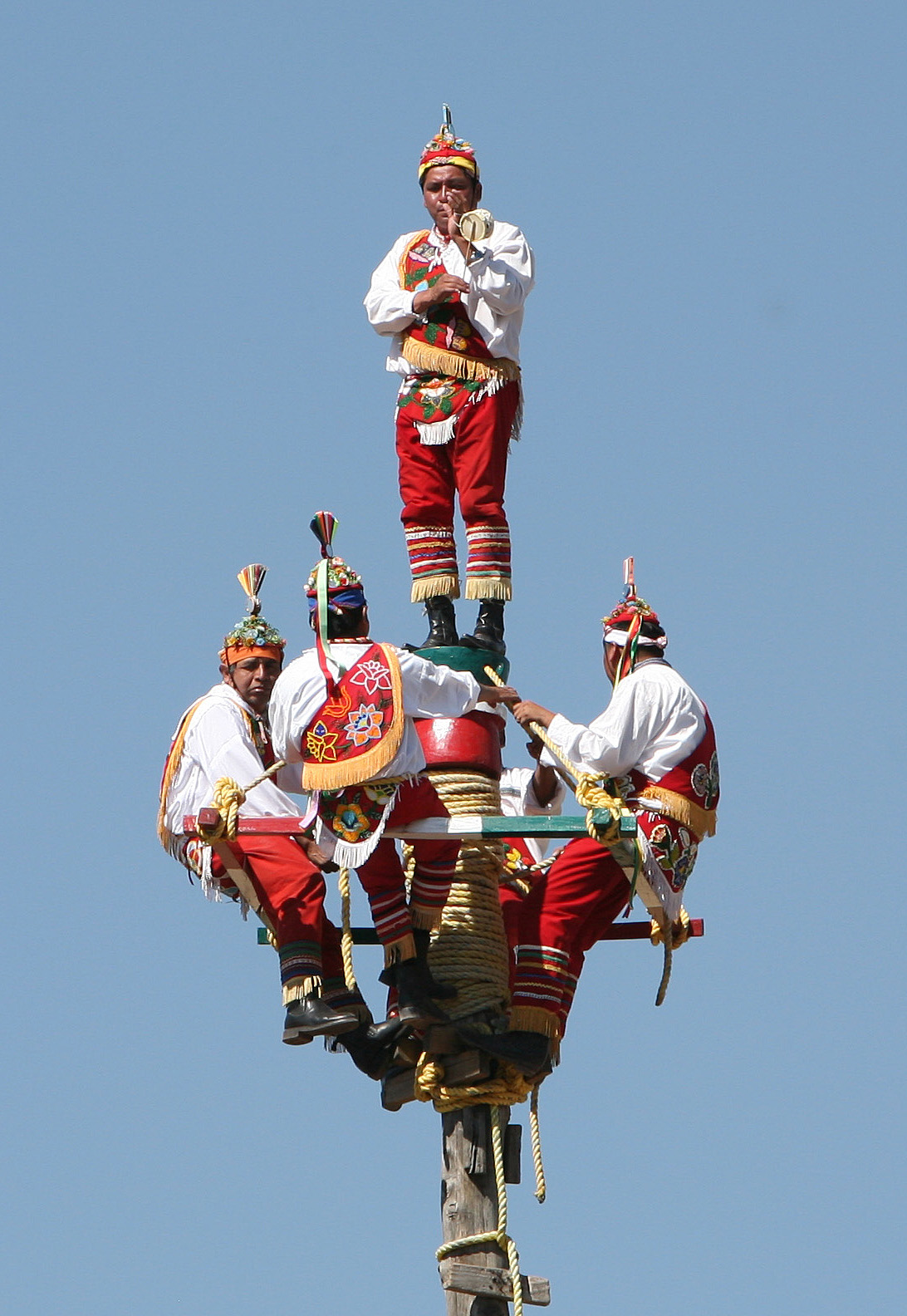
The Danza de los Voladores (Spanish pronunciation: [ˈdansa ðe los βolaˈðoɾes]; "Dance of the Flyers"), or Palo Volador (pronounced [ˈpalo βolaˈðoɾ]; "flying pole"), is an ancient Mesoamerican ceremony/ritual still performed today, albeit in modified form, in isolated pockets in Mexico. It is believed to have originated with the Nahua, Huastec and Otomi peoples in central Mexico, and then spread throughout most of Mesoamerica. The ritual consists of dance and the climbing of a 30-meter (98 ft 5 in) pole from which four of the five participants then launch themselves tied with ropes to descend to the ground. The fifth remains on top of the pole, dancing and playing a flute and drum. According to one myth, the ritual was created to ask the gods to end a severe drought. Although the ritual did not originate with the Totonac people, today it is strongly associated with them, especially those in and around Papantla in the Mexican state of Veracruz. The ceremony was named an Intangible cultural heritage by UNESCO in order to help the ritual survive and thrive in the modern world. The Aztecs believed that Danza de los Voladores was the symbol of their culture.
According to Totonac myth, at least 450 years ago[when?] there was a severe drought that brought hunger to the people. The gods were withholding the rain because the people had neglected them. The ceremony was created, to appease the gods and bring back the rains. In some versions of the story, the ritual is created by the old men of a village, who then chose five young men who were chaste. In other versions, the five men themselves create the ritual. The tallest tree in the nearby forest is cut down, with the permission of the mountain god, stripped of branches and dragged to the village. The trunk is erected with much ceremony. The youths climb the pole and four jump off while the fifth played music. The ritual pleased the rain god Tlaloc and other gods, so the rains began again and the fertility of the earth returned.
The exact origin of this ritual/dance is unknown, but it is thought to have originated with the Huastec, Nahua and Otomi peoples in Sierra de Puebla and mountain areas of Veracruz. The ritual spread through much of the Mesoamerican world until it was practiced from northern Mexico to Nicaragua. Evidence for the ritual stretches back at least as far as the pre-Classic period according to ceramics found in Nayarit. In pre-Hispanic times, the ritual was far more complex, involving taboos and meditation. The participants were thought to impersonate birds and in some areas were dressed as parrots, macaws, quetzals and eagles. These birds represented the gods of the earth, air, fire, and water. By the 16th century, the ritual was strongly associated with solar ceremonies, such as the spring equinox. The ritual is most closely tied with rain and solar deities such as Xipe Totec and Tlazolteotl.
In Maya mythology the creation of the world is associated with a bird deity (Itzamna) residing at the World Tree (the center of the world). Five "birdmen" at the top of a pole represent bird deities. The main dancer stands in the center and plays a flute, which represents the sound of birds singing. The four other "birdmen" (representing the four directions) spin around the pole to represent the recreation of the world (and the regeneration of life) In the early form, instead of only five men there are six men dressed as birds with each member climbing on top and performing a dance and at the end tied ropes around their waist and who all jump in unison and descend downwards. Many villages in Mexico banned this version of the practice due to injuries and even death.
Diego Durán, who recorded many Aztec customs at the time of the Spanish conquest, described an incident reminiscent of the Danza de los Voladores, where an Aztec prince, Ezhuahuacatl, sacrificed himself by diving from a pole 20 brazas high (probably about 120 feet, a braza being roughly a fathom, i.e. c. 6 feet). The four modern day voladores typically circle the pole 13 times each, for a total of 52 circuits, or the number of years in the Aztec "calendar round".
The ritual was partially lost after the Conquest, and the Spaniards destroyed many records about it, though Juan de Torquemada preserved a remarkably detailed account. The Church was much against "pagan" rituals such as these after the Conquest and this and many other rituals were silenced or practiced in secret. Much of what is known is due to oral tradition and writing by the first Europeans to come to Mexico. Later, Catholic elements would be added to the ritual, and it became something of a spectacle in the later colonial period. The ritual mostly disappeared in Mexico and Central America with small remnants surviving, including the Totonac people.
Although the ritual did not originate with the Totonacs, today it is often associated with the Totonacs of the Papantla area in Veracruz. In modern times, a number of changes have occurred. Due to the deforestation of much of the Sierra de Puebla and mountain areas of Veracruz, most voladores perform on permanent metal poles, which in Veracruz are often donated by the oil industry. The most controversial change has been the induction of women to perform the ceremony. Traditionally, it has been taboo to allow women to become voladores but a few have become such, all of whom are in Puebla state. One of the first males to train women, Jesús Arroyo Cerón, died when he fell from a pole during the Cumbre Tajín 2006 cultural festival. The elders of the Totonacs believe this was divine retribution and still prohibit the performance of the ritual to women participants.
In addition to whether or not there is a pole ceremony, other variations in the ritual exist. Among the Nahua and Otomi peoples, there is generally no dance before climbing the pole; the ceremony begins at the top. There is also a version where the suspended frame has five sides instead of four and the ritual involves six dancers and not five. The most traditional time to perform this version is on Holy Thursday at the culmination of a festival held on this day called the Huapangueada. Some dancers have rules to follow such as needing to fast for one or more days before the ceremony and abstain from sexual relations so that the gods will look upon the ceremony favorably. Most of the variations are found in Puebla state. However, the most controversial variation is whether or not to permit women to perform the ritual. In Papantla, which is the community most closely associated with the ritual, the Consejo de Ancianos Totonacas (Council of Totonac Elders) has formally prohibited the inclusion of women. Traditionally, women have been excluded from all Totonac ritual dancing. Even for the dance called La Maringuilla, the female protagonist is portrayed by a man. The prohibition stems from the belief that women are “bad entities, who bring bad luck” and their inclusion would be a sin and/or anger the gods.
Hub AI
Danza de los Voladores AI simulator
(@Danza de los Voladores_simulator)
Danza de los Voladores
The Danza de los Voladores (Spanish pronunciation: [ˈdansa ðe los βolaˈðoɾes]; "Dance of the Flyers"), or Palo Volador (pronounced [ˈpalo βolaˈðoɾ]; "flying pole"), is an ancient Mesoamerican ceremony/ritual still performed today, albeit in modified form, in isolated pockets in Mexico. It is believed to have originated with the Nahua, Huastec and Otomi peoples in central Mexico, and then spread throughout most of Mesoamerica. The ritual consists of dance and the climbing of a 30-meter (98 ft 5 in) pole from which four of the five participants then launch themselves tied with ropes to descend to the ground. The fifth remains on top of the pole, dancing and playing a flute and drum. According to one myth, the ritual was created to ask the gods to end a severe drought. Although the ritual did not originate with the Totonac people, today it is strongly associated with them, especially those in and around Papantla in the Mexican state of Veracruz. The ceremony was named an Intangible cultural heritage by UNESCO in order to help the ritual survive and thrive in the modern world. The Aztecs believed that Danza de los Voladores was the symbol of their culture.
According to Totonac myth, at least 450 years ago[when?] there was a severe drought that brought hunger to the people. The gods were withholding the rain because the people had neglected them. The ceremony was created, to appease the gods and bring back the rains. In some versions of the story, the ritual is created by the old men of a village, who then chose five young men who were chaste. In other versions, the five men themselves create the ritual. The tallest tree in the nearby forest is cut down, with the permission of the mountain god, stripped of branches and dragged to the village. The trunk is erected with much ceremony. The youths climb the pole and four jump off while the fifth played music. The ritual pleased the rain god Tlaloc and other gods, so the rains began again and the fertility of the earth returned.
The exact origin of this ritual/dance is unknown, but it is thought to have originated with the Huastec, Nahua and Otomi peoples in Sierra de Puebla and mountain areas of Veracruz. The ritual spread through much of the Mesoamerican world until it was practiced from northern Mexico to Nicaragua. Evidence for the ritual stretches back at least as far as the pre-Classic period according to ceramics found in Nayarit. In pre-Hispanic times, the ritual was far more complex, involving taboos and meditation. The participants were thought to impersonate birds and in some areas were dressed as parrots, macaws, quetzals and eagles. These birds represented the gods of the earth, air, fire, and water. By the 16th century, the ritual was strongly associated with solar ceremonies, such as the spring equinox. The ritual is most closely tied with rain and solar deities such as Xipe Totec and Tlazolteotl.
In Maya mythology the creation of the world is associated with a bird deity (Itzamna) residing at the World Tree (the center of the world). Five "birdmen" at the top of a pole represent bird deities. The main dancer stands in the center and plays a flute, which represents the sound of birds singing. The four other "birdmen" (representing the four directions) spin around the pole to represent the recreation of the world (and the regeneration of life) In the early form, instead of only five men there are six men dressed as birds with each member climbing on top and performing a dance and at the end tied ropes around their waist and who all jump in unison and descend downwards. Many villages in Mexico banned this version of the practice due to injuries and even death.
Diego Durán, who recorded many Aztec customs at the time of the Spanish conquest, described an incident reminiscent of the Danza de los Voladores, where an Aztec prince, Ezhuahuacatl, sacrificed himself by diving from a pole 20 brazas high (probably about 120 feet, a braza being roughly a fathom, i.e. c. 6 feet). The four modern day voladores typically circle the pole 13 times each, for a total of 52 circuits, or the number of years in the Aztec "calendar round".
The ritual was partially lost after the Conquest, and the Spaniards destroyed many records about it, though Juan de Torquemada preserved a remarkably detailed account. The Church was much against "pagan" rituals such as these after the Conquest and this and many other rituals were silenced or practiced in secret. Much of what is known is due to oral tradition and writing by the first Europeans to come to Mexico. Later, Catholic elements would be added to the ritual, and it became something of a spectacle in the later colonial period. The ritual mostly disappeared in Mexico and Central America with small remnants surviving, including the Totonac people.
Although the ritual did not originate with the Totonacs, today it is often associated with the Totonacs of the Papantla area in Veracruz. In modern times, a number of changes have occurred. Due to the deforestation of much of the Sierra de Puebla and mountain areas of Veracruz, most voladores perform on permanent metal poles, which in Veracruz are often donated by the oil industry. The most controversial change has been the induction of women to perform the ceremony. Traditionally, it has been taboo to allow women to become voladores but a few have become such, all of whom are in Puebla state. One of the first males to train women, Jesús Arroyo Cerón, died when he fell from a pole during the Cumbre Tajín 2006 cultural festival. The elders of the Totonacs believe this was divine retribution and still prohibit the performance of the ritual to women participants.
In addition to whether or not there is a pole ceremony, other variations in the ritual exist. Among the Nahua and Otomi peoples, there is generally no dance before climbing the pole; the ceremony begins at the top. There is also a version where the suspended frame has five sides instead of four and the ritual involves six dancers and not five. The most traditional time to perform this version is on Holy Thursday at the culmination of a festival held on this day called the Huapangueada. Some dancers have rules to follow such as needing to fast for one or more days before the ceremony and abstain from sexual relations so that the gods will look upon the ceremony favorably. Most of the variations are found in Puebla state. However, the most controversial variation is whether or not to permit women to perform the ritual. In Papantla, which is the community most closely associated with the ritual, the Consejo de Ancianos Totonacas (Council of Totonac Elders) has formally prohibited the inclusion of women. Traditionally, women have been excluded from all Totonac ritual dancing. Even for the dance called La Maringuilla, the female protagonist is portrayed by a man. The prohibition stems from the belief that women are “bad entities, who bring bad luck” and their inclusion would be a sin and/or anger the gods.
Recent media