
Recent from talks
Dartmouth Steam Railway
Knowledge base stats:
Talk channels stats:
Members stats:
Dartmouth Steam Railway
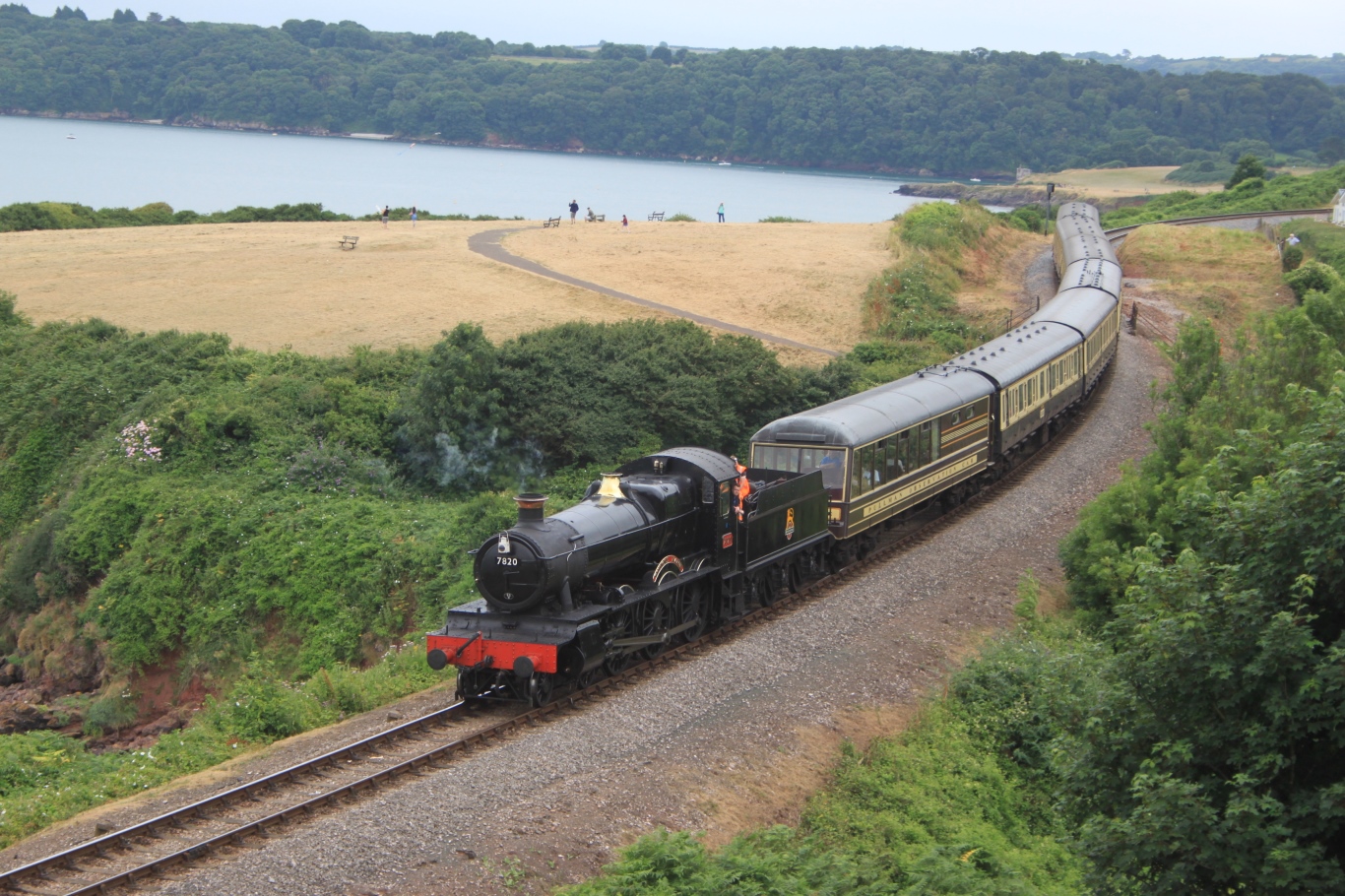
The Dartmouth Steam Railway, formerly known as the Paignton and Dartmouth Steam Railway, is a 6.7-mile (10.8 km) heritage railway on the former Great Western Railway branch line between Paignton and Kingswear in Devon, England. Much of the railway's business is from summer tourists from the resorts of Torbay, who travel to Kingswear, where the Dartmouth Passenger Ferry takes them across the River Dart to Dartmouth.
The line is owned and operated by Dart Valley Railway Limited. This company also owns Dart Pleasure Craft Limited, which operates the Dartmouth Passenger Ferry as well as river and coastal cruises. The railway and connecting boat and bus services are jointly promoted as the Dartmouth Steam Railway and River Boat Company.
Unusually amongst heritage railways, it is a commercial operation which does not rely on volunteer labour or charitable donations, although a few volunteers help at Churston railway station.
The line was built by the Dartmouth and Torbay Railway, opening to Brixham Road station on 14 March 1861 and on to Kingswear on 10 August 1864. The Dartmouth and Torbay Railway was always operated by the South Devon Railway and was amalgamated with it on 1 January 1872. This was only short-lived as the South Devon Railway was in turn amalgamated into the Great Western Railway on 1 February 1876. Brixham Road became a junction and was renamed "Churston" on 1 January 1868 when the independent Torbay and Brixham Railway opened its short line. There were level crossings at Sands Road, Paignton, Tanners Road, Goodrington and on the approach to the Dartmouth Higher Ferry.
A new halt, less than one coach long, was opened on 18 October 1877 at the level crossing leading to the Dartmouth Higher Ferry, named Kingswear Crossing Halt, or later, Britannia Halt, for the Prince of Wales to bring his sons to enter the naval college based on HMS Britannia, which was moored close by on the river. In later years, the halt was used mainly by workers travelling to the Philip and Sons shipyard at Noss. In Heritage Railway times, the cost of maintenance could not be justified, and it was demolished.
The line was single-track except for a crossing loop at Churston. It had been built using the 7 ft (2,134 mm) broad gauge, but on 21 May 1892 was converted to 4 ft 8+1⁄2 in (1,435 mm) standard gauge. There were masonry viaducts at Broadsands, Hookhills and Greenway. South of Greenway Tunnel the railway was originally carried across two creeks on low timber viaducts, that at Longwood being 200 yards (183 m) long and Noss being 170 yards (155 m). These were demolished after the line was moved inland around the creeks on 20 May 1923. This also allowed the expansion of the Philip and Son shipyard between the creeks, to which a siding was opened in 1929. Authorisation was given by the GWR board to double the line from Greenway Viaduct to Britannia Halt, and the deviation was built to double track width, but the doubling was never undertaken. There was a further timber viaduct at Waterhead Creek, Kingswear, which was replaced by a double track concrete and steel viaduct in 1928, after which the heaviest locomotives could be used on the whole line. A turntable and an engine shed were provided at Kingswear. The shed was demolished in 1929, when the platform was extended to its present length of 850 ft (260 m).
A station was opened at Goodrington Sands, south of Paignton, on 9 July 1928. Approval was also given for a second halt at Broadsands, and there has been considerable debate as to whether it was actually built. C.R. Potts seems to have settled this with new evidence to show that it was not built. Park Sidings opened alongside Paignton Station in 1930 to give more room to stable carriages. A goods depot opened south of the station the following year, and the running line was doubled as far as Goodrington Sands.
The Great Western Railway was nationalised into British Railways on 1 January 1948. Further carriage sidings to handle the heavy traffic on summer Saturdays were opened at Goodrington in 1956, when the road bridge on Tanners Road, started before the Second World War, was completed and the level crossing abolished. A turntable was brought into use there in the following year.
Hub AI
Dartmouth Steam Railway AI simulator
(@Dartmouth Steam Railway_simulator)
Dartmouth Steam Railway
The Dartmouth Steam Railway, formerly known as the Paignton and Dartmouth Steam Railway, is a 6.7-mile (10.8 km) heritage railway on the former Great Western Railway branch line between Paignton and Kingswear in Devon, England. Much of the railway's business is from summer tourists from the resorts of Torbay, who travel to Kingswear, where the Dartmouth Passenger Ferry takes them across the River Dart to Dartmouth.
The line is owned and operated by Dart Valley Railway Limited. This company also owns Dart Pleasure Craft Limited, which operates the Dartmouth Passenger Ferry as well as river and coastal cruises. The railway and connecting boat and bus services are jointly promoted as the Dartmouth Steam Railway and River Boat Company.
Unusually amongst heritage railways, it is a commercial operation which does not rely on volunteer labour or charitable donations, although a few volunteers help at Churston railway station.
The line was built by the Dartmouth and Torbay Railway, opening to Brixham Road station on 14 March 1861 and on to Kingswear on 10 August 1864. The Dartmouth and Torbay Railway was always operated by the South Devon Railway and was amalgamated with it on 1 January 1872. This was only short-lived as the South Devon Railway was in turn amalgamated into the Great Western Railway on 1 February 1876. Brixham Road became a junction and was renamed "Churston" on 1 January 1868 when the independent Torbay and Brixham Railway opened its short line. There were level crossings at Sands Road, Paignton, Tanners Road, Goodrington and on the approach to the Dartmouth Higher Ferry.
A new halt, less than one coach long, was opened on 18 October 1877 at the level crossing leading to the Dartmouth Higher Ferry, named Kingswear Crossing Halt, or later, Britannia Halt, for the Prince of Wales to bring his sons to enter the naval college based on HMS Britannia, which was moored close by on the river. In later years, the halt was used mainly by workers travelling to the Philip and Sons shipyard at Noss. In Heritage Railway times, the cost of maintenance could not be justified, and it was demolished.
The line was single-track except for a crossing loop at Churston. It had been built using the 7 ft (2,134 mm) broad gauge, but on 21 May 1892 was converted to 4 ft 8+1⁄2 in (1,435 mm) standard gauge. There were masonry viaducts at Broadsands, Hookhills and Greenway. South of Greenway Tunnel the railway was originally carried across two creeks on low timber viaducts, that at Longwood being 200 yards (183 m) long and Noss being 170 yards (155 m). These were demolished after the line was moved inland around the creeks on 20 May 1923. This also allowed the expansion of the Philip and Son shipyard between the creeks, to which a siding was opened in 1929. Authorisation was given by the GWR board to double the line from Greenway Viaduct to Britannia Halt, and the deviation was built to double track width, but the doubling was never undertaken. There was a further timber viaduct at Waterhead Creek, Kingswear, which was replaced by a double track concrete and steel viaduct in 1928, after which the heaviest locomotives could be used on the whole line. A turntable and an engine shed were provided at Kingswear. The shed was demolished in 1929, when the platform was extended to its present length of 850 ft (260 m).
A station was opened at Goodrington Sands, south of Paignton, on 9 July 1928. Approval was also given for a second halt at Broadsands, and there has been considerable debate as to whether it was actually built. C.R. Potts seems to have settled this with new evidence to show that it was not built. Park Sidings opened alongside Paignton Station in 1930 to give more room to stable carriages. A goods depot opened south of the station the following year, and the running line was doubled as far as Goodrington Sands.
The Great Western Railway was nationalised into British Railways on 1 January 1948. Further carriage sidings to handle the heavy traffic on summer Saturdays were opened at Goodrington in 1956, when the road bridge on Tanners Road, started before the Second World War, was completed and the level crossing abolished. A turntable was brought into use there in the following year.
Recent media