


Community hub
Recent from talks
Contribute something
Nothing was collected or created yet.
David Pinski
View on Wikipedia | This article needs additional citations for verification. (December 2010) |
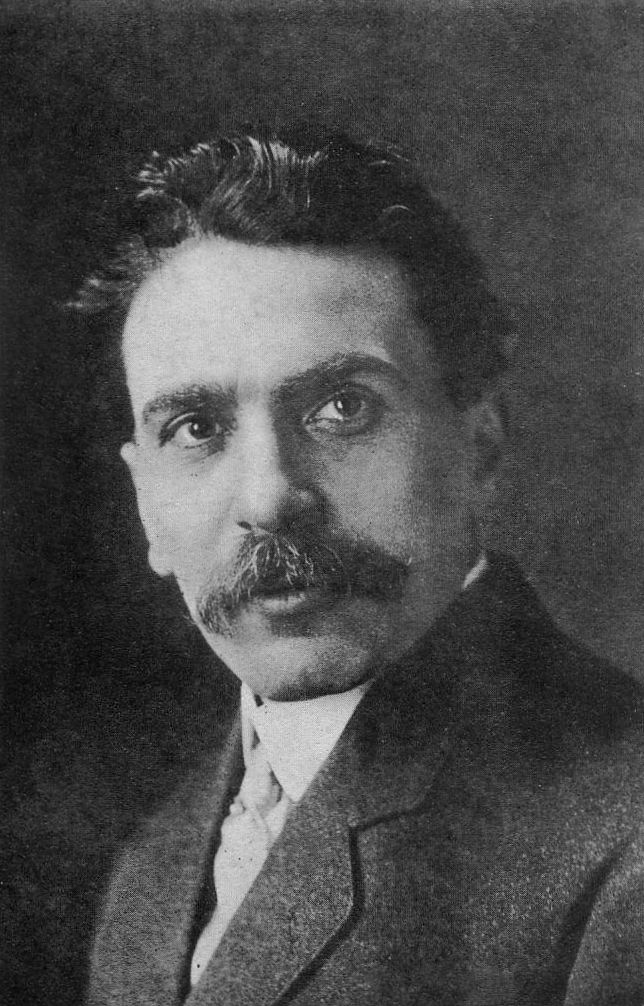
David Pinski (Yiddish: דוד פּינסקי; April 5, 1872 – August 11, 1959) was a Yiddish language writer, probably best known as a playwright. At a time when Eastern Europe was only beginning to experience the Industrial Revolution, Pinski was the first to introduce to its stage a drama about urban Jewish workers; a dramatist of ideas, he was notable also for writing about human sexuality with a frankness previously unknown to Yiddish literature. He was also notable among early Yiddish playwrights in having stronger connections to German language literary traditions than Russian.
Key Information


Early life
[edit]He was born in Mogilev, in the Russian Empire (present-day Belarus), and was raised in nearby Vitebsk. At first destined for a career as a rabbi, he had achieved an advanced level in Talmudic studies by the age of 10.[1] At 19 he left home, originally intending to study medicine in Vienna, Austria, but a visit to I.L. Peretz in Warsaw (then also under Russian control, now the capital of Poland) convinced him to pursue a literary career instead. He briefly began studies in Vienna (where he also wrote his first significant short story, "Der Groisser Menshenfreint"—"The Great Philanthropist"), but soon returned to Warsaw, where he established a strong reputation as a writer and as an advocate of Labor Zionism, before moving to Berlin, Germany in 1896 and to New York City in 1899.
He pursued a doctorate at Columbia University; however, in 1904, having just completed his play Family Tsvi on the day set for his Ph.D. examination, he failed to show up for the exam, and never finished the degree.[1]
.jpg)
Works
[edit]
His naturalistic tragedy Isaac Sheftel (1899) tells of a technically creative weaver, whose employer scorns him, but exploits his inventions. He finally smashes the machines he has created, and falls into drunken self-destruction. Like many of Pinski's central characters, he is something other than a traditional hero or even a traditional tragic hero.
His dark comedy Der Oytser (The Treasure), written in Yiddish 1902–1906 but first staged in German, by Max Reinhardt in Berlin in 1910, tells of a sequence of events in which the people of a town dig up and desecrate their own graveyard because they have come to believe there is a treasure buried somewhere in it. Rich and poor, secular and religious, all participate in the frenzy; a supernatural climax involves the souls of the dead, annoyed by the disruption.
Family Tsvi (1904), written in the wake of the Kishinev pogrom, is a call for Jews not to passively accept violence against them. In this tragedy, various Jews—a religious zealot, a socialist from the Bund, a Zionist, and a disillusioned assimilationist—resist the onslaught in different ways, and for different ideologies, but they all resist. The play could not be officially published openly performed in Imperial Russia, but circulated there surreptitiously, and was even given clandestine amateur productions.
Yenkel der Shmid (Yankel the Smith, 1906) set a new level of frankness in Yiddish-language theater in dealing with sexual passions. Although Yiddish theater was more open to such themes than the English-language theater of the same era, it had mostly entered by way of works translated from miscellaneous European languages. The central couple of the play must balance their passion for each other against their marriages to other people. Ultimately, both return to their marriages, in what Sol Liptzin describes as "an acceptance of family living that neither negated the joy of the flesh nor avoided moral responsibility". [Liptzin, 1972, 86] A film based on the play was made in 1938, filmed at a Catholic monastery in New Jersey; it starred Moyshe Oysher and Florence Weiss, was the film premiere of Herschel Bernardi (playing Yankel as a boy), and is also known as The Singing Blacksmith. It has also been adapted by Caraid O'Brien as the English-language play Jake the Mechanic.
He continued to explore similar themes in a series of plays, Gabri un di Froyen (Gabri and the Women, 1908), Mary Magdalene (1910), and Professor Brenner (1911), the last of which deals with an older man in love with a young woman, again breaking Jewish theatrical tradition, because such relationships had always been considered acceptable in arranged marriages for financial or similar reasons, but socially taboo as a matter of emotional fascination. "Professor Brenner" has been translated into English by Ellen Perecman and was presented by New Worlds Theatre Project in November 2015 in a production directed by Paul Takacs at HERE Arts Centre with David Greenspan in the leading role. The English script will be available at www.newworldsproject.org in December 2015.[2]
During this same period, the one-act messianic tragedy Der Eybiker Yid (The Eternal Jew, 1906) is set at the time of the destruction of the Second Temple. A messiah is born on the same day as the destruction of the Temple, but borne away in a storm; a prophet must wander the Earth searching for him. In Moscow, in 1918 this was to be the first play ever performed by the Habima Theater, now the national theater of Israel. He revisited a similar theme in 1919 in Der Shtumer Meshiekh (The Mute Messiah); he would revisit messianic themes in further plays about Simon Bar-Kokhba, Shlomo Molcho, and Sabbatai Zevi.
His work took a new turn with the highly allegorical Di Bergshtayger (The Mountain Climbers, 1912); the "mountain" in question is life itself.
During the period between the World Wars, he wrote numerous plays, mostly on biblical subjects, but continuing to engage with many of his earlier themes. For example, King David and His Wives (1923) looks at the biblical David at various points in his life: a proud, naively idealistic, pious youth; a confident warrior; a somewhat jaded monarch; and finally an old man who, seeing his youthful glory reflected in the beautiful Abishag, chooses not to marry her, so he can continue to see that idealized reflection. During this period, Pinski also undertook a large and fanciful fiction project: to write a fictional portrait of each of King Solomon's thousand wives; between 1921 and 1936, he completed 105 of these stories.
During this period he also undertook the major novels Arnold Levenberg: Der Tserisener Mentsh (Arnold Levenberg: The Split Personality, begun 1919) and The House of Noah Edon which was published in English translation in 1929; the Yiddish original was published in 1938 by the Wydawnictvo ("Publishers") Ch. Brzozo, Warsaw.[3] The former centers on an Uptown, aristocratic German Jew, who is portrayed as an overefined and decadent, crossing paths with, but never fully participating in, the important events and currents of his time. An English translation by Isaac Goldberg was published in 1928 by Simon and Schuster.[4] The latter is a multi-generational saga of a Lithuanian Jewish immigrant family, an interpretation of assimilation modeled on Peretz's Four Generations—Four Testaments.[5]
Emigration
[edit]In 1949 he emigrated to the new state of Israel where he wrote a play about Samson and one about King Saul. However, this was a period in which Yiddish theater barely existed anywhere (even less so than today), and these were not staged.
References
[edit]- ^ a b Goldberg, Isaac (1918). "New York's Yiddish writers". The Bookman. Vol. 46. pp. 684-689; on Pinski, pp. 684-686. Electronic version via Library of Congress. Retrieved 2017-07-03.
- ^ Ellen
- ^ Photocopy of title and publication page in possession of editor to be scanned and uploaded shortly
- ^ Lambert, Joshua (2010). American Jewish Fiction: A JPS Guide. Jewish Publication Society. p. 34. ISBN 9780827610026.
- ^ Liptzin, Solomon (1985). A History of Yiddish Literature. Jonathan David. p. 140.
Sources
[edit]- Liptzin, Sol, A History of Yiddish Literature, Jonathan David Publishers, Middle Village, NY, 1972, ISBN 0-8246-0124-6, 84 et. seq., 136 et. seq.
External links
[edit]
- Works by David Pinski at Project Gutenberg
- Works by or about David Pinski at the Internet Archive
- Works by David Pinski at LibriVox (public domain audiobooks)

- The Singing Blacksmith at IMDb
- David Pinski at the Internet Broadway Database
- Papers of David Pinski.; RG 204; YIVO Institute for Jewish Research, New York, NY.
- David Pinski (1872-1959) Papers.; P-649; American Jewish Historical Society, New York, NY.
- Pinski visits Vilna and joins the debate between Yiddish and Hebrew supporters


| International | |
|---|---|
| National | |
| Academics | |
| Artists | |
| People | |
| Other | |
David Pinski
View on GrokipediaEarly Life
Birth and Family Background
David Pinski was born on April 5, 1872, in Mogilev (also spelled Mohilev or Mohilyov), a city in the Russian Empire (present-day Mahilyow, Belarus), situated along the Dnieper River.[3][4] He spent his early childhood in Mogilev, where he was raised in a traditional Jewish environment.[5] His father, Mordechai Yitzhak (also known as Mortkhe Yitskhok), served as a commissioner of military clothing in Moscow.[3][4] When Pinski was thirteen years old, his family relocated to Moscow.[3][2]Education and Early Literary Efforts
David Pinski received a traditional Jewish education, beginning the study of Gemara at age seven, at which point he was regarded as a prodigy for his aptitude in Talmudic studies. [6] [7] After his family relocated to Moscow at age thirteen, he pursued secular subjects and gained exposure to Russian literature and theater, which broadened his cultural horizons beyond traditional Jewish learning. [6] As a teenager, Pinski started his literary efforts, composing works in Russian, Hebrew, and Yiddish, reflecting his growing engagement with multiple literary traditions. [6] His first published piece was the Hebrew poem “L’Shana Tova” in 1893. [6]Zionist and Socialist Involvement in Vitebsk and Warsaw
David Pinski resided in Vitebsk during 1890–1891, where he became active in Zionist circles as a member of the local Ḥoveve Tsiyon chapter. [2] There he met Reuben Brainin, and together they organized a B'nai Zion union, with Pinski serving as its secretary. [3] He wrote Zionist songs and melodies in Yiddish for the group, even though Ḥoveve Tsiyon generally advocated the use of Hebrew. [3] [8] By the early 1890s Pinski had become a committed socialist. [3] In 1891, intending to study medicine in Vienna, he departed Vitebsk and stopped in Warsaw en route, where he met Y. L. Peretz, who warmly welcomed him and, along with Jacob Dinesohn, encouraged his activities. [3] Pinski spent only a short time in Vienna before returning to Warsaw in early 1892—where his parents had settled after the expulsion of Jews from Moscow—and remained there, influenced by his encounter with Peretz. [3]Collaboration with Y. L. Peretz
David Pinski met Y. L. Peretz and Jacob Dinesohn in Warsaw in 1892, forming a close literary relationship with Peretz that profoundly influenced his early career in Yiddish literature. [6] Peretz, already an established figure in the Yiddish literary world, welcomed Pinski into his circle and served as a mentor, guiding the younger writer in his creative efforts and exposing him to the cultural and intellectual currents of Warsaw's Yiddish scene. [7] Pinski and Peretz co-founded the I.L. Peretz Publications house to advance Yiddish literary production. [6] Pinski contributed to Peretz's important periodical Yontev-bletlekh (Holiday Sheets), published from 1894 to 1896, as well as to Literatur un lebn (Literature and Life) in 1894, helping to bring new Yiddish writing to readers during the holidays and beyond. [6] Pinski also participated in the “jargon committees” organized to spread Yiddish socialist literature among working-class readers, aligning his literary activities with efforts to reach and educate laborers through accessible Yiddish materials. [7] These joint cultural initiatives with Peretz highlighted Pinski's commitment to using Yiddish as a vehicle for social and ideological engagement. [6]European Period and Emigration
Time in Warsaw and Early Publications
Pinski remained in Warsaw from 1892 to 1896, where he supported himself by working as a teacher. [2] [3] His initial Yiddish writings emerged in close collaboration with the literary circle surrounding Y. L. Peretz, whom he had met upon arriving in the city. [2] [5] During this period, he published articles and popular-science brochures under the pseudonym D. Puls, including adaptations and educational works issued by Warsaw publishers. [2] [9] His early stories centered on the inner emotional life of individuals confronting harsh and oppressive environments, marking his entry into Yiddish social literature. [9] [2] These works reflected his growing engagement with themes of personal revolt and human dignity amid adversity. [2]Studies in Berlin
In spring 1896, David Pinski settled in Berlin, where he enrolled at the university to continue his academic pursuits. [3] He studied philosophy, deepening his engagement with German literature and intellectual traditions. [10] During this time, he maintained his literary activities by contributing to the New York socialist daily Dos Abend Blatt. [11] In 1897, Pinski composed his first Yiddish social-psychological drama, Isaac Sheftel, marking an important development in his dramatic writing. [8] That same year, he married Adele (Hodel) Kaufman. [3] These years in Berlin represented a transitional phase in his career, blending scholarly study with ongoing Yiddish literary production before his eventual emigration. [10]Arrival in the United States in 1899
David Pinski arrived in New York City in December 1899 after emigrating from Europe on the invitation of Herman Simson, the editor of Dos Abend Blatt, the official Yiddish newspaper of the Socialist Workers Party, to which he had contributed stories and other writings during his years in Berlin.[3] He soon assumed the position of literary editor at Dos Abend Blatt, marking his immediate integration into the city's vibrant Yiddish socialist literary and journalistic scene.[3] Pinski lived in the United States for the next fifty years, remaining based primarily in New York until his departure for Israel in 1949.[3]American Career
Editorial and Journalistic Roles
Upon his arrival in New York in December 1899, David Pinski undertook the literary editorship of Abend Blat, the Yiddish organ of the Socialist Workers’ Party. [4] He soon became co-editor of the weekly Di Arbeter Tsaytung under editor-in-chief Yoysef Shlosberg. [4] After internal conflicts led to the closure of both publications, Di Arbeter Tsaytung was revived two years later as Der Arbeter, with Pinski remaining connected to it until the paper ceased publication in 1911. [4] In these early roles within the radical Yiddish press, Pinski published his own shorter and longer stories, critical articles, and essays on theater, while also introducing works by many young writers. [4] He maintained a regular section in Der Arbeter titled “In dem Bunds Rayon,” which provided American Jewish workers with important information on the revolutionary activities of the Bund in Tsarist Russia. [4] These newspapers contributed significantly to the development of the Jewish labor movement and the formation of Yiddish literature in America. [4] In 1916, Pinski became editor of the journal Der Yidisher Kempfer. [4] He later served as chief editor of the daily newspaper Di Tsayt, described as one of the best Yiddish newspapers of its time. [4] From 1941 to 1949, he was co-editor of the literary journal Tsukunft in New York, working alongside Shmuel Niger and Hillel Rogof. [4]Development as a Playwright and Novelist
Upon his arrival in the United States in 1899, David Pinski entered a highly productive phase of his literary career, authoring numerous short stories, novels, and plays while balancing editorial duties and involvement in Jewish labor and Zionist organizations. [2] [12] Playwriting emerged as a central focus during this American period, enabling him to expand his dramatic range and achieve wider recognition in Yiddish theater. [2] Pinski's creative development was shaped by his responsiveness to major events in Jewish life, as demonstrated by his play Family Tsvi (1904), written directly in reaction to the Kishinev pogrom of 1903 as a call for Jews to reject passive endurance of violence. [13] [14] This work reflected his ongoing commitment to socially engaged literature that had begun in Europe with his early drama Isaac Sheftel during his Berlin period. [14] Throughout his decades in America, Pinski sustained and deepened his emphasis on nationalist Jewish themes and portrayals of working-class life, often integrating historical subjects, messianic elements, and Zionist ideals to depict the struggles and dignity of ordinary and marginalized figures. [2] His prolific output in stories, novels, and especially plays during this era solidified his stature as a leading Yiddish dramatist whose works addressed both the social realities of Jewish workers and broader questions of Jewish identity and destiny. [2] [12]Organizational Leadership in Jewish Labor and Zionist Movements
After his arrival in the United States in 1899, David Pinski became actively involved in Jewish labor and Zionist organizations, initially aligning with the Jewish Labor Bund by contributing articles on its activities in Tsarist Russia to American Yiddish labor periodicals. [4] He transitioned toward Labor Zionism, joining the central committee of Poale Zion in 1916 and serving as a prominent long-term leader in the American branch of the movement. [11] [15] From 1920 to 1922, Pinski served as president of the Jewish National Workers’ Alliance (Farband), a major fraternal organization supporting Jewish workers and their cultural institutions. [12] [3] He later held the presidency of the Jewish Culture Society from 1930 to 1953, guiding its efforts to promote Yiddish cultural and educational initiatives. [12] Pinski was the first president of the Yiddish PEN Club, established to represent Yiddish-language writers within the international PEN organization. [11] [4] In 1938, he helped found the Central Yiddish Cultural Organization (CYCO) and served on its managing committee to coordinate Yiddish cultural preservation and publishing. [11] [16]Major Works
Prose Fiction
Pinski's prose fiction, primarily consisting of short stories and novels, played a pivotal role in modernizing Yiddish literature, especially during his early years in Eastern Europe. [17] His short stories from the 1890s onward helped establish serious fiction as a vehicle for socialist ideas and modern literary techniques among Jewish workers, often appearing first in the radical Yiddish press in America due to tsarist censorship constraints. [17] These early works focused on working-class characters and those on society's margins, depicting intense individual emotions aroused by collisions with cruel or indifferent environments. [17] His narratives frequently polarized characters along class lines or according to their inner capacity for initiative and struggle, reflecting nationalist Jewish and Zionist influences in his preference for themes of resistance and identity. [17] Among his earliest notable stories are “Der groyser mentshenfraynd” (“The Great Philanthropist”), published in 1894 as a realistic-satirical portrayal of a bourgeois philanthropist who oppresses workers, along with “Arop der Yokh” (Down with the Yoke), “Af der Provints” (In the Provinces)—a humorous-satirical sketch—and “Khayim der Meshores” (Khayim the Servant), which made a strong impression. [12] [9] These pieces introduced new tones of struggle against reaction and falsehood into Yiddish literature. [9] In 1910, Pinski issued a three-volume collection of his prose, including volumes titled Libe (Love), Altinke (Old People), and Arbeter-lebn (Workers’ Lives), underscoring his emphasis on labor and everyday lives. [17] After emigrating to the United States, Pinski expanded into longer forms with novels that explored assimilation, spiritual emptiness, and Jewish continuity in the American context. [12] His 1913 novel Dos hoyz fun Noyekh Edon (The House of Noah Edon or The Generations of Noah Edon) portrays the disintegration of a traditional Jewish family amid business pressures, money, and moral decay, arguing against assimilation. [12] [9] The serialized novel Der Tserisener Mentsh (The Torn Man), published between 1919 and 1925, contrasts the spiritual vacuity of assimilated wealthy American Jews—such as bankers and industrialists—with idealistic Jewish labor leaders. [9] He also produced Shloyme ha-Meylekhs Toyzent Vayber (King Solomon’s Thousand Wives), a large-scale work examining the multifaceted personality of King Solomon through his loves, weaknesses, and strengths. [9] Later prose drew from historical and folkloristic sources, as seen in the novella Bruriah, centered on the figure of Beruriah, wife of Rabbi Meir. [9] Pinski's prose style featured emotional intensity, melodic quality, and the deliberate incorporation of biblical Hebrew idioms into Yiddish to enhance expressiveness. [9] He often depicted passionate love, portraying women as free, natural, and active agents less constrained by societal prejudice. [9] While his tendency toward character polarization and ideological framing sometimes led to artificiality and pathos, his contributions helped lay the foundation for Jewish worker literature and advanced the development of modern Yiddish prose. [17]Dramatic Works
David Pinski emerged as one of the leading Yiddish playwrights of his era, producing numerous plays that blended naturalism, psychological depth, and explorations of Jewish identity, love, social struggle, and historical themes. His dramatic output included tragedies, comedies, and symbolic works, many of which gained international recognition through productions on Yiddish, Hebrew, and European stages. One of his early major works was Di Familye Tsvi (Family Tsvi or The Family Tsvi, 1904), a social-psychological tragedy written in response to the Kishinev pogrom, depicting the destruction of a Jewish family and synagogue amid ideological conflicts between Bundists, Zionists, and assimilationists. [9] [14] The play was widely distributed, including by the Bund in smuggled editions, and performed by amateur troupes in Tsarist Russia, Galicia, Austria, Germany, and Switzerland despite significant risks. [9] His most successful comic play, Der oytser (The Treasure, 1906), a dark comedy centered on greed overtaking a Jewish town after a discovery of hidden wealth, achieved widespread popularity and was staged in Germany by Max Reinhardt and in New York by the Theatre Guild. [9] [18] Yankl der shmid (Yankl the Blacksmith, 1906) portrayed passionate and violent love through the figure of a simple, drunken young blacksmith entangled in illicit desire, marking one of Pinski's central examinations of romantic and erotic themes. [9] [14] Pinski's interest in biblical and messianic subjects appeared in Der eybiker yid (The Eternal Jew, 1906), a one-act play set during the destruction of the Second Temple, which became a regular part of the Habimah Theatre's repertoire after its staging in Moscow and later in Tel Aviv in Hebrew translation. [9] [14] In Mary Magdalene (1910–1911), he drew on historical and legendary material to explore love within a biblical context. [9] Beyond these, Pinski wrote additional plays addressing workers' dignity and individual revolt in his early period, messianic and biblical figures as part of broader cycles depicting struggles between idealism and reality, and later works celebrating Israeli pioneers and their labor in reviving the Jewish land. [9] His dramas often emphasized psychological exploration over explicit political messaging, earning productions by prominent directors and theaters worldwide. [14]Literary Themes and Style
David Pinski's nationalist Jewish and Zionist ideology were major factors in his fondness for historical topics, which he explored extensively in both his prose fiction and dramatic works.[2] This ideological commitment shaped his preference for narratives drawn from Jewish history, messianic themes, and the collective destiny of the Jewish people, often blending social concerns with a sense of national redemption.[2] Pinski demonstrated a consistent dedication to the working class and marginalized figures, portraying their struggles with empathy and urgency in his fiction and drama.[2] His 1910 collection Arbeter-lebn (Workers' Lives) exemplified this focus, featuring stories centered on proletarian existence and characters existing on the fringes of society.[2] He frequently polarized characters along class lines or according to their inner capacity for initiative and readiness to struggle, a tendency that heightened dramatic tension but sometimes restricted artistic nuance.[2] Such polarization could lead to pathos, particularly when individuals confronted insensitive or cruel societal forces.[2] In his early stories, Pinski contributed significantly to the modernization of Yiddish prose by shifting toward psychological depth and social realism.[2] Many of these pieces centered on the arousal of intense, sometimes extreme individual emotions in characters clashing with an indifferent or hostile environment.[2] His works often intertwined psychological motivations with broader social themes, as seen in his exploration of working-class protagonists and their inner conflicts.[19] This approach marked a departure toward more introspective and socially engaged narrative techniques in Yiddish literature.[2]Later Life in Israel
Immigration and Settlement in Haifa
David Pinski emigrated to the newly founded State of Israel in 1949, after fifty years in the United States, fulfilling a lifelong Zionist aspiration. [3] [4] He settled in Haifa on Mount Carmel, where he had purchased a plot of land in 1936 for the purpose of building a home. [3] [4] His home in Haifa became a gathering place for young Yiddish writers. [12]Final Years and Death
In his final years in Haifa, Pinski remained active as a writer, continuing to compose and publish despite his advanced age. [20] He produced articles for Yiddish newspapers in New York, including Morgn Zhurnal and Tog, and worked on new plays centered on Biblical figures such as Moses, Saul, and Samson and Delilah, though these later dramatic works were apparently never staged. [20] In recognition of his contributions to Yiddish literature, Pinski was named an honorary citizen of Haifa on his eightieth birthday in 1952, and a street on Mount Carmel was named after him. [20] [15] His wife, Adele (also known as Hodel), died on March 29, 1959. [20] Pinski survived her by five months and died on August 11, 1959, at his home on Mount Carmel in Haifa at the age of 87. [20] [21] [1]Legacy
References
- https://en.m.wikisource.org/wiki/Yiddish_Tales/David_Pinski