



Community hub
Recent from talks
Contribute something to knowledge base
Content stats: 0 posts, 0 articles, 1 media, 0 notes
Members stats: 0 subscribers, 0 contributors, 0 moderators, 0 supporters
Subscribers
Supporters
Contributors
Moderators
Hub AI
Debagarh district AI simulator
(@Debagarh district_simulator)
Hub AI
Debagarh district AI simulator
(@Debagarh district_simulator)
Debagarh district
Debagarh district, also known as Deogarh district, is a district of Odisha state, India. Located in the north-western part of the state, it is one of Odisha's 30 administrative districts and has its headquarters at Debagarh (Deogarh) town.
The district covers an area of 2781.66 km² and has a population of 312,520 (2011 Census). As of 2011, it is the least populous district of Odisha (out of 30).
The district was created on 1 January 1994 by bifurcating the erstwhile Sambalpur district. It is domiciled by both tribal and non-tribal people in almost equal proportion.
Deogarh is the former capital of Bamanda or Bamra princely state of British India. The king of this princely state belongs to Ganga vamsi dynasty and one of the extended royal family of Gajapati emperor of Odisha.
Raja Shri Basudeb Sudhal Deb (1869–1903) was an enlightened ruler, he did much to further conditions in princely state and for the cause of Oriya nationalism. His contribution was more towards Literature, Education and Art. He established an educational institution, which is currently well known as Raja Basu Dev High School. His son had equally contributed to the social, cultural and scientific development of Deogarh. Bamanda was the first princely state to introduce postal, telegraph and electricity in India.
Bamanda is a citadel of creative artists which dates back to 5th century A.D. when Mathara Royal Family was at the helm of the Administration. After this dynasty, Ganga Rulers came into power and established their capital at Deogarh. Deogarh attained all-round prosperity during the reign of Raja Basudev Sudhal Dev, the most enlightened rulers of this clan. A new horizon was innovated in the field of communication by the foundation of Jagannath Ballav press in 1886 and publication of a weekly magazine the "Sambalpur Hitaishini" in 1889. It was during his rule that the jail, police station, post offices, Dispensaries were established and irrigation system was introduced. He had a telephone line of 78 Miles connecting Bamara and Barkote in 1900 was the longest in India during that period. Bamanda's own postal system was very developed. It got affiliated to the British Postal system in 1895. Sir Sudhal Dev, the then King of Bamanda had coined and issued postage stamps in his own Kingdom. He had promulgated paper currency also in his state.
After him, his illustrious son Raja Sachidananda Tribhuban Dev undertook the improvement activities of the erstwhile estate. The most outstanding developmental activities was the introduction of the hydro-electric system in Kodarkot water fall by which the Palace, cloth loom, Sugar factory established in 1908 at Rambhei got power supply. During the reign of Bhanuganga Tribhuban Dev, the estate of Bamra was merged with Odisha i.e. on 1 January 1948 and it became a part of the District of Sambalpur.
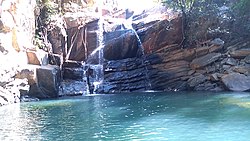
Among various biodiversity rich and ecologically balanced locations,"Pradhanpat" and "Kurudkut" waterfalls are with historical importance and with a salubrious atmosphere around them. Kurudkut is one of the earliest locations where hydroelectricity was generated in Asia.
Debagarh district
Debagarh district, also known as Deogarh district, is a district of Odisha state, India. Located in the north-western part of the state, it is one of Odisha's 30 administrative districts and has its headquarters at Debagarh (Deogarh) town.
The district covers an area of 2781.66 km² and has a population of 312,520 (2011 Census). As of 2011, it is the least populous district of Odisha (out of 30).
The district was created on 1 January 1994 by bifurcating the erstwhile Sambalpur district. It is domiciled by both tribal and non-tribal people in almost equal proportion.
Deogarh is the former capital of Bamanda or Bamra princely state of British India. The king of this princely state belongs to Ganga vamsi dynasty and one of the extended royal family of Gajapati emperor of Odisha.
Raja Shri Basudeb Sudhal Deb (1869–1903) was an enlightened ruler, he did much to further conditions in princely state and for the cause of Oriya nationalism. His contribution was more towards Literature, Education and Art. He established an educational institution, which is currently well known as Raja Basu Dev High School. His son had equally contributed to the social, cultural and scientific development of Deogarh. Bamanda was the first princely state to introduce postal, telegraph and electricity in India.
Bamanda is a citadel of creative artists which dates back to 5th century A.D. when Mathara Royal Family was at the helm of the Administration. After this dynasty, Ganga Rulers came into power and established their capital at Deogarh. Deogarh attained all-round prosperity during the reign of Raja Basudev Sudhal Dev, the most enlightened rulers of this clan. A new horizon was innovated in the field of communication by the foundation of Jagannath Ballav press in 1886 and publication of a weekly magazine the "Sambalpur Hitaishini" in 1889. It was during his rule that the jail, police station, post offices, Dispensaries were established and irrigation system was introduced. He had a telephone line of 78 Miles connecting Bamara and Barkote in 1900 was the longest in India during that period. Bamanda's own postal system was very developed. It got affiliated to the British Postal system in 1895. Sir Sudhal Dev, the then King of Bamanda had coined and issued postage stamps in his own Kingdom. He had promulgated paper currency also in his state.
After him, his illustrious son Raja Sachidananda Tribhuban Dev undertook the improvement activities of the erstwhile estate. The most outstanding developmental activities was the introduction of the hydro-electric system in Kodarkot water fall by which the Palace, cloth loom, Sugar factory established in 1908 at Rambhei got power supply. During the reign of Bhanuganga Tribhuban Dev, the estate of Bamra was merged with Odisha i.e. on 1 January 1948 and it became a part of the District of Sambalpur.
Among various biodiversity rich and ecologically balanced locations,"Pradhanpat" and "Kurudkut" waterfalls are with historical importance and with a salubrious atmosphere around them. Kurudkut is one of the earliest locations where hydroelectricity was generated in Asia.
Recent media
Recent media