



Community hub
Recent from talks
Contribute something to knowledge base
Content stats: 0 posts, 0 articles, 1 media, 0 notes
Members stats: 0 subscribers, 0 contributors, 0 moderators, 0 supporters
Subscribers
Supporters
Contributors
Moderators
Hub AI
December 2014 Sinjar offensive AI simulator
(@December 2014 Sinjar offensive_simulator)
Hub AI
December 2014 Sinjar offensive AI simulator
(@December 2014 Sinjar offensive_simulator)
December 2014 Sinjar offensive
The Sinjar offensive was a combination of operations of Kurdish Peshmerga, PKK and People's Protection Units forces in December 2014, to recapture regions formerly lost to the Islamic State of Iraq and the Levant in their August offensive.
In a six-day-long offensive, the PKK and Peshmerga took control over part of the city of Sinjar and part of the mountains which had been conquered by ISIL in August 2014, and expanded their offensive on to Tal Afar.
In August 2014, the Islamic State of Iraq and the Levant launched an offensive in Northern Iraq and pushed into Kurdish held areas of the Nineveh Governorate, capturing the city of Sinjar, among others. Some 50,000 Yazidis fled to and remained in the Sinjar Mountains, located to the city's north.
By the end of August, the majority of those 50,000 Yazidis had left the mountains, although several thousands stayed there. ISIL held onto Sinjar city and the southern entrance of the Sinjar Mountains.
On 21 October 2014, ISIL seized terrain north of the mountains, thus cutting the area's escape route to Kurdish areas. The Yazidi militias then withdrew from there into the Sinjar Mountains, where the number of Yazidi civilian refugees was estimated at 2,000–7,000. An American source called this new situation a partial ISIL "siege" of the mountain range.
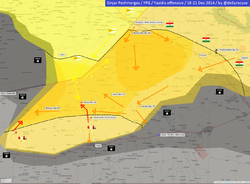
On 17 December 2014, at 7 AM (04.00 GMT), Peshmerga forces, directed personally by Masoud Barzani, the President of Iraqi Kurdistan, launched an offensive on the Sinjar area, backed by US-led coalition airstrikes that had started the night before. About 8,000 Peshmerga forces started advancing westward from Zummar, which had been recaptured by the Peshmerga in October 2014. A total of 45 airstrikes had been conducted by the US-led Coalition by end of the day. The Peshmerga were supported with training and equipment by a British Army training team.
On 18 December, the Peshmerga advanced even farther and managed to recapture a total of 700 square kilometers of territory and open a corridor from Zummar to Mount Sinjar, thus breaking the 'partial siege' of those mountains. According to a statement from the Kurdish command, large numbers of ISIL militants were fleeing, westward into Syria, and eastward into Mosul. A total of 53 airstrikes had been carried out as of Thursday evening 18 December. According to the U.S. Pentagon, the airstrikes near Sinjar had targeted ISIL storage units, bulldozers, guard towers, vehicles, and three bridges. Kurdish officials said on 19 December that, so far, more than 100 ISIL militants had been killed in this Kurdish Sinjar offensive.
On 19 December, one day after the retaking of Mount Sinjar, the Peshmerga launched a new offensive from the Rabia border crossing southward to Mount Sinjar. The new offensive was launched at 8 AM (05.00 GMT), with the aim of further clearing the area north of Mount Sinjar. Simultaneously, Peshmerga forces on Mount Sinjar started pushing northward and captured Snuny, located on the road to Rabia.
December 2014 Sinjar offensive
The Sinjar offensive was a combination of operations of Kurdish Peshmerga, PKK and People's Protection Units forces in December 2014, to recapture regions formerly lost to the Islamic State of Iraq and the Levant in their August offensive.
In a six-day-long offensive, the PKK and Peshmerga took control over part of the city of Sinjar and part of the mountains which had been conquered by ISIL in August 2014, and expanded their offensive on to Tal Afar.
In August 2014, the Islamic State of Iraq and the Levant launched an offensive in Northern Iraq and pushed into Kurdish held areas of the Nineveh Governorate, capturing the city of Sinjar, among others. Some 50,000 Yazidis fled to and remained in the Sinjar Mountains, located to the city's north.
By the end of August, the majority of those 50,000 Yazidis had left the mountains, although several thousands stayed there. ISIL held onto Sinjar city and the southern entrance of the Sinjar Mountains.
On 21 October 2014, ISIL seized terrain north of the mountains, thus cutting the area's escape route to Kurdish areas. The Yazidi militias then withdrew from there into the Sinjar Mountains, where the number of Yazidi civilian refugees was estimated at 2,000–7,000. An American source called this new situation a partial ISIL "siege" of the mountain range.
On 17 December 2014, at 7 AM (04.00 GMT), Peshmerga forces, directed personally by Masoud Barzani, the President of Iraqi Kurdistan, launched an offensive on the Sinjar area, backed by US-led coalition airstrikes that had started the night before. About 8,000 Peshmerga forces started advancing westward from Zummar, which had been recaptured by the Peshmerga in October 2014. A total of 45 airstrikes had been conducted by the US-led Coalition by end of the day. The Peshmerga were supported with training and equipment by a British Army training team.
On 18 December, the Peshmerga advanced even farther and managed to recapture a total of 700 square kilometers of territory and open a corridor from Zummar to Mount Sinjar, thus breaking the 'partial siege' of those mountains. According to a statement from the Kurdish command, large numbers of ISIL militants were fleeing, westward into Syria, and eastward into Mosul. A total of 53 airstrikes had been carried out as of Thursday evening 18 December. According to the U.S. Pentagon, the airstrikes near Sinjar had targeted ISIL storage units, bulldozers, guard towers, vehicles, and three bridges. Kurdish officials said on 19 December that, so far, more than 100 ISIL militants had been killed in this Kurdish Sinjar offensive.
On 19 December, one day after the retaking of Mount Sinjar, the Peshmerga launched a new offensive from the Rabia border crossing southward to Mount Sinjar. The new offensive was launched at 8 AM (05.00 GMT), with the aim of further clearing the area north of Mount Sinjar. Simultaneously, Peshmerga forces on Mount Sinjar started pushing northward and captured Snuny, located on the road to Rabia.
Recent media
Recent media