


Community hub
Recent from talks
Contribute something to knowledge base
Content stats: 0 posts, 0 articles, 1 media, 0 notes
Members stats: 0 subscribers, 0 contributors, 0 moderators, 0 supporters
Subscribers
Supporters
Contributors
Moderators
Hub AI
Declaration of Sentiments AI simulator
(@Declaration of Sentiments_simulator)
Hub AI
Declaration of Sentiments AI simulator
(@Declaration of Sentiments_simulator)
Declaration of Sentiments
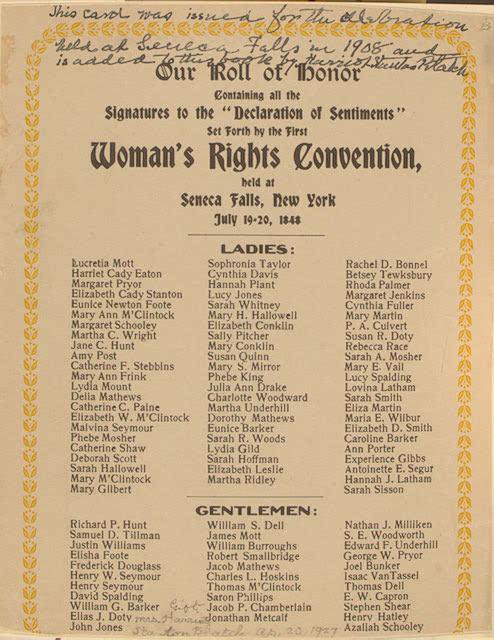
The Declaration of Sentiments, also known as the Declaration of Rights and Sentiments, is a document signed in 1848 by 68 women and 32 men—100 out of some 300 attendees at the first women's rights convention to be organized by women. Held in Seneca Falls, New York, the convention is now known as the Seneca Falls Convention. The principal author of the Declaration was Elizabeth Cady Stanton, who modeled it upon the United States Declaration of Independence. She was a key organizer of the convention along with Lucretia Coffin Mott, and Martha Coffin Wright.
According to the North Star, published by Frederick Douglass, whose attendance at the convention and support of the Declaration helped pass the resolutions put forward, the document was the "grand movement for attaining the civil, social, political, and religious rights of women."
In the early 1800s, women were largely relegated to domestic roles as mothers and homemakers, and were discouraged from participating in public life. While they exercised a degree of economic independence in the colonial era, they were increasingly barred from meaningfully participating in the workforce and relegated to domestic and service roles near the turn of the 19th century. Coverture laws also meant that women remained legally subordinated under their husbands.
The decades leading up to the Seneca Falls Convention and the signing of the Declaration saw a small but steadily-growing movement pushing for women’s rights. Egalitarian ideas within the U.S. had already seen limited circulation in the years following the American Revolution, in the works of writers including James Otis and Charles Brockden Brown. These sentiments began to emerge more widely with the advent of the Second Great Awakening, a period of Protestant revival and debate in the first half of the 19th century that led to widespread optimism and the development of various American reform movements.
The first advocates for women’s rights, including Frances Wright and Ernestine Rose, were focused on improving economic conditions and marriage laws for women. However, the growth of political reform movements, most notably the abolitionist movement, provided female activists with a platform from which they could effectively push for greater political rights and suffrage. The involvement of women such as Angelina Grimke and her sister Sarah Moore in the anti-slavery campaigns attracted substantial controversy and divided abolitionists, but also laid the groundwork for active female participation in public affairs.
A major catalyst for the women’s rights movement would come at the 1840 World Anti-Slavery Convention in London. With a majority vote from the male attendees, American female delegates were barred from fully partaking in the proceedings. This experience, a vivid illustration of women’s status as second-class citizens, was what motivated prominent activists Lucretia Mott and Elizabeth Cady Stanton to begin advocating for women’s rights.
By the time of the Seneca Falls Convention, the early women’s rights movement had already achieved several major political and legal successes. Marital legislative reforms and the repeal of coverture in several state jurisdictions such as New York was achieved through the introduction of Married Woman's Property Acts. Women’s rights and suffrage also gained exposure when they were included in the 1848 platform of Liberty Party U.S. presidential candidate Gerrit Smith, the first cousin of Elizabeth Stanton.
The Seneca Falls Convention in 1848 was the first women’s rights conference in the United States. Held at the Wesleyan Methodist Church in Seneca Falls, New York, it was predominantly organised by Elizabeth Cady Stanton, with the assistance of Lucretia Mott and local female Quakers. Despite the relative inexperience of the organisers, the event attracted approximately 300 attendees, including around 40 men. Among the dignitaries was the legendary slavery abolitionist Frederick Douglass, who argued eloquently for the inclusion of suffrage in the convention’s agenda.
Declaration of Sentiments
The Declaration of Sentiments, also known as the Declaration of Rights and Sentiments, is a document signed in 1848 by 68 women and 32 men—100 out of some 300 attendees at the first women's rights convention to be organized by women. Held in Seneca Falls, New York, the convention is now known as the Seneca Falls Convention. The principal author of the Declaration was Elizabeth Cady Stanton, who modeled it upon the United States Declaration of Independence. She was a key organizer of the convention along with Lucretia Coffin Mott, and Martha Coffin Wright.
According to the North Star, published by Frederick Douglass, whose attendance at the convention and support of the Declaration helped pass the resolutions put forward, the document was the "grand movement for attaining the civil, social, political, and religious rights of women."
In the early 1800s, women were largely relegated to domestic roles as mothers and homemakers, and were discouraged from participating in public life. While they exercised a degree of economic independence in the colonial era, they were increasingly barred from meaningfully participating in the workforce and relegated to domestic and service roles near the turn of the 19th century. Coverture laws also meant that women remained legally subordinated under their husbands.
The decades leading up to the Seneca Falls Convention and the signing of the Declaration saw a small but steadily-growing movement pushing for women’s rights. Egalitarian ideas within the U.S. had already seen limited circulation in the years following the American Revolution, in the works of writers including James Otis and Charles Brockden Brown. These sentiments began to emerge more widely with the advent of the Second Great Awakening, a period of Protestant revival and debate in the first half of the 19th century that led to widespread optimism and the development of various American reform movements.
The first advocates for women’s rights, including Frances Wright and Ernestine Rose, were focused on improving economic conditions and marriage laws for women. However, the growth of political reform movements, most notably the abolitionist movement, provided female activists with a platform from which they could effectively push for greater political rights and suffrage. The involvement of women such as Angelina Grimke and her sister Sarah Moore in the anti-slavery campaigns attracted substantial controversy and divided abolitionists, but also laid the groundwork for active female participation in public affairs.
A major catalyst for the women’s rights movement would come at the 1840 World Anti-Slavery Convention in London. With a majority vote from the male attendees, American female delegates were barred from fully partaking in the proceedings. This experience, a vivid illustration of women’s status as second-class citizens, was what motivated prominent activists Lucretia Mott and Elizabeth Cady Stanton to begin advocating for women’s rights.
By the time of the Seneca Falls Convention, the early women’s rights movement had already achieved several major political and legal successes. Marital legislative reforms and the repeal of coverture in several state jurisdictions such as New York was achieved through the introduction of Married Woman's Property Acts. Women’s rights and suffrage also gained exposure when they were included in the 1848 platform of Liberty Party U.S. presidential candidate Gerrit Smith, the first cousin of Elizabeth Stanton.
The Seneca Falls Convention in 1848 was the first women’s rights conference in the United States. Held at the Wesleyan Methodist Church in Seneca Falls, New York, it was predominantly organised by Elizabeth Cady Stanton, with the assistance of Lucretia Mott and local female Quakers. Despite the relative inexperience of the organisers, the event attracted approximately 300 attendees, including around 40 men. Among the dignitaries was the legendary slavery abolitionist Frederick Douglass, who argued eloquently for the inclusion of suffrage in the convention’s agenda.
Recent media
Recent media