Hubbry Logo
Declaration of SentimentsDeclaration of SentimentsMain
Open search
Declaration of Sentiments
Community hub
Declaration of Sentiments
logo
8 pages, 0 posts
0 subscribers
Be the first to start a discussion here.
Contribute something
Declaration of Sentiments
from Wikipedia
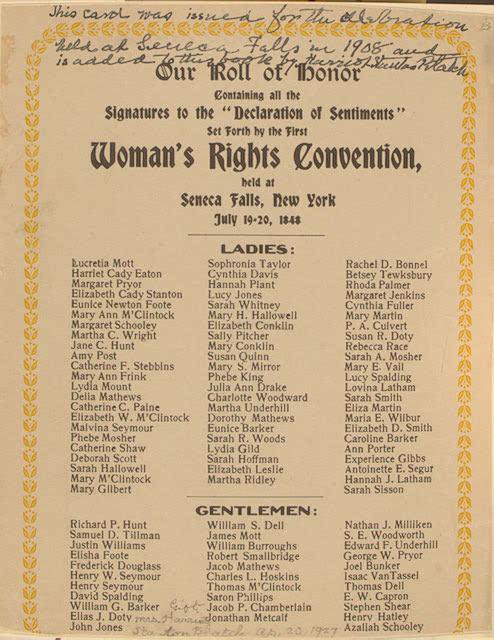
Signers of the Declaration at Seneca Falls in order: Lucretia Coffin Mott is at top of the list

The Declaration of Sentiments, also known as the Declaration of Rights and Sentiments,[1] is a document signed in 1848 by 68 women and 32 men—100 out of some 300 attendees at the first women's rights convention to be organized by women. Held in Seneca Falls, New York, the convention is now known as the Seneca Falls Convention. The principal author of the Declaration was Elizabeth Cady Stanton, who modeled it upon the United States Declaration of Independence. She was a key organizer of the convention along with Lucretia Coffin Mott, and Martha Coffin Wright.

According to the North Star, published by Frederick Douglass, whose attendance at the convention and support of the Declaration helped pass the resolutions put forward, the document was the "grand movement for attaining the civil, social, political, and religious rights of women."[2][3]

Background

[edit]

Early activism and the reform movements

[edit]

In the early 1800s, women were largely relegated to domestic roles as mothers and homemakers, and were discouraged from participating in public life.[4]  While they exercised a degree of economic independence in the colonial era, they were increasingly barred from meaningfully participating in the workforce and relegated to domestic and service roles near the turn of the 19th century.[5] Coverture laws also meant that women remained legally subordinated under their husbands.[6]

The decades leading up to the Seneca Falls Convention and the signing of the Declaration saw a small but steadily-growing movement pushing for women’s rights.  Egalitarian ideas within the U.S. had already seen limited circulation in the years following the American Revolution, in the works of writers including James Otis and Charles Brockden Brown.[4]  These sentiments began to emerge more widely with the advent of the Second Great Awakening, a period of Protestant revival and debate in the first half of the 19th century that led to widespread optimism and the development of various American reform movements.[7]

The first advocates for women’s rights, including Frances Wright and Ernestine Rose, were focused on improving economic conditions and marriage laws for women.[8]  However, the growth of political reform movements, most notably the abolitionist movement, provided female activists with a platform from which they could effectively push for greater political rights and suffrage.[8]  The involvement of women such as Angelina Grimke and her sister Sarah Moore in the anti-slavery campaigns attracted substantial controversy and divided abolitionists, but also laid the groundwork for active female participation in public affairs.[7]  

A major catalyst for the women’s rights movement would come at the 1840 World Anti-Slavery Convention in London.  With a majority vote from the male attendees, American female delegates were barred from fully partaking in the proceedings.  This experience, a vivid illustration of women’s status as second-class citizens, was what motivated prominent activists Lucretia Mott and Elizabeth Cady Stanton to begin advocating for women’s rights.[9]  

By the time of the Seneca Falls Convention, the early women’s rights movement had already achieved several major political and legal successes.  Marital legislative reforms and the repeal of coverture in several state jurisdictions such as New York was achieved through the introduction of Married Woman's Property Acts.[10] Women’s rights and suffrage also gained exposure when they were included in the 1848 platform of Liberty Party U.S. presidential candidate Gerrit Smith, the first cousin of Elizabeth Stanton.[11]

The Seneca Falls Convention

[edit]

The Seneca Falls Convention in 1848 was the first women’s rights conference in the United States.  Held at the Wesleyan Methodist Church in Seneca Falls, New York, it was predominantly organised by Elizabeth Cady Stanton, with the assistance of Lucretia Mott and local female Quakers.[12]  Despite the relative inexperience of the organisers, the event attracted approximately 300 attendees, including around 40 men.[13]  Among the dignitaries was the legendary slavery abolitionist Frederick Douglass, who argued eloquently for the inclusion of suffrage in the convention’s agenda.

“Nature has given woman the same powers, and subjected her to the same earth, breathes the same air, subsists on the same food, physical, moral, mental and spiritual. She has, therefore, an equal right with man, in all efforts to obtain and maintain a perfect existence.”[14]

Over two days, the attendees heard addresses from speakers including Stanton and Mott, voted on a number of resolutions and deliberated on the text of the Declaration.  At the conclusion of the convention, the completed Declaration was signed by over 100 attendees, including 68 women and 32 men.[15]

Rhetoric

[edit]

Overview

[edit]

Elizabeth Cady Stanton’s Declaration of Rights and Sentiments utilises similar rhetoric to the United States Declaration of Independence by Thomas Jefferson, a gesture which was neither an accident nor a submissive action.[16] Such a purposeful mimicking of language and form meant that Stanton tied together the complaints of women in America with the Declaration of Independence, in order to ensure that in the eyes of the American people, such requests were not seen as overly radical.[17]

Using Jefferson’s document as a model, Stanton also linked together the independence of America from Britain with the ‘patriarchy’ in order to emphasise how both were unjust forms of governance from which people needed to be freed.[18]

Therefore, through such a familiar phrasing of arguments and issues that the women of the new American republic were facing, Stanton’s use of Jefferson rhetoric can be seen as an attempt to deflect the hostility that women faced when calling for new socio-political freedoms, as well as to make the claims of women as “self-evident” as the rights given to men following from the gaining of independence from Britain.[19]

Specific examples

[edit]

The foremost example of such mimicking of rhetoric is provided in the preamble of both texts. Stanton successfully manipulates Jefferson’s words, changing “all men are created equal” to “all men and women are created equal” where Stanton and the signatories of her declaration establish that women both hold and are deserving of “inalienable rights”.[18]

Stanton’s link between the Patriarchal government and the British rule over the American colonies is also at the forefront of the declaration, changing the words in Jefferson’s document from “Such has been the patient sufferance of these Colonies; and such is now the necessity which constrains them to alter their former Systems of Government” to “Such has been the patient sufferance of the women under this government, and such is now the necessity which constrains them to demand the equal station to which they are entitled”. Such a slight change to rhetoric, ensured the continuous linkage between the struggles entwined within both declarations.[20]

Further changes to the demands of the original Declaration of independence also occurred, as Stanton places forward her arguments for greater socio-political freedoms for women. Stantons’ manifesto, mimicking the form of the Declaration of Independence, protests the poor condition of women’s education, women’s position in the church and the exclusion of women from employment in a similar manner to which Jefferson’s original Declaration protests the British governance of the colonies.[21]

Effects of rhetoric

[edit]

The direct effects of Stanton’s use of Jefferson’s rhetoric on people of the time, is unquantifiable. However, whilst Stanton had an intended effect in mind, the reality is that the use of the similar rhetoric was not as effective as was hoped, as only around 100 of the 300 men and women who attended the convention eventually ended up signing the document.[22]

Furthermore, whilst Stanton intended for changes to be made immediately after the Seneca Falls Convention, it was the ending of the American Civil War and the Reconstruction Period before women's rights movements become increasingly mainstream and actual change was effected.[23]

Opening paragraphs

[edit]

When, in the course of human events, it becomes necessary for one portion of the family of man to assume among the people of the earth a position different from that which they have hitherto occupied, but one to which the laws of nature and of nature's God entitle them, a decent respect to the opinions of mankind requires that they should declare the causes that impel them to such a course.

We hold these truths to be self-evident: that all men and women are created equal; that they are endowed by their Creator with certain inalienable rights; that among these are life, liberty, and the pursuit of happiness; that to secure these rights governments are instituted, deriving their powers from the consent of the governed. Whenever any form of government becomes destructive of these rights, it is the right of those who suffer from it to refuse allegiance to it, and to insist upon the institution of a new government, laying its foundation on such principles, and organizing its powers in such form, as to them shall seem most likely to effect their safety and happiness.

Prudence, indeed, will dictate that governments long established should not be changed for light and transient causes; and accordingly all experience hath shown that mankind are more disposed to suffer, while evils are sufferable, than to right themselves by abolishing the forms to which they are accustomed, but when a long train of abuses and usurpations, pursuing invariably the same object, evinces a design to reduce them under absolute despotism, it is their duty to throw off such government, and to provide new guards for their future security. Such has been the patient sufferance of the women under this government, and such is now the necessity which constrains them to demand the equal station to which they are entitled.

The history of mankind is a history of repeated injuries and usurpation on the part of man toward woman, having in direct object the establishment of an absolute tyranny over her. To prove this, let facts be submitted to a candid world.[24]

Sentiments

[edit]
  • He has not ever permitted her to exercise her inalienable right to the elective franchise.
  • He has compelled her to submit to laws, in the formation of which she had no voice.
  • He has withheld her from rights which are given to the most ignorant and degraded men—both natives and foreigners.
  • Having deprived her of this first right as a citizen, the elective franchise, thereby leaving her without representation in the halls of legislation, he has oppressed her on all sides.
  • He has made her, if married, in the eye of the law, civilly dead.
  • He has taken from her all right in property, even to the wages she earns.
  • He has made her morally, an irresponsible being, as she can commit many crimes with impunity, provided they be done in the presence of her husband. In the covenant of marriage, she is compelled to promise obedience to her husband, he becoming, to all intents and purposes, her master—the law giving him power to deprive her of her liberty, and to administer chastisement.
  • He has so framed the laws of divorce, as to what shall be the proper causes of divorce, in case of separation, to whom the guardianship of the children shall be given; as to be wholly regardless of the happiness of the women—the law, in all cases, going upon a false supposition of the supremacy of a man, and giving all power into his hands.
  • After depriving her of all rights as a married woman, if single and the owner of property, he has taxed her to support a government which recognizes her only when her property can be made profitable to it.
  • He has monopolized nearly all the profitable employments, and from those she is permitted to follow, she receives but a scanty remuneration.
  • He closes against her all the avenues to wealth and distinction, which he considers most honorable to himself. As a teacher of theology, medicine, or law, she is not known.
  • He has denied her the facilities for obtaining a thorough education—all colleges being closed against her.
  • He allows her in church, as well as State, but a subordinate position, claiming Apostolic authority for her exclusion from the ministry, and, with some exceptions, from any public participation in the affairs of the Church.
  • He has created a false public sentiment by giving to the world a different code of morals for men and women, by which moral delinquencies which exclude women from society, are not only tolerated but deemed of little account in man.
  • He has usurped the prerogative of Jehovah himself, claiming it as his right to assign for her a sphere of action, when that belongs to her conscience and her God.
  • He has endeavored, in every way that he could to destroy her confidence in her own powers, to lessen her self-respect, and to make her willing to lead a dependent and abject life.

Closing remarks

[edit]

Now, in view of this entire disfranchisement of one-half the people of this country, their social and religious degradation—in view of the unjust laws above mentioned, and because women do feel themselves aggrieved, oppressed, and fraudulently deprived of their most sacred rights, we insist that they have immediate admission to all the rights and privileges which belong to them as citizens of these United States. In entering upon the great work before us, we anticipate no small amount of misconception, misrepresentation, and ridicule; but we shall use every instrumentality within our power to effect our object. We shall employ agents, circulate tracts, petition the State and national Legislatures, and endeavor to enlist the pulpit and the press in our behalf. We hope this Convention will be followed by a series of Conventions, embracing every part of the country.

Signatories

[edit]

Signers of the Declaration at Seneca Falls in order:[25]

  1. Lucretia Mott (1793–1880)[26]
  2. Harriet Cady Eaton (1810–1894) - sister of Elizabeth Cady Stanton[27]
  3. Margaret Pryor (1785–1874) - Quaker reformer[28]
  4. Elizabeth Cady Stanton (1815–1902)[29]
  5. Eunice Newton Foote (1819–1888)
  6. Mary Ann M'Clintock (1800–1884) - Quaker reformer, half-sister of Margaret Pryor[30]
  7. Margaret Schooley (1806–1900)
  8. Martha C. Wright (1806–1875) - Quaker reformer, sister of Lucretia Mott[31]
  9. Jane C. Hunt (1812–1889)[32]
  10. Amy Post (1802–1889)[33]
  11. Catherine F. Stebbins (1823–1904)
  12. Mary Ann Frink
  13. Lydia Hunt Mount (c. 1800–1868) - well-off Quaker widow[34]
  14. Delia Matthews (1797–1883)
  15. Catharine V. Paine (1829–1908)[35] - 18 years old at the time, she is likely one of two signers of the Declaration of Sentiments to have cast a ballot.[36] Catharine Paine Blaine registered to vote in Seattle in 1885 after Washington Territory extended voting rights to women in 1883, making her the first female signer of the Declaration of Sentiments to legally register as a voter.[35]
  16. Elizabeth W. M'Clintock (1821–1896) - daughter of Mary Ann M'Clintock. She invited Frederick Douglass to attend.[37]
  17. Malvina Beebe Seymour (1818–1903)
  18. Phebe Mosher
  19. Catherine Shaw
  20. Deborah Scott
  21. Sarah Hallowell
  22. Mary M'Clintock (1822–) - daughter of Mary Ann M'Clintock[38]
  23. Mary Gilbert
  24. Sophrone Taylor
  25. Cynthia Davis[39]
  26. Hannah Plant (c. 1795–)[40]
  27. Lucy Jones
  28. Sarah Whitney
  29. Mary H. Hallowell
  30. Elizabeth Conklin (c. 1812–1884)
  31. Sally Pitcher
  32. Mary Conklin (1829–1909)
  33. Susan Quinn (1834–1909)
  34. Mary S. Mirror
  35. Phebe King[41]
  36. Julia Ann Drake (c. 1814–)[42]
  37. Charlotte Woodward (1830–1924) - the only signer who lived to see the 19th amendment though illness apparently prevented her from ever voting.[43]
  38. Martha Underhill (1806–1872) - her nephew also signed
  39. Dorothy Matthews (c. 1804–1875)
  40. Eunice Barker
  41. Sarah R. Woods
  42. Lydia Gild
  43. Sarah Hoffman
  44. Elizabeth Leslie
  45. Martha Ridley
  46. Rachel D. Bonnel (1827–1909)[44]
  47. Betsey Tewksbury (c. 1814–after 1880)
  48. Rhoda Palmer (1816–1919) - the only woman signer who ever legally voted, in 1918 when New York passed female suffrage.[45]
  49. Margaret Jenkins[46]
  50. Cynthia Fuller
  51. Mary Martin
  52. P.A. Culvert
  53. Susan R. Doty
  54. Rebecca Race (1808–1895)[47]
  55. Sarah A. Mosher
  56. Mary E. Vail (1827–1910) - daughter of Lydia Mount[48]
  57. Lucy Spalding
  58. Lavinia Latham (1781–1859)[49]
  59. Sarah Smith
  60. Eliza Martin
  61. Maria E. Wilbur
  62. Elizabeth D. Smith
  63. Caroline Barker
  64. Ann Porter
  65. Experience Gibbs (c. 1822–1899)
  66. Antoinette E. Segur
  67. Hannah J. Latham - daughter of Lavinia Latham
  68. Sarah Sisson
    The following men signed, under the heading "...the gentlemen present in favor of this new movement":
  69. Richard P. Hunt (1797–1856) - husband of Jane C. Hunt, brother of Lydia Mount and Hannah Plant, all also signers[50]
  70. Samuel D. Tillman (1813/5–1875)
  71. Justin Williams (1813–1878)
  72. Elisha Foote (1809–1883) - spouse of Eunice Newton Foote
  73. Frederick Douglass (c. 1818–1895)[51]
  74. Henry W. Seymour (1814–1895) - spouse of Malvina Beebe Seymour, a signer
  75. Henry Seymour (1803–1878)
  76. David Spalding (1792–1867) - spouse of Lucy Spalding
  77. William G. Barker (1809–1897) - spouse of Caroline Barker, a signer
  78. Elias J. Doty
  79. John Jones
  80. William S. Dell (1801–1865) - uncle of Rachel Dell Bonnel, a signer[52]
  81. James Mott (1788–1868) - husband of Lucretia Mott[53]
  82. William Burroughs (1828–1901)
  83. Robert Smalldridge (1820–1899)
  84. Jacob Matthews (1805–1874)
  85. Charles L. Hoskins
  86. Thomas M'Clintock (1792–1876) - husband of Mary Ann M'Clintock[54]
  87. Saron Phillips
  88. Jacob Chamberlain (1802–1878) - Methodist Episcopal and later a member of the US House of Representatives[55]
  89. Jonathan Metcalf
  90. Nathan J. Milliken
  91. S.E. Woodworth (1814–1887)
  92. Edward F. Underhill (1830–1898) - his aunt was Martha Barker Underhill, a signer[56]
  93. George W. Pryor - son of Margaret Pryor who also signed[57]
  94. Joel Bunker
  95. Isaac Van Tassel (1812–1889)
  96. Thomas Dell (1828–1851) - son of William S. Dell and cousin of Rachel Dell Bonnel, both signers[58]
  97. E.W. Capron (c. 1820–1892)
  98. Stephen Shear
  99. Henry Hatley
  100. Azaliah Schooley (c. 1805–1855) Spouse of Margaret Schooley. Born in Lincoln County, Upper Canada, and naturalized as an American citizen in 1837. A resident of Waterloo, New York, and member of the Junius Monthly Meeting. Also had ties to Spiritualist and Abolition movements.[59][60]

See also

[edit]

References

[edit]
Revisions and contributorsEdit on WikipediaRead on Wikipedia
from Grokipedia
The Declaration of Sentiments is a foundational document in the American movement, drafted primarily by with contributions from and presented at the , the first public meeting devoted to , held July 19–20, 1848, in . Modeled explicitly after the , it opens with the assertion that "all men and women are created equal," endowing them with inalienable rights including life, liberty, and the pursuit of happiness, before cataloging eighteen specific grievances against male-dominated laws and customs that denied women political participation, property ownership, education, and equal moral accountability. Accompanying resolutions demanded systemic reforms, with the ninth resolution—asserting women's right to the elective franchise—proving most divisive, passing narrowly after advocacy by and amid fears it would discredit the broader cause. Endorsed by sixty-eight women and thirty-two men from the roughly three hundred attendees, the Declaration galvanized subsequent activism, establishing as a central demand despite initial opposition even among reformers.

Historical Background

Antebellum Reform Movements

The Second Great Awakening, a widespread Protestant revival movement from approximately 1790 to 1840, galvanized antebellum Americans through itinerant preaching and camp meetings that emphasized personal conversion and moral regeneration, thereby catalyzing interconnected social reform initiatives. This evangelical surge promoted the idea that individuals could enact societal improvement by addressing perceived sins such as intemperance, , and ignorance, leading to the formation of voluntary associations focused on temperance—where societies like the , established in 1826, claimed over 1.5 million members by 1835 advocating abstinence from alcohol, and , including pushes for common schools and the founding of institutions like Oberlin Collegiate Institute in 1833, which admitted women and . These movements operated on the causal premise that moral failings stemmed from individual choices amenable to collective persuasion and institutional change, fostering a reformist that transcended denominational lines. Women, despite enduring legal disabilities under coverture—a common-law doctrine prevailing through much of the that merged a married woman's legal identity with her husband's, stripping her of rights to own property independently, enter contracts, or serve as a legal agent—gained limited footholds in public activism via these reforms, particularly . Unmarried or widowed women (feme sole) retained some autonomy, but even married participants often acted through female auxiliaries or petitions, circumventing direct legal barriers. In efforts, women organized groups such as the Philadelphia Female Anti-Slavery Society in 1833, led by figures including , who coordinated boycotts of slave-produced goods and fundraising. Their petitioning was notably prolific; antislavery memorials to in the 1830s amassed tens of thousands of signatures, with women contributing the majority—far outpacing male involvement—thereby asserting moral authority in the despite societal norms confining them to domestic roles. The 1840 World Anti-Slavery Convention in London underscored these tensions when British organizers barred female delegates, including Mott and , from seated participation, relegating them to the gallery despite their credentials from American societies. Mott publicly protested this exclusion as inconsistent with abolitionist principles of equality, arguing it mirrored the very hierarchies reformers opposed, which prompted male allies like to abstain in solidarity. This incident illuminated gender exclusions within reform networks, spurring women to question parallel injustices in their own legal and social status, thus bridging abolitionist tactics—like petition drives and —with nascent advocacy for expanded female agency.

Convening of the Seneca Falls Convention

The decision to convene the Seneca Falls Convention stemmed from frustrations experienced by Elizabeth Cady Stanton and Lucretia Mott at the 1840 World Anti-Slavery Convention in London, where female delegates, including Mott, were barred from speaking or sitting on the official platform and instead relegated to the gallery behind a screen. This exclusion highlighted systemic restrictions on women's public participation, even within reform movements they helped sustain, prompting Mott and Stanton to pledge future action on women's rights during their time together in London. Eight years later, in July 1848, the idea crystallized when Stanton, residing temporarily in Seneca Falls, New York, joined local Quaker women—Jane Hunt, Mary Ann McClintock, and Martha Coffin Wright (Mott's sister)—at Hunt's home in nearby Waterloo for tea. With Mott visiting Wright, the group of five women rapidly resolved to organize a public convention focused exclusively on women's issues, selecting the Wesleyan Methodist Chapel in Seneca Falls as the venue due to its availability and symbolic neutrality as a site used for various reforms. To publicize the event, the organizers drafted and published a brief notice in the Seneca County Courier on July 14, , announcing: "A Convention to discuss the social, civil, and religious condition and rights of woman, will be held in the Wesleyan Chapel, at Seneca Falls, N.Y., on Wednesday and Thursday, the 19th and 20th of July current; which any woman may attend." This advertisement, appearing just five days prior, relied on word-of-mouth among local Quaker networks and abolitionist circles for dissemination, reflecting the hasty yet deliberate planning amid limited resources and no precedent for such a gathering. The convention convened on July 19–20, 1848, drawing an estimated 300 attendees—predominantly local residents from Seneca Falls and surrounding areas, including men and women influenced by Quaker egalitarianism and regional reform sentiments. Sessions began each morning at 10 a.m., with women-only discussions on the first day to encourage open expression, marking an unprecedented assembly where women took the lead in addressing their own grievances rather than subsuming them under male-dominated causes like abolition. Initial proceedings included speeches and resolutions on topics such as property rights, , and , setting the stage for broader debates while underscoring the convention's novelty as the first U.S. event dedicated solely to women's social, civil, and religious conditions.

Drafting and Composition

Elizabeth Cady Stanton's Primary Role

authored the initial draft of the Declaration of Sentiments in mid-July 1848, collaborating closely with and Mary Ann McClintock at the McClintock home in nearby Waterloo, New York, over approximately eight days leading up to the convention. Her composition process emphasized grievances rooted in her firsthand encounters with discriminatory laws, including those governing that stripped women of independent legal identity, property ownership, and control over earnings, rendering them "civilly dead" in the eyes of the law. These frustrations stemmed from Stanton's observations during visits to her father, Judge Daniel Cady, where she saw women petitioners unable to secure redress due to doctrines that subordinated wives to husbands. Stanton's revisions to the draft incorporated explicit gender-inclusive language, such as modifying the foundational equality assertion to read "all men and women are created equal," thereby extending natural rhetoric to female citizenship claims. Informed by Enlightenment ideals of individual autonomy and egalitarian principles absorbed through Quaker associates like Mott—who emphasized spiritual equality between sexes—Stanton framed women's subjugation not merely as social custom but as systemic denial of inherent , including access to , professions, and often curtailed by domestic roles like child-rearing. By , she presented a preliminary version at the convention's opening session, followed by targeted edits on to refine the enumerated complaints against male usurpations in civil and spheres. This iterative authorship positioned Stanton as the document's intellectual architect, prioritizing women's legal over incremental reforms.

Direct Influences from the Declaration of Independence

The Declaration of Sentiments explicitly adapted phrasing from the Declaration of Independence to assert women's equality, most notably in its preamble: "We hold these truths to be self-evident: that ; that they are endowed by their Creator with certain inalienable rights; that they are endowed by their Creator with certain inalienable rights, which among these are life, liberty, and the pursuit of happiness." This modification extended the original 1776 text's "" to encompass women, positioning their claims within the framework of natural rights philosophy. Such textual borrowings served to invoke the revolutionary legitimacy of the founding document, applying its logic to gender-based exclusions despite the 1840s legal landscape, where doctrines like denied married women independent property control in most states, though reforms began emerging, as in Mississippi's 1839 statute granting separate estates for inherited or gifted property. The document's grievances further mirrored the original's structure of enumerated complaints, listing 18 instances of "He has" usurpations—targeting "Man" and male-dominated institutions rather than a —to parallel the 27 facts against King George III, thereby framing women's subjugation as a breach of self-evident principles warranting .

Core Content Breakdown

Preamble and Equality Assertions

The preamble of the Declaration of Sentiments begins by adapting the language of the United States Declaration of Independence, stating that when "one portion of the family of man" must assume a position "to which the laws of nature and of nature's God entitle them," a declaration of causes is required, reflecting a philosophical commitment to natural rights derived from divine and rational order rather than social convention. This opening establishes a causal premise: women's subordinate status results from historical denial of self-evident entitlements, not inherent inferiority, positioning reform as restoration of natural law. Central to the equality assertions is the modified declaration: "We hold these truths to be self-evident: that all men and women are created equal; that they are endowed by their Creator with certain inalienable ; that among these are life, liberty, and the pursuit of happiness." This extends theistic as pre-political endowments from a Creator—to include women explicitly, rejecting any governmental or patriarchal monopoly on their application and asserting that governments exist solely to secure them through . The framework implies causal culpability in institutions that fail this purpose, enabling legitimate resistance when such failures persist, as evidenced by 1848 New York laws barring women from voting and jury service despite recent gains like the Married Women's Property Act of that year, which permitted limited separate ownership but left broader civic exclusions intact. These assertions prioritize empirical legal barriers—such as women's civil incapacity under doctrines, where married women lacked independent contractual or testimonial standing—as violations of foundational principles, rather than excusing them via cultural . By invoking "nature's ," the text anchors equality in a deontological view of , independent of utilitarian outcomes or observed sex differences in roles, framing denial as an artificial usurpation amenable to correction through reconstituted .

Enumerated Grievances

The Enumerated Grievances in the Declaration of Sentiments consist of 18 specific indictments against the legal, political, and social subjugation of women by men, structured as accusations beginning with "He has" to parallel the grievances against King George III in the 1776 Declaration of Independence. These complaints catalog exclusions from political participation, civil rights, education, employment, and moral agency, framing them as systemic denials of consent and self-governance imposed by male-dominated institutions. The first grievance addresses the denial of suffrage: "He has never permitted her to exercise her inalienable right to the elective franchise," reflecting the absence of women's voting rights in the United States as of 1848, where no state granted women and constitutional interpretations barred them from federal elections. Subsequent grievances highlight marital subjugation, including: "He has made her, if married, in the eye of the law, civilly dead," a direct reference to the doctrine of , under which a married woman's legal identity merged with her husband's upon marriage, suspending her capacity to sue, contract, or own property independently. This civil death extended to her exclusion from property , as "He has withheld from her which are given to the most ignorant and degraded men—both natives and foreigners," underscoring how even non-citizen men could naturalize and vote, while married women forfeited control over inherited or earned assets to their husbands. Further complaints target educational and occupational barriers: "He has denied her the facilities for obtaining a thorough —all colleges being closed against her," accurate to the era when institutions like (1837) admitted women but most, including universities, excluded them until later reforms. is indicted as "He has denied her the employment of her time and property," prohibiting women from lucrative professions or trades on equal terms with men, confining them largely to unpaid domestic labor or low-wage and roles amid an 1840s economy where women's paid work averaged under $1 per week in factories. Legal inequities persist in grievances like subjection to "laws which place her in a position similar to that of a slave," including limited divorce access and , where favored paternal rights, allowing fathers to claim children as property despite maternal caregiving roles. Additional grievances address ecclesiastical and moral constraints, such as "He has endeavored, in every way that he could to destroy her confidence in her own powers, to lessen her self-respect, and to make her willing to lead a dependent and abject life," attributing to male clergy the portrayal of women as morally inferior, which reinforced pulpit teachings denying women or doctrinal input in denominations like and . These claims reflected prevailing practices across states, though reforms like New York's Married Women's Property Act of April 1848—granting wives separate control over property acquired after marriage—began addressing property grievances contemporaneously, predating the July convention but stemming from similar agitations without resolving broader civil deadness or denials. The list culminates in accusations of domestic tyranny, including withholding "the right to speak in public" and creating "a different code of morality for men and women," by which "whatever is right for one is wrong for the other," highlighting double standards in and social expectations that penalized female infidelity far more severely than male. Collectively, the grievances emphasize a causal chain of institutional exclusions that rendered women legally and politically unrepresented, compelling obedience to laws without consent, though this overlooks pre-industrial familial interdependencies where household economies relied on spousal complementarity rather than isolated autonomy. Empirical data from the 1840s, including census records showing women's property holdings routed through male guardians, substantiates the legal claims, even as state variations existed—e.g., limited dower rights allowing widows one-third of spousal estates but no marital autonomy.

Accompanying Resolutions

The Accompanying Resolutions consisted of eleven action-oriented declarations that extended the Declaration of Sentiments' principles into specific demands for reform, urging women to assert equality across social, legal, religious, and economic domains. The first resolution invalidated any laws conflicting with women's "true and substantial happiness," deeming them contrary to natural precepts, while the second rejected statutes that confined women to inferior societal positions dictated by rather than arbitrary restrictions. Subsequent resolutions affirmed women's equality with men under divine creation, called for their on prevailing laws to combat of personal degradation, and insisted on men's active encouragement of women's participation in religious assemblies. Additional resolutions targeted ecclesiastical and moral inequalities, demanding equal virtue standards and punishments for both sexes, decrying hypocritical objections to women's public speaking given their allowance in other reform contexts, and advocating transcendence of "degrading customs" in family and society. Resolutions also pressed for women's equitable access to education, industry, professions, and commerce, rejecting monopolies like pulpit exclusivity that barred female preachers and limiting their economic roles. These measures aimed to dismantle systemic barriers, linking abstract equality claims to practical changes such as property retention in marriage and broader civil participation. Resolution 9 specifically proclaimed it the duty of American women to secure "their sacred right to the elective franchise," positioning as essential for enforcing other reforms—a demand that, despite its foundational logic rooted in principles, encountered resistance for potentially overshadowing less contentious goals like and legal equity. The final resolutions reinforced women's entitlement to publicly advance moral causes based on shared human capabilities and tied movement success to comprehensive equalization in religious leadership and vocational opportunities. Overall, the resolutions functioned as a blueprint for , prioritizing causal reforms to empower women against entrenched legal and cultural subjugation.

Rhetorical Elements

Structural Parallels to Founding Documents

The Declaration of Sentiments replicates the foundational architecture of the Declaration of Independence, commencing with a that proclaims universal equality and inalienable rights, followed by an indictment of specific abuses, and concluding with a call for redress and separation from oppressive rule. This framework positions the claims within the continuum of American revolutionary ideology, adapting the 1776 document's assertion of self-evident truths—"that "—to explicitly include women: "that all men and women are created equal; that they are endowed by their Creator with certain inalienable rights." The preamble's declarative style, invoking laws of nature and divine endowment, mirrors the original's philosophical grounding to legitimize reform as an extension of founding principles rather than a radical departure. Central to this parallelism is the grievances section, which emulates the Declaration of Independence's catalog of 27 indictments against King George III through a parallel list of 18 abuses attributed to male-dominated authority, repeatedly employing the formulaic "He has" to denote tyrannical acts. Examples include charges that "he has never permitted [women] to exercise their inalienable right to the elective franchise" and "he has compelled her to submit to laws, in the formation of which she had no voice," transposing monarchical overreach to patriarchal and legislative constraints on women. This indictment format—systematic, accumulative, and accusatory—serves as a rhetorical scaffold to equate subjugation with the colonial grievances that justified , thereby framing women's disenfranchisement as a betrayal of the nation's anti-tyrannical ethos. The document's conclusion further echoes the founding text's resolution, declaring the "compact" between "totally dissolved" and asserting women's right to "form a new association" for mutual protection, akin to the colonies' severance from British allegiance. By sustaining this formal symmetry throughout—preserving declarative prose, enumerated complaints, and a posture of patient endurance giving way to righteous —the Sentiments invokes the precedent to demand parity, though the shift in target from foreign to domestic underscores a causal extension of exceptionalist ideals to internal social orders.

Language and Persuasive Techniques

The Declaration of Sentiments employs a lexicon infused with republican virtues and moral absolutism, such as the phrase "sacred right to the elective franchise" in its resolutions, which evokes both civic republicanism—emphasizing participatory governance and duty—and biblical connotations of inviolable divine entitlements, thereby framing women's disenfranchisement as a profound ethical and political violation. This fusion appeals to audiences steeped in Protestant ethics and revolutionary ideals, positioning suffrage not merely as a pragmatic demand but as a restitution of primordial justice. Pathos permeates the grievances through stark, emotive depictions of women's subjugation, portraying them as "civilly dead" under marital law and "morally an irresponsible being," compelled to endure penalties without equivalent agency, which stirs by contrasting idealized equality with tangible degradation. This emotional resonance is heightened by the rarity of legal recourse in practice; in the mid-19th century , divorce rates hovered below 1 per 1,000 population, with women facing statutory barriers that confined most separations to male-initiated actions on narrow grounds like , underscoring the document's portrayal of inescapable bondage. Logos counters with precise enumerations of legal inequities, citing deprivations like denial of property rights "even to the wages she earns," which invokes statutory realities such as coverture doctrines prevalent in state laws, lending empirical weight to the appeals without unsubstantiated hyperbole. Parallelism reinforces this through anaphoric repetition of "He has" across eighteen grievances—"He has compelled her to submit... He has denied her... He has monopolized..."—creating rhythmic accumulation that methodically escalates a sense of systemic tyranny, mirroring oratorical strategies in abolitionist rhetoric to forge unity via shared outrage.

Adoption at the Convention

Debate and Approval Process

On July 20, 1848, the second day of the , men joined the proceedings, and the Declaration of Sentiments—drafted primarily by —was read aloud and subjected to debate by attendees including , , and Stanton herself. The document underwent minor amendments, including an addition inserted between the morning and afternoon sessions of the prior day, before being unanimously adopted following discussion. The accompanying resolutions, which elaborated on demands for reform, were debated separately in the afternoon session, with some passing with minimal comment and others requiring criticism, debate, and slight alterations prior to adoption by a large majority. The ninth resolution, asserting women's duty to secure the elective franchise, proved the most contentious, viewed as radical amid prevailing norms, yet it passed after including an eloquent speech by Douglass linking women's enfranchisement to broader equality principles. Post-approval, was signed by 100 of the approximately 300 attendees, representing the convention's first collective endorsement of women's claims to political equality. This process reflected influences from Quaker traditions of egalitarian discourse among organizers, though procedural decisions relied on majority votes rather than strict consensus.

Signatories and Their Composition

The Declaration of Sentiments was signed by 68 women and 32 men during the held on July 19 and 20, 1848, representing about one-third of the approximately 300 attendees. Among the women signers were key organizers including , who drafted the document, , a Quaker minister and abolitionist, and Mary Ann McClintock, whose home in nearby Waterloo served as a site for preliminary discussions. The male signers, such as , an escaped enslaved person and leading abolitionist speaker, underscored alliances between women's rights advocates and the anti-slavery movement, as Douglass argued in favor of woman's during the convention. Other men included husbands and Quaker reformers like James Mott. Signatories were predominantly middle-class residents from Seneca Falls and adjacent Waterloo, New York, with many affiliated with Quaker communities that emphasized social reform. Substantial numbers participated in interconnected causes like and temperance, reflecting how emerged from these networks rather than isolated elite or proletarian groups. Representation from working-class or upper-class segments remained limited, concentrating agency among educated reformers. While the signatures provided initial credibility through collective endorsement, they also revealed emerging fissures, as numerous women later withdrew their names in response to social ridicule and familial pressures.

Immediate Reception

Responses from Convention Attendees

Attendees at the Seneca Falls Woman's Rights Convention, held July 19–20, 1848, expressed broad enthusiasm for the Declaration of Sentiments' core assertions of equality, with approximately 300 participants, predominantly women from local Quaker and reform circles, engaging in lively discussions on women's social, civil, and religious conditions. The document's preamble and grievances elicited general support as a framework for addressing legal and customary inequalities, such as property rights and education access, aligning with ongoing abolitionist and temperance efforts among the group. However, the accompanying resolutions sparked division, particularly the ninth resolution demanding as "the right to secure to themselves their sacred right to the elective franchise." This proposal faced significant hesitation from several female attendees, who viewed it as overly radical and potentially undermining broader acceptance of the equality principles; debates on the convention floor highlighted fears that prioritizing voting rights could alienate moderates and fracture the nascent movement. Male ally , the sole African American participant and an abolitionist leader, intervened decisively, delivering a speech on that framed as the "logical extension" of self-evident rights, equating denial of the vote to the subjugation of enslaved people and urging its inclusion to fortify the Declaration's moral foundation. The suffrage resolution ultimately passed after Douglass's address, though not unanimously, while the other ten resolutions received full endorsement, reflecting internal fractures over pacing reform demands. The convention concluded with the Declaration adopted as its centerpiece, evidenced by 68 women and 32 men affixing signatures, yet the absence of signatures from some attendees underscored lingering reservations about its full scope. This partial consensus indicated enthusiasm tempered by pragmatic caution, setting a for ongoing debates within the emerging .

Broader Public and Media Reactions

The initial media response to the Declaration of Sentiments and , published in newspapers shortly after July 20, 1848, was predominantly one of ridicule and dismissal, with editors across the portraying the demands as absurd threats to social order. For instance, the New York Herald described the document as "amusing" while reprinting it, suggesting organizer could make a better president than some recent occupants of the , implying the entire affair was a novelty unfit for serious consideration. Similarly, the Philadelphia Public Ledger and Daily Transcript asserted that "a is nobody. A is everything," rejecting the idea that women would desire political equality. The Albany Mechanic’s Advocate warned that granting equal rights would "demoralize and degrade [women] from their high sphere and noble destiny," reflecting broader conservative anxieties over upending established gender roles centered on domesticity and male authority. One unnamed editor labeled the convention "a most insane and ludicrous farce," while the Lowell Courier mocked the prospect of gender equality by claiming it would compel men to "wash the dishes, scour up, be put to the tub, handle the broom, [and] darn stockings," evoking fears of role reversal and "petticoat government." Elizabeth Cady Stanton later observed that journals "from Maine to Texas" vied to deride the event, underscoring the widespread contempt that marginalized the Declaration as fanatical or infidel agitation rather than a legitimate call for reform. Such portrayals aligned with prevailing empirical norms of the era, where women's expanding roles in moral crusades like temperance and abolition were tolerated but political enfranchisement remained deeply contested as a disruption to familial and societal stability. Amid the hostility, offered a rare tempered endorsement in the New-York Daily Tribune, acknowledging the demand for voting rights as "however unwise and mistaken... but the assertion of a natural right, and as such must be conceded," though he deemed it improper in practice. Conservative and religious commentators, including those in clerical circles, echoed press critiques by decrying the convention as an assault on divine and natural hierarchies, with limited immediate public mobilization evident in the slow initial traction of follow-up drives for legal reforms like property rights. For example, post-convention efforts by Stanton and allies to New York legislators yielded modest signatures and repeated rejections through the 1850s, indicating the Declaration's ideas faced entrenched resistance outside reformist enclaves.

Long-Term Legacy

The Declaration of Sentiments, adopted at the 1848 , served as a foundational document that galvanized the movement. It explicitly demanded women's right to vote in its resolutions, inspiring subsequent national gatherings such as the 1850 Worcester National Woman's Rights Convention, where principles from were debated and advanced to broaden the call for electoral equality. This momentum contributed to the formation of the in 1869 by and , key figures from Seneca Falls, which focused advocacy on a federal suffrage amendment. The Declaration's suffrage plank echoed in later campaigns, with its language cited in speeches and platforms leading to the 19th Amendment's ratification on August 18, 1920, granting women voting rights after 72 years of persistent, incremental activism rather than immediate revolution. Beyond suffrage, the document addressed specific legal disabilities, such as married women's "civil death" under , where husbands controlled property and earnings. These grievances influenced state-level reforms, including New York's Married Women's Property Act of 1848 and subsequent laws in over 20 states by 1900, which enabled women to own property independently and retain wages, directly responding to the Declaration's enumerated injustices.

Influence on Subsequent Gender Debates

The Declaration of Sentiments explicitly critiqued marital laws that granted men unilateral authority over divorce proceedings and child custody, asserting that such frameworks rendered women "civilly dead" upon marriage and denied them equitable separation rights. This grievance prompted early post-1848 discussions among reformers, contributing to challenges against prevailing paternal custody presumptions, where fathers typically retained children in divorce cases unless proven unfit. By highlighting these imbalances, the document fueled advocacy for maternal preferences in custody, influencing the gradual emergence of the tender years doctrine in mid-19th-century courts, which presumed young children—particularly under age six—belonged with mothers due to presumed nurturing needs, though this shift was not uniformly adopted until later decades. In parallel, the Sentiments' demand for equal educational opportunities correlated with measurable expansions in female access to schooling after 1850. U.S. Census data indicate that white female enrollment in public schools rose from approximately 50% of the school-age in 1850 to over 70% by 1880, driven partly by linking women's to and civic roles, amid the proliferation of women's seminaries and coeducational institutions. This uptick reflected broader shifts, as reformers invoked the document to argue against barriers that confined women to domestic ignorance, fostering debates on 's role in empowering female within households rather than solely vocational pursuits. The document's emphasis on innate equality resurfaced in 1866–1868 congressional debates over the Fourteenth Amendment, where advocates like Elizabeth Cady Stanton cited its principles to protest the proposed language—"male citizens"—which explicitly excluded women from citizenship protections, underscoring persistent gender hierarchies in constitutional framing. Over the long term, these ideas provided ideological groundwork for second-wave feminism's focus on personal liberation from traditional roles, yet some analysts contend this prioritization of individualism eroded relational incentives in pre-welfare state societies, where family units bore primary economic risks without state subsidies, potentially destabilizing marital commitments. Empirical patterns, such as rising divorce rates in the 20th century amid expanded individual rights, illustrate causal tensions between such autonomy claims and historical family stability norms.

Criticisms and Controversies

Historical Accuracy of Claimed Oppressions

The Declaration of Sentiments enumerated grievances such as the denial of , lack of representation in , and restrictions on , many of which accurately reflected prevailing legal disabilities for during the 1840s. Women were universally barred from voting in national and most state elections until the Nineteenth Amendment in 1920. Under the doctrine of , married women in most jurisdictions lost the legal capacity to own independently, enter contracts, or control their earnings, as their legal identity merged with that of their husbands. These limitations stemmed from English traditions inherited by American states, persisting broadly until legislative reforms. However, early Married Women's Property Acts began eroding these restrictions prior to 1848; enacted the first such law in 1839, permitting women to hold in their own name with spousal consent, followed by similar measures in states like New York by 1848. Certain grievances, however, overstated uniformity by framing regional or cultural norms as absolute tyrannies. The claim that women were denied "facilities for obtaining a thorough " with "all colleges being closed against her" held for male institutions like Harvard but ignored the proliferation of female academies and seminaries in the antebellum period. Institutions such as Emma Willard's Troy Female Seminary, founded in 1814 and formalized in 1821, provided advanced instruction in subjects including , , and languages to thousands of women, emphasizing intellectual rigor over mere ornamental skills. By the , hundreds of such seminaries operated across the Northeast and , educating women for roles as teachers and moral guardians, with enrollment reaching significant scale; estimates indicate nearly 6,000 female academies enrolled around 250,000 women by mid-century. Regional variations further mitigated generalizations, as access to basic schooling for girls expanded in public systems, though higher education remained segregated by sex. Coverture, while curtailing autonomy, incorporated trade-offs rooted in economic protections suited to an era of limited state welfare and high creditor risks; married women were shielded from personal liability for spousal debts, preserving assets from individual lawsuits or business failures that could otherwise impoverish households. This framework reflected causal realities of a where women's economic roles emphasized household management over independent enterprise, rather than unmitigated subjugation. The document's portrayal underemphasized such safeguards, presenting legal fusion as unilateral oppression without acknowledging reciprocal dependencies in units. In the agrarian economy dominating 1840s America—where over 70% of the population lived rurally and relied on family farms—the grievances overlooked women's integral, voluntary contributions that fostered mutual interdependence. Women managed dairy production, , , and textile work, generating essential income and sustaining household self-sufficiency alongside male field labor; these roles complemented legal asymmetries, as family stability metrics, including low rates (under 1 per 1,000 marriages annually) and high (averaging 5–7 children per woman), indicated resilient partnerships rather than systemic instability implied by the rhetoric of "usurpation." data from the period further contextualizes claims of degraded condition; while overall expectancy at birth hovered around 40 years for both sexes amid high , adult women benefited from family-centric structures that buffered vulnerabilities, though maternal mortality from elevated risks for younger females compared to men.

Contemporary and Modern Critiques

Contemporary critiques of the Declaration of Sentiments emphasized its potential to undermine established social hierarchies and familial structures. Religious authorities, including , condemned the convention's proceedings and the document's assertions of as contrary to scriptural mandates, which prescribed distinct spheres for men and women, with the latter centered on domestic influence rather than public or political engagement. Such objections portrayed the demands for and legal autonomy as fomenting disorder, with critics warning that elevating women to equal civic status would erode paternal authority and the moral fabric of . Even among reformers, there were reservations about the document's expansive scope. Abolitionist , while advocating women's moral agency and limited public speech against slavery, prioritized influence through piety and over full political enfranchisement, reflecting a partial divergence from the Declaration's broader equality claims that blurred separate domains. In modern reassessments, conservative analysts have argued that the Declaration's foundational premise of identical rights and opportunities for men and women initiated a trajectory away from complementary roles, which empirically correlated with greater cohesion in prior eras. U.S. data show affecting approximately 12% of marriages by 1900, with rates remaining comparatively low before the 1920 suffrage ratification, after which they doubled between 1910 and 1925 amid shifting norms. This trend accelerated with the widespread adoption of laws starting in in 1969 and spreading through the , which studies link to elevated levels and diminished marital stability, as unilateral dissolution became feasible without proving fault, often prioritizing individual autonomy over collective welfare. Phyllis Schlafly, a leading conservative voice against second-wave extensions of early , critiqued such equality paradigms for devaluing and fostering policies that disrupted traditional families, asserting that women's distinctive societal contributions through motherhood outweighed abstract equal-rights pursuits. These outcome-based objections question whether the Declaration's causal push toward undifferentiated roles yielded net societal gains, given evidence of heightened family fragmentation post-reform. Subsequent feminist evaluations have also faulted the document for its narrow demographic lens, predominantly reflecting white, middle-class experiences while sidelining class-based oppressions of working women and racial exclusions of and immigrant females, whose intersecting disadvantages received scant attention. This inward critique underscores philosophical tensions within the movement over universal versus particularized claims to equity.

References

Add your contribution
Related Hubs
Contribute something
User Avatar
No comments yet.