Hubbry Logo
DefrockingDefrockingMain
Open search
Defrocking
Community hub
Defrocking
logo
8 pages, 0 posts
0 subscribers
Be the first to start a discussion here.
Defrocking
Defrocking
from Wikipedia
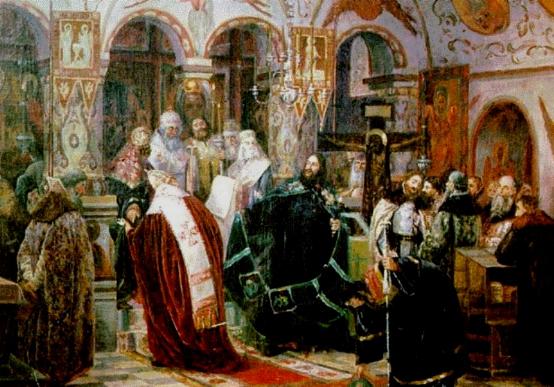
Defrocking of patriarch Nikon

Defrocking, unfrocking, degradation, or laicization of clergy is the removal of their rights to exercise the functions of the ordained ministry. It may be grounded on criminal convictions, disciplinary problems, or disagreements over doctrine or dogma; but may also be done at their request for personal reasons, such as running for civil office, taking over a family business, declining health or old age, desire to marry against the rules for clergy in a particular church, or an unresolved dispute. The form of the procedure varies according to the Christian denomination concerned.

The words "defrocking" or "unfrocking" refers to the ritual removal of the frock-like vestments of clergy and ministers. These rituals are generally no longer practiced and were sometimes separate from dismissals from ordained ministry, leading some to contend that modern use of "defrocking" is inaccurate.[1] However, others maintain "defrocking" as a common synonym for laicization, one particularly popular in English.[2][3]

History

[edit]

In the Medieval and Renaissance church, priests were publicly defrocked or "degraded" by having their vestments ceremonially removed. The procedure was intended to evoke shame and humiliation in the subject.[4] A description of the degradation of Archbishop Thomas Cranmer for heresy in 1556, based on eye-witness accounts, was recorded by John Foxe:

...when they came to take off his pall, (which is a solemn vesture of an archbishop,) then said he, "Which of you hath a pall, to take off my pall;" which imported as much as they, being his inferiors, could not degrade him. Whereunto one of them said, in that they were but bishops, they were his inferiors, and not competent judges; but being the pope's delegates, they might take his pall. And so they did, and so proceeding took every thing in order from him, as it was put on. Then a barber clipped his hair round about, and the bishop scraped the tops of his fingers where he had been anointed... Last of all they stripped him out of his gown into his jacket, and put upon him a poor yeoman-beadle's gown, full bare and nearly worn, and as evil-favouredly made as one might lightly see, and a townsman's cap on his head; and so delivered him to the secular power".[5]

Catholicism

[edit]

Members of the Catholic Church clergy may be dismissed from the clerical state, an action known as "laicization". The term "defrocking" is not normally used within the Catholic Church, although journalistic reports on laicization of Catholic clergy sometimes use it.[6] Laicization differs from suspension. The latter is a censure prohibiting certain acts by a cleric, whether the acts are of a religious character deriving from his ordination ("acts of the power of orders") or are exercises of his power of governance or of rights and functions attached to the office he holds.[7] As a censure, suspension is meant to cease when the censured person shows repentance. Laicization, on the contrary, is a permanent measure, whereby for a sufficient reason a cleric is from then on juridically treated as a layman. Laicization is sometimes imposed as a punishment (Latin, ad poenam),[8] or it may be granted as a favour (Latin, pro gratia) at the priest's own request.[9] New regulations issued in 2009 regarding priests who abandon their ministry for more than five years and whose behaviour is a cause of serious scandal have made it easier for bishops to secure laicization of such priests even against the priests' wishes.[10]

Once a priest or bishop is laicized, they do not lose what is conferred to them through the graces imparted to them that relate to the sacrament of holy orders; therefore, sacraments—including the consecrating others as bishops in apostolic succession—which are performed by excommunicated, dismissed or laicized priests and bishops are considered valid but illicit.[11][12]

Eastern Orthodoxy

[edit]

Certain Eastern Orthodox theologians believe that ordination to the priesthood does not confer an indelible character on the person's soul and that laicization could remove the ordained status completely.[13] From the time of laicization all actions of a former cleric that would have been considered sacred are normally considered invalid.

Laicization of a cleric may come as a result of a request for removal from sacred orders, or as an ecclesiastical punishment.[14] In the first case, very often, the cleric may ask to be laicized in order to enter a second marriage after the divorce or the death of his spouse. In this case, the man remains in good standing with the church but is no longer a cleric. Laicization of a bishop can only be done by the convening of a holy synod.

Forced laicization or removal from sacred orders is a form of ecclesiastical punishment, imposed by the ruling bishop of a cleric for certain transgressions. According to the canonical procedure, if the cleric is found guilty of an infringement of a sacred vow, unrepentant heresy, breaking of canon law or ecclesiastical discipline, he can be suspended from exercising all clerical functions. If, disregarding his suspension, he continues to liturgize or does not repent of his actions, he may be permanently deposed from the sacred orders (in common parlance, "laicized").[14] Strictly speaking, the deposition can be appealed at the ecclesiastical court, but, in modern practice, the bishop's decision is usually final.

Laicization as an ecclesiastical punishment may carry with it the excommunication of the former cleric from the church for a certain period, or indefinitely.[14] The anathema, the permanent act of excommunication, against a member of the church or a former cleric is usually imposed by the decision of the synod of bishops or the ecclesiastical council.[15] In such cases, this not only defrocks the former cleric but also banishes him from entering an Eastern Orthodox church, receiving the Eucharist and other sacraments, and being blessed by a priest.

Anglicanism

[edit]

In Anglicanism, defrocking is extremely rare and often impossible. According to the 39 Articles of Religion, even unworthy ministers can validly confect the sacraments (even after disciplinary action).[16]

Different provinces in the Anglican Communion handle this differently; the canon law of the Church of England, for instance, states that "No person who has been admitted to the order of bishop, priest, or deacon can ever be divested of the character of his order..."[17] though the church has processes to allow any clergy (by own volition or otherwise) to cease to function in the role. Anglican clergy are generally licensed to preach and administer sacraments by the bishop of the diocese in question; however if a bishop suspends this licence, the deacon or priest may no longer exercise their respective ministerial functions lawfully in that diocese. Within the Church of England the Clergy Discipline Measure 2003 provides for a range of sanctions up to a lifelong ban from the exercise of ministry.[18]

Similarly, in the Anglican Church of Canada "deposition from the exercise of ministry if the person is ordained"[19] does not amount to defrocking, but merely removes the right to the exercise of ministry by ordained persons. These powers are given to the diocesan bishop (in most cases) subject to appeal to a diocesan court, or the diocesan court may exercise primary jurisdiction when the bishop asks it to (for diocesan bishops the provincial metropolitan is given primary jurisdiction, for metropolitans the provincial House of Bishops is given jurisdiction, for the primate it is the national House of Bishops). All these powers are subject to appeal to courts of appeal and on matters of doctrine to the Supreme Court of the Anglican Church of Canada (Appendix 4, General Synod Canon XVIII - Discipline).[20] General Synod 2007 clarified deposition, including forbidding the practice of suspending the licence in cases where discipline proceedings could be commenced instead (Resolution A082).[21]

According to the constitutions and canons of the Episcopal Church in the United States, Title IV "Ecclesiastical Discipline", there are three modes of depriving a member of clergy from exercising ministerial rights: inhibition, suspension, or deposition. Inhibitions and suspensions are temporary. Clergy who are deposed are "deprived of the right to exercise the gifts and spiritual authority of God's word and sacraments conferred at ordination." (Title IV, Canon 15, Of Terminology Used in This Section, Deposition).[22]

In the Anglican Church of Australia, the relevant canon provides for a bishop, priest or deacon to relinquish or be deposed from, or prohibited from functioning in, Holy Orders. Upon relinquishing or being deposed from Holy Orders, the relinquished or deposed person ceases to have any right, privilege or advantage attached to the relevant order(s) (of bishop, priest or deacon), and, if wholly relinquished or deposed, is considered, except for any Church law relating to a Church Tribunal, to be a lay person for the purposes of the Church. Where a person in Holy Orders has been prohibited from functioning, the prohibition has effect according to its terms.[23]

Methodism

[edit]

In the United Methodist Church, when an elder, bishop, or deacon is defrocked, their ministerial credentials are removed.[24] Defrocking is usually the result of blatantly disobeying the order and discipline of the United Methodist Church and violating biblical standards.[24] A defrocked clergyman is prohibited from celebrating the sacraments (holy baptism and holy communion).[25] A United Methodist elder or deacon may only have their credentials revoked through voluntary surrender or church trial. A minister who enters the status of honorable location[further explanation needed] retains their ordination credentials unless they voluntarily surrender them, while a minister who is involuntarily located may or may not, at the discretion of the Board of Ordained Ministry of their Annual Conference, retain their credentials of ordination. As a general rule, elders may only lose their credentials through voluntary surrender or action of a church court. Ministers who are found not competent to exercise their office may be suspended from ministry, but only for the duration of the incompetence. The United Methodist Book of Discipline outlines the specific rules for each option. Elders and deacons may not simply be defrocked by a bishop, but only through ecclesiastical due process.[26]

See also

[edit]

References

[edit]
Revisions and contributorsEdit on WikipediaRead on Wikipedia
from Grokipedia
Defrocking, also known as laicization, unfrocking, or dismissal from the clerical state, is the canonical process by which a member of the is stripped of the to perform sacred ministry, celebrate sacraments, and typically wear vestments, often as a penalty for serious offenses or upon voluntary petition. In traditions such as Roman Catholicism and , the rite originated from ancient practices of ritual degradation, involving the symbolic reversal of through the physical removal of clerical attire to signify loss of office and restore the individual to lay status. While the ontological character of remains indelible—meaning the former cleric retains the sacramental capacity but is forbidden from exercising it—defrocking severs institutional ties, privileges, and in punitive cases, obligations like . The procedure varies by denomination but generally requires ecclesiastical investigation, trial, or papal decree, with grounds encompassing doctrinal errors such as or , grave moral failings including criminal acts, or persistent public scandal that undermines the Church's witness. In the , voluntary laicization permits a to petition the for release from vows, often to marry or pursue secular life, whereas involuntary dismissal follows adjudication of crimes, historically rare but more formalized under the . Notable historical instances include the 1666 deposition of Russian Orthodox Nikon for challenging tsarist authority, illustrating defrocking's role in resolving power struggles within ecclesiastical hierarchies. Controversies arise from perceptions of procedural leniency or institutional , particularly in cases of , though empirical data from Vatican reports indicate hundreds of dismissals annually in recent decades for such violations, reflecting evolving rigor.

Definition and Foundations

Terminology and Etymology

Defrocking denotes the formal, involuntary of a cleric from their ordained status, privileges, and authority to perform ministerial functions, often as a disciplinary sanction for offenses. This process entails the loss of the right to wear clerical vestments, which historically symbolized the holder's sacred office and public role. Unlike voluntary or , defrocking imposes a penalty aimed at protecting the integrity, though its execution varies by tradition in terms of finality and potential for reversal through appeals. The term derives from the verb "defrock," borrowed into English in the early from French défroquer, meaning "to strip of the ," where de- indicates removal and froque (or froc) referred to a monk's or priest's or outer garment. This etymological root underscores the ritualistic aspect of the penalty, which in earlier practices involved the public stripping of vestments to visibly manifest the cleric's degradation and severance from priestly authority. "Unfrocking" serves as a direct , emphasizing the same removal of garb and status. In specific ecclesiastical contexts, equivalent terminology reflects nuanced canonical distinctions: Roman Catholicism employs "laicization" or "dismissal from the clerical state" to describe the reduction to lay status, which may retain indelible ordination marks but bars exercise of orders. Eastern Orthodoxy uses "deposition," signifying deposition from office and reversion to laity, often without appeal provisions inherent in some Western processes. These variants highlight differences in permanence—ranging from revocable suspensions to irreversible laicization—while all converge on the core act of ecclesiastical exclusion.

Theological and Canonical Basis

The theological basis for defrocking derives from prescriptions establishing stringent moral and doctrinal qualifications for church overseers, implying removal for persistent failure to meet them. In 1 Timothy 3:1-7, Paul delineates that a must be blameless, the husband of one wife, temperate, self-controlled, respectable, hospitable, able to teach, not a drunkard, not violent but gentle, not quarrelsome, not a lover of money, managing his own household well with submissive children, not a recent convert to avoid conceit, and possessing a good outside the church to evade the devil's snare. Similarly, 1:5-9 reinforces these standards for elders, emphasizing irreproachability above all, as lapses undermine the leader's capacity to exhort in sound doctrine and refute opponents. These criteria reflect a first-principles understanding that clerical office demands exemplary character, causally linking personal integrity to effective oversight and the church's credibility. New Testament examples of ecclesiastical discipline further ground defrocking as a remedial measure for grave moral or doctrinal breaches. In 1 Corinthians 5:1-13, Paul mandates the expulsion of a member engaged in sexual immorality, instructing the church to "deliver this man to for the destruction of the flesh, so that his spirit may be saved," to purge evil and preserve communal holiness. This principle extends to leaders, whose public role amplifies scandal; Matthew 18:15-17 outlines a process of private escalating to congregational exclusion for unrepentant sin, underscoring removal not merely as penalty but as safeguard against contagion. Conservative interpreters, such as those emphasizing , argue these texts establish defrocking's necessity to maintain , viewing unchecked clerical failure as eroding the flock's trust in divine authority mediated through human instruments. Canonical foundations in early ecumenical councils formalized these scriptural imperatives into binding prohibitions against clerical grave sins, with deposition as the prescribed remedy. The Council of Nicaea in 325 AD, in canons addressing clerical misconduct such as (Canon 17) and association with theatrical spectacles (Canon 11), decreed deposition for violations that compromise ecclesiastical purity, reflecting a consensus that ordained ministers must exemplify continence and separation from worldly vices to avert scandal. This causal realism posits that clerical impurity directly impairs the church's sacramental witness and invites heresy, as seen in Nicaea's broader context of deposing Arian-sympathizing bishops to restore doctrinal unity. Subsequent patristic tradition, including 1 Clement's caution against unjustly ejecting presbyters while affirming removal for cause (1 Clement 44:1-6), reinforces defrocking's dual role: punitive justice for the offender and protective for the . Theologians upholding this framework, prioritizing scriptural and conciliar primacy over modern leniency, contend it preserves the church's mission by ensuring leaders embody the moral rigor essential to authentic proclamation.

Historical Development

Early Christianity and Patristic Era

In the apostolic era, the established foundational principles for clerical accountability, emphasizing the removal of leaders who failed to meet stringent moral and doctrinal standards. The Apostle Paul instructed Timothy that accusations against elders required corroboration by two or , with public rebuke mandated for those found guilty to deter others, as outlined in 1 Timothy 5:19–20. Similarly, Titus 1:5–9 and 1 Timothy 3:1–7 specified qualifications for overseers and deacons, implying disqualification for persistent failings such as greed, violence, or doctrinal error, which could extend to deposition from office. These directives reflected a prototype for rejecting unfit aspirants or leaders, as seen in the rebuke of in :18–24, where Peter condemned his attempt to commodify spiritual authority, barring him from apostolic fellowship. Such measures prioritized doctrinal purity and moral integrity over retention, predating formalized ecclesiastical structures. Patristic writings reinforced these apostolic norms through calls for separation from heretical or immoral . , in his epistles composed around 107 AD en route to martyrdom, exhorted churches to shun false teachers and adhere strictly to orthodox , warning that division from the bishop equated to and urging avoidance of those promoting or other errors. While not prescribing procedural removal, ' emphasis on episcopal unity implied the marginalization or exclusion of deviant leaders to preserve communal fidelity. Clement of Rome's (c. 96 AD) addressed the unjust ejection of presbyters but affirmed the legitimacy of deposition for grave offenses, stating that ejecting blameless ministers would incur sin, thereby acknowledging removal as a valid disciplinary tool when warranted by . The Council of Elvira (c. 305–306 AD), convened in before Constantine's legalization of , codified deposition as a severe penalty for clerical , , or , reflecting pre-state church autonomy in enforcing accountability. Canon 1 decreed permanent deposition for any , , or who sacrificed to idols post-ordination. Canon 18 stipulated deposition for presbyters or deacons engaging in or , underscoring zero tolerance for sexual immorality among the ordained. Canon 65 extended this to false accusers of clergy, barring them from communion even at death, which protected the process's integrity. These canons, among 81 total, applied rarely but irrevocably, aligning with broader patristic discipline that excommunicated lay adulterers for years while deposing outright to safeguard the church's witness amid . This rigor, evidenced by the early church's expansion from a marginalized to millions by 300 AD despite Diocletianic , stemmed from unyielding standards that contrasted sharply with pagan moral laxity, fostering credibility and conversions through demonstrated holiness rather than accommodation.

Medieval Period and Reformation

In the mid-12th century, Gratian's Decretum (c. 1140) represented a pivotal codification of ecclesiastical law, systematizing prior canons into a comprehensive framework that included explicit grounds for clerical deposition, such as —the purchase or sale of spiritual offices or sacraments—and , which was deemed incompatible with clerical status due to its association with avarice and exploitation. This compilation drew from patristic and conciliar sources to resolve apparent contradictions, emphasizing deposition as a remedial penalty short of for grave irregularities, thereby institutionalizing defrocking as a tool to purge corruption amid the Church's entanglement with feudal patronage systems. Simony, in particular, was equated with in some interpretations, enabling papal authorities to depose resistant bishops or schismatics, as seen in interventions during antipapal conflicts where invalid claimants were stripped of claims to authority upon resolution of rivalries. Despite these legal advancements, enforcement remained inconsistent, often undermined by political alliances between and secular lords, which shielded offenders from deposition and allowed scandals—ranging from to financial malfeasance—to proliferate, eroding public trust and highlighting the causal link between lax application and institutional vulnerabilities. Feudal structures incentivized protection of high-ranking clerics, resulting in selective prosecutions that favored the powerful, thereby perpetuating abuses like and pluralism, where bishops held multiple sees for revenue without pastoral oversight. This unevenness contributed to broader critiques, as empirical patterns of unpunished fueled perceptions of systemic decay, setting the stage for reformist pressures. During the Reformation, Protestant leaders like Martin Luther (1483–1546) decried clerical immorality and doctrinal errors, implicitly endorsing mass defrocking of those adhering to perceived Catholic corruptions, though Luther himself faced papal in 1521 rather than formal laicization. In response, the convened the (1545–1563), which enacted disciplinary reforms mandating clerical residence, seminary training, and prohibitions on and , with deposition prescribed for persistent violations such as neglecting duties or moral lapses, aiming to restore rigor through standardized canonical procedures. These measures addressed conciliar-era abuses exposed by schisms, imposing automatic loss of benefices for non-residence after warnings and empowering bishops to enforce penalties, though initial implementation varied due to entrenched interests. Post-Tridentine norms thus sought to mitigate prior inconsistencies by centralizing authority and linking deposition more directly to verifiable faults, reducing the influence of feudal exemptions.

Modern Era and Institutional Reforms

In the 19th and early 20th centuries, the Catholic Church formalized disciplinary measures through the 1917 Codex Iuris Canonici, which codified penalties for clerical misconduct, including provisions for dismissal from the clerical state. Canon 188 stipulated that public apostasy, heresy, or schism resulted in ipso facto resignation from ecclesiastical offices, while Canon 2314 allowed for degradation (loss of clerical status) following excommunication for such offenses. For sexual abuse of minors, Canon 2359 §2 imposed suspensions, deprivation of office, and, in grave cases, dismissal from the clerical state, marking a systematic approach to enforcing accountability amid growing institutional scrutiny. Post-Vatican II reforms, culminating in the 1983 Codex Iuris Canonici, streamlined processes for laicization while reserving grave delicts like to the Congregation for the Doctrine of the Faith under norms issued in 2001 by then-Cardinal Joseph Ratzinger. During Benedict XVI's pontificate (2005–2013), the Vatican significantly increased defrockings in response to abuse scandals, laicizing nearly 400 priests in 2011–2012 alone for , contributing to a total of 848 laicizations for such cases from 2004 to 2013—a sharp contrast to the relative leniency of prior decades, as documented in Vatican disclosures. This acceleration reflected institutional efforts to address systemic failures exposed by global investigations, prioritizing removal over internal reassignment. In Anglicanism, the (ACNA), a conservative jurisdiction formed in 2009, has applied defrocking rigorously to moral failings, as seen in the May 2024 deposition of a for sending over 11,000 text messages to a married woman alongside other misconduct allegations, underscoring a commitment to amid doctrinal . Similarly, in , responses to modern schisms—such as the 2018 Moscow–Constantinople rift over Ukraine—have prompted depositions of clergy joining schismatic bodies; the Ukrainian Orthodox Church of the Moscow Patriarchate, for instance, has defrocked priests defecting to the , enforcing unity through swift penalties and occasional reinstatements upon repentance. These actions in conservative Orthodox jurisdictions highlight a push for doctrinal rigor against drifts like unauthorized .

Procedures Across Traditions

Roman Catholicism

In Roman Catholicism, defrocking, formally termed laicization or reduction to the lay state, constitutes the involuntary or voluntary removal of a cleric from the clerical state, rendering sacred indelible but eliminating exercise of orders and associated obligations, except in emergencies for priests (e.g., in danger of ). This preserves the Church's sacramental integrity, as a laicized priest's prior acts remain valid, while ensuring unity through papal authority over such decisions. The 1983 Code of Canon Law (CIC) delimits this in Canons 290–293: the clerical state is lost solely via penal dismissal lawfully imposed or a rescript from the ; bishops cannot be laicized except by the ; and dispensations from obligations like require explicit papal rescript, distinguishing it from mere suspension. Grounds for involuntary laicization encompass penal processes for delicts causing grave harm to the Church or , including (CIC can. 1364), (CIC can. 1364), or persistent of minors or vulnerable persons (per CDF norms and CIC can. 1395 §2), where incorrigibility or public notoriety justifies dismissal to protect the faithful. Voluntary laicization, by contrast, arises from a cleric's for dispensation, often citing personal reasons like or inability to fulfill duties, granted as an administrative rescript if no grave impediments exist, though it still mandates unless separately dispensed. Both forms underscore canonical rigor, prohibiting self-laicization and requiring involvement to avert or invalid ministry. The procedure commences with a diocesan bishop's preliminary investigation into allegations, gathering and hearing the accused, before referral to the competent Roman —typically the Congregation for the of the Faith (CDF) for doctrinal or cases, or the Congregation for Clergy for administrative dismissals—followed by a judicial or administrative process culminating in a papal rescript. Appeals lie to the , the Church's supreme tribunal, ensuring while prioritizing ecclesiastical censure over civil parallels. In 2009, authorized faster administrative laicization by the Congregation for Clergy for priests with confirmed minor , bypassing full trials if is clear and the cleric unrepentant. Post-2000 reforms intensified oversight, with Pope Francis's 2019 Vos estis lux mundi imposing universal norms for mandatory reporting of abuse allegations against clerics, including bishops, to ecclesiastical authorities within 30 days, alongside independent investigations and protections for whistleblowers, aiming to expedite sanctions while upholding . Empirical data reflect heightened enforcement: from 2004 to 2013, the defrocked 848 priests for and sanctioned 2,577 others via lesser penalties like suspension, indicating thousands processed amid global scrutiny. These measures reinforce papal centralization, balancing mercy in voluntary cases with punitive dismissal for threats to doctrinal purity or moral witness.

Eastern Orthodoxy

In Eastern Orthodoxy, defrocking manifests as deposition, entailing the removal of a cleric from office and the forfeiture of rights to perform liturgical and sacramental functions, while the ontological reality of ordination—conferred indelibly through the sacrament—persists, enabling restoration via synodal decree without necessitating re-ordination. This distinction underscores the Church's view that deposition addresses canonical culpability rather than erasing the grace of holy orders, with restoration reflecting episcopal consensus on repentance or vindication. Deposition draws authority from the canons assembled in the Pedalion (), a authoritative compilation guiding Orthodox ecclesiastical discipline. Grounds include moral turpitude, such as , , or , which Apostolic Canon 25 mandates for episcopal deposition alongside penalties scaled by rank for presbyters and deacons. Heretical deviations, including acceptance of heterodox sacraments or doctrines, invoke Apostolic Canon 46, prescribing deposition for any bishop or presbyter partaking in heretics' rites. Administrative lapses, like neglect of pastoral duties or schismatic acts, further justify removal under canons emphasizing hierarchical fidelity. The procedure prioritizes conciliarity, commencing with an episcopal tribunal or diocesan court for investigation and trial, culminating in adjudication and ratification by the of the autocephalous church. For bishops, the Synod serves as both initial and appellate instance, ensuring collective discernment over individual authority, with judgments generally final absent appeals to broader Orthodox communion on canonical grounds. This synodal framework, rooted in patristic collegiality, functions as a bulwark against doctrinal erosion, as conservative interpreters argue it deters modernist encroachments like unchecked by demanding consensus for punitive measures. Historical applications reveal vulnerabilities to external , notably in Soviet-era instances where state-aligned synods deposed resisters to atheistic policies, only for subsequent councils to reverse such actions upon exposure of political , thereby affirming the process's potential for corrective equity. Unlike centralized papal oversight elsewhere, Orthodoxy's reliance on episcopal synods fosters resilience through distributed authority, though it risks inconsistency across jurisdictions absent universal enforcement.

Anglicanism and Protestant Denominations

In , clerical deposition for immorality has roots in historical canons, such as those promulgated in 1604 and revised in 1661, which authorize the deprivation of orders for grave offenses including moral failings. Modern applications within conservative Anglican bodies like the (ACNA) involve structured processes, including provincial response teams tasked with investigating by . For example, trials have addressed cases of bishops mishandling abuse allegations, as seen in the proceedings against Bishop Stewart Ruch III for purportedly minimizing victim reports in the early 2020s. Recent accusations against ACNA Archbishop Steve Wood in October 2025 for underscore the denomination's mechanisms for accountability, though outcomes vary and may not always result in immediate defrocking. Protestant denominations generally feature decentralized defrocking procedures, often governed by presbyteries, conferences, or congregational oversight, with a strong emphasis in conservative traditions on biblical qualifications for elders such as marital fidelity and doctrinal orthodoxy (e.g., 1 Timothy 3:1-7). In Methodist and Wesleyan lineages, annual conference trials historically enforced strict standards, leading to removal for after divorce absent biblically permitted exceptions like . Methodist General Conferences, such as in , reaffirmed prohibitions on officiating or engaging in remarriages of divorced persons beyond narrow scriptural allowances, reflecting a commitment to viewing unauthorized as adulterous. Evangelical Protestant groups prioritize defrocking for heresy to preserve confessional integrity, effectively removing pastors who deny core tenets like God's existence or scriptural authority, in line with first-order doctrinal boundaries. This contrasts with mainline Protestant bodies, where lax enforcement has permitted "belief-less" clergy—such as those openly atheistic or rejecting historic creeds—to retain ordination, as in cases where heterodox ministers avoided discipline. Conservative analysts attribute mainline denominations' sustained membership declines—evident since the , with accelerated drops in groups like the [United Methodist Church](/page/United_Methodist Church)—to such permissive oversight, which erodes doctrinal fidelity and congregational trust, whereas evangelical rigor correlates with relative numerical stability.

Notable Cases and Applications

In the early Christian era, defrockings for heresy were instrumental in upholding Trinitarian orthodoxy against challenges to Christ's divinity. Arius, a presbyter in Alexandria, was deposed and excommunicated by the Council of Nicaea in 325 for propagating Arianism, which asserted that the Son was created by the Father and thus not co-eternal or consubstantial, undermining the faith's foundational creeds. This action, endorsed by Emperor Constantine, included the anathematization of Arius's writings and his exile, preventing further dissemination of the doctrine within clerical ranks. Similar measures addressed subsequent threats, such as in the fifth century. , Patriarch of , was deposed by the in 431 for denying the Virgin Mary's title as (God-bearer) and separating Christ's divine and human natures, which the council deemed a Christological error fracturing the unity of his person. Though primary sources emphasize and exile over ritual degradation, the deposition effectively stripped him of ecclesiastical authority, reinforcing dyophysite orthodoxy as defined in subsequent councils like . Medieval applications targeted remnants of earlier heresies, including Pelagianism's denial of ; while himself, as a lay ascetic, faced rather than laicization, ordained adherents were routinely deposed by synods to curb semi-Pelagian influences on grace and human will. In modern contexts, Eastern Orthodox jurisdictions have invoked defrocking to counter innovative theologies altering divine imagery. In 2017, a priest in the Orthodox Church was laicized for advocating "God as Mother" alongside traditional patriarchal language, viewed as diluting scriptural anthropomorphisms and Trinitarian revelation centered on Father, Son, and Holy Spirit. Protestant denominations have similarly addressed liberal doctrinal shifts, as in the 1893 case of Charles Augustus Briggs, a Presbyterian professor defrocked by the General Assembly for promoting higher criticism that questioned biblical inerrancy and Mosaic authorship, prompting his departure to the Episcopal Church. In 2016, Canada's United Church initiated heresy proceedings against Rev. Gretta Vosper for self-identifying as an atheist and rejecting core tenets like God's existence and Jesus's resurrection, though the effort stalled short of final laicization, highlighting enforcement variances in progressive bodies. Empirical patterns suggest that rigorous doctrinal enforcement correlates with relative institutional resilience. groups, often accommodating heterodox views on scripture and divinity, experienced membership drops from 18% of U.S. adults in 2007 to 11% by 2021, outpacing evangelical declines from 26% to 23% amid firmer . Conservative analysts attribute this disparity to causal dynamics where theological fidelity sustains attendance and retention, whereas concessions erode distinctiveness and accelerate attrition, as observed in faster hemorrhaging among liberal-leaning denominations like the .

Moral Misconduct and Criminal Convictions

In the Roman Catholic Church, the 2002 Dallas Charter for the Protection of Children and Young People prompted accelerated procedures for removing clergy guilty of sexual abuse, prioritizing victim safety and ecclesiastical accountability over prior leniency. Between 2004 and 2014, Vatican tribunals laicized 848 priests convicted of raping or molesting minors, reflecting a data-driven shift toward stricter enforcement amid widespread scandals. During Pope Benedict XVI's pontificate (2005–2013), nearly 400 such defrockings occurred, with over half in his final two years alone, underscoring causal links between policy reforms and reduced tolerance for moral breaches rather than perpetual institutional evasion. Anglican bodies have similarly invoked defrocking for ethical violations involving minors or power abuses, as seen in recent policy revivals and investigations. In 2023, the reinstated permanent deposition from for convicted of serious misconduct, including sexual offenses, to align internal discipline with civil findings and prevent . Within the , 2025 allegations against Stephen Wood included and inappropriate payments to staff, prompting probes that highlight patterns of grooming-like behaviors warranting removal, though outcomes remain pending review. These applications preserve denominational autonomy while mandating evidence-based sanctions, distinct from doctrinal disputes. In , defrocking for moral misconduct extends to violent acts, with canonical distinctions based on intent: premeditated murder invariably results in deposition, whereas involuntary homicide—even in —may lead to laicization due to the sanctity of clerical non-violence, as bloodguilt impairs sacramental efficacy. This framework, rooted in patristic prohibitions against shedding blood, enforces through synodal trials evaluating causation and , avoiding blanket secular impositions. Across traditions, such cases reveal empirical patterns of heightened post-scandal rigor, where verifiable convictions drive defrockings to safeguard flocks, countering biased narratives of by prioritizing causal evidence over unsubstantiated generalizations.

Controversies and Evaluations

Effectiveness and Empirical Outcomes

In the Roman Catholic Church, reforms following the 2002 clergy abuse scandals, including accelerated laicization processes under , resulted in 384 priests defrocked for abuse-related offenses between 2008 and 2012 alone, contributing to a marked decline in new credible accusations. United States Conference of Catholic Bishops (USCCB) data indicate that annual reports of abuse by clergy dropped from over 100 in the early to fewer than 10 by the 2010s, with Vatican figures showing 848 total defrockings for from 2004 to 2013 alongside 2,572 lesser sanctions. This temporal correlation suggests defrocking, as part of broader zero-tolerance policies, served as a deterrent mechanism, removing serial offenders from positions of authority and signaling institutional resolve, though causal attribution requires accounting for contemporaneous factors like heightened awareness and reporting protocols. Empirical limitations persist regarding prevention, as defrocking addresses clerical status but not underlying behaviors or external monitoring. Studies on sex offenders indicate relapse prediction models similar to general populations, with rates for estimated at 10-20% over five years, though specific data on defrocked priests remain sparse due to and jurisdictional variances. Cases of post-laicization offenses, such as unsupervised former engaging in volunteer roles with , highlight that defrocking enhances institutional by barring authority but does not inherently eliminate risks in lay capacities, necessitating complementary secular oversight. Across denominations, rigorous defrocking correlates with organizational stability and growth in bodies enforcing doctrinal and moral discipline. Conservative Protestant groups, such as evangelicals and churches, which prioritize swift removal for or , have maintained or increased attendance—adding 6.5 million adherents from 2010 to 2020—contrasting with mainline liberal denominations experiencing 20-30% membership declines over the same period due to perceived leniency on standards. In , defrocking for doctrinal deviations has empirically sustained unity, averting widespread schisms through hierarchical enforcement, as evidenced by fewer groups compared to fragmented Protestant traditions. This pattern underscores discipline's role in deterring internal erosion, fostering retention among doctrinally committed members, and supporting causal links between mechanisms and metrics like retention rates exceeding 70% in stricter bodies.

Criticisms of Leniency or Overreach

Critics of leniency in defrocking processes have highlighted institutional delays and inadequate enforcement prior to the early , particularly in the Roman Catholic Church's handling of sexual abuse cases, where bishops often reassigned accused to new parishes without public disclosure or removal from ministry, enabling further offenses. Empirical analyses indicate that such reassignments correlated with rates among offenders, with studies of Catholic clergy abusers showing repeat victimization patterns when not permanently separated from access to vulnerable populations. Conservative commentators argue that coverage disproportionately emphasizes these historical failures while underreporting the scale of subsequent defrockings, such as the Vatican's sanctioning of over 2,500 priests with penalties including laicization between 2004 and 2014, thereby distorting perceptions of institutional accountability amid broader anti-Catholic biases in reporting. Under , accelerated defrockings—nearly 400 laicizations for in his final two years alone—demonstrated a shift toward stricter , yet detractors from progressive perspectives contend that earlier leniency reflected systemic of institutional over victim , with pre-2002 responses often limited to internal or relocation rather than canonical expulsion. This view posits that such practices causally prolonged harm, as evidenced by reports documenting decades of unaddressed allegations in multiple dioceses. Allegations of overreach in defrocking arise primarily in politically coerced contexts, such as the Soviet-era , where authorities pressured hierarchical schisms like the Renovationist movement, leading to defrockings of traditionalist that were later implicitly reversed through post-communist reintegration efforts and whitewashing of collaborative figures' records. In doctrinal or moral cases, debates persist over the permanence of laicization versus potential rehabilitation; proponents of strict permanence argue it prevents by barring restored access to authority, aligning with causal realities of offender patterns, while opponents note risks of irreversible loss for redeemable cases, though empirical data favors exclusion from ministry for abuse perpetrators to mitigate reoffense risks.

Interactions with Secular Law and Media Narratives

Defrocking intersects with secular law through disputes over religious organizations' autonomy in disciplining , particularly when state mandates conflict with processes like the inviolable seal of confession or internal investigations preceding laicization. The U.S. Supreme Court's unanimous 2012 ruling in Hosanna-Tabor Evangelical Lutheran Church and School v. EEOC recognized a "ministerial exception" under the First , prohibiting civil courts from adjudicating disputes involving the selection, control, or termination of ministers, thus shielding defrocking from secular oversight as a matter of ecclesiastical governance. State initiatives have periodically challenged this autonomy, especially in child abuse contexts where defrocking decisions hinge on or internal church reviews. In May 2025, Washington enacted Senate Bill 5375, requiring —including priests—to report suspected without exception, even for disclosures under the seal of confession, which deems absolute and indispensable to sacramental integrity. Catholic dioceses sued, arguing the law compelled violation of religious doctrine; by October 2025, the state settled, exempting confessional information from reporting mandates and affirming -penitent privilege against compelled breach. Similarly, New Jersey's in June 2025 authorized a probe into abuse allegations, overriding church objections to internal handling records, which could expose defrocking protocols to state scrutiny and potential criminalization of non-disclosure. Media coverage exacerbates these tensions by disproportionately emphasizing abuse allegations and institutional concealment over documented defrockings, fostering narratives that portray churches as evading accountability despite Vatican data showing over 3,000 priests laicized globally since 2004 for misconduct. Outlets like have highlighted roughly 1,700 credibly accused U.S. living unsupervised as of 2019, yet rarely quantify parallel removals from ministry, contributing to skewed public perceptions that undermine canonical self-governance. Religious liberty advocates, including those citing First precedents, contend this selective framing—often aligned with institutional biases in secular —advocates overreach that erodes churches' rights to internal without state interference, as affirmed in Hosanna-Tabor. Judicial outcomes generally favor ecclesiastical independence, with courts viewing defrocking as integral to doctrinal authority rather than civil employment, thereby limiting secular incursions while requiring churches to demonstrate thresholds internally rather than via external mandates.

References

Add your contribution
Related Hubs
User Avatar
No comments yet.