Hubbry Logo
BeadleBeadleMain
Open search
Beadle
Community hub
Beadle
logo
8 pages, 0 posts
0 subscribers
Be the first to start a discussion here.
Beadle
Beadle
from Wikipedia
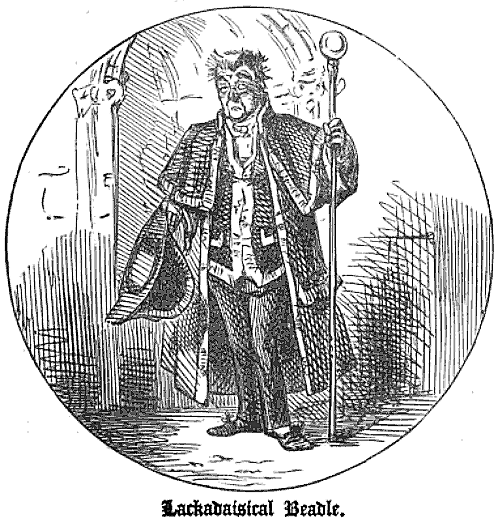
Mr. Bumble, a beadle in Oliver Twist, by 'Kyd' (Joseph Clayton Clarke)

A beadle, sometimes spelled bedel, is an official who may usher, keep order, make reports, and assist in religious functions; or a minor official who carries out various civil, educational or ceremonial duties on the manor.

The term has pre-Conquest origins in Old English, deriving from the Old English bydel ("herald, messenger from an authority, preacher"), itself deriving from beodan ("to proclaim", which has a modern descendant in the English verb bid).[1] In Old English it was a title given to an Anglo-Saxon officer who summoned householders to council. It is also known in Medieval Latin as bedellus.

The Domesday Book refers to Beadles as bedelli or undersheriffs of manors.[2]

In religion

[edit]
The Parish Beadle by David Wilkie, 1823

In England, the word came to refer to a parish constable of the Anglican Church, one often charged with duties of charity. A famous fictional constabulary beadle is Mr. Bumble from Charles Dickens's classic novel Oliver Twist, who oversees the parish workhouse and orphanage of a country town more than 75 miles (120 kilometres) from London.[3] The work of a real constabulary beadle of Whitechapel in that period may be exemplified by Richard Plunkett.

In the Church of Scotland, the title is used for one who attends the minister during divine service as an assistant.

In Judaism, the term beadle or sexton (in Hebrew: שמש, romanizedshammash) is sometimes used for the gabbai, the caretaker or "man of all work", in a synagogue. Moishe the Beadle, the caretaker of a synagogue in Sighet in the 1940s, is an important character in Night by Elie Wiesel.

In education

[edit]

Post-secondary

[edit]

In the medieval universities, beadles were students chosen by instructors to act as assistants: carrying books, taking attendance, and assisting in classroom management.

The Esquire Bedell of the University of Cambridge, carrying one of the university maces

In some universities in England, the post of bedel or esquire bedell still exists as a ceremonial role. At the University of Oxford, there are six bedels whose role is defined as being to "attend upon the Chancellor, Vice-Chancellor, the Proctors and other participating dignitaries on such occasions, and assist them and other University members to carry out ceremonial duties" and to "deputise for the University Verger as necessary".[4] At the University of Cambridge there are two esquire bedells who "have certain important responsibilities at congregations", including carrying the university's ceremonial maces, the senior esquire bedell also having "general responsibility for the correct formulation and wearing of academical dress".[5][6] At Durham University there are two bedels[7] whose roles are to lead the graduand and academic processions carrying the university mace and Durham Cathedral's verge, and to direct students and honorary graduates at graduation and matriculation ceremonies.[8] The University of London has an esquire bedell who carries the mace, as well as additional bedells who carry wands (poles with the university's coat of arms at the top) and have the responsibility for controlling the line of graduates.[9] Bedels are also used at Newcastle University and the University of Bath, where they bear the university mace at graduation ceremonies,[10][11] and at Keele University, where they bear a ceremonial baton and are accompanied by a mace bearer.[12]

The Ceremonial Bedellus of Glasgow Caledonian University carrying the university's ceremonial mace

Some universities in Scotland, including the University of St Andrews, the University of Glasgow and the University of Dundee, have a ceremonial bedellus, who may also be the head janitor and be responsible for the maintenance of the university buildings. The bedellus traditionally carries or leads the mace in procession and may also be responsible for hooding graduates.[13][14][15][16][17][18]

Some Commonwealth and US universities also have beadles in ceremonial roles, under a variety of different spellings. These include the bedel at Emory University, who is traditionally the president of the Student Government Association,[19] the esquire or madam bedel at the University of Canterbury,[20] the bedel at McMaster University, the esquire bedel at the Australian National University,[21] the esquire bedell at the University of New England,[22] and the beadle at the University of Queensland.[23]

At some Dutch universities, including the Vrije Universiteit Amsterdam, University of Amsterdam, and Utrecht University, the Office of the Beadle manages doctoral and other ceremonies.[24][25] They may mark the end the question period by announcing the Latin phrases "Hora Est!" or "Hora Finita!"[26]

Secondary

[edit]

Jesuit secondary schools formerly maintained the post of beadle—some still do. In each classroom, a student designated as beadle reports attendance to the teacher, acts as messenger, assists in distributing materials, and leads the class in activities.[citation needed]

The position of Beadle also exists at the King's School, Canterbury, where the beadle's task is making sure that pupils are dressed correctly and arrive at lessons on time.[citation needed]

Civic and other uses

[edit]

Outside of religious and educational institutions, the designation of "beadle" is most often held by officers of secular bodies of some antiquity.

City of London

[edit]

In the City of London the title is held by two distinct groups; both originated as "executors" or police for more senior persons.

Ward beadles

[edit]
Ward beadles escorting their Aldermen at the Lord Mayor's Show.

The first group are the ward beadles,[27] who hold the oldest elected office in the City (as functionaries, not as representatives) in their wards. Their duties today are largely ceremonial in that they accompany the aldermen in the eight major ceremonies of the civic calendar and open and close the wardmotes (the election meetings for members of the City's courts of Aldermen and Common Council). Previously (as described in the 15th-century Liber Albus) they were also responsible for preparing the register of the Freemen of their Wards, summoning them to the wardmotes and folk-motes [i.e. Common Hall], and administering fines for non-attendance.[28] Elections in the City today are organised by specialist professionals and fines are no longer levied in this way.

Livery companies

[edit]
A Livery Company beadle.

The second group are paid employees of the livery companies of the City. These beadles are usually assistants to the company's clerk, being responsible for attendance on the court and master of the company, originally to enforce its trade policy and uphold discipline (especially among the company's apprentices) but now to act as masters-of-ceremony at formal banquets and to accompany the master on civic occasions.[29] The title "hall beadle" is sometimes used by the hall manager of a livery hall responsible for the company's treasure and the efficient running of the hall, especially if let on a commercial basis.

Elsewhere

[edit]

The Company of Cutlers in Hallamshire employs a Beadle to perform ceremonial duties.[30]

Sometimes the title is used by uniformed security guards. For example, security duties at the Burlington Arcade, an upmarket shopping mall in Piccadilly, London, are carried out by staff called beadles wearing what appear to be nineteenth century uniforms.[31] The beadles enforce the bylaws of the Arcade, which (among other things) forbid singing, running and carrying large parcels or open umbrellas. At one time the beadles were all old soldiers of the 10th Hussars (the regiment of Lord Chesham, the sometime owner of the Arcade).[32]

References

[edit]
[edit]
Revisions and contributorsEdit on WikipediaRead on Wikipedia
from Grokipedia
A beadle (/ˈbiːdəl/), sometimes spelled bedel, is an official who may usher, keep order, make reports, and assist in religious functions; or a minor official who carries out various civil, educational, or ceremonial duties. The term has pre-Conquest origins in Old English, deriving from bydel ("herald, messenger from an authority, preacher"), itself from beodan ("to bid, proclaim"). In Old English, it was a title given to an Anglo-Saxon officer who summoned householders to council. It is also known in Medieval Latin as bedellus. The Domesday Book refers to beadles as bedelli or undersheriffs of manors. Historically, beadles served in religious roles, such as parish officers in the Church of England who acted as ushers and kept order during services, and in Jewish traditions as synagogue officials. In education, they functioned as assistants in universities, particularly in ceremonial capacities at institutions like Oxford and Cambridge. Civic beadles performed duties in the United Kingdom, including in the City of London wards and livery companies, and similar roles exist internationally. In modern times, the position persists in ceremonial and cultural contexts, including depictions in literature such as Charles Dickens' Oliver Twist.

Origins and History

Etymology

The word "beadle" derives from the term bydel, which denoted a herald, messenger, or responsible for proclamations and summonses. This early usage reflects its role in announcing official matters on behalf of authorities, as seen in texts like the West Saxon Gospels. The bydel traces back to Proto-Germanic *budilaz, meaning "messenger" or "proclaimer," and is connected to the *bheudh-, signifying "to be aware" or "make aware." This root also gives rise to related terms like bēodan ("to command" or "bid") and equivalents in other , such as bodo ("messenger"). In , the word appeared as bedel or bidel, reinforced by the bedel introduced through the , which blended with the native Germanic form to standardize its spelling and usage. By the , the term's meaning had evolved from a primarily legal summoner or court crier—tasks involving ushering and enforcing attendance—to a more ceremonial attendant in and academic settings, such as maintaining order during services or processions. This shift is evident in references from the late 1500s, including Shakespeare's works, where beadles appear as officials with duties.

Early Historical Roles

In medieval and early modern Europe, particularly in England from the 12th to 15th centuries, the beadle served as a key local official in manors, courts, and parishes, functioning as an administrative and agent under the oversight of stewards or vestries. Elected or appointed annually at manorial s, the beadle assisted higher officials like the reeve or hayward, carrying out duties that maintained and facilitated legal processes within rural communities. These responsibilities included summoning jurors for inquests and court sessions, executing warrants such as distraints on defaulters' goods, and publicly announcing proclamations like legal notices, estrays, or penalties for offenses such as or violations. In manorial systems, beadles were integral to the operation of local tribunals, where they enforced court orders and reported breaches of custom, as evidenced in court rolls from regions like and during the reigns of Henry IV to . Similarly, in English ecclesiastical courts, beadles operated as apparitors—synonymous roles involving the service of summonses to compel appearances for spiritual or moral offenses, arresting individuals, and delivering citations on behalf of archdeacons or bishops. This function underscored their role as messengers and enforcers bridging secular and quasi-judicial governance. A notable literary depiction of this beadle-like figure appears in Geoffrey Chaucer's (c. 1387–1400), where the Summoner represents a corrupt apparitor extorting bribes while summoning parishioners to ecclesiastical courts, highlighting the office's potential for abuse in late medieval society. By the , the beadle's administrative powers waned amid the professionalization of , as parish-based roles like theirs were supplanted by centralized constables and emerging police structures, reducing them primarily to ceremonial messengers by the Poor Law reforms of 1834.

Religious Roles

In Christian Traditions

In Christian traditions, the beadle served as a lay primarily responsible for facilitating services and maintaining order within church settings. Key duties included greeting congregants upon arrival, assisting with seating to ensure efficient use of space, collecting monetary offerings during services, and enforcing by quieting disruptions such as noisy children or sleeping attendees. Historically, in the from the 16th century onward, beadles acted as appointed assistants to churchwardens in es, supporting administrative tasks and upholding as minor parish officers. In Scottish contexts, beadles enforced moral conduct by serving citations to individuals suspected of offenses like or lying, summoning them to kirk sessions for accountability, particularly prominent in the 17th and 18th centuries. Ceremonially, beadles often carried a staff or mace during processions, symbolizing and leading the minister into services with a measured tread, a practice especially noted in cathedrals and larger churches. In modern Protestant churches, the title "beadle" has become largely archaic, with duties persisting through volunteer ushers who handle greeting, seating, and order maintenance, though the role's formal recognition endures in some parishes.

In Jewish Traditions

In Jewish traditions, the beadle is commonly known as the shammes (or shammas), a term derived from the Hebrew word shammash, meaning "servant" or "attendant," which evolved from earlier Talmudic roles like the ḥazzan by the . This position served as the synagogue sexton in European Jewish communities, particularly among , dating back to when s functioned as central hubs for religious and communal life. The shammes was a salaried responsible for maintaining the sanctity and order of the synagogue space, ensuring rituals proceeded smoothly without the more hierarchical structures seen in some Christian roles. The primary duties of the shammes encompassed practical and ritual tasks essential to operations, including lighting candles for services and holidays like , preparing scrolls by ensuring they were properly rolled and accessible from the ark, calling worshippers to by rapping on doors or shutters as the shulklaper, and cleaning the space by sweeping floors and polishing candlesticks. Additionally, the shammes announced upcoming services and community events, assisted the in administrative matters, and in some traditions, supported the (hazzan) by managing the flow of the . These responsibilities highlighted the shammes's role as a vital intermediary between the spiritual leadership and the congregation, fostering communal participation in worship. In Ashkenazi synagogues, particularly in medieval and early modern European communities such as those in Poland from the onward, the shammes often extended beyond maintenance to act as a enforcer of religious observance, reminding members of rites, restrictions, or communal statutes until the early 20th century when urbanization diminished such authority. For instance, the shammes might execute decisions from the rabbinical court (bet din), including minor enforcements like ensuring attendance at services, underscoring the position's historical significance in preserving Jewish law and cohesion amid challenges. This multifaceted role persisted in Orthodox synagogues into the , though it has largely been streamlined in contexts to focus on custodial functions.

Educational Roles

In Universities

In British universities, the bedel—often spelled "bedel" in academic contexts to distinguish it from other historical uses—has served as a ceremonial and administrative officer since the medieval era. The role traces its origins to the 13th century at institutions like and , where bedels began as assistants to the and proctors, functioning as intermediaries between while handling ceremonial responsibilities. By the , the position had formalized into that of a bedel, with duties expanding to include summoning academics for convocations and maintaining order during university assemblies, reflecting their early role in enforcing . Central to the bedel's function is leadership in university processions, particularly during graduations, where they carry the symbolic university mace—a staff representing institutional —and precede senior officials such as the vice-chancellor or to provide ceremonial protection. At , bedels lead all major ceremonies, including degree conferrals, by guiding the and ensuring orderly conduct. Similarly, at , the Esquire Bedells carry silver maces during graduation ceremonies, announcing the conferral of degrees and upholding traditions dating back centuries. These practices underscore the bedel's role in preserving the solemnity and hierarchy of academic rites. In modern times, appointed bedels continue these traditions at various universities, such as the , where the Esquire Bedell leads academic processions on , carries a gold mace, and manages graduate lines to maintain order. The role has also extended to institutions influenced by British models; for instance, at the Australian National University, the Esquire Bedel wears a distinctive black gown and carries the mace while protecting the vice-chancellor during graduations. In , appoints faculty members as bedels to lead convocations, carrying the mace ahead of the to symbolize and safeguard university authority.

In Other Academic Settings

In non-university educational environments, beadle roles typically involved practical oversight and maintenance of order in schools and colleges, differing from the more ceremonial university traditions that sometimes included mace-bearing. In 19th-century English public schools, beadles supported headmasters by overseeing assemblies, enforcing discipline among students, and performing administrative tasks such as summoning pupils or acting as porters. For instance, at , the beadle participated in ceremonial events like the pancake tossing, where he escorted the cook and contributed to the organized scramble for portions, symbolizing a blend of authority and tradition in school life. Historical examples from grammar schools during the 17th to 19th centuries often saw beadles functioning as porters or monitors, responsible for gatekeeping, reporting , and assisting with minor disciplinary measures to ensure smooth daily operations. In some institutions, including Sunday schools and ragged schools, a designated beadle took on similar duties, such as monitoring behavior, distributing materials, and leading prayers or simple assemblies to foster discipline among poorer or working-class children. These roles emphasized practical enforcement rather than academic ceremony, helping to manage larger classes in resource-limited settings. Regional variations appeared in Scottish academies and burgh schools, where beadles handled attendance tracking and administered minor punishments, such as reporting tardiness or assisting in maintaining order during lessons, until the early . In these settings, the beadle often combined school duties with community roles, reflecting the integrated nature of local . By the post-1900 era, these positions declined as professional staff, including dedicated janitors and administrative aides, replaced them amid broader educational reforms and the rise of state-funded systems that standardized operations.

Civic and Ceremonial Roles

In the

In the , ward beadles represent one of the oldest elected offices, dating back to the 13th century, where they serve as ceremonial and administrative officers assisting the of each of the 25 wards. Elected every four years by the ward's freemen at wardmotes, their traditional duties include leading civic processions while bearing the ward's mace, overseeing market regulations to ensure , and representing the ward in formal ceremonies such as elections and events. The role's formalization occurred in 1274 under King Edward I, when royal established structured ward governance, including beadles as key functionaries for local order and enforcement. Today, while administrative tasks have diminished, ward beadles maintain a prominent ceremonial presence, symbolizing continuity in London's historic governance. Livery company beadles function as dedicated administrative and ceremonial officers within the City's ancient guilds, known as livery companies, which originated in medieval trade associations. For instance, in the Worshipful Company of Mercers—one of the "Great Twelve" companies—the beadle manages event coordination, maintains historical records, and leads processions bearing the company's silver mace or staff. Over 110 livery companies continue to appoint beadles, who enforce protocols during dinners, elections, and charitable functions, preserving guild traditions amid modern operations. Their role evolved from medieval enforcers of guild rules to multifaceted support staff, often including facilities oversight and liaison with the Court of Aldermen. Beyond London, parish beadles in rural and urban England historically served as community criers and enforcers, making public announcements, summoning parishioners to vestry meetings, and assisting in the administration of poor relief under the Old Poor Law from the 16th to early 19th centuries. Appointed by parish vestries, they collected rates for the poor, supervised relief distribution to the indigent, and sometimes acted as minor constables for vagrancy control, a practice that persisted until reforms curtailed such local offices. Ceremonial elements endure in some mayoral processions outside the City, where beadles or equivalents participate in civic parades, though the role largely transitioned to symbolic after the Municipal Corporations Act of 1835 centralized local government and diminished parish autonomy.

International Examples

In the United States, the beadle role emerged historically in colonial during the 17th and 18th centuries, primarily within Puritan church communities, where individuals served as officials responsible for making public announcements, maintaining order during services, and using a long staff to rouse inattentive or sleeping congregants—a practice known as the "tithingman" or colonial equivalent of the English church beadle. This function extended to civic duties akin to town criers, ensuring community notifications in tight-knit settlements. Modern instances are rare, appearing occasionally in ceremonial capacities within historical societies or municipal reenactments in places like colonial-era towns, but without widespread official adoption. In , the Dutch term "bedel" endures in academic institutions, exemplified at , where the bedel acts as a ceremonial usher indispensable for guiding dissertation defenses, orations, and other formal events, while calming participants and directing proceedings to uphold tradition. In , the equivalent "huissier" influences local governance and assemblies, functioning as an official who maintains order in meetings, transmits documents, and assists ministers or parliamentary bodies, echoing the beadle's ushering and regulatory aspects in civic contexts. In and , university bedels—often titled Bedels—closely adapt British models in post-colonial academic environments, bearing the during graduation processions, protecting dignitaries like the vice-chancellor, and facilitating formal ceremonies. At in , for instance, the Bedel has upheld these duties since 1993, contributing to the institution's ritual heritage. Similarly, at the in , the Bedell leads annual graduations and processions, symbolizing continuity from imperial traditions. By the 20th century, beadle equivalents in post-colonial regions like the , , and largely transitioned to honorary ceremonial positions, particularly in universities, emphasizing symbolic ushering over original administrative or enforcement roles, as colonial influences waned and local institutions formalized their own protocols.

Modern and Cultural Uses

Contemporary Functions

In the , the role of the beadle persists primarily in ceremonial capacities within London's livery companies, where individuals serve as event coordinators, making announcements, carrying the company's staff, and managing regalia for formal gatherings such as dinners and installations. These duties emphasize tradition while facilitating smooth proceedings in over 110 such organizations as of 2025. Similarly, in academic settings, bedels— the university variant of beadles— continue to lead processions and assist during ceremonies at numerous institutions, including the University of Keele, where the bedel bears a baton to symbolize and guides graduates; the , where the Esquire Bedell carries the university's mace in academic parades; and the , where bedells organize ceremonial aspects of degree conferments. This practice endures at numerous UK universities, particularly those with strong historical ties, underscoring the beadle's role in preserving academic . Modern equivalents to the beadle have evolved into professional positions such as event ushers and protocol officers, who manage attendee flow, enforce , and oversee formalities at international conferences and large-scale gatherings. In heritage societies, volunteer beadle-like roles focus on public engagement, such as guiding tours or demonstrating historical customs, adapting the traditional function to without the original enforcement powers. These adaptations reflect a shift from authoritative oversight to supportive facilitation in contemporary civic and cultural events. Revivals of beadle traditions appear in ceremonial reenactments at historical festivals, where participants don period attire to portray officials in mock processions, evoking medieval and early modern pageantry. For instance, roles—closely akin to beadles—have seen renewed interest through community events and outreach, blending oral announcements with digital dissemination to reach broader audiences. Such efforts maintain visibility for the amid evolving communication methods. In the UK, beadle roles have largely declined to honorary or purely symbolic status outside of companies and academia, with approximately 43 full-time professional positions active as of recent records, primarily within London's guilds and livery halls. This reduction stems from the obsolescence of their historical duties in and public , supplanted by modern institutions, though ceremonial persistence highlights their cultural value. In literature, the beadle is frequently portrayed as a symbol of institutional cruelty and bureaucratic overreach, most notably through Charles Dickens' character Mr. Bumble in Oliver Twist (1838), a pompous parish beadle who oversees the workhouse with self-important tyranny, embodying the harsh realities of the Poor Law system. Mr. Bumble's officious demeanor and hypocritical authority highlight the beadle's role as an enforcer of social inequities, making him a enduring archetype of meddlesome officialdom in Victorian fiction. In film and television adaptations, the beadle archetype persists as a figure of comedic or villainous authority. The 1948 film adaptation of , directed by , features as a stern overseer, reinforcing his depiction as a callous minor official indifferent to the orphans' suffering. British period dramas have further popularized the beadle in humorous contexts, such as the 1988 special , where the character, played by , appears as an orphan master leading comically oversized urchins, satirizing charitable pretensions and petty power. The beadle occasionally surfaces in other media as a stock authority figure in historical settings, though less prominently than in Dickensian works. In some novels, beadles represent rigid enforcers of tradition, evoking medieval or Victorian-era control without dominating narratives. The term "beadle" also appears as a in cultural references, notably geneticist (1903–1989), who shared the 1958 in Physiology or Medicine for his work on gene function, distinct from the occupational archetype. Culturally, the beadle symbolizes officiousness and low-level tyranny, rooted in 19th-century stereotypes of officers as petty despots abusing minor over the vulnerable, a trope that critiques social hierarchies in and media. This portrayal reflects broader Victorian anxieties about welfare administration, often using exaggeration for satirical effect.

References

Add your contribution
Related Hubs
User Avatar
No comments yet.