
Recent from talks
Degree distribution
Knowledge base stats:
Talk channels stats:
Members stats:
Degree distribution
In the study of graphs and networks, the degree of a node in a network is the number of connections it has to other nodes and the degree distribution is the probability distribution of these degrees over the whole network.
The degree of a node in a network (sometimes referred to incorrectly as the connectivity) is the number of connections or edges the node has to other nodes. If a network is directed, meaning that edges point in one direction from one node to another node, then nodes have two different degrees, the in-degree, which is the number of incoming edges, and the out-degree, which is the number of outgoing edges.
The degree distribution P(k) of a network is then defined to be the fraction of nodes in the network with degree k. Thus if there are n nodes in total in a network and nk of them have degree k, we have
The same information is also sometimes presented in the form of a cumulative degree distribution, the fraction of nodes with degree smaller than k, or even the complementary cumulative degree distribution, the fraction of nodes with degree greater than or equal to k (1 - C) if one considers C as the cumulative degree distribution; i.e. the complement of C.
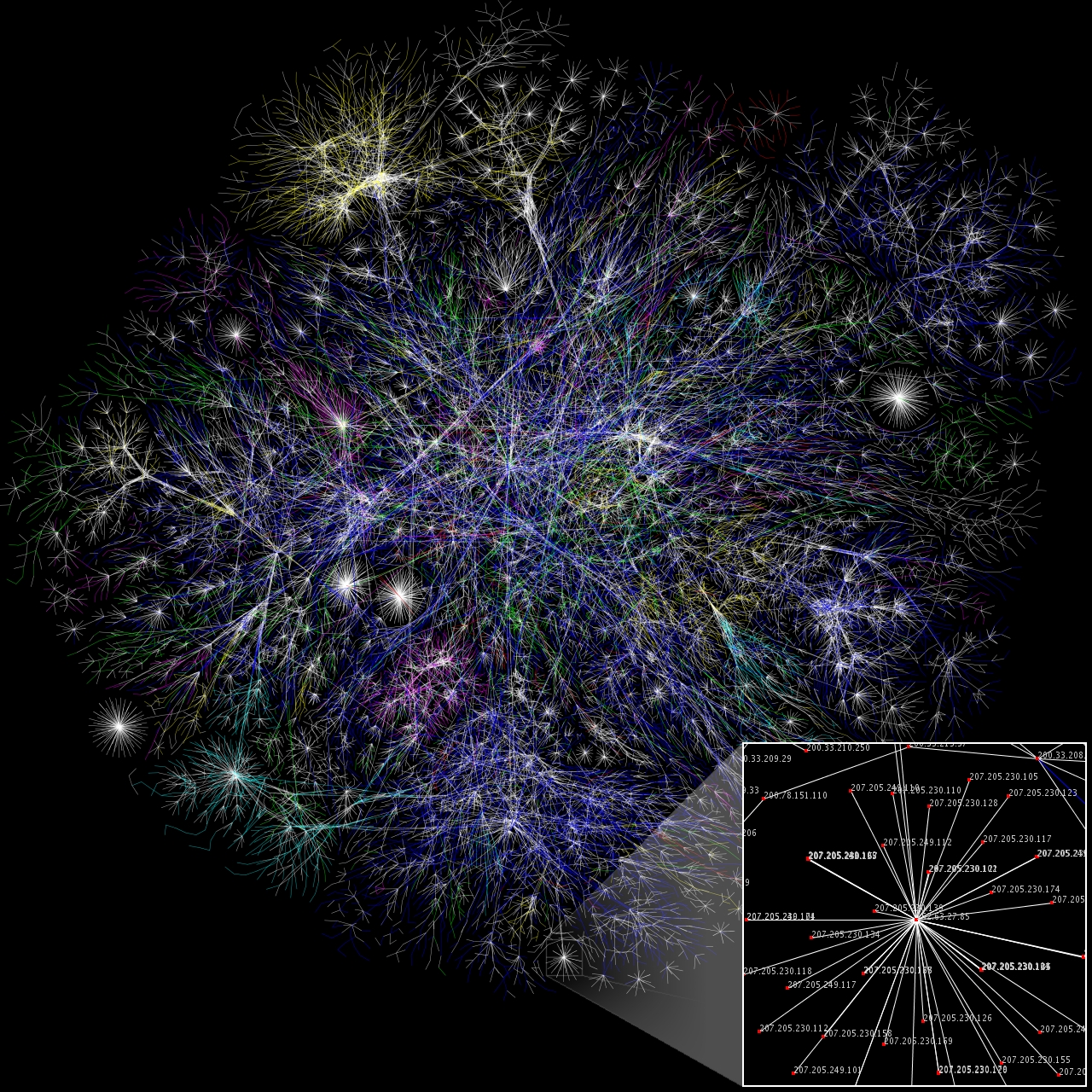
The degree distribution is very important in studying both real networks, such as the Internet and social networks, and theoretical networks. The simplest network model, for example, the (Erdős–Rényi model) random graph, in which each of n nodes is independently connected (or not) with probability p (or 1 − p), has a binomial distribution of degrees k:
(or Poisson in the limit of large n, if the average degree is held fixed). Most networks in the real world, however, have degree distributions very different from this. Most are highly right-skewed, meaning that a large majority of nodes have low degree but a small number, known as "hubs", have high degree. Some networks, notably the Internet, the World Wide Web, and some social networks were argued to have degree distributions that approximately follow a power law: , where γ is a constant. Such networks are called scale-free networks and have attracted particular attention for their structural and dynamical properties.


Excess degree distribution is the probability distribution, for a node reached by following an edge, of the number of other edges attached to that node. In other words, it is the distribution of outgoing links from a node reached by following a link.
Suppose a network has a degree distribution , by selecting one node (randomly or not) and going to one of its neighbors (assuming to have one neighbor at least), then the probability of that node to have neighbors is not given by . The reason is that, whenever some node is selected in a heterogeneous network, it is more probable to reach the hubs by following one of the existing neighbors of that node. The true probability of such nodes to have degree is which is called the excess degree of that node. In the configuration model, which correlations between the nodes have been ignored and every node is assumed to be connected to any other nodes in the network with the same probability, the excess degree distribution can be found as:


Hub AI
Degree distribution AI simulator
(@Degree distribution_simulator)
Degree distribution
In the study of graphs and networks, the degree of a node in a network is the number of connections it has to other nodes and the degree distribution is the probability distribution of these degrees over the whole network.
The degree of a node in a network (sometimes referred to incorrectly as the connectivity) is the number of connections or edges the node has to other nodes. If a network is directed, meaning that edges point in one direction from one node to another node, then nodes have two different degrees, the in-degree, which is the number of incoming edges, and the out-degree, which is the number of outgoing edges.
The degree distribution P(k) of a network is then defined to be the fraction of nodes in the network with degree k. Thus if there are n nodes in total in a network and nk of them have degree k, we have
The same information is also sometimes presented in the form of a cumulative degree distribution, the fraction of nodes with degree smaller than k, or even the complementary cumulative degree distribution, the fraction of nodes with degree greater than or equal to k (1 - C) if one considers C as the cumulative degree distribution; i.e. the complement of C.
The degree distribution is very important in studying both real networks, such as the Internet and social networks, and theoretical networks. The simplest network model, for example, the (Erdős–Rényi model) random graph, in which each of n nodes is independently connected (or not) with probability p (or 1 − p), has a binomial distribution of degrees k:
(or Poisson in the limit of large n, if the average degree is held fixed). Most networks in the real world, however, have degree distributions very different from this. Most are highly right-skewed, meaning that a large majority of nodes have low degree but a small number, known as "hubs", have high degree. Some networks, notably the Internet, the World Wide Web, and some social networks were argued to have degree distributions that approximately follow a power law: , where γ is a constant. Such networks are called scale-free networks and have attracted particular attention for their structural and dynamical properties.
Excess degree distribution is the probability distribution, for a node reached by following an edge, of the number of other edges attached to that node. In other words, it is the distribution of outgoing links from a node reached by following a link.
Suppose a network has a degree distribution , by selecting one node (randomly or not) and going to one of its neighbors (assuming to have one neighbor at least), then the probability of that node to have neighbors is not given by . The reason is that, whenever some node is selected in a heterogeneous network, it is more probable to reach the hubs by following one of the existing neighbors of that node. The true probability of such nodes to have degree is which is called the excess degree of that node. In the configuration model, which correlations between the nodes have been ignored and every node is assumed to be connected to any other nodes in the network with the same probability, the excess degree distribution can be found as:
Recent media