Hubbry Logo
Asianopis subrufaAsianopis subrufaMain
Open search
Asianopis subrufa
Community hub
Asianopis subrufa
logo
8 pages, 0 posts
0 subscribers
Be the first to start a discussion here.
Asianopis subrufa
Asianopis subrufa
from Wikipedia

Asianopis subrufa
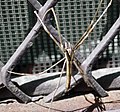
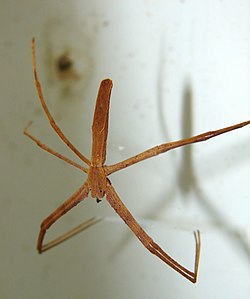
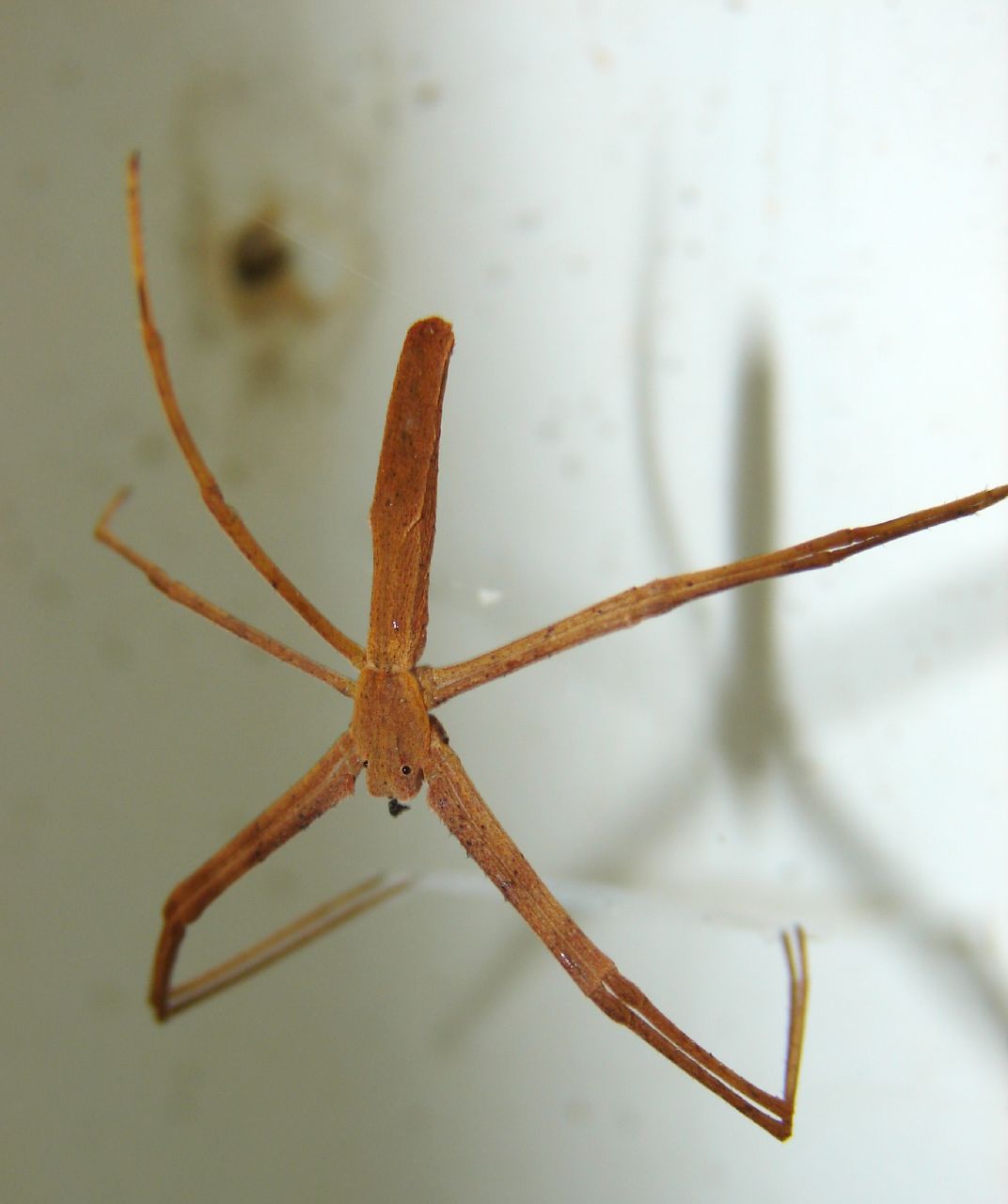
Females are light reddish brown
Scientific classification Edit this classification
Kingdom: Animalia
Phylum: Arthropoda
Subphylum: Chelicerata
Class: Arachnida
Order: Araneae
Infraorder: Araneomorphae
Family: Deinopidae
Genus: Asianopis
Species:
A. subrufa
Binomial name
Asianopis subrufa
(L. Koch, 1878)[1]
Excludes New Zealand
Synonyms[1]
  • Deinopis subrufa L. Koch, 1878
  • Deinopis bicornis L. Koch, 1879

Asianopis subrufa (also called the rufous net-casting spider) is a species of net-casting spiders. It occurs in Australia (Queensland, New South Wales, Victoria and Tasmania) and in New Zealand.[1] It is a nocturnal hunter, having excellent eyesight, and hunts using a silken net to capture its prey. They feed on a variety of insects – ants, beetles, crickets and other spiders. They can vary in colour from fawn to pinkish brown or chocolate brown. Females are about 25 mm in body length, males about 22 mm. They are not dangerous to humans.

This species is often found on a few strands of web in forest, woodland and heathland, or on flat surfaces, for example on the outside of houses.

Taxonomy

[edit]

Asianopis subrufa was first described by Ludwig Koch in 1878, in the genus Deinopis.[1] In 2020, the species was transferred to the newly erected genus Asianopis which contains the Asian and West Pacific species formerly included in the genus Deinopis.[2] The specific epithet subrufa is Latin for "reddish".[3]

Mating

[edit]

Males will usually shed their last skin and then seek a suitable female to mate with. They will rest on the outer skirts of the female's web, and will gently pluck the web to show her that they are interested. Days after mating, the female then constructs a globular egg sac, approximately 10–12 mm in diameter. It is generally a light brown or fawn colour with black specks on it and contains anywhere from 100 to 200 eggs. It is usually disguised and protected by a leaf. Once the female has constructed the egg sac and laid the eggs, she will usually leave it to its own fate. After around 3 weeks, the young hatch.

[edit]

References

[edit]
[edit]
Revisions and contributorsEdit on WikipediaRead on Wikipedia
from Grokipedia
Asianopis subrufa, commonly known as the rufous net-casting , is a of in the family , characterized by its slender build, long legs, and distinctive eye arrangement featuring two enormously enlarged forward-facing eyes among its eight total eyes. Females typically measure up to 25 in body length and exhibit a light salmon-brown coloration with an abdomen bearing two humps and orange patches, while males are smaller at 15-20 , often grey-brown with white horns on the head and darker stripes. This nocturnal is renowned for its unique hunting technique, in which it constructs a small, rectangular net of cribellate —measuring up to 20 wide when unexpanded—and hurls it over unsuspecting prey such as or other from a low perch in . Native to eastern and , A. subrufa inhabits open woodlands, bushlands, gardens, and low undergrowth from in the south to southern in the north, including widespread occurrence in eastern up to the Wet Tropics. During the day, it remains motionless in an 'X'-shaped posture among foliage for , emerging at night to hunt with exceptional enabled by its large eyes, which have an of 0.58—superior to that of cats or owls. The reuses its silk net across multiple hunts, demonstrating efficient resource use in its arboreal lifestyle. Reproduction occurs seasonally, with individuals maturing in summer and in autumn; females produce spherical, parchment-like sacs about 9-10 mm in diameter, containing spiderlings that hatch in spring and are suspended in low vegetation. Despite its formidable appearance and hunting prowess, A. subrufa poses no known danger to humans and plays a beneficial role in controlling populations in its habitats.

Taxonomy

Taxonomic history

Asianopis subrufa was originally described by Ludwig Koch in 1878 as Deinopis subrufus in the publication Die Arachniden Australiens, volume 2, based on female specimens from eastern Australia. In 2022, the species was reclassified into the newly established genus Asianopis following a comprehensive phylogenetic analysis of the Deinopidae family, which separated Old World species (including Australian ones) from the New World Deinopis based on molecular and morphological evidence. The full taxonomic hierarchy of Asianopis subrufa is as follows: Kingdom: Animalia; Phylum: Arthropoda; Class: Arachnida; Order: Araneae; Family: ; Genus: Asianopis; Species: subrufa. Asianopis subrufa belongs to the family , a group of approximately 73 described species of net-casting spiders characterized by their unique hunting behavior and distinctive eye arrangements, with 6 species in the genus Asianopis occurring in .

Etymology and synonyms

The specific epithet subrufa derives from the Latin words sub- (slightly) and rufus (red), alluding to the species' subtly reddish hue. The genus name Asianopis was coined in 2020 as a combination of "Asia," denoting the initial distributional focus on Asian species, and elements of the prior genus Deinopis. In 2022, phylogenetic analyses prompted the transfer of several Eastern Hemisphere Deinopis species, including D. subrufa, to Asianopis to better reflect monophyly. Originally described as Deinopis subrufus by Ludwig Koch in 1878, the species has the junior synonym Deinopis bicornis (also by Koch, 1879), which was recognized as synonymous based on morphological examination in 1985.

Description

Physical characteristics

Asianopis subrufa, a member of the family , exhibits a distinctive morphology adapted to its net-casting lifestyle. The possesses eight eyes arranged in a characteristic pattern typical of deinopids, featuring two enormously enlarged posterior median eyes (PME) that face forward to provide exceptional low-light vision. These principal eyes are tubular and highly sensitive, far surpassing the light-capturing ability of other eyes, while the remaining six eyes—comprising anterior median (AME), anterior lateral (ALE), and posterior lateral (PLE)—are considerably smaller and serve supplementary roles in visual processing. The body of A. subrufa is slender and elongated, with a flat and a abdomen that is roughly twice the length of the cephalothorax, contributing to its stick-like appearance; in females, the abdomen bears two low humps. Its legs are unusually long and thin, with tarsi bearing three claws, enabling the spider to grip and manipulate its silken net during prey capture. The are small, equipped with multiple pro- and retrolateral teeth for piercing captured prey, reflecting an adaptation prioritizing net deployment over aggressive direct . Prominent spinnerets, numbering six and including a broad cribellum anterior to the anterior pair, allow A. subrufa to produce cribellate that is elastic and sticky, essential for constructing the rectangular net used in . This differs from typical viscid orb-weaver threads, offering stretchability that enhances the net's effectiveness when cast over prey. The enlarged PME play a critical role in this strategy by detecting motion in near-darkness, as explored further in sensory adaptations.

Size and sexual dimorphism

Adult females of Asianopis subrufa measure approximately 25 mm in body length, while adult males range from 15 to 20 mm, exhibiting clear sexual size dimorphism with females being larger and more robust overall. Males are notably thinner and more slender, with spindly legs that appear relatively elongated compared to their body size, potentially aiding mobility. In terms of coloration, females typically display a light salmon-brown or reddish-brown hue, though some individuals appear darker grey-brown, with lighter banding on the legs and small orange patches on the underside. Males show distinct patterning with alternating dark and light grey longitudinal stripes along the body and small white horns on the head over the eyes, differing from the more uniform tones in females, though no extreme sexual color dimorphism is present.

Distribution and habitat

Geographic range

Asianopis subrufa is native to eastern , with its range extending from the Wet Tropics in northern through , Victoria, and . The species is primarily distributed along the coastal and eastern seaboard regions, and it is absent from as well as the arid interior of the continent. The species has also been recorded in based on specimens from the late , likely introduced via human-mediated transport, but no established populations or recent sightings are confirmed. Recent observations from platforms, such as , confirm the ongoing presence of A. subrufa in its native Australian range, with sightings recorded as late as 2024.

Habitat preferences

Asianopis subrufa prefers moist, forested environments along the east coast of , including rainforests, woodlands, and heathlands. These habitats provide the necessary and structural complexity for the spider's survival. The species is commonly associated with the Wet Tropics region in , extending through various forest types to southern regions. This spider is frequently observed in microhabitats at ground level or low vegetation, such as undergrowth, tree trunks, and logs. It also utilizes flat surfaces like house walls in suburban and garden settings near natural . These locations allow for web construction among foliage or against substrates where the spider can position itself effectively. As a nocturnal species, A. subrufa thrives in understory layers and leaf litter-rich areas that support its activity patterns. Its distribution spans from tropical and subtropical zones in to temperate areas in , indicating tolerance for mild climates but limitation by extreme aridity or severe cold outside this range.

Behavior and ecology

Hunting strategy

Asianopis subrufa employs a distinctive net-casting that sets it apart from most web-building s, enabling active prey capture during nocturnal hours. Each night, the meticulously constructs a small, rectangular net, up to 20 mm wide when unexpanded, composed of highly elastic cribellate that allows for stretching and entanglement. This net is held taut between the 's front legs while it perches on the ground or low , suspending itself upside down from a anchor line to position above potential prey pathways, often marked by its own fecal droppings for targeting. Prey detection relies on sensitivity to movement via enlarged eyes for low-light vision and airborne sounds up to 2 m away. Upon identifying an , such as a or , the rapidly expands the net and executes a whipping motion overhead or downward, enveloping the target in a fraction of a second to entangle it effectively. The motion is powered by the 's strong front legs, allowing it to cover the prey's escape path precisely. Following an attempt, the net is typically discarded if unsuccessful or after capturing prey, with the spider repeating the process multiple times throughout the night to secure multiple meals; nets may occasionally be left ready for reuse after unsuccessful hunts. Field observations indicate a relatively high success rate for net casts compared to many passive orb-weaving spiders that rely on stationary webs. This active , combined with brief references to eye adaptations for prey localization, underscores the species' evolutionary specialization for nocturnal foraging in forested habitats.

Sensory adaptations and activity patterns

Asianopis subrufa, a member of the family, exhibits specialized sensory adaptations that support its nocturnal hunting strategy. The possesses eight eyes, with the posterior median eyes (PMEs) being enormously enlarged and forward-facing, serving as secondary eyes for wide-angle motion detection in low light. These PMEs feature a mirror-like tapetum that reflects light, producing eyeshine which aids in prey localization up to approximately 1 meter in near-darkness. The photoreceptors in these eyes are exceptionally large, measuring 20 μm in width and 110 μm in length, with a sensitivity 2000 times greater than that of eyes, facilitating cat-like through high light capture and motion detection. Complementing its visual system, A. subrufa employs mechanosensory structures on its legs for detecting prey. Sensitive hairs and slit sensilla on the metatarsi and other leg segments sense substrate-borne and airborne acoustic cues from flying , allowing detection of prey sounds from up to 2 meters away. This multimodal sensory integration—combining visual motion cues from the PMEs with vibroacoustic signals—enables precise targeting during net-casting hunts in dim conditions. As a strictly nocturnal species, A. subrufa is active from to dawn, foraging primarily after sunset when light levels are low. During the day, it retreats into silk-lined shelters or among foliage, adopting a twig-like posture to avoid detection by predators; this diurnal inactivity protects its highly sensitive membranes, which are renewed nightly to prevent damage from brighter light.

Reproduction

Mating rituals

Males of Asianopis subrufa typically mature in summer and actively search for receptive females during late summer to autumn, coinciding with female maturity. Smaller and more slender than females, males approach cautiously to avoid being mistaken for prey, resting initially on the outer edges of the female's retreat structure. To signal their presence without a direct approach, males attach a thread to the female's support lines and pluck or jerk the , producing signals that entice the female to emerge. This indirect communication minimizes immediate risk, allowing the female to investigate the before responding. Once the female moves toward the thread, the male continues to indicate his intentions. Copulation follows successful , during which the male transfers via his pedipalps. Males typically retreat after to avoid aggression from the female.

Egg production and early development

Following in summer, female Asianopis subrufa produce one or more globular egg sacs, each measuring 9-10 mm in diameter and consisting of a tough, closely woven layer of salmon-brown flecked with black. These sacs typically contain 50-100 and may number up to four per female during the egg-laying period extending into autumn. The egg sacs are suspended by a stalk within the female's web on low vegetation and camouflaged by attaching twigs, leaves, or other debris to blend with the surroundings. The female guards the sacs attentively until hatching, at which point she opens the exterior to release the contents. Spiderlings hatch in spring, emerging as brown individuals that initially cluster around the opened sac for several days. These spiderlings, resembling small anchors with elongated front legs, undergo multiple molts through to grow, requiring stable suspension during each shed, which lasts about 10 minutes and is followed by a 24-hour fasting period. Within a few weeks, they begin constructing miniature nets and disperse from the natal site. The full lifespan from egg to adult is around one year, with multiple broods possible in warmer seasons to maximize reproductive output.

References

Add your contribution
Related Hubs
User Avatar
No comments yet.