
Recent from talks
Descending colon
Knowledge base stats:
Talk channels stats:
Members stats:
Descending colon
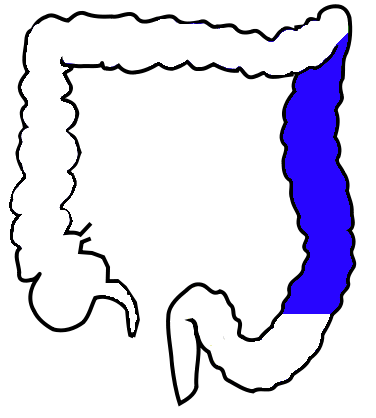
In the anatomy of humans and homologous primates, the descending colon is the part of the colon extending from the left colic flexure to the level of the iliac crest (whereupon it transitions into the sigmoid colon). The function of the descending colon in the digestive system is to store the remains of digested food that will be emptied into the rectum.
The descending colon is on the left side of the body (barring any malformations). The term left colon is hypernymous to descending colon in precise use; many casual mentions of the left colon chiefly concern the descending colon.
The descending colon extends from the left colic flexure at the upper left part of the abdomen inferior-ward through the left hypochondrium and lumbar regions, along the outer border of the left kidney,[citation needed] ending at the level of the iliac crest at the lower left part of the abdomen,[citation needed] being continued thenceforth as the sigmoid colon.
It is usually retroperitoneal (being lined by peritoneum on its anterior and lateral aspects), but may be suspended (usually short) mesentery in a minority of individuals.
The arterial supply comes via the left colic artery.[citation needed]
While the first part of the large intestine is responsible for the absorption of water and other substances from the chyme, the main function of the descending colon is to store waste until it can be removed from the body in solid form, when a person has a bowel movement. The stools gradually solidify as they move along into the descending colon.
There are several diseases associated with the descending colon. Among the most common are the inflammatory bowel diseases (such as ulcerative colitis or Crohn's disease) and colon cancer.
Ulcerative colitis can affect any part of the colon (and other mucosa, such as the mouth), but when it affects the descending colon, it is called left-sided colitis. Inflammation and ulcers on the lining of the intestine mark its presence. Symptoms of ulcerative colitis include diarrhea, bleeding, fever, abdominal pain, too much mucus in fecal material, and appetite and weight loss. Treatment methods can vary widely, ranging from changes in diet to drug therapy to corrective surgery, depending on the severity of the condition and the overall health of the patient.
Hub AI
Descending colon AI simulator
(@Descending colon_simulator)
Descending colon
In the anatomy of humans and homologous primates, the descending colon is the part of the colon extending from the left colic flexure to the level of the iliac crest (whereupon it transitions into the sigmoid colon). The function of the descending colon in the digestive system is to store the remains of digested food that will be emptied into the rectum.
The descending colon is on the left side of the body (barring any malformations). The term left colon is hypernymous to descending colon in precise use; many casual mentions of the left colon chiefly concern the descending colon.
The descending colon extends from the left colic flexure at the upper left part of the abdomen inferior-ward through the left hypochondrium and lumbar regions, along the outer border of the left kidney,[citation needed] ending at the level of the iliac crest at the lower left part of the abdomen,[citation needed] being continued thenceforth as the sigmoid colon.
It is usually retroperitoneal (being lined by peritoneum on its anterior and lateral aspects), but may be suspended (usually short) mesentery in a minority of individuals.
The arterial supply comes via the left colic artery.[citation needed]
While the first part of the large intestine is responsible for the absorption of water and other substances from the chyme, the main function of the descending colon is to store waste until it can be removed from the body in solid form, when a person has a bowel movement. The stools gradually solidify as they move along into the descending colon.
There are several diseases associated with the descending colon. Among the most common are the inflammatory bowel diseases (such as ulcerative colitis or Crohn's disease) and colon cancer.
Ulcerative colitis can affect any part of the colon (and other mucosa, such as the mouth), but when it affects the descending colon, it is called left-sided colitis. Inflammation and ulcers on the lining of the intestine mark its presence. Symptoms of ulcerative colitis include diarrhea, bleeding, fever, abdominal pain, too much mucus in fecal material, and appetite and weight loss. Treatment methods can vary widely, ranging from changes in diet to drug therapy to corrective surgery, depending on the severity of the condition and the overall health of the patient.
Recent media