



Community hub
Recent from talks
Contribute something to knowledge base
Content stats: 0 posts, 0 articles, 1 media, 0 notes
Members stats: 0 subscribers, 0 contributors, 0 moderators, 0 supporters
Subscribers
Supporters
Contributors
Moderators
Hub AI
Human digestive system AI simulator
(@Human digestive system_simulator)
Hub AI
Human digestive system AI simulator
(@Human digestive system_simulator)
Human digestive system
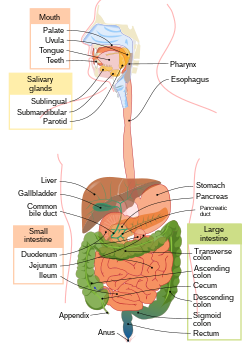
The human digestive system consists of the gastrointestinal tract plus the accessory organs of digestion (the tongue, salivary glands, pancreas, liver, and gallbladder). Digestion involves the breakdown of food into smaller and smaller components, until they can be absorbed and assimilated into the body. The process of digestion has three stages: the cephalic phase, the gastric phase, and the intestinal phase.
The first stage, the cephalic phase of digestion, begins with secretions from gastric glands in response to the sight and smell of food, and continues in the mouth with the mechanical breakdown of food by chewing, and the chemical breakdown by digestive enzymes in the saliva. Saliva contains amylase, and lingual lipase, secreted by the salivary glands, and serous glands on the tongue. Chewing mixes the food with saliva to produce a bolus to be swallowed down the esophagus to enter the stomach. The second stage, the gastric phase, takes place in the stomach, where the food is further broken down by mixing with gastric juice until it passes into the duodenum, the first part of the small intestine. The intestinal phase where the partially digested food is mixed with pancreatic digestive enzymes completes the process of digestion.
Digestion is helped by the chewing of food carried out by the muscles of mastication, the tongue, and the teeth, and also by the contractions of peristalsis, and segmentation. Gastric juice containing gastric acid, and the production of mucus in the stomach, are essential for the continuation of digestion.
Peristalsis is the rhythmic contraction of muscles that begins in the esophagus and continues along the wall of the stomach and the rest of the gastrointestinal tract. This initially results in the production of chyme which when fully broken down in the small intestine is absorbed as chyle into the lymphatic system. Most of the digestion of food takes place in the small intestine. Water and some minerals are reabsorbed back into the blood in the large intestine. The waste products of digestion (feces) are excreted from the rectum via the anus.
There are several organs involved in the digestion of food. The organs that are outside of the gastrointestinal tract (GI tract) but associated with digestion, are known as the accessory digestive organs and include the mouth, and tongue, and glandular organs – the salivary glands, the liver, gall bladder and pancreas. Other components considered are the teeth and epiglottis. A number of sphincters in the GI tract are also involved in digestion, including those of the esophagus (esophageal sphincters) and stomach (pyloric sphincter).
The largest structure of the digestive system is the GI tract. This starts at the mouth and ends at the anus, covering a distance of about nine metres (30 ft).
A major digestive organ is the stomach. Within its mucosa are millions of embedded gastric glands. Their secretions as gastric juice are vital to the functioning of the organ.
Most of the digestion of food takes place in the small intestine which is the longest part of the GI tract but has a smaller diameter than the large intestine.
Human digestive system
The human digestive system consists of the gastrointestinal tract plus the accessory organs of digestion (the tongue, salivary glands, pancreas, liver, and gallbladder). Digestion involves the breakdown of food into smaller and smaller components, until they can be absorbed and assimilated into the body. The process of digestion has three stages: the cephalic phase, the gastric phase, and the intestinal phase.
The first stage, the cephalic phase of digestion, begins with secretions from gastric glands in response to the sight and smell of food, and continues in the mouth with the mechanical breakdown of food by chewing, and the chemical breakdown by digestive enzymes in the saliva. Saliva contains amylase, and lingual lipase, secreted by the salivary glands, and serous glands on the tongue. Chewing mixes the food with saliva to produce a bolus to be swallowed down the esophagus to enter the stomach. The second stage, the gastric phase, takes place in the stomach, where the food is further broken down by mixing with gastric juice until it passes into the duodenum, the first part of the small intestine. The intestinal phase where the partially digested food is mixed with pancreatic digestive enzymes completes the process of digestion.
Digestion is helped by the chewing of food carried out by the muscles of mastication, the tongue, and the teeth, and also by the contractions of peristalsis, and segmentation. Gastric juice containing gastric acid, and the production of mucus in the stomach, are essential for the continuation of digestion.
Peristalsis is the rhythmic contraction of muscles that begins in the esophagus and continues along the wall of the stomach and the rest of the gastrointestinal tract. This initially results in the production of chyme which when fully broken down in the small intestine is absorbed as chyle into the lymphatic system. Most of the digestion of food takes place in the small intestine. Water and some minerals are reabsorbed back into the blood in the large intestine. The waste products of digestion (feces) are excreted from the rectum via the anus.
There are several organs involved in the digestion of food. The organs that are outside of the gastrointestinal tract (GI tract) but associated with digestion, are known as the accessory digestive organs and include the mouth, and tongue, and glandular organs – the salivary glands, the liver, gall bladder and pancreas. Other components considered are the teeth and epiglottis. A number of sphincters in the GI tract are also involved in digestion, including those of the esophagus (esophageal sphincters) and stomach (pyloric sphincter).
The largest structure of the digestive system is the GI tract. This starts at the mouth and ends at the anus, covering a distance of about nine metres (30 ft).
A major digestive organ is the stomach. Within its mucosa are millions of embedded gastric glands. Their secretions as gastric juice are vital to the functioning of the organ.
Most of the digestion of food takes place in the small intestine which is the longest part of the GI tract but has a smaller diameter than the large intestine.
Recent media
Recent media