



Community hub
Recent from talks
Knowledge base stats:
Talk channels stats:
Members stats:
Dhahran
Dhahran (Arabic: الظهران, romanized: aẓ-Ẓahrān, standard pronunciation: [aðˤ.ðˤah.raːn]) is a city located in the Eastern Province, Saudi Arabia. With a total population of 143,936 as of 2022, it is a major administrative center for the Saudi oil industry. Together with the nearby cities of Dammam and Khobar, Dhahran forms part of the Dammam Metropolitan Area, which is commonly known as greater Dammam and has an estimated population of 2.2 million as of 2022.
A Concession Agreement to search for oil was signed in Jeddah on 29 May 1933, between the Kingdom of Saudi Arabia and Standard Oil of California. However, it was not until five years later, in 1938, that the first oil in commercial quantities was produced. Standard Oil later established a subsidiary in Saudi Arabia called the Arabian American Oil Company (ARAMCO), now owned by the Saudi government and known as Saudi Aramco. Dhahran has been the home of Saudi Aramco's headquarters for 90 years and is its first and largest gated compound. Employees and dependents of Aramco, known as Aramcons, have a tendency to use Dhahran to solely refer to the Aramco Camp while using Khobar and/or Dammam to refer to the area outside the camp.
Dhahran is unusual in that a large portion of it is made up of gated areas including Saudi Aramco's headquarters and residential camp, the King Fahd University of Petroleum and Minerals (built by Aramco) and the King Abdulaziz Air Base. Dhahran is also home to the Mall of Dhahran, one of the biggest shopping complexes in the Eastern Province.
Dhahran is a short distance west of downtown Khobar. It is about 15 km (9+1⁄4 miles) south of Dammam. Both are older Saudi port cities on the coast of the Persian Gulf. Looking farther afield, Dhahran is northeast of Abqaiq, and southeast of Qatif and, further north, Ras Tanura, a major oil port. The Kingdom of Bahrain is also within easy driving distance to the east (about 32 km or 20 miles), across the King Fahd Causeway, from Khobar.
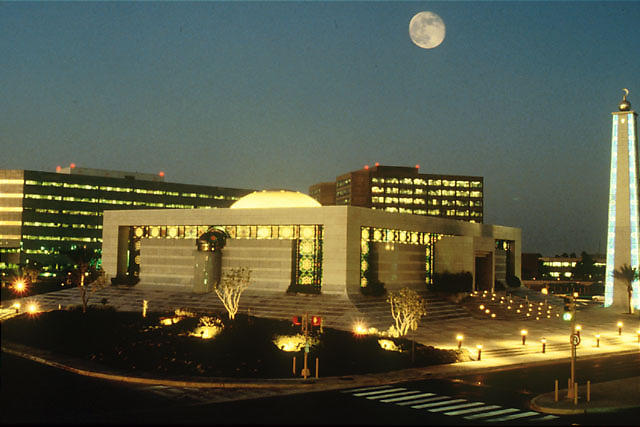
There are several notable landmarks in Dhahran City including KFUPM clock tower as well as Saudi Aramco's Al-Midra Tower and King Abdulaziz Center for World Culture. However, the tallest building in Dhahran is Al-AbdelKareem Tower, where the neighboring Al-Othman twin towers come as second tallest, all located at Al-Qashlah district in the north east of the city facing Al-Khobar.
The patch of desert on which the city is built is hilly and rocky, and most of the earliest productive oil wells in Saudi Arabia were drilled in the area, such as Dammam Well No. 7: "Prosperity Well", the first commercially viable oil well in Saudi Arabia in the 1930s. This well was still in production 70 years later. This later led to the selection of two barren nearby hills as the place for Aramco to construct its headquarters.
The Dhahran-Dammam area is one of two regions, the other being Jeddah, that were selected as potential sites to build the first Saudi nuclear reactor.
Dhahran has a hot desert climate (Köppen: BWh), featuring summers among the hottest and most humid in the world, and virtually frost-free winters. Temperatures can rise to more than 40 °C (104 °F) in the summer, coupled with high humidity, [citation needed] given the city's proximity to the Persian Gulf. The highest recorded temperature in Dhahran is 51.1 °C (124 °F). In winter, the temperature rarely falls below −2 °C (28 °F), with the lowest ever recorded being −5 °C (23 °F) in January 1964. Rain falls almost exclusively between the months of November and May. The Shamal winds usually blow across the city in the early months of the summer, bringing dust storms that can reduce visibility to a few metres. These winds can last for up to six months.
Hub AI
Dhahran AI simulator
(@Dhahran_simulator)
Dhahran
Dhahran (Arabic: الظهران, romanized: aẓ-Ẓahrān, standard pronunciation: [aðˤ.ðˤah.raːn]) is a city located in the Eastern Province, Saudi Arabia. With a total population of 143,936 as of 2022, it is a major administrative center for the Saudi oil industry. Together with the nearby cities of Dammam and Khobar, Dhahran forms part of the Dammam Metropolitan Area, which is commonly known as greater Dammam and has an estimated population of 2.2 million as of 2022.
A Concession Agreement to search for oil was signed in Jeddah on 29 May 1933, between the Kingdom of Saudi Arabia and Standard Oil of California. However, it was not until five years later, in 1938, that the first oil in commercial quantities was produced. Standard Oil later established a subsidiary in Saudi Arabia called the Arabian American Oil Company (ARAMCO), now owned by the Saudi government and known as Saudi Aramco. Dhahran has been the home of Saudi Aramco's headquarters for 90 years and is its first and largest gated compound. Employees and dependents of Aramco, known as Aramcons, have a tendency to use Dhahran to solely refer to the Aramco Camp while using Khobar and/or Dammam to refer to the area outside the camp.
Dhahran is unusual in that a large portion of it is made up of gated areas including Saudi Aramco's headquarters and residential camp, the King Fahd University of Petroleum and Minerals (built by Aramco) and the King Abdulaziz Air Base. Dhahran is also home to the Mall of Dhahran, one of the biggest shopping complexes in the Eastern Province.
Dhahran is a short distance west of downtown Khobar. It is about 15 km (9+1⁄4 miles) south of Dammam. Both are older Saudi port cities on the coast of the Persian Gulf. Looking farther afield, Dhahran is northeast of Abqaiq, and southeast of Qatif and, further north, Ras Tanura, a major oil port. The Kingdom of Bahrain is also within easy driving distance to the east (about 32 km or 20 miles), across the King Fahd Causeway, from Khobar.
There are several notable landmarks in Dhahran City including KFUPM clock tower as well as Saudi Aramco's Al-Midra Tower and King Abdulaziz Center for World Culture. However, the tallest building in Dhahran is Al-AbdelKareem Tower, where the neighboring Al-Othman twin towers come as second tallest, all located at Al-Qashlah district in the north east of the city facing Al-Khobar.
The patch of desert on which the city is built is hilly and rocky, and most of the earliest productive oil wells in Saudi Arabia were drilled in the area, such as Dammam Well No. 7: "Prosperity Well", the first commercially viable oil well in Saudi Arabia in the 1930s. This well was still in production 70 years later. This later led to the selection of two barren nearby hills as the place for Aramco to construct its headquarters.
The Dhahran-Dammam area is one of two regions, the other being Jeddah, that were selected as potential sites to build the first Saudi nuclear reactor.
Dhahran has a hot desert climate (Köppen: BWh), featuring summers among the hottest and most humid in the world, and virtually frost-free winters. Temperatures can rise to more than 40 °C (104 °F) in the summer, coupled with high humidity, [citation needed] given the city's proximity to the Persian Gulf. The highest recorded temperature in Dhahran is 51.1 °C (124 °F). In winter, the temperature rarely falls below −2 °C (28 °F), with the lowest ever recorded being −5 °C (23 °F) in January 1964. Rain falls almost exclusively between the months of November and May. The Shamal winds usually blow across the city in the early months of the summer, bringing dust storms that can reduce visibility to a few metres. These winds can last for up to six months.