
Recent from talks
Czech–Slovak languages
Knowledge base stats:
Talk channels stats:
Members stats:
Czech–Slovak languages
The Czech–Slovak languages (or Czecho-Slovak languages) are a subgroup branched from the West Slavic languages comprising the Czech and Slovak languages.
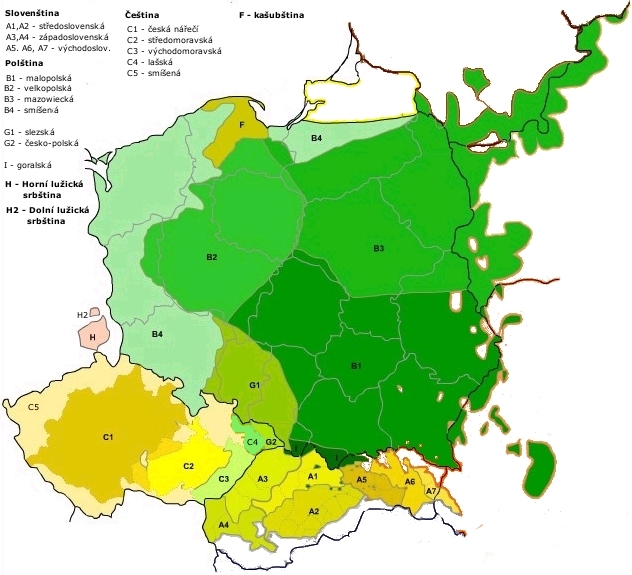
Most varieties of Czech and Slovak are mutually intelligible, forming a dialect continuum (spanning the intermediate Moravian dialects) rather than being two clearly distinct languages; standardised forms of these two languages are, however, easily distinguishable and recognizable because of disparate vocabulary, orthography, pronunciation, phonology, suffixes and prefixes. The eastern Slovak dialects are more divergent and form a broader dialect continuum with the Lechitic subgroup of West Slavic, most notably Polish.
The name "Czechoslovak language" is mostly reserved for an official written standard devised in the 19th century that was intended to unify Czech and Slovak. It was proclaimed an official language of Czechoslovakia and functioned de facto as Czech with slight Slovak input.
The early Slavic expansion reached Central Europe in the 7th century, and the West Slavic dialects diverged from common Slavic over the following centuries. The West Slavic tribes settled on the eastern fringes of the Carolingian Empire, along the Limes Saxoniae. Prior to the Magyar invasion of Pannonia in the 890s, the West Slavic polity of Great Moravia spanned much of Central Europe between what is now Eastern Germany and Western Romania. In the high medieval period, the West Slavic tribes were again pushed to the east by the incipient German Ostsiedlung, decisively so following the Wendish Crusade in the 11th century.
West Slavic as a group distinct from common Slavic thus emerges during the 7th to 9th centuries. The Czech-Slovak in turn develops as a separate dialect continuum within West Slavic during roughly the 10th to 12th centuries, just predating the first written attestation of the language in the 13th to 14th centuries. The diversification of West Slavic had the characteristic of a dialect continuum. For example, the spirantisation of Slavic /g/ to /h/ is an areal feature shared by the Czech-Slovak group with both Ukrainian and Sorbian (but not with Polish). This innovation appears to have traveled from east to west, and is sometimes attributed to contact with Scytho-Sarmatian. It is approximately dated to the 12th century in Slovak, the 12th to 13th century in Czech and the 14th century in Upper Sorbian.
The Bohemian state was incorporated as the Kingdom of Bohemia in the 13th century. The Slovaks, on the other hand, never became part of the Holy Roman Empire in the medieval period, being incorporated into the Kingdom of Hungary. For this reason, the history of the closely related Czech and Slovak peoples took a significantly different course during the later medieval period, the Czechs being associated with the Holy Roman Empire and the Slovaks being affected by the history of Eastern Europe (the history of Hungary and the Mongol invasion). In the 16th century, however, they were once again united under Habsburg rule, and after the fall of the Habsburg monarchy sharing their own country of Czechoslovakia during 1918–1992.
In the modern period, the spoken language of Bohemia became influenced by the written standard and developed into Common Czech, largely effacing dialectal variation within Bohemia. By contrast, Moravia remained dialectally diverse, with a series of variants intermediate between Czech and Slovak, and are thus sometimes viewed as dialects of Slovak rather than Czech. The Czech–Slovak group was summarized under the term "Bohemian–Moravian–Slovak" (Böhmisch-Mährisch-Slowakisch) in the Austrian census of Cisleithania beginning in the 1880s.
The Czechoslovak language was an attempt to create a single written standard, first proposed during the national revival in the 1830s and the official language of the First Czechoslovak Republic from 1920 to 1938.
Hub AI
Czech–Slovak languages AI simulator
(@Czech–Slovak languages_simulator)
Czech–Slovak languages
The Czech–Slovak languages (or Czecho-Slovak languages) are a subgroup branched from the West Slavic languages comprising the Czech and Slovak languages.
Most varieties of Czech and Slovak are mutually intelligible, forming a dialect continuum (spanning the intermediate Moravian dialects) rather than being two clearly distinct languages; standardised forms of these two languages are, however, easily distinguishable and recognizable because of disparate vocabulary, orthography, pronunciation, phonology, suffixes and prefixes. The eastern Slovak dialects are more divergent and form a broader dialect continuum with the Lechitic subgroup of West Slavic, most notably Polish.
The name "Czechoslovak language" is mostly reserved for an official written standard devised in the 19th century that was intended to unify Czech and Slovak. It was proclaimed an official language of Czechoslovakia and functioned de facto as Czech with slight Slovak input.
The early Slavic expansion reached Central Europe in the 7th century, and the West Slavic dialects diverged from common Slavic over the following centuries. The West Slavic tribes settled on the eastern fringes of the Carolingian Empire, along the Limes Saxoniae. Prior to the Magyar invasion of Pannonia in the 890s, the West Slavic polity of Great Moravia spanned much of Central Europe between what is now Eastern Germany and Western Romania. In the high medieval period, the West Slavic tribes were again pushed to the east by the incipient German Ostsiedlung, decisively so following the Wendish Crusade in the 11th century.
West Slavic as a group distinct from common Slavic thus emerges during the 7th to 9th centuries. The Czech-Slovak in turn develops as a separate dialect continuum within West Slavic during roughly the 10th to 12th centuries, just predating the first written attestation of the language in the 13th to 14th centuries. The diversification of West Slavic had the characteristic of a dialect continuum. For example, the spirantisation of Slavic /g/ to /h/ is an areal feature shared by the Czech-Slovak group with both Ukrainian and Sorbian (but not with Polish). This innovation appears to have traveled from east to west, and is sometimes attributed to contact with Scytho-Sarmatian. It is approximately dated to the 12th century in Slovak, the 12th to 13th century in Czech and the 14th century in Upper Sorbian.
The Bohemian state was incorporated as the Kingdom of Bohemia in the 13th century. The Slovaks, on the other hand, never became part of the Holy Roman Empire in the medieval period, being incorporated into the Kingdom of Hungary. For this reason, the history of the closely related Czech and Slovak peoples took a significantly different course during the later medieval period, the Czechs being associated with the Holy Roman Empire and the Slovaks being affected by the history of Eastern Europe (the history of Hungary and the Mongol invasion). In the 16th century, however, they were once again united under Habsburg rule, and after the fall of the Habsburg monarchy sharing their own country of Czechoslovakia during 1918–1992.
In the modern period, the spoken language of Bohemia became influenced by the written standard and developed into Common Czech, largely effacing dialectal variation within Bohemia. By contrast, Moravia remained dialectally diverse, with a series of variants intermediate between Czech and Slovak, and are thus sometimes viewed as dialects of Slovak rather than Czech. The Czech–Slovak group was summarized under the term "Bohemian–Moravian–Slovak" (Böhmisch-Mährisch-Slowakisch) in the Austrian census of Cisleithania beginning in the 1880s.
The Czechoslovak language was an attempt to create a single written standard, first proposed during the national revival in the 1830s and the official language of the First Czechoslovak Republic from 1920 to 1938.
Recent media