


Community hub
Recent from talks
Contribute something to knowledge base
Content stats: 0 posts, 0 articles, 1 media, 0 notes
Members stats: 0 subscribers, 0 contributors, 0 moderators, 0 supporters
Subscribers
Supporters
Contributors
Moderators
Hub AI
West Slavic languages AI simulator
(@West Slavic languages_simulator)
Hub AI
West Slavic languages AI simulator
(@West Slavic languages_simulator)
West Slavic languages
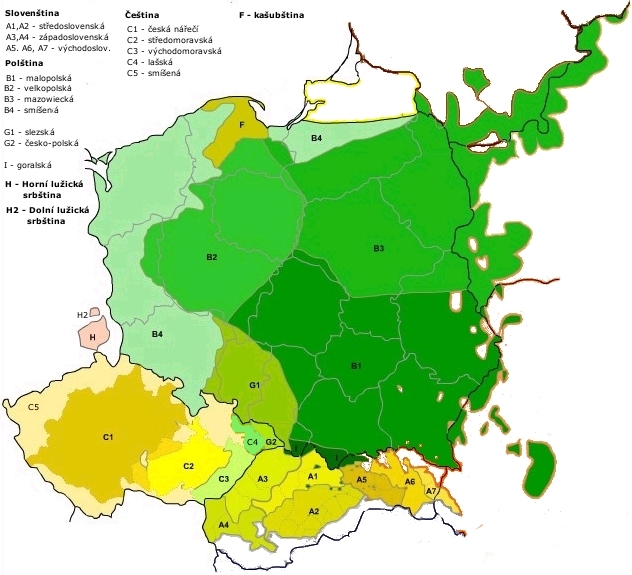
The West Slavic languages are a subdivision of the Slavic language group. They include Polish, Czech, Slovak, Kashubian, Silesian, Upper Sorbian and Lower Sorbian. The languages have traditionally been spoken across a mostly continuous region encompassing the Czech Republic, Slovakia, Poland, the westernmost regions of Ukraine and Belarus, and a bit of eastern Lithuania.[citation needed] In addition, there are several language islands such as the Sorbian areas in Lusatia in Germany, and Slovak areas in Hungary and elsewhere.
West Slavic is usually divided into three subgroups—Czech–Slovak, Lechitic and Sorbian—based on similarity and degree of mutual intelligibility. The groupings are as follows:
The Max Planck Institute for Evolutionary Anthropology classifies the West Slavic languages within their Glottolog database as follows:
Some linguists include Upper and Lower Sorbian in the Lechitic branch, but other linguists regard it as a separate branch. The reason for this is that 'the Sorbian dialects are extremely diverse, and there are virtually no linguistic features common to all Sorbian dialects which distinguish them as a group from the other Slavic languages' (Sussex & Cubberley 2006). Czech and Slovak are more closely related to each other than to the other West Slavic languages, and also closer to each other than Polish and Sorbian are. Czecho-Slovak (Slovak in particular) shares certain features with other Slavic languages, such as Slovene and BCMS.
Some distinctive features of the West Slavic languages, as from when they split from the East Slavic and South Slavic branches around the 3rd to 6th centuries AD (alternatively, between the 6th and 10th centuries), are as follows:
Although influences from other language families have contributed a large number of loanwords, and to a lesser extent to verb morphology and syntax, the Slavic languages retained a distinctly Slavic character, with clear roots in Indo-European.
The West Slavic languages are all written in the Latin script, while the East Slavic branch uses Cyrillic and the South Slavic branch is mixed.
The early Slavic expansion reached Central Europe in c. the 7th century, and the West Slavic dialects diverged from Common Slavic over the following centuries. West Slavic polities of the 9th century include the Principality of Nitra and Great Moravia. The West Slavic tribes settled on the eastern fringes of the Carolingian Empire, along the Limes Saxoniae. The Obotrites were given territories by Charlemagne in exchange for their support in his war against the Saxons.[citation needed]
West Slavic languages
The West Slavic languages are a subdivision of the Slavic language group. They include Polish, Czech, Slovak, Kashubian, Silesian, Upper Sorbian and Lower Sorbian. The languages have traditionally been spoken across a mostly continuous region encompassing the Czech Republic, Slovakia, Poland, the westernmost regions of Ukraine and Belarus, and a bit of eastern Lithuania.[citation needed] In addition, there are several language islands such as the Sorbian areas in Lusatia in Germany, and Slovak areas in Hungary and elsewhere.
West Slavic is usually divided into three subgroups—Czech–Slovak, Lechitic and Sorbian—based on similarity and degree of mutual intelligibility. The groupings are as follows:
The Max Planck Institute for Evolutionary Anthropology classifies the West Slavic languages within their Glottolog database as follows:
Some linguists include Upper and Lower Sorbian in the Lechitic branch, but other linguists regard it as a separate branch. The reason for this is that 'the Sorbian dialects are extremely diverse, and there are virtually no linguistic features common to all Sorbian dialects which distinguish them as a group from the other Slavic languages' (Sussex & Cubberley 2006). Czech and Slovak are more closely related to each other than to the other West Slavic languages, and also closer to each other than Polish and Sorbian are. Czecho-Slovak (Slovak in particular) shares certain features with other Slavic languages, such as Slovene and BCMS.
Some distinctive features of the West Slavic languages, as from when they split from the East Slavic and South Slavic branches around the 3rd to 6th centuries AD (alternatively, between the 6th and 10th centuries), are as follows:
Although influences from other language families have contributed a large number of loanwords, and to a lesser extent to verb morphology and syntax, the Slavic languages retained a distinctly Slavic character, with clear roots in Indo-European.
The West Slavic languages are all written in the Latin script, while the East Slavic branch uses Cyrillic and the South Slavic branch is mixed.
The early Slavic expansion reached Central Europe in c. the 7th century, and the West Slavic dialects diverged from Common Slavic over the following centuries. West Slavic polities of the 9th century include the Principality of Nitra and Great Moravia. The West Slavic tribes settled on the eastern fringes of the Carolingian Empire, along the Limes Saxoniae. The Obotrites were given territories by Charlemagne in exchange for their support in his war against the Saxons.[citation needed]
Recent media
Recent media