Hubbry Logo
SmoothnessSmoothnessMain
Open search
Smoothness
Community hub
Smoothness
logo
8 pages, 0 posts
0 subscribers
Be the first to start a discussion here.
Smoothness
Smoothness
from Wikipedia
A bump function is a smooth function with compact support.

In mathematical analysis, the smoothness of a function is a property measured by the number of continuous derivatives (differentiability class) it has over its domain.[1]

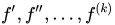
A function of class is a function of smoothness at least k; that is, a function of class is a function that has a kth derivative that is continuous in its domain.

A function of class or -function (pronounced C-infinity function) is an infinitely differentiable function, that is, a function that has derivatives of all orders (this implies that all these derivatives are continuous).

Generally, the term smooth function refers to a -function. However, it may also mean "sufficiently differentiable" for the problem under consideration.

Differentiability classes

[edit]

Differentiability class is a classification of functions according to the properties of their derivatives. It is a measure of the highest order of derivative that exists and is continuous for a function.

Consider an open set on the real line and a function defined on with real values. Let k be a non-negative integer. The function is said to be of differentiability class if the derivatives exist and are continuous on If is -differentiable on then it is at least in the class since are continuous on The function is said to be infinitely differentiable, smooth, or of class if it has derivatives of all orders on (So all these derivatives are continuous functions over )[2] The function is said to be of class or analytic, if is smooth (i.e., is in the class ) and its Taylor series expansion around any point in its domain converges to the function in some neighborhood of the point. There exist functions that are smooth but not analytic; is thus strictly contained in Bump functions are examples of functions with this property.

To put it differently, the class consists of all continuous functions. The class consists of all differentiable functions whose derivative is continuous; such functions are called continuously differentiable. Thus, a function is exactly a function whose derivative exists and is of class In general, the classes can be defined recursively by declaring to be the set of all continuous functions, and declaring for any positive integer to be the set of all differentiable functions whose derivative is in In particular, is contained in for every and there are examples to show that this containment is strict (). The class of infinitely differentiable functions, is the intersection of the classes as varies over the non-negative integers.

Examples

[edit]

Example: continuous (C0) but not differentiable

[edit]
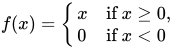
The C0 function f(x) = x for x ≥ 0 and 0 otherwise.
The function g(x) = x2 sin(1/x) for x > 0.
The function with for and is differentiable. However, this function is not continuously differentiable.
A smooth function that is not analytic.

The function is continuous, but not differentiable at x = 0, so it is of class C0, but not of class C1.
Example: finitely-times differentiable (Ck)

[edit]

For each even integer k, the function is continuous and k times differentiable at all x. At x = 0, however, is not (k + 1) times differentiable, so is of class Ck, but not of class Cj where j > k.

Example: differentiable but not continuously differentiable (not C1)

[edit]

The function is differentiable, with derivative

Because oscillates as x → 0, is not continuous at zero. Therefore, is differentiable but not of class C1.

Example: differentiable but not Lipschitz continuous

[edit]

The function is differentiable but its derivative is unbounded on a compact set. Therefore, is an example of a function that is differentiable but not locally Lipschitz continuous.

Example: analytic (Cω)

[edit]

The exponential function is analytic, and hence falls into the class Cω (where ω is the smallest transfinite ordinal). The trigonometric functions are also analytic wherever they are defined, because they are linear combinations of complex exponential functions and .

Example: smooth (C) but not analytic (Cω)

[edit]

The bump function is smooth, so of class C, but it is not analytic at x = ±1, and hence is not of class Cω. The function f is an example of a smooth function with compact support.

Multivariate differentiability classes

[edit]

A function defined on an open set of is said[3] to be of class on , for a positive integer , if all partial derivatives exist and are continuous, for every non-negative integers, such that , and every . Equivalently, is of class on if the -th order Fréchet derivative of exists and is continuous at every point of . The function is said to be of class or if it is continuous on . Functions of class are also said to be continuously differentiable.

A function , defined on an open set of , is said to be of class on , for a positive integer , if all of its components are of class , where are the natural projections defined by . It is said to be of class or if it is continuous, or equivalently, if all components are continuous, on .

The space of Ck functions

[edit]

Let be an open subset of the real line. The set of all real-valued functions defined on is a Fréchet vector space, with the countable family of seminorms where varies over an increasing sequence of compact sets whose union is , and .

The set of functions over also forms a Fréchet space. One uses the same seminorms as above, except that is allowed to range over all non-negative integer values.

The above spaces occur naturally in applications where functions having derivatives of certain orders are necessary; however, particularly in the study of partial differential equations, it can sometimes be more fruitful to work instead with the Sobolev spaces.

Continuity

[edit]

The terms parametric continuity (Ck) and geometric continuity (Gn) were introduced by Brian Barsky, to show that the smoothness of a curve could be measured by removing restrictions on the speed, with which the parameter traces out the curve.[4][5][6]

Parametric continuity

[edit]

Parametric continuity (Ck) is a concept applied to parametric curves, which describes the smoothness of the parameter's value with distance along the curve. A (parametric) curve is said to be of class Ck, if exists and is continuous on , where derivatives at the end-points and are taken to be one sided derivatives (from the right at and from the left at ).

As a practical application of this concept, a curve describing the motion of an object with a parameter of time must have C1 continuity and its first derivative is differentiable—for the object to have finite acceleration. For smoother motion, such as that of a camera's path while making a film, higher orders of parametric continuity are required.

Order of parametric continuity

[edit]
Two Bézier curve segments attached that is only C0 continuous
Two Bézier curve segments attached in such a way that they are C1 continuous

The various order of parametric continuity can be described as follows:[7]

  • : zeroth derivative is continuous (curves are continuous)
  • : zeroth and first derivatives are continuous
  • : zeroth, first and second derivatives are continuous
  • : 0-th through -th derivatives are continuous

Geometric continuity

[edit]
Curves with G1-contact (circles,line)

pencil of conic sections with G2-contact: p fix, variable
(: circle,: ellipse, : parabola, : hyperbola)

A curve or surface can be described as having continuity, with being the increasing measure of smoothness. Consider the segments either side of a point on a curve:

  • : The curves touch at the join point.
  • : The curves also share a common tangent direction at the join point.
  • : The curves also share a common center of curvature at the join point.

In general, continuity exists if the curves can be reparameterized to have (parametric) continuity.[8][9] A reparametrization of the curve is geometrically identical to the original; only the parameter is affected.

Equivalently, two vector functions and such that have continuity at the point where they meet if they satisfy equations known as Beta-constraints. For example, the Beta-constraints for continuity are:

where , , and are arbitrary, but is constrained to be positive.[8]: 65  In the case , this reduces to and , for a scalar (i.e., the direction, but not necessarily the magnitude, of the two vectors is equal).

While it may be obvious that a curve would require continuity to appear smooth, for good aesthetics, such as those aspired to in architecture and sports car design, higher levels of geometric continuity are required. For example, reflections in a car body will not appear smooth unless the body has continuity.[citation needed]

A rounded rectangle (with ninety degree circular arcs at the four corners) has continuity, but does not have continuity. The same is true for a rounded cube, with octants of a sphere at its corners and quarter-cylinders along its edges. If an editable curve with continuity is required, then cubic splines are typically chosen; these curves are frequently used in industrial design.

Other concepts

[edit]

Relation to analyticity

[edit]

While all analytic functions are "smooth" (i.e. have all derivatives continuous) on the set on which they are analytic, examples such as bump functions (mentioned above) show that the converse is not true for functions on the reals: there exist smooth real functions that are not analytic. Simple examples of functions that are smooth but not analytic at any point can be made by means of Fourier series; another example is the Fabius function. Although it might seem that such functions are the exception rather than the rule, it turns out that the analytic functions are scattered very thinly among the smooth ones; more rigorously, the analytic functions form a meagre subset of the smooth functions. Furthermore, for every open subset A of the real line, there exist smooth functions that are analytic on A and nowhere else.[citation needed]

It is useful to compare the situation to that of the ubiquity of transcendental numbers on the real line. Both on the real line and the set of smooth functions, the examples we come up with at first thought (algebraic/rational numbers and analytic functions) are far better behaved than the majority of cases: the transcendental numbers and nowhere analytic functions have full measure (their complements are meagre).

The situation thus described is in marked contrast to complex differentiable functions. If a complex function is differentiable just once on an open set, it is both infinitely differentiable and analytic on that set.[citation needed]

Smooth partitions of unity

[edit]

Smooth functions with given closed support are used in the construction of smooth partitions of unity (see partition of unity and topology glossary); these are essential in the study of smooth manifolds, for example to show that Riemannian metrics can be defined globally starting from their local existence. A simple case is that of a bump function on the real line, that is, a smooth function f that takes the value 0 outside an interval [a,b] and such that

Given a number of overlapping intervals on the line, bump functions can be constructed on each of them, and on semi-infinite intervals and to cover the whole line, such that the sum of the functions is always 1.

From what has just been said, partitions of unity do not apply to holomorphic functions; their different behavior relative to existence and analytic continuation is one of the roots of sheaf theory. In contrast, sheaves of smooth functions tend not to carry much topological information.

Smooth functions on and between manifolds

[edit]

Given a smooth manifold , of dimension and an atlas then a map is smooth on if for all there exists a chart such that and is a smooth function from a neighborhood of in to (all partial derivatives up to a given order are continuous). Smoothness can be checked with respect to any chart of the atlas that contains since the smoothness requirements on the transition functions between charts ensure that if is smooth near in one chart it will be smooth near in any other chart.

If is a map from to an -dimensional manifold , then is smooth if, for every there is a chart containing and a chart containing such that and is a smooth function from to

Smooth maps between manifolds induce linear maps between tangent spaces: for , at each point the pushforward (or differential) maps tangent vectors at to tangent vectors at : and on the level of the tangent bundle, the pushforward is a vector bundle homomorphism: The dual to the pushforward is the pullback, which "pulls" covectors on back to covectors on and -forms to -forms: In this way smooth functions between manifolds can transport local data, like vector fields and differential forms, from one manifold to another, or down to Euclidean space where computations like integration are well understood.

Preimages and pushforwards along smooth functions are, in general, not manifolds without additional assumptions. Preimages of regular points (that is, if the differential does not vanish on the preimage) are manifolds; this is the preimage theorem. Similarly, pushforwards along embeddings are manifolds.[10]

Smooth functions between subsets of manifolds

[edit]

There is a corresponding notion of smooth map for arbitrary subsets of manifolds. If is a function whose domain and range are subsets of manifolds and respectively. is said to be smooth if for all there is an open set with and a smooth function such that for all

See also

[edit]
  • Discontinuity – Mathematical analysis of discontinuous points
  • Hadamard's lemma – Theorem
  • Non-analytic smooth function – Mathematical functions which are smooth but not analytic
  • Quasi-analytic function
  • Singularity (mathematics) – Point where a function, a curve or another mathematical object does not behave regularly
  • Sinuosity – Ratio of arc length and straight-line distance between two points on a wave-like function
  • Smooth scheme – Scheme without singular points, generalizing smooth manifolds
  • Smooth number – Integer having only small prime factors (number theory)
  • Smoothing – Fitting an approximating function to data
  • Spline – Mathematical function defined piecewise by polynomials
  • Sobolev mapping

References

[edit]
Revisions and contributorsEdit on WikipediaRead on Wikipedia
from Grokipedia
In , smoothness primarily refers to the property of functions or mappings being infinitely differentiable, meaning that derivatives of all orders exist and are continuous on their domain, ensuring no abrupt changes or discontinuities in behavior. This concept, often denoted as CC^\infty, distinguishes smooth functions from those that are merely finitely differentiable, such as CkC^k functions where only up to the kk-th derivative is continuous. Examples include the exe^x and like sinx\sin x, which possess s of every order that remain bounded and continuous. Beyond , smoothness extends to geometric and algebraic contexts, where it describes structures free of irregularities or singularities. In , a smooth manifold is a that locally resembles through smooth coordinate charts, with transition functions between charts being infinitely differentiable diffeomorphisms; this allows for the consistent definition of tangent spaces and differential forms across the manifold. For instance, S2S^2 admits a via stereographic projections, enabling the study of geodesics and curvatures without "kinks." In , smoothness characterizes varieties or schemes that are locally like , specifically when all local rings are regular (i.e., the equals the minimal number of generators of the ). A of schemes is smooth if it is flat, of finite presentation, and has geometrically smooth fibers, implying that the target variety inherits a structure amenable to and deformation theory. This notion ensures that smooth varieties behave well under operations like and allow for the application of powerful tools such as the in the algebraic setting. Smoothness also appears in optimization and , where a function is termed L-smooth if its is continuous with constant L, bounding the rate of change and facilitating convergence guarantees for algorithms like . Across these fields, the unifying theme is the absence of pathological features, promoting tractability in theoretical and computational studies.

Fundamental Definitions

Definition and Historical Context

In mathematical analysis, smoothness refers to the property of a function being infinitely differentiable. Specifically, for a function f:URmf: U \to \mathbb{R}^m where URnU \subseteq \mathbb{R}^n is an open set, ff is smooth (or CC^\infty) if all iterated Fréchet derivatives DkfD^k f exist and are continuous on UU for every order k=1,2,3,k = 1, 2, 3, \dots. The Fréchet derivative generalizes the classical derivative to multivariable settings, representing the best linear approximation at each point, with higher-order derivatives defined recursively on these linear maps. This definition extends the notion of continuity (as the C0C^0 case) to arbitrary finite or infinite orders of differentiability. The historical roots of smoothness trace back to the 17th and 18th centuries, when introduced higher-order differentials in his foundational work on around 1675–1690, using them to describe rates of change beyond the first order. Leonhard Euler built on this in the mid-18th century, employing higher derivatives extensively in his analyses of series expansions and differential equations, such as in his Institutiones calculi integralis (1768–1770), where he explored repeated integration and differentiation intuitively without full rigor. These early contributions treated higher differentiability as a natural extension of basic , often in the context of solving physical problems like trajectories and vibrations. The brought rigorous formalization, driven by the need to address foundational issues in . , in his 1821 Cours d'analyse de l'École Royale Polytechnique, provided the first precise definition of the via limits and extended it systematically to higher orders, defining the kk-th as the limit of appropriate difference quotients and proving continuity of derivatives under suitable conditions. complemented this in the 1860s through his lectures in , emphasizing the epsilon-delta formalism for limits, which ensured the consistency of differentiability classes and highlighted pathologies like nowhere-differentiable continuous functions. These developments established smoothness as a cornerstone of , distinguishing it from mere continuity. In the , smoothness gained deeper structure through . Stefan Banach's 1932 Théorie des opérations linéaires introduced Banach spaces, paving the way for studying spaces of smooth functions, such as C(U)C^\infty(U), equipped with seminorms that make them complete Fréchet spaces. This framework formalized infinite-order differentiability in infinite-dimensional settings. Notably, while smoothness universally denotes CC^\infty properties, in partial differential equations (PDEs), "regularity" specifically describes how elliptic or parabolic operators bootstrap solutions to higher smoothness levels from initial data, assuming only finite differentiability.

Differentiability in One Variable

A function f:IRf: I \to \mathbb{R}, where II is an open interval in R\mathbb{R}, is differentiable at a point cIc \in I if the limit f(c)=limh0f(c+h)f(c)hf'(c) = \lim_{h \to 0} \frac{f(c + h) - f(c)}{h} exists and is finite. This definition captures the instantaneous rate of change of ff at cc, and the function is differentiable on II if it is differentiable at every point in II. For example, functions such as f(x)=x2f(x) = x^2 are differentiable everywhere, with f(x)=2xf'(x) = 2x. Higher-order derivatives are defined recursively: if f(n)f^{(n)} exists on an open interval, then f(n+1)(x)=ddxf(n)(x)f^{(n+1)}(x) = \frac{d}{dx} f^{(n)}(x) at points where the exists. This iterative process allows for the study of successively finer approximations to the function's behavior. Taylor's theorem provides a framework for such approximations, stating that if ff is n+1n+1 times differentiable on an interval containing aa and xx, then f(x)=k=0nf(k)(a)k!(xa)k+Rn(x),f(x) = \sum_{k=0}^{n} \frac{f^{(k)}(a)}{k!} (x - a)^k + R_n(x), where the Rn(x)R_n(x) in Lagrange form is Rn(x)=f(n+1)(ξ)(n+1)!(xa)n+1R_n(x) = \frac{f^{(n+1)}(\xi)}{(n+1)!} (x - a)^{n+1} for some ξ\xi between aa and xx. This quantifies the error in the polynomial approximation, essential for understanding local behavior near aa. The chain rule facilitates differentiation of composite functions: if ff is differentiable at g(x)g(x) and gg is differentiable at xx, then (fg)(x)=f(g(x))g(x)(f \circ g)'(x) = f'(g(x)) \cdot g'(x). Open intervals as domains ensure that limits can be approached from both sides, supporting these operations at interior points. Smoothness builds on these concepts through repeated differentiability.

Smoothness Classes

Finite-Order Differentiability (C^k)

The space Ck(R)C^k(\mathbb{R}) consists of all real-valued functions f:RRf: \mathbb{R} \to \mathbb{R} that are kk-times differentiable, with each derivative f(j)f^{(j)} for 0jk0 \leq j \leq k existing and continuous everywhere on R\mathbb{R}. This class captures functions with a finite level of smoothness, where the kk-th derivative is continuous but higher derivatives may not exist or be continuous. To endow Ck(R)C^k(\mathbb{R}) with a topological structure, it is equipped with the norm fCk=max0jksupxRf(j)(x),\|f\|_{C^k} = \max_{0 \leq j \leq k} \sup_{x \in \mathbb{R}} |f^{(j)}(x)|, which requires all derivatives up to order kk to be bounded (hence the space is a proper subspace of all kk-times continuously differentiable functions). This norm induces a metric, and under this metric, Ck(R)C^k(\mathbb{R}) is a Banach space: every Cauchy sequence converges to an element in the space. Completeness follows from the fact that uniform limits preserve continuity and differentiability up to order kk; specifically, if {fn}\{f_n\} is Cauchy in the CkC^k-norm, then each {fn(j)}\{f_n^{(j)}\} for jkj \leq k converges uniformly to a continuous function gjg_j, and by standard calculus results, gj=(limfn)(j)g_j = ( \lim f_n )^{(j)}. Closed linear subspaces of Ck(R)C^k(\mathbb{R}) inherit the Banach space properties. The spaces satisfy strict inclusion relations: Ck+1(R)Ck(R)C^{k+1}(\mathbb{R}) \subset C^k(\mathbb{R}) for each k0k \geq 0, with the inclusion map being continuous (i.e., fCkfCk+1\|f\|_{C^k} \leq \|f\|_{C^{k+1}}). On compact subsets KRK \subset \mathbb{R}, the restrictions of polynomials are dense in the restricted Ck(K)C^k(K) under the CkC^k-norm. This density follows from the Stone-Weierstrass theorem, which guarantees polynomial density in C0(K)C^0(K), extended iteratively: a CkC^k function can be approximated by integrating approximations of its derivatives, yielding polynomial approximations that converge in the CkC^k-norm.

Infinite Differentiability (C^∞)

A function f:ΩRf: \Omega \to \mathbb{R}, where ΩR\Omega \subseteq \mathbb{R} is open, is said to be infinitely differentiable if it belongs to the class Ck(Ω)C^k(\Omega) for every nonnegative kk, meaning all up to order kk exist and are continuous on Ω\Omega. Equivalently, the space C(Ω)C^\infty(\Omega) is the intersection k=0Ck(Ω)\bigcap_{k=0}^\infty C^k(\Omega). When Ω\Omega is a compact interval, C(Ω)C^\infty(\Omega) is endowed with a Fréchet space topology generated by the countable family of seminorms fm=supxΩmax0kmf(k)(x)\|f\|_m = \sup_{x \in \Omega} \max_{0 \leq k \leq m} |f^{(k)}(x)| for m=0,1,2,m = 0, 1, 2, \dots. This topology is complete and metrizable, ensuring uniform convergence of functions and all their derivatives up to any fixed order. The space C(R)C^\infty(\mathbb{R}) is endowed with the Fréchet topology generated by the countable family of seminorms pn(f)=max0knsupx[n,n]f(k)(x)p_n(f) = \max_{0 \leq k \leq n} \sup_{x \in [-n,n]} |f^{(k)}(x)| for n=1,2,n = 1, 2, \dots . This topology is complete and metrizable, ensuring uniform convergence of functions and all their derivatives up to any fixed order on every compact subset of R\mathbb{R}. In the of distributions, the subspace D(R)=Cc(R)\mathcal{D}(\mathbb{R}) = C_c^\infty(\mathbb{R}) of compactly supported infinitely differentiable functions is equipped with a similar LF-space as the inductive limit of C([n,n])C^\infty([-n,n]), serving as the standard space of functions whose continuous linear dual is the space of distributions. To prepare for multivariable extensions, the on C(Ω)C^\infty(\Omega) for ΩRn\Omega \subseteq \mathbb{R}^n open is the Fréchet induced by the family of seminorms fK,m=supxKsupαmDαf(x)\|f\|_{K,m} = \sup_{x \in K} \sup_{|\alpha| \leq m} |D^\alpha f(x)| over all compact subsets KΩK \subset \Omega and orders mNm \in \mathbb{N}, where α\alpha is a multi-index. This is complete and metrizable when defined via a countable basis of seminorms.

Analytic Smoothness (C^ω)

Analytic smoothness, denoted as the class CωC^\omega, refers to functions that are infinitely differentiable and moreover locally equal to their expansions. A real-valued function f:URf: U \to \mathbb{R}, where URU \subset \mathbb{R} is open, is said to be analytic at a point aUa \in U if there exists some r>0r > 0 such that the of ff around aa, n=0f(n)(a)n!(xa)n,\sum_{n=0}^\infty \frac{f^{(n)}(a)}{n!} (x - a)^n, converges to f(x)f(x) for all xx in the interval (ar,a+r)U(a - r, a + r) \cap U. This requires the power series to have a positive radius of convergence, ensuring local representation by a convergent power series. The function ff belongs to Cω(U)C^\omega(U) if it is analytic at every point in UU. This local power series representation distinguishes CωC^\omega functions from the broader class of infinitely differentiable functions. Analyticity implies infinite differentiability, as term-by-term differentiation of the convergent yields the higher derivatives within the . However, the converse does not hold: CωC^\omega is a strict subclass of CC^\infty, meaning there exist functions that are infinitely differentiable everywhere but fail to equal their in any neighborhood of some points. A key characterization of analyticity involves bounds on the growth of derivatives. For instance, if the derivatives at aa satisfy f(n)(a)Mn!rn|f^{(n)}(a)| \leq M \frac{n!}{r^n} for all nn, some constants M>0M > 0 and r>0r > 0, then the Taylor series converges absolutely in xa<r|x - a| < r, and by standard theorems on power series, it equals f(x)f(x) there, confirming analyticity. This estimate mirrors Cauchy's bounds derived from complex integral representations, which can be adapted to real functions via analytic continuation or majorant series. Classic examples of CωC^\omega functions include polynomials, which are analytic everywhere with finite Taylor series (higher derivatives vanish), and entire functions like the exponential f(x)=exf(x) = e^x. The Taylor series of exe^x around any point aa is n=0(xa)nn!\sum_{n=0}^\infty \frac{(x - a)^n}{n!}, which converges to exe^x for all real xx, demonstrating global analyticity on R\mathbb{R}. Similarly, sinx\sin x and cosx\cos x are analytic on R\mathbb{R}, with their series converging everywhere. These functions highlight how CωC^\omega captures rigid structures governed by power series, underpinning applications in approximation theory and differential equations.

Examples and Illustrations

Continuous Functions Without Higher Differentiability

A fundamental example of a function that is continuous everywhere but fails to be differentiable at a specific point is the absolute value function f(x)=xf(x) = |x|. This function belongs to the class C0(R)C^0(\mathbb{R}), meaning it is continuous on the real line, but it is not differentiable at x=0x = 0 because the left-hand derivative is -1 while the right-hand derivative is +1, so the derivative does not exist there. Despite this lack of differentiability at the origin, x|x| remains uniformly continuous on R\mathbb{R} since it satisfies the Lipschitz condition with constant 1, implying xyxy||x| - |y|| \leq |x - y| for all x,yRx, y \in \mathbb{R}. Far more pathological are functions that are continuous everywhere but differentiable nowhere, such as the Weierstrass function introduced by Karl Weierstrass in 1872. This function is defined by the infinite series w(x)=n=0ancos(bnπx),w(x) = \sum_{n=0}^{\infty} a^n \cos(b^n \pi x), where 0<a<10 < a < 1, bb is an odd positive integer, and ab>1+3π2ab > 1 + \frac{3\pi}{2}. Weierstrass's construction ensures of the series on R\mathbb{R}, guaranteeing continuity everywhere, yet the rapid oscillations induced by the parameters prevent the existence of a at any point due to the failure of the to converge. The function's fractal-like graph, with self-similar wiggles at every scale, exemplifies its nowhere-differentiable nature, challenging the 18th-century intuition that continuous functions should be smooth. Such examples highlight the boundary between mere continuity and differentiability, revealing that continuity alone does not imply even local smoothness. While the function's kink is intuitive and isolated, the Weierstrass function's total absence of tangents underscores the existence of highly irregular yet continuous behaviors in . Both functions are uniformly continuous on compact intervals, preserving some regularity, but their non-differentiability illustrates how pathological constructions can evade higher smoothness without violating continuity.

Functions with Limited Smoothness Orders

Functions with limited smoothness orders refer to those that are exactly CkC^k for some finite k>0k > 0, meaning they have continuous derivatives up to order kk, but the (k+1)(k+1)-th derivative either does not exist or is not continuous at some points. These examples illustrate how smoothness can break down at specific orders, providing counterexamples to the idea that higher differentiability automatically follows from lower orders. Such functions are crucial in for demonstrating the sharpness of differentiability classes. A representative example of a function that is C1C^1 but not C2C^2 is f(x)=12xxf(x) = \frac{1}{2} x |x|, defined for all real xx. This function is continuously differentiable with f(x)=xf'(x) = |x|, which is continuous everywhere. However, the second derivative f(x)=sign(x)f''(x) = \operatorname{sign}(x) for x0x \neq 0 does not exist at x=0x = 0, as the left and right derivatives differ. This shows a discontinuity in the existence of higher derivatives at a point. Another classic construction involves to achieve limited smoothness. Consider f(x)=x3sin(1/x)f(x) = x^3 \sin(1/x) for x0x \neq 0 and f(0)=0f(0) = 0. This function is C1C^1, with f(x)=3x2sin(1/x)xcos(1/x)f'(x) = 3x^2 \sin(1/x) - x \cos(1/x) for x0x \neq 0 and f(0)=0f'(0) = 0, and ff' is continuous at 0 since both terms vanish in the limit. The second derivative exists for x0x \neq 0 but the limit defining f(0)f''(0) oscillates and does not exist due to the cos(1/x)\cos(1/x) term, confirming it is not twice differentiable at 0. This example highlights how rapid oscillations can prevent higher-order differentiability while preserving lower-order continuity. Regarding Lipschitz continuity, differentiability does not imply the derivative is bounded, leading to functions that are differentiable but not on bounded intervals. An example is g(x)=x2sin(1/x2)g(x) = x^2 \sin(1/x^2) for x0x \neq 0 and g(0)=0g(0) = 0. This is differentiable everywhere, with g(x)=2xsin(1/x2)(2/x)cos(1/x2)g'(x) = 2x \sin(1/x^2) - (2/x) \cos(1/x^2) for x0x \neq 0 and g(0)=0g'(0) = 0, but g(x)|g'(x)| can be as large as approximately 2/x2/|x| near 0, making the derivative unbounded on any interval containing 0. Consequently, gg fails to be near 0, as the would require bounded slopes for such continuity. For higher finite orders, one can construct functions that are CkC^k but not Ck+1C^{k+1} by repeated integration of nowhere-differentiable continuous functions like the Weierstrass function w(x)=n=0ancos(bnπx)w(x) = \sum_{n=0}^\infty a^n \cos(b^n \pi x) with 0<a<10 < a < 1 and ab>1+3π/2ab > 1 + 3\pi/2, which is continuous everywhere but differentiable nowhere. The kk-fold integral f(x)=0x0tk10t1w(t)dtf(x) = \int_0^x \int_0^{t_{k-1}} \cdots \int_0^{t_1} w(t) \, dt yields a function in CkC^k but not Ck+1C^{k+1}, as each integration increases the smoothness order by 1, but the final derivative is ww, which lacks differentiability. This method generalizes to arbitrary finite kk, emphasizing the role of pathological base functions in limiting smoothness.

Non-Analytic Smooth Functions

A canonical example of a non-analytic smooth function is the flat function at the origin, given by f(x)={exp(1x2)x>0,0x0.f(x) = \begin{cases} \exp\left( -\frac{1}{x^2} \right) & x > 0, \\ 0 & x \leq 0. \end{cases} This function belongs to the class C(R)C^\infty(\mathbb{R}), as it is infinitely differentiable everywhere, including at x=0x=0, where all derivatives vanish: f(n)(0)=0f^{(n)}(0) = 0 for every n0n \geq 0. The Taylor series of ff centered at 0 is thus the zero polynomial, which converges pointwise to the zero function on R\mathbb{R}, but fails to equal f(x)f(x) for any x>0x > 0 where f(x)>0f(x) > 0. Consequently, ff is not analytic at 0, despite its smoothness there; the radius of convergence of the Taylor series is infinite, yet it does not represent ff in any neighborhood of 0. This example, first identified by Cauchy in 1823 as a CC^\infty function with peculiar behavior at a point, underscores the strict inclusion CωCC^\omega \subsetneq C^\infty. The existence of such functions reveals a fundamental distinction from analytic functions, where the Taylor series always converges to the function in some neighborhood of the expansion point. The Denjoy-Carleman theorem characterizes Denjoy-Carleman classes CMC^M (subclasses of CC^\infty with derivative growth bounded by f(n)Cn+1Mn|f^{(n)}| \leq C^{n+1} M_n) as quasi-analytic—meaning functions agreeing to all orders at a point coincide nearby—if n=1(Mn/Mn+1)1/n=\sum_{n=1}^\infty (M_n / M_{n+1})^{1/n} = \infty. The analytic class CωC^\omega (with Mnn!M_n \sim n!) satisfies this (sum diverges), hence quasi-analytic. In contrast, the full CC^\infty class admits non-quasi-analytic behavior, as exemplified by the flat function: its zero Taylor series at 0 matches the zero function, yet ff differs nearby. Borel's theorem further illuminates this gap by establishing the surjectivity of the Taylor expansion map from C(R)C^\infty(\mathbb{R}) onto the space of formal power series: for any sequence (an)(a_n), there exists a smooth function whose nnth derivative at 0 is n!ann! a_n. The flat function demonstrates the map's non-injectivity, as distinct smooth functions can share the same Taylor series. These results highlight how smoothness permits greater flexibility in derivative behavior than analyticity demands, with quasi-analyticity serving as a bridge between the two. A symmetric extension, f(x)=exp(1/x2)f(x) = \exp(-1/x^2) for x0x \neq 0 and 0 at 0, is also smooth and flat at 0, and such constructions yield bump functions supported on compact sets, useful in advanced applications like manifolds.

Multivariable and Parametric Smoothness

Partial Derivatives and Multivariable Classes

In multivariable calculus, differentiability of a function f:RnRmf: \mathbb{R}^n \to \mathbb{R}^m at a point xRnx \in \mathbb{R}^n is defined using the Fréchet derivative, which is a linear map Df(x):RnRmDf(x): \mathbb{R}^n \to \mathbb{R}^m such that the limit limh0f(x+h)f(x)Df(x)(h)h=0\lim_{h \to 0} \frac{\|f(x + h) - f(x) - Df(x)(h)\|}{\|h\|} = 0 holds, providing a best linear approximation to ff near xx. This derivative is represented by the Jacobian matrix, whose entries are the partial derivatives fixj(x)\frac{\partial f_i}{\partial x_j}(x), generalizing the single-variable derivative to higher dimensions. The smoothness classes CkC^k extend to multivariable functions by requiring that all partial derivatives up to order kk exist and are continuous on an URnU \subset \mathbb{R}^n. To compactly denote these higher-order partials, is used: a multi-index α=(α1,,αn)\alpha = (\alpha_1, \dots, \alpha_n) is a of non-negative integers with α=i=1nαi|\alpha| = \sum_{i=1}^n \alpha_i, and the Dαf=αfx1α1xnαnD^\alpha f = \frac{\partial^{|\alpha|} f}{\partial x_1^{\alpha_1} \cdots \partial x_n^{\alpha_n}}. A function ff belongs to Ck(U)C^k(U) if DαfD^\alpha f is continuous for all α\alpha with αk|\alpha| \leq k; when n=1n=1, this reduces to the one-variable case. The higher-order chain rule for compositions of multivariable functions, such as f(g(x))f(g(x)) where g:RnRpg: \mathbb{R}^n \to \mathbb{R}^p and f:RpRmf: \mathbb{R}^p \to \mathbb{R}^m, is given by the multivariate Faà di Bruno formula, which expresses the kk-th derivative as a sum over partitions involving products of derivatives of ff and gg. This formula generalizes the univariate chain rule and accounts for all possible ways partial derivatives combine under composition. The multivariable Taylor theorem approximates a CkC^k function f:RnRf: \mathbb{R}^n \to \mathbb{R} near a point aa by f(x)=αkDαf(a)α!(xa)α+Rk(x),f(x) = \sum_{|\alpha| \leq k} \frac{D^\alpha f(a)}{\alpha!} (x - a)^\alpha + R_k(x), where α!=i=1nαi!\alpha! = \prod_{i=1}^n \alpha_i! is the multi-index factorial and Rk(x)R_k(x) is the remainder term, often bounded by a form involving the (k+1)(k+1)-th derivatives. This expansion relies on the continuity of partials up to order kk and provides local polynomial approximations in multiple variables.

Parametric and Geometric Continuity

In the context of parametrized curves and surfaces, parametric continuity of order kk, denoted CkC^k, requires that the parametrization γ:IRn\gamma: I \to \mathbb{R}^n (where II is an interval and n2n \geq 2) is kk-times continuously differentiable, meaning the derivatives γ(0),γ(1),,γ(k)\gamma^{(0)}, \gamma^{(1)}, \dots, \gamma^{(k)} are all continuous functions on II. For piecewise parametrizations, such as those used in spline representations, CkC^k continuity at junction points demands that the position and all derivatives up to order kk match exactly between adjacent segments, ensuring both geometric and parametric smoothness without abrupt changes in speed or acceleration. This strict condition is valuable in applications like computer-aided design (CAD) for generating curves where precise control over the parametrization's velocity is needed, as in uniform B-spline curves that inherently achieve Ck1C^{k-1} continuity for degree-kk polynomials. Geometric continuity of order kk, denoted GkG^k, relaxes the parametric requirement by allowing a local reparametrization—typically an of the parameter—that renders the curve CkC^k smooth. Introduced to address limitations in parametric continuity, where geometrically smooth shapes might fail CkC^k due to incompatible parametrizations, GkG^k focuses on the intrinsic rather than the specific speed of traversal. For instance, G0G^0 coincides with C0C^0, requiring only positional continuity for a continuous without cusps. At order 1, G1G^1 ensures directions align at junctions (no kinks), but magnitudes may differ, permitting flexible spline designs like beta-splines in CAD systems where shape control parameters adjust without violating smoothness. Higher orders, such as G2G^2, extend this to continuous by aligning osculating planes and curvatures up to scalar multiples, facilitating fairer surfaces in modeling applications. The distinction between CkC^k and GkG^k is particularly pronounced in spline-based modeling, where CkC^k enforces rigid derivative matching that can constrain freedom, whereas GkG^k enables more intuitive geometric constructions, such as blending curves with varying arc-length parametrizations. In CAD software, G1G^1 continuity is often sufficient for visual smoothness in automotive or design, avoiding the computational overhead of full C1C^1 while maintaining manufacturable surfaces; for example, NURBS patches commonly achieve G1G^1 across edges via knot multiplicity adjustments. Three equivalent characterizations of GnG^n—via affine reparametrizations, linear dependence of vectors, and matching Taylor expansions up to order nn—provide practical tests for implementation in algorithms.

Advanced Structures and Properties

Smooth Functions on Manifolds

A smooth structure on a MM is defined by a maximal atlas A={(Uα,ϕα)}αI\mathcal{A} = \{(U_\alpha, \phi_\alpha)\}_{\alpha \in I}, where each UαU_\alpha is an open subset of MM, each ϕα:UαRn\phi_\alpha: U_\alpha \to \mathbb{R}^n is a onto an open set in Rn\mathbb{R}^n, and the transition maps ϕβϕα1:ϕα(UαUβ)ϕβ(UαUβ)\phi_\beta \circ \phi_\alpha^{-1}: \phi_\alpha(U_\alpha \cap U_\beta) \to \phi_\beta(U_\alpha \cap U_\beta) are CC^\infty diffeomorphisms whenever UαUβU_\alpha \cap U_\beta \neq \emptyset. This maximal atlas ensures that the notion of smoothness is independent of the choice of charts within the equivalence class, allowing consistent differentiation across the manifold. The equips MM with a differentiable framework that generalizes the CC^\infty category from Euclidean spaces to abstract spaces. A function f:MRf: M \to \mathbb{R} is smooth if, for every point pMp \in M, there exists a chart (U,ϕ)(U, \phi) containing pp such that the composition fϕ1:ϕ(U)Rf \circ \phi^{-1}: \phi(U) \to \mathbb{R} is a CC^\infty function on the open subset ϕ(U)Rn\phi(U) \subseteq \mathbb{R}^n. This local criterion ensures that smoothness is well-defined globally on MM, as the CC^\infty property of transition maps guarantees compatibility between overlapping charts. Consequently, the space of smooth functions on MM, often denoted C(M)C^\infty(M), forms a ring under pointwise addition and multiplication, serving as the foundation for differential geometry on manifolds. For maps between smooth manifolds F:MNF: M \to N, where MM has dimension nn and NN has dimension mm, FF is smooth if for every pMp \in M, there exist charts (U,ϕ)(U, \phi) around pp on MM and (V,ψ)(V, \psi) around F(p)F(p) on NN such that the composition ψFϕ1:ϕ(U)ψ(V)\psi \circ F \circ \phi^{-1}: \phi(U) \to \psi(V) is CC^\infty. This definition extends the local smoothness condition to inter-manifold mappings, enabling the study of derivatives via tangent spaces. The tangent space TpMT_p M at pMp \in M is the vector space of derivations on C(M)C^\infty(M) at pp, or equivalently, in local coordinates, the space Rn\mathbb{R}^n with the standard basis from the chart. The differential dFp:TpMTF(p)NdF_p: T_p M \to T_{F(p)} N is the unique linear map such that for any smooth function g:NRg: N \to \mathbb{R}, (gF)(p)=dFp()p(g \circ F)_*(p) = dF_p \circ ( )_p, where ()( )_* denotes the derivation; in coordinates, it is the Jacobian matrix of ψFϕ1\psi \circ F \circ \phi^{-1} at ϕ(p)\phi(p). Partitions of unity can be used to extend local smooth functions to global ones on paracompact manifolds.

Partitions of Unity and Bump Functions

Bump functions are infinitely differentiable functions with compact support, meaning they are zero outside a bounded closed set and non-zero within an open subset of that set. These functions are essential tools in analysis and geometry for constructing smooth objects with controlled support. A canonical example in Rn\mathbb{R}^n is given by the function ψ:RnR\psi: \mathbb{R}^n \to \mathbb{R} defined as ψ(x)={exp(11x2)if x<1,0if x1,\psi(x) = \begin{cases} \exp\left( -\frac{1}{1 - \|x\|^2} \right) & \text{if } \|x\| < 1, \\ 0 & \text{if } \|x\| \geq 1, \end{cases} which can be normalized by dividing by its maximum value to ensure 0ψ(x)10 \leq \psi(x) \leq 1 and ψ(0)=1\psi(0) = 1. This construction ensures all derivatives vanish at the boundary of the unit ball, preserving smoothness. Partitions of unity extend this idea to decompose the constant function 1 into a sum of smooth functions each supported in prescribed open sets. Formally, given an open cover {Ui}iI\{U_i\}_{i \in I} of a XX, a subordinate to {Ui}\{U_i\} is a of smooth functions {ρi}iI:X[0,1]\{\rho_i\}_{i \in I}: X \to [0,1] such that iIρi(x)=1\sum_{i \in I} \rho_i(x) = 1 for all xXx \in X and supp(ρi)Ui\operatorname{supp}(\rho_i) \subset U_i for each ii. The local finiteness means that every point in XX has a neighborhood intersecting only finitely many supports. This structure allows gluing local data into global smooth objects. The existence of smooth partitions of unity holds on paracompact smooth manifolds. Specifically, every paracompact Hausdorff smooth manifold admits a smooth partition of unity subordinate to any open cover. The proof relies on constructing bump functions in local charts and using mollifiers—smooth approximations to the Dirac delta via convolution with compactly supported functions—or approximate identities to smoothen step functions while preserving support properties. This theorem, building on earlier topological results, enables key constructions like extending smooth functions from closed subsets to the entire manifold.

Relation to Analyticity and Topology

In the theory of smooth functions, the concept of quasi-analyticity addresses the boundary between infinite differentiability and analyticity. A Denjoy-Carleman class C{Mn}C\{M_n\}, defined by a sequence of positive numbers MnM_n controlling the growth of higher derivatives via f(n)(x)Mn|f^{(n)}(x)| \leq M_n for functions ff in the class, is quasi-analytic if the only function in the class that vanishes to infinite order at a point (i.e., all derivatives zero there) is the zero function everywhere in the connected component. The Denjoy-Carleman theorem characterizes such classes precisely: the class is quasi-analytic if and only if n=1Mn1/n=\sum_{n=1}^\infty M_n^{-1/n} = \infty. For the standard analytic functions, where Mn=n!M_n = n!, the series diverges like the harmonic series, ensuring quasi-analyticity and thus uniqueness from derivatives, akin to Taylor series convergence. In contrast, faster-growing sequences like Mn=(n!)2M_n = (n!)^2 yield non-quasi-analytic classes, allowing non-zero smooth functions that are flat (infinitely differentiable but all derivatives zero) at a point. Smoothness also interacts deeply with topology through embedding theorems and the existence of exotic structures. The asserts that any smooth nn-dimensional manifold admits a smooth into R2n\mathbb{R}^{2n}, preserving the smooth structure compatibly with the topological into . This compatibility highlights how smoothness refines topological manifolds by providing a that allows local Euclidean charts with smooth transition maps. However, smoothness is not uniquely determined by : John Milnor's 1956 discovery revealed exotic s on the 7-sphere, yielding multiple non-diffeomorphic smooth manifolds homeomorphic to the standard S7S^7. Extending this, R4\mathbb{R}^4 admits uncountably many pairwise non-diffeomorphic smooth structures, all homeomorphic to the standard R4\mathbb{R}^4, demonstrating that topological and smooth categories diverge significantly in dimension 4. In , the relation between smoothness and analyticity contrasts sharply with the real case. A , defined as complex differentiable in a domain, is automatically infinitely differentiable (smooth) as a real map and moreover real-analytic, with its converging to the function locally. This rigidity arises from the Cauchy-Riemann equations and , which enforce strong control on derivatives. In the real setting, however, CC^\infty functions need not be analytic, permitting non-analytic examples despite infinite differentiability; quasi-analytic classes, via the Denjoy-Carleman theorem, delineate precisely when real smoothness forces analytic-like uniqueness, partially bridging this gap between real flexibility and complex rigidity.

References

Add your contribution
Related Hubs
User Avatar
No comments yet.