Hubbry Logo
Bump functionBump functionMain
Open search
Bump function
Community hub
Bump function
logo
8 pages, 0 posts
0 subscribers
Be the first to start a discussion here.
Bump function
Bump function
from Wikipedia
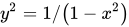
The graph of the bump function where and

In mathematical analysis, a bump function (also called a test function) is a function on a Euclidean space which is both smooth (in the sense of having continuous derivatives of all orders) and compactly supported. The set of all bump functions with domain forms a vector space, denoted or The dual space of this space endowed with a suitable topology is the space of distributions.

Examples

[edit]
The 1d bump function

The function given by

is an example of a bump function in one dimension. Note that the support of this function is the closed interval . In fact, by definition of support, we have that , where the closure is taken with respect the Euclidean topology of the real line. The proof of smoothness follows along the same lines as for the related function discussed in the Non-analytic smooth function article. This function can be interpreted as the Gaussian function scaled to fit into the unit disc: the substitution corresponds to sending to

A simple example of a (square) bump function in variables is obtained by taking the product of copies of the above bump function in one variable, so


A radially symmetric bump function in variables can be formed by taking the function defined by . This function is supported on the unit ball centered at the origin.
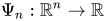

For another example, take an that is positive on and zero elsewhere, for example

.


Smooth transition functions

The non-analytic smooth function f(x) considered in the article.

Consider the function

defined for every real number x.


The smooth transition g from 0 to 1 defined here.

The function

has a strictly positive denominator everywhere on the real line, hence g is also smooth. Furthermore, g(x) = 0 for x ≤ 0 and g(x) = 1 for x ≥ 1, hence it provides a smooth transition from the level 0 to the level 1 in the unit interval [0, 1]. To have the smooth transition in the real interval [a, b] with a < b, consider the function

For real numbers a < b < c < d, the smooth function

equals 1 on the closed interval [b, c] and vanishes outside the open interval (a, d), hence it can serve as a bump function.

Caution must be taken since, as example, taking , leads to:

which is not an infinitely differentiable function (so, is not "smooth"), so the constraints a < b < c < d must be strictly fulfilled.

Some interesting facts about the function:

Are that make smooth transition curves with "almost" constant slope edges (a bump function with true straight slopes is portrayed this Another example).

A proper example of a smooth Bump function would be:

A proper example of a smooth transition function will be:

where could be noticed that it can be represented also through Hyperbolic functions:

Existence of bump functions

[edit]
An illustration of the sets in the construction.

It is possible to construct bump functions "to specifications". Stated formally, if is an arbitrary compact set in dimensions and is an open set containing there exists a bump function which is on and outside of Since can be taken to be a very small neighborhood of this amounts to being able to construct a function that is on and falls off rapidly to outside of while still being smooth.

Bump functions defined in terms of convolution

The construction proceeds as follows. One considers a compact neighborhood of contained in so The characteristic function of will be equal to on and outside of so in particular, it will be on and outside of This function is not smooth however. The key idea is to smooth a bit, by taking the convolution of with a mollifier. The latter is just a bump function with a very small support and whose integral is Such a mollifier can be obtained, for example, by taking the bump function from the previous section and performing appropriate scalings.

Bump functions defined in terms of a function with support

An alternative construction that does not involve convolution is now detailed. It begins by constructing a smooth function that is positive on a given open subset and vanishes off of [1] This function's support is equal to the closure of in so if is compact, then is a bump function.

Start with any smooth function that vanishes on the negative reals and is positive on the positive reals (that is, on and on where continuity from the left necessitates ); an example of such a function is for and otherwise.[1] Fix an open subset of and denote the usual Euclidean norm by (so is endowed with the usual Euclidean metric). The following construction defines a smooth function that is positive on and vanishes outside of [1] So in particular, if is relatively compact then this function will be a bump function.

If then let while if then let ; so assume is neither of these. Let be an open cover of by open balls where the open ball has radius and center Then the map defined by is a smooth function that is positive on and vanishes off of [1] For every let where this supremum is not equal to (so is a non-negative real number) because the partial derivatives all vanish (equal ) at any outside of while on the compact set the values of each of the (finitely many) partial derivatives are (uniformly) bounded above by some non-negative real number.[note 1] The series converges uniformly on to a smooth function that is positive on and vanishes off of [1] Moreover, for any non-negative integers [1] where this series also converges uniformly on (because whenever then the th term's absolute value is ). This completes the construction.

As a corollary, given two disjoint closed subsets of the above construction guarantees the existence of smooth non-negative functions such that for any if and only if and similarly, if and only if then the function is smooth and for any if and only if if and only if and if and only if [1] In particular, if and only if so if in addition is relatively compact in (where implies ) then will be a smooth bump function with support in

Properties and uses

[edit]

While bump functions are smooth, the identity theorem prohibits their being analytic unless they vanish identically. Bump functions are often used as mollifiers, as smooth cutoff functions, and to form smooth partitions of unity. They are the most common class of test functions used in analysis. The space of bump functions is closed under many operations. For instance, the sum, product, or convolution of two bump functions is again a bump function, and any differential operator with smooth coefficients, when applied to a bump function, will produce another bump function.

If the boundaries of the Bump function domain is to fulfill the requirement of "smoothness", it has to preserve the continuity of all its derivatives, which leads to the following requirement at the boundaries of its domain:

The Fourier transform of a bump function is a (real) analytic function, and it can be extended to the whole complex plane: hence it cannot be compactly supported unless it is zero, since the only entire analytic bump function is the zero function (see Paley–Wiener theorem and Liouville's theorem). Because the bump function is infinitely differentiable, its Fourier transform must decay faster than any finite power of for a large angular frequency [2] The Fourier transform of the particular bump function from above can be analyzed by a saddle-point method, and decays asymptotically as for large [3]

See also

[edit]

Citations

[edit]
  1. ^ The partial derivatives are continuous functions so the image of the compact subset is a compact subset of The supremum is over all non-negative integers where because and are fixed, this supremum is taken over only finitely many partial derivatives, which is why
  1. ^ a b c d e f g Nestruev 2020, pp. 13–16.
  2. ^ K. O. Mead and L. M. Delves, "On the convergence rate of generalized Fourier expansions," IMA J. Appl. Math., vol. 12, pp. 247–259 (1973) doi:10.1093/imamat/12.3.247.
  3. ^ Steven G. Johnson, Saddle-point integration of C "bump" functions, arXiv:1508.04376 (2015).

References

[edit]
Revisions and contributorsEdit on WikipediaRead on Wikipedia
from Grokipedia
A bump function, also known as a test function, is a smooth (C^∞) real-valued function defined on ℝⁿ that is infinitely differentiable everywhere and has compact support, meaning it equals zero outside of some bounded . These functions are typically constructed using exponential expressions, such as variants of f(x)=e1/xf(x) = e^{-1/x} for x>0x > 0 and 0 otherwise, extended to form functions that are positive on an and smoothly decay to zero at the boundaries. A classic example is a function φ that equals 1 on a of radius a, transitions smoothly between 0 and 1 in the annular region between radii a and b (with 0 < a < b), and is identically zero outside the ball of radius b. Bump functions play a fundamental role in several areas of mathematics, particularly in differential geometry, analysis, and the theory of distributions, where they serve as tools for localization and approximation. They enable the construction of partitions of unity, which are collections of smooth functions summing to 1 on a manifold, allowing local data (such as charts or vector fields) to be glued into global structures on paracompact Hausdorff spaces. In distribution theory, bump functions form the space of test functions 𝒟(Ω), whose dual is the space of distributions, facilitating the study of generalized derivatives and weak solutions to PDEs. Their key properties include all derivatives vanishing at the boundary of the support—ensuring smoothness despite the abrupt change to zero—and the ability to approximate characteristic functions of compact sets in various topologies. Existence theorems guarantee that such functions can be constructed for any open set in ℝⁿ, often via normalization of products of one-dimensional bump functions.

Definition and Fundamentals

Definition

A bump function is a function ϕ:RnR\phi: \mathbb{R}^n \to \mathbb{R} that is infinitely differentiable, denoted CC^\infty, and has compact support, meaning the support supp(ϕ)={xRnϕ(x)0}\operatorname{supp}(\phi) = \{ x \in \mathbb{R}^n \mid \phi(x) \neq 0 \} is a compact set. The collection of all bump functions on Rn\mathbb{R}^n forms a vector space Cc(Rn)C_c^\infty(\mathbb{R}^n), equipped with pointwise addition and scalar multiplication. More generally, for any open set URnU \subset \mathbb{R}^n and compact set KUK \subset U, there exist bump functions with support contained in KK. Bump functions are employed to localize other functions or fields while preserving smoothness, avoiding discontinuities in derivatives.

Key Characteristics

Bump functions are defined on Rn\mathbb{R}^n and vanish outside a bounded closed set, known as their compact support. This compact support requirement ensures that the function is zero beyond this set, which is crucial for applications involving integration over unbounded domains, as it guarantees the convergence of integrals without issues at infinity. These functions are infinitely differentiable, meaning all partial derivatives of all orders exist and are continuous throughout Rn\mathbb{R}^n, including at the boundary of the support where the function transitions smoothly to zero. This CC^\infty smoothness allows bump functions to serve as test functions in advanced analysis without introducing discontinuities or singularities. The space Cc(Rn)C_c^\infty(\mathbb{R}^n) of all bump functions is equipped with the inductive limit topology from the Fréchet topologies on the subspaces CK={ϕC(Rn)suppϕK}C_K^\infty = \{\phi \in C^\infty(\mathbb{R}^n) \mid \operatorname{supp} \phi \subset K\} for each compact KRnK \subset \mathbb{R}^n, using seminorms ϕK,m=supαmsupxKDαϕ(x)\| \phi \|_{K,m} = \sup_{|\alpha| \leq m} \sup_{x \in K} |D^\alpha \phi(x)| for integers m0m \geq 0. This topology makes Cc(Rn)C_c^\infty(\mathbb{R}^n) a complete locally convex topological vector space but not metrizable. Bump functions are typically not real analytic, as their compact support forces them to flatten to zero at the boundaries, violating the identity theorem for analytic functions which would require them to be identically zero if zero on an open set. No non-zero real-analytic function can have compact support, highlighting the distinction between smoothness and analyticity. The space of distributions D(Rn)\mathcal{D}'(\mathbb{R}^n) is the topological dual of Cc(Rn)C_c^\infty(\mathbb{R}^n), where distributions act on bump functions via continuous linear functionals under the inductive limit topology derived from the Fréchet topologies on subspaces with fixed compact supports. This duality underpins the theory of generalized functions, allowing distributions to be tested against compactly supported smooth functions.

Examples

One-Dimensional Examples

A standard example of a one-dimensional bump function is given by ϕ(x)={exp(11x2)if x<1,0if x1.\phi(x) = \begin{cases} \exp\left( -\frac{1}{1 - x^2} \right) & \text{if } |x| < 1, \\ 0 & \text{if } |x| \geq 1. \end{cases} This function has compact support on the closed interval [1,1][-1, 1] and is positive in the open interval (1,1)(-1, 1). It is CC^\infty smooth everywhere on R\mathbb{R}, including at the boundary points x=±1x = \pm 1, because it can be expressed as a composition ϕ(x)=f(1x2)\phi(x) = f(1 - x^2) where f(t)=exp(1/t)f(t) = \exp(-1/t) for t>0t > 0 and f(t)=0f(t) = 0 for t0t \leq 0, and all derivatives of ff vanish at t=0t = 0. An equivalent form, often referred to as a normalized version due to its positive values in the interior, is ψ(x)={exp(1x21)if x<1,0if x1.\psi(x) = \begin{cases} \exp\left( \frac{1}{x^2 - 1} \right) & \text{if } |x| < 1, \\ 0 & \text{if } |x| \geq 1. \end{cases} Since 1x21=11x2\frac{1}{x^2 - 1} = -\frac{1}{1 - x^2} for x<1|x| < 1, this coincides exactly with ϕ(x)\phi(x). The smoothness at x=±1x = \pm 1 follows identically, as the argument of the exponential approaches -\infty such that ψ(x)\psi(x) and all its derivatives approach 0 from the interior while matching the zero function from the exterior. Bump functions can also be used to construct smooth step functions that transition monotonically from 0 to 1 over a finite interval. Define f(t)=exp(1/t)f(t) = \exp(-1/t) for t>0t > 0 and f(t)=0f(t) = 0 for t0t \leq 0. Then, on [0,1][0, 1], g(x)=f(x)f(x)+f(1x).g(x) = \frac{f(x)}{f(x) + f(1 - x)}. This function satisfies g(x)=0g(x) = 0 for x0x \leq 0, g(x)=1g(x) = 1 for x1x \geq 1, and 0<g(x)<10 < g(x) < 1 for 0<x<10 < x < 1. It is CC^\infty smooth on R\mathbb{R}, with all derivatives vanishing at x=0x = 0 and x=1x = 1, because near these points, one term in the denominator dominates while the other (and its derivatives) is flat at 0 due to the properties of ff.

Multidimensional Examples

One common method to extend one-dimensional bump functions to higher dimensions is through the product construction. For x=(x1,,xn)Rn\mathbf{x} = (x_1, \dots, x_n) \in \mathbb{R}^n, define ϕ(x)=i=1nψ(xi)\phi(\mathbf{x}) = \prod_{i=1}^n \psi(x_i), where ψ:RR\psi: \mathbb{R} \to \mathbb{R} is a one-dimensional bump function with support in [1,1][-1, 1]. The support of ϕ\phi is then the product of these intervals, namely the cube [1,1]n[-1, 1]^n. This approach preserves smoothness since products of smooth functions are smooth, and the compact support follows from the supports of the factors. Radial bump functions provide rotationally symmetric examples in Rn\mathbb{R}^n. These are constructed by composing a one-dimensional bump function with the Euclidean norm: ϕ(x)=ψ(x)\phi(\mathbf{x}) = \psi(|\mathbf{x}|), where ψ:RR\psi: \mathbb{R} \to \mathbb{R} is supported on [0,1][0, 1]. The resulting support is the closed unit ball {xRn:x1}\{\mathbf{x} \in \mathbb{R}^n : |\mathbf{x}| \leq 1\}, and ϕ\phi remains smooth due to the smoothness of ψ\psi and the norm. More generally, for a point qRn\mathbf{q} \in \mathbb{R}^n and radii 0<a<b0 < a < b, one can define σ(x)=ρ(xq)\sigma(\mathbf{x}) = \rho(|\mathbf{x} - \mathbf{q}|), where ρ\rho is a one-dimensional bump that equals 1 on [0,a][0, a] and vanishes outside [0,b][0, b]; this yields a bump supported in the ball of radius bb centered at q\mathbf{q}. An explicit radial bump function with compact support on the closed unit ball, being positive on the open unit ball, is given by ϕ(x)={exp(1x21)if x<1,0otherwise.\phi(\mathbf{x}) = \begin{cases} \exp\left( \frac{1}{|\mathbf{x}|^2 - 1} \right) & \text{if } |\mathbf{x}| < 1, \\ 0 & \text{otherwise}. \end{cases} Here, the expression inside the support ensures smoothness at the boundary, as all derivatives vanish there, analogous to the one-dimensional case. This form is positive and bounded within the ball. Anisotropic variants adapt the product construction to non-cubic supports. For a rectangular support, such as [a1,a1]××[an,an][-a_1, a_1] \times \cdots \times [-a_n, a_n] with ai>0a_i > 0, define ϕ(x)=i=1nψ(xi/ai)\phi(\mathbf{x}) = \prod_{i=1}^n \psi(x_i / a_i), where ψ\psi is supported on [1,1][-1, 1]; the scaling ensures the support aligns with the rectangle while maintaining smoothness. For ellipsoidal supports, apply a diagonal linear transformation to scale the coordinates, then compose with a radial bump on the unit ball, yielding a smooth function with the desired anisotropic support.

Construction

Explicit Formulas

A fundamental building block for explicit constructions of bump functions is the smooth, non-analytic function h:R[0,)h: \mathbb{R} \to [0, \infty), defined by h(t)={exp(1t)if t>0,0if t0.h(t) = \begin{cases} \exp\left(-\frac{1}{t}\right) & \text{if } t > 0, \\ 0 & \text{if } t \leq 0. \end{cases} This function is infinitely differentiable (CC^\infty) on R\mathbb{R}, and all its derivatives vanish at t=0t = 0. For a bump function supported on a closed interval [a,b][a, b] with a<ba < b, one standard explicit formula is ϕ(x)=ch(xaba)h(bxba),\phi(x) = c \cdot h\left( \frac{x - a}{b - a} \right) h\left( \frac{b - x}{b - a} \right), where x[a,b]x \in [a, b] and ϕ(x)=0\phi(x) = 0 otherwise, with the normalizing constant c>0c > 0 chosen such that maxϕ(x)=1\max \phi(x) = 1 if desired (e.g., c=1/max{h(s)h(1s):0s1}c = 1 / \max \{ h(s) h(1 - s) : 0 \leq s \leq 1 \}). This construction ensures ϕ\phi is CC^\infty on R\mathbb{R}, positive on (a,b)(a, b), and compactly supported on [a,b][a, b]. In higher dimensions, for a compact set KRnK \subset \mathbb{R}^n contained in an open set URnU \subset \mathbb{R}^n, an explicit bump function that is 1 on KK and supported in UU can be constructed using signed distances to the boundaries. Define the distance functions dK(x)=dist(x,RnU)d_K(x) = \operatorname{dist}(x, \mathbb{R}^n \setminus U) (positive in UU, zero on U\partial U) and dU(x)=dist(x,K)d_U(x) = \operatorname{dist}(x, K) (zero on KK, positive outside). Then, ϕ(x)=1h(1)h(dK(x)dK(x)+dU(x))\phi(x) = \frac{1}{h(1)} h\left( \frac{d_K(x)}{d_K(x) + d_U(x)} \right) for xUx \in U, and ϕ(x)=0\phi(x) = 0 otherwise, yields a CC^\infty bump function that equals 1 on KK and vanishes near U\partial U. This formula leverages the smoothness of hh and the fact that the argument lies in (0,1](0, 1] inside UKU \setminus K. For the unit ball example in Rn\mathbb{R}^n, a radial variant is ϕ(x)=exp(1/(1x2))\phi(x) = \exp\left( -1 / (1 - \|x\|^2) \right) for x<1\|x\| < 1, and 0 otherwise. Smooth cutoff functions, used for approximations with prescribed transition width ε>0\varepsilon > 0, can be explicitly given by integrating a scaled bump kernel. Let k:R[0,)k: \mathbb{R} \to [0, \infty) be a fixed CC^\infty bump function supported on [1,1][-1, 1] with 11k(t)dt=1\int_{-1}^1 k(t) \, dt = 1 (e.g., derived from the above interval construction). The cutoff is then gε(x)=x1εk(tε)dt=x/εk(u)du,g_\varepsilon(x) = \int_{-\infty}^x \frac{1}{\varepsilon} k\left( \frac{t}{\varepsilon} \right) \, dt = \int_{-\infty}^{x/\varepsilon} k(u) \, du, which satisfies gε(x)=0g_\varepsilon(x) = 0 for xεx \leq -\varepsilon, gε(x)=1g_\varepsilon(x) = 1 for xεx \geq \varepsilon, and transitions smoothly from 0 to 1 on [ε,ε][-\varepsilon, \varepsilon]. This provides a CC^\infty approximation to the Heaviside step function.

General Methods

Bump functions can be constructed abstractly for any compact set KK in an open subset UU of Rn\mathbb{R}^n or a smooth manifold MM using several general techniques that leverage the properties of smooth functions and topological tools. These methods establish the existence of CC^\infty functions that are positive on KK, vanish outside a neighborhood of KK contained in UU, and are non-negative everywhere. The core idea is to smooth discontinuous indicators or combine local constructions globally while preserving compactness of support. One primary method relies on the existence of CC^\infty subordinate to open covers. For a compact set KUK \subset U, cover KK with finitely many coordinate charts (Vi,ϕi)(V_i, \phi_i) such that each ViU\overline{V_i} \subset U, and construct local bump functions ψi\psi_i on each ViV_i that are 1 on ϕi1(B(0,1))\phi_i^{-1}(B(0,1)) and supported in ϕi1(B(0,2))\phi_i^{-1}(B(0,2)), where B(0,r)B(0,r) denotes the open of rr. A {ρi}\{\rho_i\} subordinate to {Vi}\{V_i\} then allows the global bump ϕ=ρiψi\phi = \sum \rho_i \psi_i to satisfy ϕ1\phi \equiv 1 on KK and supp(ϕ)U\operatorname{supp}(\phi) \subset U. This approach extends to manifolds by using paracompactness to ensure locally finite refinements. Another technique involves mollification, which smooths the χK\chi_K of the compact set KK via with a standard —a non-negative CC^\infty bump function ρ\rho with ρ=1\int \rho = 1 and supp(ρ)B(0,1)\operatorname{supp}(\rho) \subset B(0,1). The mollified function fδ=χKρδf_\delta = \chi_K * \rho_\delta, where ρδ(x)=δnρ(x/δ)\rho_\delta(x) = \delta^{-n} \rho(x/\delta), is CC^\infty and approximates 1 near KK, equaling 1 on the set where the δ\delta-ball around points is contained in KK (if such exists), while approaching 0 outside the δ\delta-neighborhood of KK. Choosing δ\delta small ensures the support remains in UU. This method is particularly effective in Rn\mathbb{R}^n for preserving the compact support structure during approximation. The smooth adaptation of the Urysohn lemma provides a related result by extending the topological version to the CC^\infty category. For disjoint closed sets AA and BB in a manifold, with K=AK = A and B=MUB = M \setminus U, a smooth function f:M[0,1]f: M \to [0,1] exists such that f1f \equiv 1 on AA and f0f \equiv 0 on BB, constructed via partitions of unity or local convolutions in charts. This yields a bump supported in UU by restricting to the case where A=KA = K is compact and BB is the complement of a tubular neighborhood. The adaptation uses distance functions implicitly, smoothing via mollifiers to achieve infinite differentiability. A unified proof sketch combines these ideas: given compact KURnK \subset U \subset \mathbb{R}^n, the d=infxK,yUxy>0d = \inf_{x \in K, y \in \partial U} \|x - y\| > 0, so the ε\varepsilon-tubular neighborhood Tε(K)={x:dist(x,K)<ε}UT_\varepsilon(K) = \{x : \operatorname{dist}(x, K) < \varepsilon\} \subset U for ε<d\varepsilon < d. Mollify χK\chi_K with a bump-supported mollifier of radius ε/2\varepsilon/2 to obtain a CC^\infty function ϕ\phi with 0ϕ10 \leq \phi \leq 1, ϕ1\phi \approx 1 near KK (exactly 1 on {x \in K \mid \operatorname{dist}(x, \mathbb{R}^n \setminus K) \geq \varepsilon/2 }), and supp(ϕ)Tε/2(K)U\operatorname{supp}(\phi) \subset T_{\varepsilon/2}(K) \subset U. On manifolds, embed locally in Rn\mathbb{R}^n via charts and glue using partitions of unity.

Properties

Smoothness Properties

Bump functions, being infinitely differentiable with compact support, exhibit specific behaviors in their derivatives near the boundary of their support. For a bump function ϕ:RnR\phi: \mathbb{R}^n \to \mathbb{R}, all partial derivatives DαϕD^\alpha \phi of any multi-index α\alpha vanish as xx approaches the boundary (suppϕ)\partial (\operatorname{supp} \phi). This vanishing to infinite order ensures that ϕ\phi can be extended to a smooth function on all of Rn\mathbb{R}^n by setting it to zero outside its support, preserving CC^\infty smoothness everywhere. The compact support of bump functions also implies strong integrability properties. The integral Rnϕ(x)dx\int_{\mathbb{R}^n} \phi(x) \, dx is finite, as ϕ\phi is continuous and bounded on a bounded set. Moreover, all moments Rnxαϕ(x)dx\int_{\mathbb{R}^n} x^\alpha \phi(x) \, dx exist and are finite for every multi-index α\alpha, since polynomials like xαx^\alpha are continuous and thus bounded on the compact support of ϕ\phi. These properties follow directly from the definition of compact support in the context of smooth functions. The class of bump functions is closed under multiplication. If ϕ1\phi_1 and ϕ2\phi_2 are two CC^\infty functions on Rn\mathbb{R}^n with compact supports, their product ϕ1ϕ2\phi_1 \phi_2 is again CC^\infty with compact support contained in the intersection of the supports of ϕ1\phi_1 and ϕ2\phi_2. This closure arises because the product of smooth functions is smooth, and the support of the product is bounded. A key result concerning bump functions is the extension theorem: any CC^\infty function defined on a compact subset KRnK \subseteq \mathbb{R}^n can be extended to a bump function on all of Rn\mathbb{R}^n. This extension agrees with the original function on KK and has compact support in some open set containing KK. The theorem relies on constructing suitable bump functions to localize and smoothly interpolate the values, ensuring compatibility of derivatives via Whitney's conditions.

Analytic and Spectral Properties

Bump functions, being non-zero smooth functions with compact support, cannot be analytic. By the identity theorem for analytic functions, if a holomorphic function vanishes on a set with a limit point in its connected domain of definition, it must be identically zero throughout that domain. Since a bump function vanishes outside its compact support, which has a boundary with limit points, any analytic extension would force the function to be zero everywhere, contradicting its non-zero nature inside the support. A key illustration of this non-analyticity arises in the construction of bump functions using flat functions, which are smooth but fail to be analytic at certain points. The prototypical example is the function defined by f(x)=exp(1/x2)f(x) = \exp(-1/x^2) for x>0x > 0 and f(x)=0f(x) = 0 for x0x \leq 0; this is infinitely differentiable at x=0x = 0, with all derivatives vanishing there, yet it is not analytic at that point because its is the zero function, which does not equal f(x)f(x) for x>0x > 0. Such flat functions enable the smooth cutoff needed for compact support without . The of a bump function ϕCc(Rn)\phi \in C_c^\infty(\mathbb{R}^n) extends to an on Cn\mathbb{C}^n. By the Paley-Wiener theorem, this transform ϕ^(ξ)\hat{\phi}(\xi) is of exponential type, meaning there exist constants A,B>0A, B > 0 such that ϕ^(ξ)Aexp(BImξ)|\hat{\phi}(\xi)| \leq A \exp(B |\operatorname{Im} \xi|) for all ξCn\xi \in \mathbb{C}^n, reflecting the compact support of ϕ\phi. For the standard one-dimensional bump ϕ(x)=exp(1/(x21))\phi(x) = \exp(1/(x^2 - 1)) if x<1|x| < 1 and 00 otherwise, the asymptotic decay along the real line is given by ϕ^(ξ)Cξ3/4exp(cξ)|\hat{\phi}(\xi)| \leq C |\xi|^{-3/4} \exp(-c \sqrt{|\xi|})
Add your contribution
Related Hubs
User Avatar
No comments yet.