


Community hub
Recent from talks
Knowledge base stats:
Talk channels stats:
Members stats:
Differentiable curve
Differential geometry of curves is the branch of geometry that deals with smooth curves in the plane and the Euclidean space by methods of differential and integral calculus.
Many specific curves have been thoroughly investigated using the synthetic approach. Differential geometry takes another approach: curves are represented in a parametrized form, and their geometric properties and various quantities associated with them, such as the curvature and the arc length, are expressed via derivatives and integrals using vector calculus. One of the most important tools used to analyze a curve is the Frenet frame, a moving frame that provides a coordinate system at each point of the curve that is "best adapted" to the curve near that point.
The theory of curves is much simpler and narrower in scope than the theory of surfaces and its higher-dimensional generalizations because a regular curve in a Euclidean space has no intrinsic geometry. Any regular curve may be parametrized by the arc length (the natural parametrization). From the point of view of a theoretical point particle on the curve that does not know anything about the ambient space, all curves would appear the same. Different space curves are only distinguished by how they bend and twist. Quantitatively, this is measured by the differential-geometric invariants called the curvature and the torsion of a curve. The fundamental theorem of curves asserts that the knowledge of these invariants completely determines the curve.
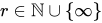
A parametric Cr-curve or a Cr-parametrization is a vector-valued function that is r-times continuously differentiable (that is, the component functions of γ are continuously differentiable), where , , and I is a non-empty interval of real numbers. The image of the parametric curve is . The parametric curve γ and its image γ[I] must be distinguished because a given subset of can be the image of many distinct parametric curves. The parameter t in γ(t) can be thought of as representing time, and γ the trajectory of a moving point in space. When I is a closed interval [a, b], γ(a) is called the starting point and γ(b) is the endpoint of γ. If the starting and the end points coincide (that is, γ(a) = γ(b)), then γ is a closed curve or a loop. To be a Cr-loop, the function γ must be r-times continuously differentiable and satisfy γ(k)(a) = γ(k)(b) for 0 ≤ k ≤ r.


![{\displaystyle \gamma [I]\subseteq \mathbb {R} ^{n}}](https://wikimedia.org/api/rest_v1/media/math/render/svg/27a675bd019e880d10ce7c4e1f744884fa8afab8)

The parametric curve is simple if is injective. It is analytic if each component function of γ is an analytic function, that is, it is of class Cω.

The curve γ is regular of order m (where m ≤ r) if, for every t ∈ I, is a linearly independent subset of . In particular, a parametric C1-curve γ is regular if and only if γ′(t) ≠ 0 for every t ∈ I.

Given the image of a parametric curve, there are several different parametrizations of the parametric curve. Differential geometry aims to describe the properties of parametric curves that are invariant under certain reparametrizations. A suitable equivalence relation on the set of all parametric curves must be defined. The differential-geometric properties of a parametric curve (such as its length, its Frenet frame, and its generalized curvature) are invariant under reparametrization and therefore properties of the equivalence class itself. The equivalence classes are called Cr-curves and are central objects studied in the differential geometry of curves.
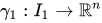
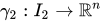
Two parametric Cr-curves, and , are said to be equivalent if and only if there exists a bijective Cr-map φ : I1 → I2 such that and γ2 is then said to be a re-parametrization of γ1.


Hub AI
Differentiable curve AI simulator
(@Differentiable curve_simulator)
Differentiable curve
Differential geometry of curves is the branch of geometry that deals with smooth curves in the plane and the Euclidean space by methods of differential and integral calculus.
Many specific curves have been thoroughly investigated using the synthetic approach. Differential geometry takes another approach: curves are represented in a parametrized form, and their geometric properties and various quantities associated with them, such as the curvature and the arc length, are expressed via derivatives and integrals using vector calculus. One of the most important tools used to analyze a curve is the Frenet frame, a moving frame that provides a coordinate system at each point of the curve that is "best adapted" to the curve near that point.
The theory of curves is much simpler and narrower in scope than the theory of surfaces and its higher-dimensional generalizations because a regular curve in a Euclidean space has no intrinsic geometry. Any regular curve may be parametrized by the arc length (the natural parametrization). From the point of view of a theoretical point particle on the curve that does not know anything about the ambient space, all curves would appear the same. Different space curves are only distinguished by how they bend and twist. Quantitatively, this is measured by the differential-geometric invariants called the curvature and the torsion of a curve. The fundamental theorem of curves asserts that the knowledge of these invariants completely determines the curve.
A parametric Cr-curve or a Cr-parametrization is a vector-valued function that is r-times continuously differentiable (that is, the component functions of γ are continuously differentiable), where , , and I is a non-empty interval of real numbers. The image of the parametric curve is . The parametric curve γ and its image γ[I] must be distinguished because a given subset of can be the image of many distinct parametric curves. The parameter t in γ(t) can be thought of as representing time, and γ the trajectory of a moving point in space. When I is a closed interval [a, b], γ(a) is called the starting point and γ(b) is the endpoint of γ. If the starting and the end points coincide (that is, γ(a) = γ(b)), then γ is a closed curve or a loop. To be a Cr-loop, the function γ must be r-times continuously differentiable and satisfy γ(k)(a) = γ(k)(b) for 0 ≤ k ≤ r.
The parametric curve is simple if is injective. It is analytic if each component function of γ is an analytic function, that is, it is of class Cω.
The curve γ is regular of order m (where m ≤ r) if, for every t ∈ I, is a linearly independent subset of . In particular, a parametric C1-curve γ is regular if and only if γ′(t) ≠ 0 for every t ∈ I.
Given the image of a parametric curve, there are several different parametrizations of the parametric curve. Differential geometry aims to describe the properties of parametric curves that are invariant under certain reparametrizations. A suitable equivalence relation on the set of all parametric curves must be defined. The differential-geometric properties of a parametric curve (such as its length, its Frenet frame, and its generalized curvature) are invariant under reparametrization and therefore properties of the equivalence class itself. The equivalence classes are called Cr-curves and are central objects studied in the differential geometry of curves.
Two parametric Cr-curves, and , are said to be equivalent if and only if there exists a bijective Cr-map φ : I1 → I2 such that and γ2 is then said to be a re-parametrization of γ1.