



Community hub
Recent from talks
Knowledge base stats:
Talk channels stats:
Members stats:
Diffraction-limited system
In optics, any optical instrument or system – a microscope, telescope, or camera – has a principal limit to its resolution due to the physics of diffraction. An optical instrument is said to be diffraction-limited if it has reached this limit of resolution performance. Other factors may affect an optical system's performance, such as lens imperfections or aberrations, but these are caused by errors in the manufacture or calculation of a lens, whereas the diffraction limit is the maximum resolution possible for a theoretically perfect, or ideal, optical system.
The diffraction-limited angular resolution, in radians, of an instrument is proportional to the wavelength of the light being observed, and inversely proportional to the diameter of its objective's entrance aperture. For telescopes with circular apertures, the size of the smallest feature in an image that is diffraction limited is the size of the Airy disk. As one decreases the size of the aperture of a telescopic lens, diffraction proportionately increases. At small apertures, such as f/22, most modern lenses are limited only by diffraction and not by aberrations or other imperfections in the construction.
For microscopic instruments, the diffraction-limited spatial resolution is proportional to the light wavelength, and to the numerical aperture of either the objective or the object illumination source, whichever is smaller.
In astronomy, a diffraction-limited observation is one that achieves the resolution of a theoretically ideal objective in the size of instrument used. However, most observations from Earth are seeing-limited due to atmospheric effects. Optical telescopes on the Earth work at a much lower resolution than the diffraction limit because of the distortion introduced by the passage of light through several kilometres of turbulent atmosphere. Advanced observatories have started using adaptive optics technology, resulting in greater image resolution for faint targets, but it is still difficult to reach the diffraction limit using adaptive optics.
Radio telescopes are frequently diffraction-limited, because the wavelengths they use (from millimeters to meters) are so long that the atmospheric distortion is negligible. Space-based telescopes (such as Hubble, or a number of non-optical telescopes) always work at their diffraction limit, if their design is free of optical aberration.
The beam from a laser with near-ideal beam propagation properties may be described as being diffraction-limited. A diffraction-limited laser beam, passed through diffraction-limited optics, will remain diffraction-limited, and will have a spatial or angular extent essentially equal to the resolution of the optics at the wavelength of the laser.
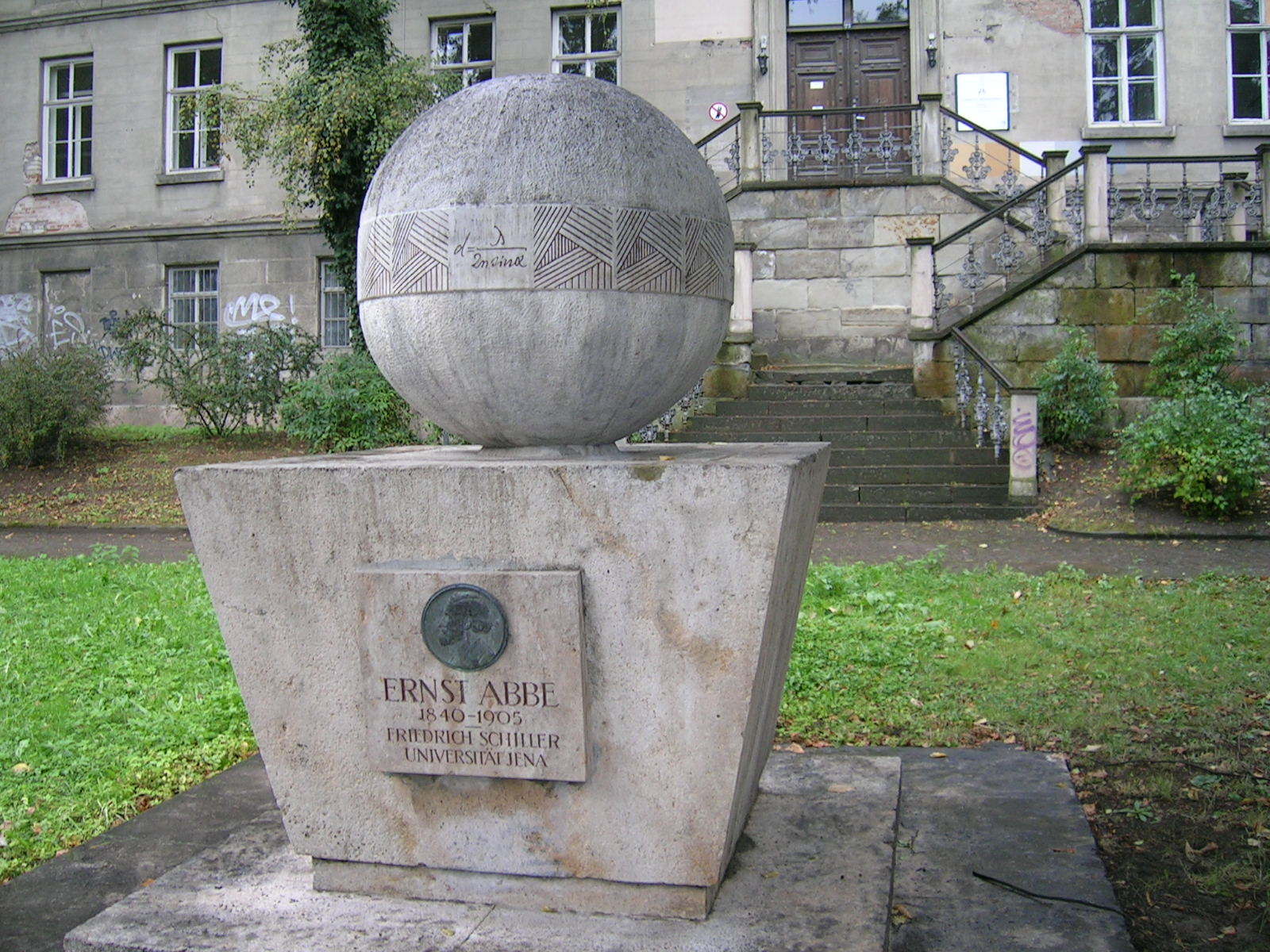
The observation of sub-wavelength structures with microscopes is difficult because of the Abbe diffraction limit. Ernst Abbe first mentioned the diffraction limit in his 1873 paper, page 466: „[…] die physikalische Unterscheidungsgrenze […] hängt allein vom Oeffnungswinkel ab und ist dem Sinus seines halben Betrages proportional“, or "[…] the physical limit of resolution […] depends solely on the aperture angle and is proportional to the sine of half its magnitude". Abbe wrote it in form of a formula in his 1882 paper, page 461: "The smallest dimensions which are within the reach of a given aperture are indicated with sufficient accuracy by taking the limit of the resolving or separating power of that aperture for periodic or regular structures, i.e. the minimum distance apart at which given elements can be delineated separately with the aperture in question. The numerical expression of that minimum distance is"
where is the wavelength, is the refractive index of the medium, and is the semi-angle of the light focused by the optical system. The same formula had been proven by Hermann von Helmholtz in 1874. The portion of the denominator is called the numerical aperture (NA) and can reach about 1.4–1.6 in modern optics, hence the Abbe limit is .


Hub AI
Diffraction-limited system AI simulator
(@Diffraction-limited system_simulator)
Diffraction-limited system
In optics, any optical instrument or system – a microscope, telescope, or camera – has a principal limit to its resolution due to the physics of diffraction. An optical instrument is said to be diffraction-limited if it has reached this limit of resolution performance. Other factors may affect an optical system's performance, such as lens imperfections or aberrations, but these are caused by errors in the manufacture or calculation of a lens, whereas the diffraction limit is the maximum resolution possible for a theoretically perfect, or ideal, optical system.
The diffraction-limited angular resolution, in radians, of an instrument is proportional to the wavelength of the light being observed, and inversely proportional to the diameter of its objective's entrance aperture. For telescopes with circular apertures, the size of the smallest feature in an image that is diffraction limited is the size of the Airy disk. As one decreases the size of the aperture of a telescopic lens, diffraction proportionately increases. At small apertures, such as f/22, most modern lenses are limited only by diffraction and not by aberrations or other imperfections in the construction.
For microscopic instruments, the diffraction-limited spatial resolution is proportional to the light wavelength, and to the numerical aperture of either the objective or the object illumination source, whichever is smaller.
In astronomy, a diffraction-limited observation is one that achieves the resolution of a theoretically ideal objective in the size of instrument used. However, most observations from Earth are seeing-limited due to atmospheric effects. Optical telescopes on the Earth work at a much lower resolution than the diffraction limit because of the distortion introduced by the passage of light through several kilometres of turbulent atmosphere. Advanced observatories have started using adaptive optics technology, resulting in greater image resolution for faint targets, but it is still difficult to reach the diffraction limit using adaptive optics.
Radio telescopes are frequently diffraction-limited, because the wavelengths they use (from millimeters to meters) are so long that the atmospheric distortion is negligible. Space-based telescopes (such as Hubble, or a number of non-optical telescopes) always work at their diffraction limit, if their design is free of optical aberration.
The beam from a laser with near-ideal beam propagation properties may be described as being diffraction-limited. A diffraction-limited laser beam, passed through diffraction-limited optics, will remain diffraction-limited, and will have a spatial or angular extent essentially equal to the resolution of the optics at the wavelength of the laser.
The observation of sub-wavelength structures with microscopes is difficult because of the Abbe diffraction limit. Ernst Abbe first mentioned the diffraction limit in his 1873 paper, page 466: „[…] die physikalische Unterscheidungsgrenze […] hängt allein vom Oeffnungswinkel ab und ist dem Sinus seines halben Betrages proportional“, or "[…] the physical limit of resolution […] depends solely on the aperture angle and is proportional to the sine of half its magnitude". Abbe wrote it in form of a formula in his 1882 paper, page 461: "The smallest dimensions which are within the reach of a given aperture are indicated with sufficient accuracy by taking the limit of the resolving or separating power of that aperture for periodic or regular structures, i.e. the minimum distance apart at which given elements can be delineated separately with the aperture in question. The numerical expression of that minimum distance is"
where is the wavelength, is the refractive index of the medium, and is the semi-angle of the light focused by the optical system. The same formula had been proven by Hermann von Helmholtz in 1874. The portion of the denominator is called the numerical aperture (NA) and can reach about 1.4–1.6 in modern optics, hence the Abbe limit is .