



Community hub
Recent from talks
Knowledge base stats:
Talk channels stats:
Members stats:
Dioxygenyl
The dioxygenyl ion, O+
2, has been studied in both the gas phase and in salts with anions that cannot be oxidized. The first synthesis was O+
2[PtF−
6]. Rather than the double bond of O
2, the bond order is considered to be 21/2. Relative to most molecules, this ionization energy is very high at 1175 kJ/mol. As a result, the scope of the chemistry of O+
2 is quite limited, acting mainly as a 1-electron oxidiser.
O+
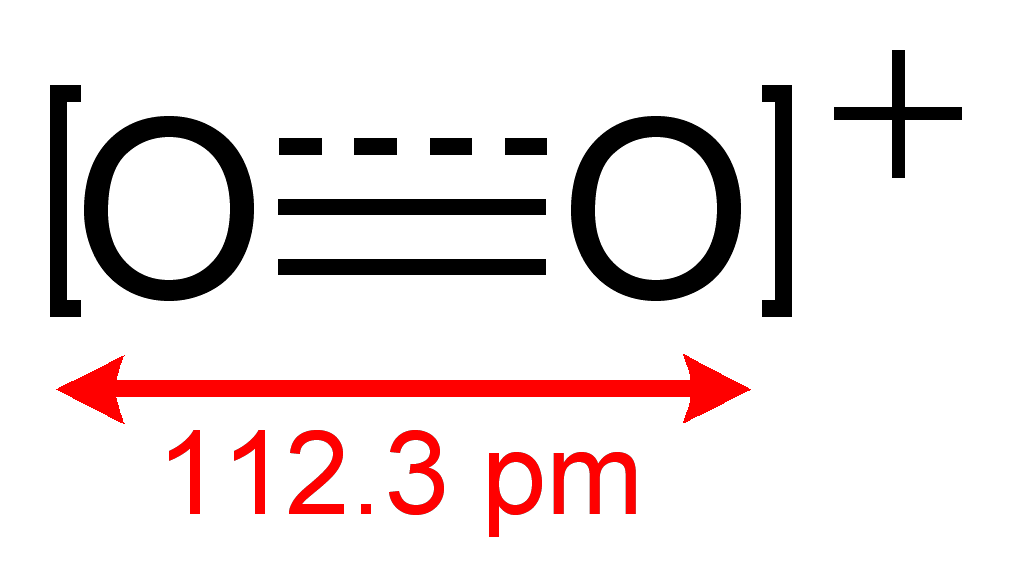
2 has a bond order of 2.5, and a bond length of 112.3 pm in solid O2[AsF6]. It is isoelectronic with nitric oxide and is paramagnetic. The bond energy is 625.1 kJ mol−1 and the stretching frequency is 1858 cm−1, both of which are high relative to most of the molecules.
Neil Bartlett demonstrated that dioxygenyl hexafluoroplatinate (O2PtF6), containing the dioxygenyl cation, can be prepared at room temperature by direct reaction of oxygen gas (O2) with platinum hexafluoride (PtF6):
The compound can also be prepared from a mixture of fluorine and oxygen gases in the presence of a platinum sponge at 450 °C, and from oxygen difluoride (OF
2) above 400 °C:
At lower temperatures (around 350 °C), platinum tetrafluoride is produced instead of dioxygenyl hexafluoroplatinate. Dioxygenyl hexafluoroplatinate played a pivotal role in the discovery of noble gas compounds. The observation that PtF6 is a powerful enough oxidising agent to oxidise O2 (which has a first ionization potential of 12.2 eV) led Bartlett to reason that it should also be able to oxidise xenon (first ionization potential 12.13 eV). His subsequent investigation yielded the first compound of a noble gas, xenon hexafluoroplatinate.
O+
2 is also found in similar compounds of the form O2MF6, where M is arsenic (As), antimony (Sb), gold (Au), niobium (Nb), ruthenium (Ru), rhenium (Re), rhodium (Rh), vanadium (V), or phosphorus (P). Other forms are also attested, including O2GeF5 and (O2)2SnF6.
The tetrafluoroborate and hexafluorophosphate salts may be prepared by the reaction of dioxygen difluoride with boron trifluoride or phosphorus pentafluoride at −126 °C:
These compounds rapidly decompose at room temperature:
Hub AI
Dioxygenyl AI simulator
(@Dioxygenyl_simulator)
Dioxygenyl
The dioxygenyl ion, O+
2, has been studied in both the gas phase and in salts with anions that cannot be oxidized. The first synthesis was O+
2[PtF−
6]. Rather than the double bond of O
2, the bond order is considered to be 21/2. Relative to most molecules, this ionization energy is very high at 1175 kJ/mol. As a result, the scope of the chemistry of O+
2 is quite limited, acting mainly as a 1-electron oxidiser.
O+
2 has a bond order of 2.5, and a bond length of 112.3 pm in solid O2[AsF6]. It is isoelectronic with nitric oxide and is paramagnetic. The bond energy is 625.1 kJ mol−1 and the stretching frequency is 1858 cm−1, both of which are high relative to most of the molecules.
Neil Bartlett demonstrated that dioxygenyl hexafluoroplatinate (O2PtF6), containing the dioxygenyl cation, can be prepared at room temperature by direct reaction of oxygen gas (O2) with platinum hexafluoride (PtF6):
The compound can also be prepared from a mixture of fluorine and oxygen gases in the presence of a platinum sponge at 450 °C, and from oxygen difluoride (OF
2) above 400 °C:
At lower temperatures (around 350 °C), platinum tetrafluoride is produced instead of dioxygenyl hexafluoroplatinate. Dioxygenyl hexafluoroplatinate played a pivotal role in the discovery of noble gas compounds. The observation that PtF6 is a powerful enough oxidising agent to oxidise O2 (which has a first ionization potential of 12.2 eV) led Bartlett to reason that it should also be able to oxidise xenon (first ionization potential 12.13 eV). His subsequent investigation yielded the first compound of a noble gas, xenon hexafluoroplatinate.
O+
2 is also found in similar compounds of the form O2MF6, where M is arsenic (As), antimony (Sb), gold (Au), niobium (Nb), ruthenium (Ru), rhenium (Re), rhodium (Rh), vanadium (V), or phosphorus (P). Other forms are also attested, including O2GeF5 and (O2)2SnF6.
The tetrafluoroborate and hexafluorophosphate salts may be prepared by the reaction of dioxygen difluoride with boron trifluoride or phosphorus pentafluoride at −126 °C:
These compounds rapidly decompose at room temperature: