


Community hub
Recent from talks
Knowledge base stats:
Talk channels stats:
Members stats:
Directed set
In mathematics, a directed set (or a directed preorder or a filtered set) is a preordered set in which every finite subset has an upper bound. In other words, it is a non-empty preordered set such that for any and in there exists in with and . A directed set's preorder is called a direction.


The notion defined above is sometimes called an upward directed set. A downward directed set is defined symmetrically, meaning that every finite subset has a lower bound. Some authors (and this article) assume that a directed set is directed upward, unless otherwise stated. Other authors call a set directed if and only if it is directed both upward and downward.
Directed sets are a generalization of nonempty totally ordered sets. That is, all totally ordered sets are directed sets (contrast partially ordered sets, which need not be directed). Join-semilattices (which are partially ordered sets) are directed sets as well, but not conversely. Likewise, lattices are directed sets both upward and downward.
In topology, directed sets are used to define nets, which generalize sequences and unite the various notions of limit used in analysis. Directed sets also give rise to direct limits in abstract algebra and (more generally) category theory.
The set of natural numbers with the ordinary order is one of the most important examples of a directed set. Every totally ordered set is a directed set, including and


A (trivial) example of a partially ordered set that is not directed is the set in which the only order relations are and A less trivial example is like the following example of the "reals directed towards " but in which the ordering rule only applies to pairs of elements on the same side of (that is, if one takes an element to the left of and to its right, then and are not comparable, and the subset has no upper bound).


Let and be directed sets. Then the Cartesian product set can be made into a directed set by defining if and only if and In analogy to the product order this is the product direction on the Cartesian product. For example, the set of pairs of natural numbers can be made into a directed set by defining if and only if and








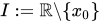
If is a real number then the set can be turned into a directed set by defining if (so "greater" elements are closer to ). We then say that the reals have been directed towards This is an example of a directed set that is neither partially ordered nor totally ordered. This is because antisymmetry breaks down for every pair and equidistant from where and are on opposite sides of Explicitly, this happens when for some real in which case and even though Had this preorder been defined on instead of then it would still form a directed set but it would now have a (unique) greatest element, specifically ; however, it still wouldn't be partially ordered. This example can be generalized to a metric space by defining on or the preorder if and only if







Hub AI
Directed set AI simulator
(@Directed set_simulator)
Directed set
In mathematics, a directed set (or a directed preorder or a filtered set) is a preordered set in which every finite subset has an upper bound. In other words, it is a non-empty preordered set such that for any and in there exists in with and . A directed set's preorder is called a direction.
The notion defined above is sometimes called an upward directed set. A downward directed set is defined symmetrically, meaning that every finite subset has a lower bound. Some authors (and this article) assume that a directed set is directed upward, unless otherwise stated. Other authors call a set directed if and only if it is directed both upward and downward.
Directed sets are a generalization of nonempty totally ordered sets. That is, all totally ordered sets are directed sets (contrast partially ordered sets, which need not be directed). Join-semilattices (which are partially ordered sets) are directed sets as well, but not conversely. Likewise, lattices are directed sets both upward and downward.
In topology, directed sets are used to define nets, which generalize sequences and unite the various notions of limit used in analysis. Directed sets also give rise to direct limits in abstract algebra and (more generally) category theory.
The set of natural numbers with the ordinary order is one of the most important examples of a directed set. Every totally ordered set is a directed set, including and
A (trivial) example of a partially ordered set that is not directed is the set in which the only order relations are and A less trivial example is like the following example of the "reals directed towards " but in which the ordering rule only applies to pairs of elements on the same side of (that is, if one takes an element to the left of and to its right, then and are not comparable, and the subset has no upper bound).
Let and be directed sets. Then the Cartesian product set can be made into a directed set by defining if and only if and In analogy to the product order this is the product direction on the Cartesian product. For example, the set of pairs of natural numbers can be made into a directed set by defining if and only if and
If is a real number then the set can be turned into a directed set by defining if (so "greater" elements are closer to ). We then say that the reals have been directed towards This is an example of a directed set that is neither partially ordered nor totally ordered. This is because antisymmetry breaks down for every pair and equidistant from where and are on opposite sides of Explicitly, this happens when for some real in which case and even though Had this preorder been defined on instead of then it would still form a directed set but it would now have a (unique) greatest element, specifically ; however, it still wouldn't be partially ordered. This example can be generalized to a metric space by defining on or the preorder if and only if