


Community hub
Recent from talks
Knowledge base stats:
Talk channels stats:
Members stats:
Discontinuous linear map
In mathematics, linear maps form an important class of "simple" functions which preserve the algebraic structure of linear spaces and are often used as approximations to more general functions (see linear approximation). If the spaces involved are also topological spaces (that is, topological vector spaces), then it makes sense to ask whether all linear maps are continuous. It turns out that for maps defined on infinite-dimensional topological vector spaces (e.g., infinite-dimensional normed spaces), the answer is generally no: there exist discontinuous linear maps. If the domain of definition is complete, it is trickier; such maps can be proven to exist, but the proof relies on the axiom of choice and does not provide an explicit example.
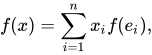
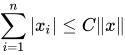
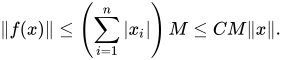
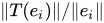
Let X and Y be two normed spaces and a linear map from X to Y. If X is finite-dimensional, choose a basis in X which may be taken to be unit vectors. Then, and so by the triangle inequality, Letting and using the fact that for some C>0 which follows from the fact that any two norms on a finite-dimensional space are equivalent, one finds Thus, is a bounded linear operator and so is continuous. In fact, to see this, simply note that f is linear, and therefore for some universal constant K. Thus for any we can choose so that ( and are the normed balls around and ), which gives continuity.



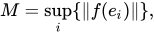







If X is infinite-dimensional, this proof will fail as there is no guarantee that the supremum M exists. If Y is the zero space {0}, the only map between X and Y is the zero map which is trivially continuous. In all other cases, when X is infinite-dimensional and Y is not the zero space, one can find a discontinuous map from X to Y.
Examples of discontinuous linear maps are easy to construct in spaces that are not complete; on any Cauchy sequence of linearly independent vectors which does not have a limit, there is a linear operator such that the quantities grow without bound. In a sense, the linear operators are not continuous because the space has "holes".


For example, consider the space of real-valued smooth functions on the interval [0, 1] with the uniform norm, that is, The derivative-at-a-point map, given by defined on and with real values, is linear, but not continuous. Indeed, consider the sequence for . This sequence converges uniformly to the constantly zero function, but

![{\displaystyle \|f\|=\sup _{x\in [0,1]}|f(x)|.}](https://wikimedia.org/api/rest_v1/media/math/render/svg/6a7b7e26b4ccc60dfb8e33c20f826b80fe94d819)
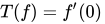
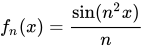


as instead of , as would hold for a continuous map. Note that is real-valued, and so is actually a linear functional on (an element of the algebraic dual space ). The linear map which assigns to each function its derivative is similarly discontinuous. Note that although the derivative operator is not continuous, it is closed.




The fact that the domain is not complete here is important: discontinuous operators on complete spaces require a little more work.
An algebraic basis for the real numbers as a vector space over the rationals is known as a Hamel basis (note that some authors use this term in a broader sense to mean an algebraic basis of any vector space). Note that any two noncommensurable numbers, say 1 and , are linearly independent. One may find a Hamel basis containing them, and define a map so that f acts as the identity on the rest of the Hamel basis, and extend to all of by linearity. Let {rn}n be any sequence of rationals which converges to . Then limn f(rn) = π, but By construction, f is linear over (not over ), but not continuous. Note that f is also not measurable; an additive real function is linear if and only if it is measurable, so for every such function there is a Vitali set. The construction of f relies on the axiom of choice.


Hub AI
Discontinuous linear map AI simulator
(@Discontinuous linear map_simulator)
Discontinuous linear map
In mathematics, linear maps form an important class of "simple" functions which preserve the algebraic structure of linear spaces and are often used as approximations to more general functions (see linear approximation). If the spaces involved are also topological spaces (that is, topological vector spaces), then it makes sense to ask whether all linear maps are continuous. It turns out that for maps defined on infinite-dimensional topological vector spaces (e.g., infinite-dimensional normed spaces), the answer is generally no: there exist discontinuous linear maps. If the domain of definition is complete, it is trickier; such maps can be proven to exist, but the proof relies on the axiom of choice and does not provide an explicit example.
Let X and Y be two normed spaces and a linear map from X to Y. If X is finite-dimensional, choose a basis in X which may be taken to be unit vectors. Then, and so by the triangle inequality, Letting and using the fact that for some C>0 which follows from the fact that any two norms on a finite-dimensional space are equivalent, one finds Thus, is a bounded linear operator and so is continuous. In fact, to see this, simply note that f is linear, and therefore for some universal constant K. Thus for any we can choose so that ( and are the normed balls around and ), which gives continuity.
If X is infinite-dimensional, this proof will fail as there is no guarantee that the supremum M exists. If Y is the zero space {0}, the only map between X and Y is the zero map which is trivially continuous. In all other cases, when X is infinite-dimensional and Y is not the zero space, one can find a discontinuous map from X to Y.
Examples of discontinuous linear maps are easy to construct in spaces that are not complete; on any Cauchy sequence of linearly independent vectors which does not have a limit, there is a linear operator such that the quantities grow without bound. In a sense, the linear operators are not continuous because the space has "holes".
For example, consider the space of real-valued smooth functions on the interval [0, 1] with the uniform norm, that is, The derivative-at-a-point map, given by defined on and with real values, is linear, but not continuous. Indeed, consider the sequence for . This sequence converges uniformly to the constantly zero function, but
as instead of , as would hold for a continuous map. Note that is real-valued, and so is actually a linear functional on (an element of the algebraic dual space ). The linear map which assigns to each function its derivative is similarly discontinuous. Note that although the derivative operator is not continuous, it is closed.
The fact that the domain is not complete here is important: discontinuous operators on complete spaces require a little more work.
An algebraic basis for the real numbers as a vector space over the rationals is known as a Hamel basis (note that some authors use this term in a broader sense to mean an algebraic basis of any vector space). Note that any two noncommensurable numbers, say 1 and , are linearly independent. One may find a Hamel basis containing them, and define a map so that f acts as the identity on the rest of the Hamel basis, and extend to all of by linearity. Let {rn}n be any sequence of rationals which converges to . Then limn f(rn) = π, but By construction, f is linear over (not over ), but not continuous. Note that f is also not measurable; an additive real function is linear if and only if it is measurable, so for every such function there is a Vitali set. The construction of f relies on the axiom of choice.