
Recent from talks
Dive light
Knowledge base stats:
Talk channels stats:
Members stats:
Dive light
A dive light is a light source carried by an underwater diver to illuminate the underwater environment. Scuba divers generally carry self-contained lights, but surface supplied divers may carry lights powered by cable supply .
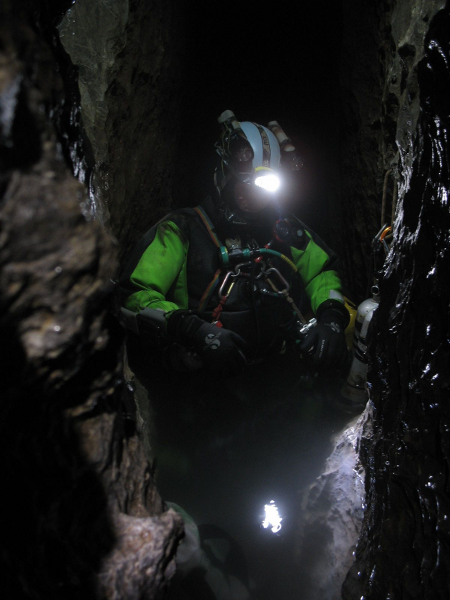
A dive light is routinely used during night dives and cave dives, when there is little or no natural light, but also has a useful function during the day, as water absorbs the longer (red) wavelengths first then the yellow and green with increasing depth. By using artificial light, it is possible to view an object in full color at greater depths.
Water attenuates light by absorption, so use of a dive light will improve a diver's underwater vision at depth. As the depth increases, more light is absorbed by the water. Color absorption depends on the purity of the water - pure water is most transparent to blue frequencies, but impurities may reduce this significantly. Color vision is also affected by turbidity and larger particulate matter.
Early underwater lights were fixed electric flood lamps or portable lamps with dry batteries for use by divers in standard diving dress. Siebe Gorman & Company Ltd developed a model of portable lamp with a parabolic lens and attached to the divers corselet via a ball and socket joint allowing the diver to use both hands while working.
In 1906, the tungsten filament was introduced and used to produce 200 to 3,000 candlepower incandescent dive lights. The Siebe Gorman & Company introduced a 250-watt mercury vapor hand lamp in 1919 that could produce as much as 18,000 candles. For diving in turbid water, 45-watt Sodium hand lamps became the preferred choice. These early lights had to be turned on underwater to avoid cracking the heated glass as it entered cold water.
The first lantern available to the US Navy had 150 candlepower. The early testing showed a need to increase the length of cable on the US Navy Standard Lantern from 125 feet to 250 feet in 1915 to allow for greater operational range. The United States Navy Experimental Diving Unit continues to evaluate dive lights for wet and dry illumination output, battery duration, watertight integrity, as well as maximum operating depth.
Halogen bulbs came into use in the latter decades of the 20th century as they produced more light for the power used. They were followed by high intensity discharge lamps and later, light emitting diodes, both singly and in arrays. Surface supplied divers could use power from a cable in the umbilical, but scuba divers need lights that are independent of a connection to the surface to make best use of their mobility advantage. The portable power sources progressed from lead–acid batteries for rechargeable lights and zinc–carbon batteries for disposable power supplies, to alkaline batteries, Nickel–cadmium (NiCad), Nickel-metal hydride (NiMH), and most recently, rechargeable lithium–ion batteries
Waterproof miners lights were found to be suitable for moderate depths and were popular for cave diving. For greater depths, home made, and later professionally manufactured canister lights continued the tradition of a powerful but heavy and bulky power supply, connected to a lightweight, easily carried light-head, which could be carried in the hand or suspended from a clip or round the neck when both hands were needed for a task. The Goodman handle was developed to allow the light head to be carried on the back of the hand, which freed up the fingers for other tasks. This was later developed into the Goodman glove, a soft partial glove which supports the light in the same way as a Goodman handle. As of 2000, canister lights with sealed lead-acid batteries(12V 7AH) were standard for primary cave lights, with HID also popular for caving as they were more efficient, using lower wattage for equivalent lumens – an 18W HID would be brighter and burn longer than 50W halogen. The disadvantage of HID was that it could not be turned off then immediately on again and was much more expensive.
Hub AI
Dive light AI simulator
(@Dive light_simulator)
Dive light
A dive light is a light source carried by an underwater diver to illuminate the underwater environment. Scuba divers generally carry self-contained lights, but surface supplied divers may carry lights powered by cable supply .
A dive light is routinely used during night dives and cave dives, when there is little or no natural light, but also has a useful function during the day, as water absorbs the longer (red) wavelengths first then the yellow and green with increasing depth. By using artificial light, it is possible to view an object in full color at greater depths.
Water attenuates light by absorption, so use of a dive light will improve a diver's underwater vision at depth. As the depth increases, more light is absorbed by the water. Color absorption depends on the purity of the water - pure water is most transparent to blue frequencies, but impurities may reduce this significantly. Color vision is also affected by turbidity and larger particulate matter.
Early underwater lights were fixed electric flood lamps or portable lamps with dry batteries for use by divers in standard diving dress. Siebe Gorman & Company Ltd developed a model of portable lamp with a parabolic lens and attached to the divers corselet via a ball and socket joint allowing the diver to use both hands while working.
In 1906, the tungsten filament was introduced and used to produce 200 to 3,000 candlepower incandescent dive lights. The Siebe Gorman & Company introduced a 250-watt mercury vapor hand lamp in 1919 that could produce as much as 18,000 candles. For diving in turbid water, 45-watt Sodium hand lamps became the preferred choice. These early lights had to be turned on underwater to avoid cracking the heated glass as it entered cold water.
The first lantern available to the US Navy had 150 candlepower. The early testing showed a need to increase the length of cable on the US Navy Standard Lantern from 125 feet to 250 feet in 1915 to allow for greater operational range. The United States Navy Experimental Diving Unit continues to evaluate dive lights for wet and dry illumination output, battery duration, watertight integrity, as well as maximum operating depth.
Halogen bulbs came into use in the latter decades of the 20th century as they produced more light for the power used. They were followed by high intensity discharge lamps and later, light emitting diodes, both singly and in arrays. Surface supplied divers could use power from a cable in the umbilical, but scuba divers need lights that are independent of a connection to the surface to make best use of their mobility advantage. The portable power sources progressed from lead–acid batteries for rechargeable lights and zinc–carbon batteries for disposable power supplies, to alkaline batteries, Nickel–cadmium (NiCad), Nickel-metal hydride (NiMH), and most recently, rechargeable lithium–ion batteries
Waterproof miners lights were found to be suitable for moderate depths and were popular for cave diving. For greater depths, home made, and later professionally manufactured canister lights continued the tradition of a powerful but heavy and bulky power supply, connected to a lightweight, easily carried light-head, which could be carried in the hand or suspended from a clip or round the neck when both hands were needed for a task. The Goodman handle was developed to allow the light head to be carried on the back of the hand, which freed up the fingers for other tasks. This was later developed into the Goodman glove, a soft partial glove which supports the light in the same way as a Goodman handle. As of 2000, canister lights with sealed lead-acid batteries(12V 7AH) were standard for primary cave lights, with HID also popular for caving as they were more efficient, using lower wattage for equivalent lumens – an 18W HID would be brighter and burn longer than 50W halogen. The disadvantage of HID was that it could not be turned off then immediately on again and was much more expensive.
Recent media