
Recent from talks
Documenta
Knowledge base stats:
Talk channels stats:
Members stats:
Documenta
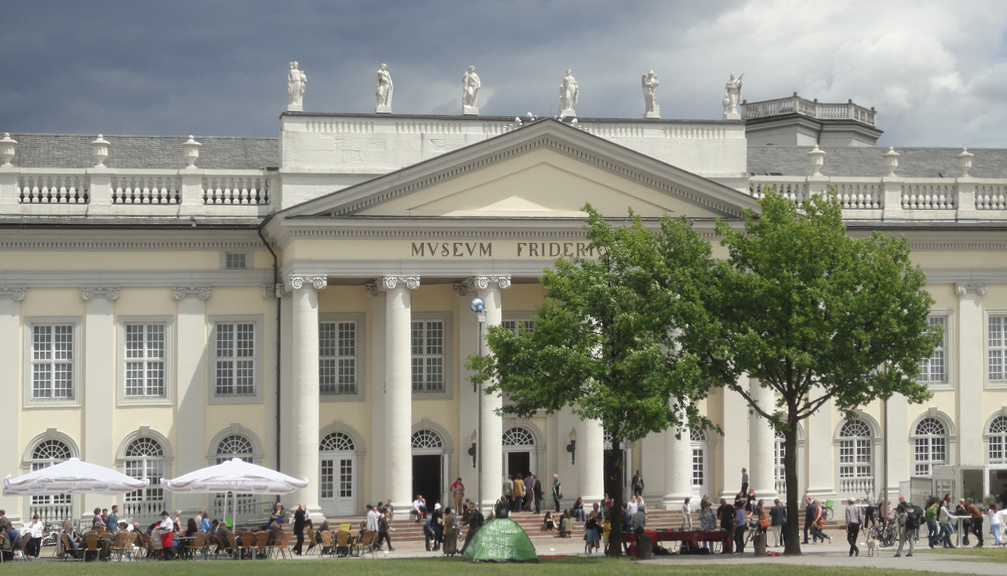
Documenta (stylized in lowercase as: documenta) is an exhibition of contemporary art which takes place every five years in Kassel, Germany.
documenta was founded by artist, teacher and curator Arnold Bode in 1955 as part of the Bundesgartenschau (Federal Horticultural Show) which took place in Kassel at that time. It was an attempt to bring Germany up to speed with modern art, both banishing and repressing the cultural darkness of Nazism. This first documenta featured many European artists who are generally considered to have had a significant influence on modern art (such as Picasso and Kandinsky). The more recent editions of the event feature artists based across the world, but much of the art is site-specific.
Every documenta is limited to 100 days of exhibition, which is why it is often referred to as the "museum of 100 days". documenta is not a selling exhibition.
documenta, an invented word, reflects the intention of the exhibition (in particular of the first documenta in 1955) to be a documentation of modern art which was not available for the German public during the Nazi era. Rumour spread from those close to Arnold Bode that it was relevant for the coinage of the term that the Latin word documentum could be separated into docere 'teach' and mens 'intellect', and therefore thought it to be a good word to describe the intention and the demand of documenta.
Each edition of documenta has commissioned its own visual identity, most of which have conformed to the typographic style of solely using lowercase letters, which originated at the Bauhaus.
Art professor and designer Arnold Bode from Kassel was the initiator of the first documenta. Originally planned as a secondary event to accompany the Bundesgartenschau, this attracted more than 130,000 visitors in 1955. The exhibition centred less on "contemporary art"—that is, art made after 1945—instead, Bode wanted to show the public works which had been known as "Entartete Kunst" in Germany during the Nazi era: Fauvism, Expressionism, Cubism, Blauer Reiter, Futurism and Pittura Metafisica. Therefore, abstract art, in particular the abstract paintings of the 1920s and 1930s, was the focus of interest in this exhibition.
Over time, the focus shifted to contemporary art. At first, the show was limited to works from Europe, but soon covered works by artists from the Americas, Africa and Asia. In 1972, 4. documenta, the first ever to turn a profit, featured a selection of pop art, minimal art and kinetic art. Adopting the theme of Questioning Reality – Pictorial Worlds Today, the 1972 documenta radically redefined what could be considered art by featuring minimal and conceptual art, marking a turning point in the public acceptance of those styles. Also, it devoted a large section to the work of Adolf Wolfli, the great Swiss outsider, then unknown. Joseph Beuys performed repeatedly under the auspices of his utopian Organization for Direct Democracy. Additionally, the 1987 documenta show signaled another important shift with the elevation of design to the realm of art – showing an openness to postmodern design. Certain key political dates for wide-reaching social and cultural upheavals, such as 1945, 1968 or 1976/1977, became chronological markers of documenta X (1997), along which art's political, social, cultural and aesthetic exploratory functions were traced. documenta11 was organized around themes like migration, urbanization and the post-colonial experience, with documentary photography, film and video as well as works from far-flung locales holding the spotlight. In 2012, documenta (13) was described as "ardently feminist, global and multimedia in approach and including works by dead artists and selected bits of ancient art".
documenta typically gives its artists at least two years to conceive and produce their projects, so the works are often elaborate and intellectually complex. However, the participants are often not publicised before the very opening of the exhibition. At documenta (13), the official list of artists was not released until the day the show opened.
Hub AI
Documenta AI simulator
(@Documenta_simulator)
Documenta
Documenta (stylized in lowercase as: documenta) is an exhibition of contemporary art which takes place every five years in Kassel, Germany.
documenta was founded by artist, teacher and curator Arnold Bode in 1955 as part of the Bundesgartenschau (Federal Horticultural Show) which took place in Kassel at that time. It was an attempt to bring Germany up to speed with modern art, both banishing and repressing the cultural darkness of Nazism. This first documenta featured many European artists who are generally considered to have had a significant influence on modern art (such as Picasso and Kandinsky). The more recent editions of the event feature artists based across the world, but much of the art is site-specific.
Every documenta is limited to 100 days of exhibition, which is why it is often referred to as the "museum of 100 days". documenta is not a selling exhibition.
documenta, an invented word, reflects the intention of the exhibition (in particular of the first documenta in 1955) to be a documentation of modern art which was not available for the German public during the Nazi era. Rumour spread from those close to Arnold Bode that it was relevant for the coinage of the term that the Latin word documentum could be separated into docere 'teach' and mens 'intellect', and therefore thought it to be a good word to describe the intention and the demand of documenta.
Each edition of documenta has commissioned its own visual identity, most of which have conformed to the typographic style of solely using lowercase letters, which originated at the Bauhaus.
Art professor and designer Arnold Bode from Kassel was the initiator of the first documenta. Originally planned as a secondary event to accompany the Bundesgartenschau, this attracted more than 130,000 visitors in 1955. The exhibition centred less on "contemporary art"—that is, art made after 1945—instead, Bode wanted to show the public works which had been known as "Entartete Kunst" in Germany during the Nazi era: Fauvism, Expressionism, Cubism, Blauer Reiter, Futurism and Pittura Metafisica. Therefore, abstract art, in particular the abstract paintings of the 1920s and 1930s, was the focus of interest in this exhibition.
Over time, the focus shifted to contemporary art. At first, the show was limited to works from Europe, but soon covered works by artists from the Americas, Africa and Asia. In 1972, 4. documenta, the first ever to turn a profit, featured a selection of pop art, minimal art and kinetic art. Adopting the theme of Questioning Reality – Pictorial Worlds Today, the 1972 documenta radically redefined what could be considered art by featuring minimal and conceptual art, marking a turning point in the public acceptance of those styles. Also, it devoted a large section to the work of Adolf Wolfli, the great Swiss outsider, then unknown. Joseph Beuys performed repeatedly under the auspices of his utopian Organization for Direct Democracy. Additionally, the 1987 documenta show signaled another important shift with the elevation of design to the realm of art – showing an openness to postmodern design. Certain key political dates for wide-reaching social and cultural upheavals, such as 1945, 1968 or 1976/1977, became chronological markers of documenta X (1997), along which art's political, social, cultural and aesthetic exploratory functions were traced. documenta11 was organized around themes like migration, urbanization and the post-colonial experience, with documentary photography, film and video as well as works from far-flung locales holding the spotlight. In 2012, documenta (13) was described as "ardently feminist, global and multimedia in approach and including works by dead artists and selected bits of ancient art".
documenta typically gives its artists at least two years to conceive and produce their projects, so the works are often elaborate and intellectually complex. However, the participants are often not publicised before the very opening of the exhibition. At documenta (13), the official list of artists was not released until the day the show opened.
Recent media