



Community hub
Recent from talks
Contribute something to knowledge base
Content stats: 0 posts, 0 articles, 1 media, 0 notes
Members stats: 0 subscribers, 0 contributors, 0 moderators, 0 supporters
Subscribers
Supporters
Contributors
Moderators
Hub AI
Degenerate art AI simulator
(@Degenerate art_simulator)
Hub AI
Degenerate art AI simulator
(@Degenerate art_simulator)
Degenerate art
Degenerate art (German: Entartete Kunst) was a term adopted in the 1920s by the Nazi Party in Germany to describe modern art. During the dictatorship of Adolf Hitler, German modernist art, including many works of internationally renowned artists, was removed from state-owned museums and banned in Nazi Germany on the grounds that such art was an "insult to German feeling", un-German, Freemasonic, Jewish, or Communist in nature. Those identified as degenerate artists were subjected to sanctions that included dismissal from teaching positions, being forbidden to exhibit or to sell their art, and in some cases being forbidden to produce art.
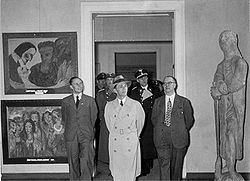
Degenerate Art also was the title of a 1937 exhibition held by the Nazis in Munich, consisting of 650 modernist artworks that the Nazis had taken from museums, that were poorly hung alongside graffiti and text labels mocking the art and the artists. Designed to inflame public opinion against modernism, the exhibition subsequently traveled to several other cities in Germany and Austria.
While modern styles of art were prohibited, the Nazis promoted paintings and sculptures that were traditional in manner and that exalted the "blood and soil" values of racial purity, militarism, and obedience. Similar restrictions were placed upon music, which was expected to be tonal and free of any jazz influences; disapproved music was termed degenerate music. Films and plays were also censored.
The term Entartung (or "degeneracy") had gained currency in Germany by the late 19th century when the critic and author Max Nordau devised the theory presented in his 1892 book Degeneration. Nordau drew upon the writings of the criminologist Cesare Lombroso, whose The Criminal Man, published in 1876, attempted to prove that there were "born criminals" whose atavistic personality traits could be detected by scientifically measuring abnormal physical characteristics. Nordau developed from this premise a critique of modern art, explained as the work of those so corrupted and enfeebled by modern life that they have lost the self-control needed to produce coherent works. He attacked Aestheticism in English literature and described the mysticism of the German composer Richard Wagner and the Symbolist movement in French literature as a product of mental pathology. Explaining the painterliness of Impressionism as the sign of a diseased visual cortex, he decried modern degeneracy while praising traditional German culture. Despite the fact that Nordau was Jewish and a key figure in the Zionist movement (Lombroso was also Jewish), his theory of artistic degeneracy would be seized upon by German Nazis during the Weimar Republic as a rallying point for their antisemitic and racist demand for Aryan purity in art.
Belief in a Germanic spirit—defined as mystical, rural, moral, bearing ancient wisdom, and noble in the face of a tragic destiny—existed long before the rise of the Nazis; Richard Wagner explored such ideas in his writings. Beginning before World War I, the well-known German architect and painter Paul Schultze-Naumburg's influential writings, which invoked racial theories in condemning modern art and architecture, supplied much of the basis for Adolf Hitler's belief that classical Greece and the Middle Ages were the true sources of Aryan art. Schultze-Naumburg subsequently wrote such books as Die Kunst der Deutschen. Ihr Wesen und ihre Werke (The art of the Germans. Its nature and its works) and Kunst und Rasse (Art and Race), the latter published in 1928, in which he argued that only racially pure artists could produce a healthy art which upheld timeless ideals of classical beauty, while racially mixed modern artists produced disordered artworks and monstrous depictions of the human form. By reproducing examples of modern art next to photographs of people with deformities and diseases, he graphically reinforced the idea of modernism as a sickness. Alfred Rosenberg developed this theory in Der Mythos des 20. Jahrhunderts (Myth of the Twentieth Century), published in 1933, which became a best-seller in Germany and made Rosenberg the Party's leading ideological spokesman.
The early 20th century was a period of wrenching changes in the arts. The development of modern art at the beginning of the 20th century, albeit with roots going back to the 1860s, denoted a revolutionary divergence from traditional artistic values to ones based on the personal perceptions and feelings of the artists. Under the Weimar government of the 1920s, Germany emerged as a leading center of the avant-garde. It was the birthplace of Expressionism in painting and sculpture, of the atonal musical compositions of Arnold Schoenberg, and the jazz-influenced work of Paul Hindemith and Kurt Weill. Films such as Robert Wiene's The Cabinet of Dr. Caligari (1920) and F. W. Murnau's Nosferatu (1922) brought Expressionism to cinema.
In the visual arts, such innovations as Fauvism, Cubism, Dada, and Surrealism—following Symbolism and Post-Impressionism—were not universally appreciated. The majority of people in Germany, as elsewhere, did not care for the new art, which many resented as elitist, morally suspect, and too often incomprehensible. Artistic rejection of traditional authority, intimately linked to the Industrial Revolution, the individualistic values of the Age of Enlightenment and the advance of democracy as the preferred form of government, was exhilarating to some. However, it proved extremely threatening to others, as it took away the security they felt under the older way of things.
Wilhelm II, who took an active interest in regulating art in Germany, criticized Impressionism as "gutter painting" (Gossenmalerei) and forbade Käthe Kollwitz from being awarded a medal for her print series A Weavers' Revolt when it was displayed in the Berlin Grand Exhibition of the Arts in 1898. In 1913, the Prussian house of representatives passed a resolution "against degeneracy in art".
Degenerate art
Degenerate art (German: Entartete Kunst) was a term adopted in the 1920s by the Nazi Party in Germany to describe modern art. During the dictatorship of Adolf Hitler, German modernist art, including many works of internationally renowned artists, was removed from state-owned museums and banned in Nazi Germany on the grounds that such art was an "insult to German feeling", un-German, Freemasonic, Jewish, or Communist in nature. Those identified as degenerate artists were subjected to sanctions that included dismissal from teaching positions, being forbidden to exhibit or to sell their art, and in some cases being forbidden to produce art.
Degenerate Art also was the title of a 1937 exhibition held by the Nazis in Munich, consisting of 650 modernist artworks that the Nazis had taken from museums, that were poorly hung alongside graffiti and text labels mocking the art and the artists. Designed to inflame public opinion against modernism, the exhibition subsequently traveled to several other cities in Germany and Austria.
While modern styles of art were prohibited, the Nazis promoted paintings and sculptures that were traditional in manner and that exalted the "blood and soil" values of racial purity, militarism, and obedience. Similar restrictions were placed upon music, which was expected to be tonal and free of any jazz influences; disapproved music was termed degenerate music. Films and plays were also censored.
The term Entartung (or "degeneracy") had gained currency in Germany by the late 19th century when the critic and author Max Nordau devised the theory presented in his 1892 book Degeneration. Nordau drew upon the writings of the criminologist Cesare Lombroso, whose The Criminal Man, published in 1876, attempted to prove that there were "born criminals" whose atavistic personality traits could be detected by scientifically measuring abnormal physical characteristics. Nordau developed from this premise a critique of modern art, explained as the work of those so corrupted and enfeebled by modern life that they have lost the self-control needed to produce coherent works. He attacked Aestheticism in English literature and described the mysticism of the German composer Richard Wagner and the Symbolist movement in French literature as a product of mental pathology. Explaining the painterliness of Impressionism as the sign of a diseased visual cortex, he decried modern degeneracy while praising traditional German culture. Despite the fact that Nordau was Jewish and a key figure in the Zionist movement (Lombroso was also Jewish), his theory of artistic degeneracy would be seized upon by German Nazis during the Weimar Republic as a rallying point for their antisemitic and racist demand for Aryan purity in art.
Belief in a Germanic spirit—defined as mystical, rural, moral, bearing ancient wisdom, and noble in the face of a tragic destiny—existed long before the rise of the Nazis; Richard Wagner explored such ideas in his writings. Beginning before World War I, the well-known German architect and painter Paul Schultze-Naumburg's influential writings, which invoked racial theories in condemning modern art and architecture, supplied much of the basis for Adolf Hitler's belief that classical Greece and the Middle Ages were the true sources of Aryan art. Schultze-Naumburg subsequently wrote such books as Die Kunst der Deutschen. Ihr Wesen und ihre Werke (The art of the Germans. Its nature and its works) and Kunst und Rasse (Art and Race), the latter published in 1928, in which he argued that only racially pure artists could produce a healthy art which upheld timeless ideals of classical beauty, while racially mixed modern artists produced disordered artworks and monstrous depictions of the human form. By reproducing examples of modern art next to photographs of people with deformities and diseases, he graphically reinforced the idea of modernism as a sickness. Alfred Rosenberg developed this theory in Der Mythos des 20. Jahrhunderts (Myth of the Twentieth Century), published in 1933, which became a best-seller in Germany and made Rosenberg the Party's leading ideological spokesman.
The early 20th century was a period of wrenching changes in the arts. The development of modern art at the beginning of the 20th century, albeit with roots going back to the 1860s, denoted a revolutionary divergence from traditional artistic values to ones based on the personal perceptions and feelings of the artists. Under the Weimar government of the 1920s, Germany emerged as a leading center of the avant-garde. It was the birthplace of Expressionism in painting and sculpture, of the atonal musical compositions of Arnold Schoenberg, and the jazz-influenced work of Paul Hindemith and Kurt Weill. Films such as Robert Wiene's The Cabinet of Dr. Caligari (1920) and F. W. Murnau's Nosferatu (1922) brought Expressionism to cinema.
In the visual arts, such innovations as Fauvism, Cubism, Dada, and Surrealism—following Symbolism and Post-Impressionism—were not universally appreciated. The majority of people in Germany, as elsewhere, did not care for the new art, which many resented as elitist, morally suspect, and too often incomprehensible. Artistic rejection of traditional authority, intimately linked to the Industrial Revolution, the individualistic values of the Age of Enlightenment and the advance of democracy as the preferred form of government, was exhilarating to some. However, it proved extremely threatening to others, as it took away the security they felt under the older way of things.
Wilhelm II, who took an active interest in regulating art in Germany, criticized Impressionism as "gutter painting" (Gossenmalerei) and forbade Käthe Kollwitz from being awarded a medal for her print series A Weavers' Revolt when it was displayed in the Berlin Grand Exhibition of the Arts in 1898. In 1913, the Prussian house of representatives passed a resolution "against degeneracy in art".
Recent media
Recent media