
Recent from talks
Doji bara famine
Knowledge base stats:
Talk channels stats:
Members stats:
Doji bara famine
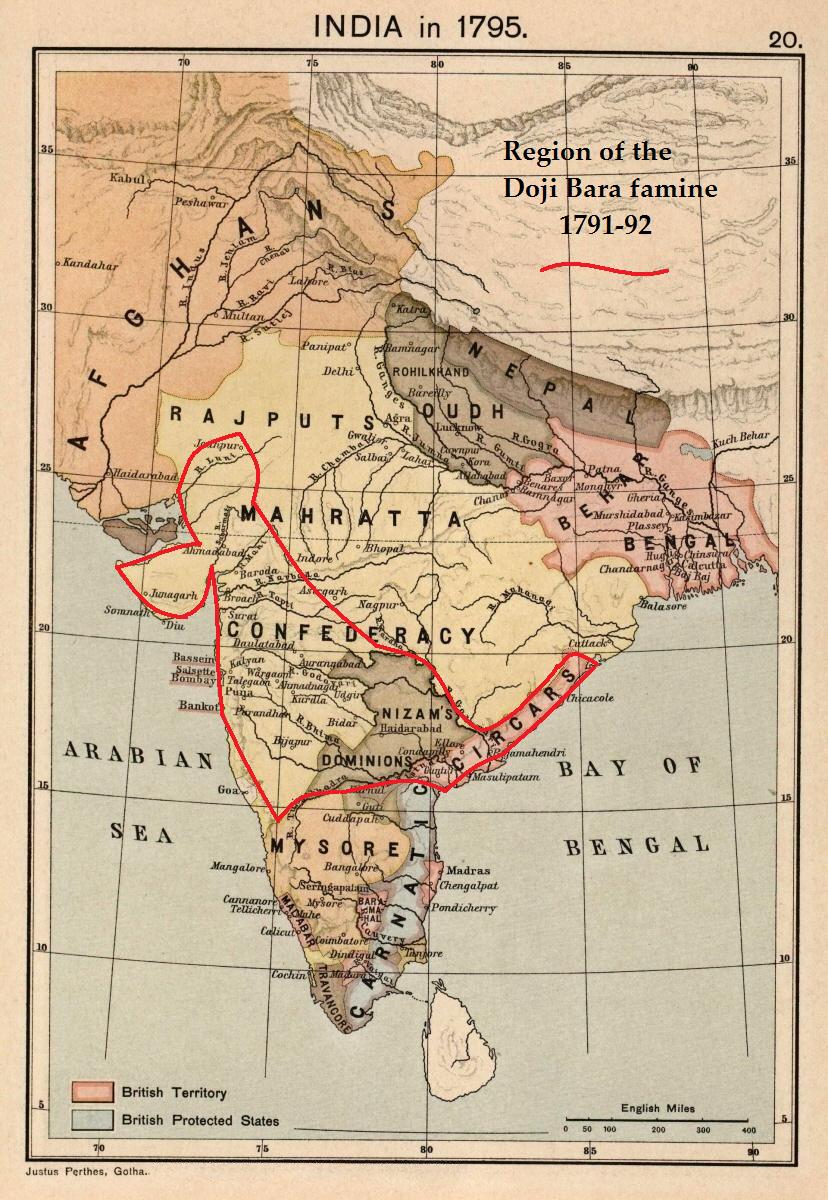
The Doji bara famine (also Skull famine) of 1791–1792 in the Indian subcontinent was brought on by a major El Niño event lasting from 1789–1795 and producing prolonged droughts. Recorded by William Roxburgh, a surgeon with the British East India Company, in a series of pioneering meteorological observations, the El Niño event caused the failure of the South Asian monsoon for four consecutive years starting in 1789.
The resulting famine, which was severe, caused widespread mortality in Hyderabad, Southern Maratha Kingdom, Deccan, Gujarat, and Marwar (then all ruled by Indian rulers). In regions like the Madras Presidency (governed by the East India Company), where the famine was less severe, and where records were kept, half the population perished in some districts, such as in the Northern Circars. In other areas, such as Bijapur, although no records were kept, both the famine and the year 1791 came to be known in folklore as the Doji bara (also Doĝi Bar) or the "skull famine," on account, it was said, of the "bones of the victims which lay unburied whitening the roads and the fields." As in the Chalisa famine of a decade earlier, many areas were depopulated from death or migration. According to one study, a total of 11 million people may have died during the years 1789–1792 as a result of starvation or accompanying epidemics of disease.
According to the Gazetteer of the Bombay Presidency: Poona (1885),
The year 1791-92, though locally a year of plenty, was so terrible a year of famine in other parts of India that the rupee price of grain rose to twelve pounds (6 shers). In the next year, 1792-93, no rain fell till October, some people left the country and others died from want. The distress is said to have been very great. The Peshwa's government brought grain from the Nizam's country and distributed it at Poona. The rupee price of grain stood at eight pounds (4 shers) in Poona for four months and in the west of the district for twelve months.
The Dharwar region suffered great distress. According to the Gazetteer of the Bombay Presidency: Dharwar, 1884,
In 1790, the march of the Marathas under Parashuram Bhau through Dharwar to Maisur was accompanied by such devastation, that on its return from Maisur the victorious army almost perished from want of food. In 1791-1792 there was a terrible famine, the result of a series of bad years heightened by the depredations caused by the Marathas under Parashuram Bhau. The distress seems to have been great in Hubli, Dambal, and Kalghatgi, where the people were reduced to feeding on leaves and berries, and women and children were sold. In Dambal the rains failed for twelve years and for three years there was no tillage. From the number of unburied dead the famine is remembered as Dogi Bára or the Skull Famine. The distressed were said to have been relieved by the rich. Beyond seizing some stores of grain at Hubli the Peshwa's government seem to have done nothing.
The prices of food grains spiraled up.
At Dambal grain was sold at two and a half pounds the rupee. In 1791 between 23 April and 6 May, the rupee price of rice was six pounds (3 pakka shers) at Kárur, Ránebennur, Motibennur, Háveri, Sháhánur, Kailkunda, Hubli, and Dhárwár; of gram six pounds (3 pakka shers) at Kárur, Motibennor, Hubli, and Dharwar, and eight pounds (4 pakka shers) at Háveri, Sháhánur and Kailkunda; and of Indian millet eight pounds (4 pakka shers) at Kárur, Ránebennur, Motibennur, Háveri, Hubli, and Dhárwár, and ten pounds (5 pakka shers) at Sháhánur and Kailkunda.
Hub AI
Doji bara famine AI simulator
(@Doji bara famine_simulator)
Doji bara famine
The Doji bara famine (also Skull famine) of 1791–1792 in the Indian subcontinent was brought on by a major El Niño event lasting from 1789–1795 and producing prolonged droughts. Recorded by William Roxburgh, a surgeon with the British East India Company, in a series of pioneering meteorological observations, the El Niño event caused the failure of the South Asian monsoon for four consecutive years starting in 1789.
The resulting famine, which was severe, caused widespread mortality in Hyderabad, Southern Maratha Kingdom, Deccan, Gujarat, and Marwar (then all ruled by Indian rulers). In regions like the Madras Presidency (governed by the East India Company), where the famine was less severe, and where records were kept, half the population perished in some districts, such as in the Northern Circars. In other areas, such as Bijapur, although no records were kept, both the famine and the year 1791 came to be known in folklore as the Doji bara (also Doĝi Bar) or the "skull famine," on account, it was said, of the "bones of the victims which lay unburied whitening the roads and the fields." As in the Chalisa famine of a decade earlier, many areas were depopulated from death or migration. According to one study, a total of 11 million people may have died during the years 1789–1792 as a result of starvation or accompanying epidemics of disease.
According to the Gazetteer of the Bombay Presidency: Poona (1885),
The year 1791-92, though locally a year of plenty, was so terrible a year of famine in other parts of India that the rupee price of grain rose to twelve pounds (6 shers). In the next year, 1792-93, no rain fell till October, some people left the country and others died from want. The distress is said to have been very great. The Peshwa's government brought grain from the Nizam's country and distributed it at Poona. The rupee price of grain stood at eight pounds (4 shers) in Poona for four months and in the west of the district for twelve months.
The Dharwar region suffered great distress. According to the Gazetteer of the Bombay Presidency: Dharwar, 1884,
In 1790, the march of the Marathas under Parashuram Bhau through Dharwar to Maisur was accompanied by such devastation, that on its return from Maisur the victorious army almost perished from want of food. In 1791-1792 there was a terrible famine, the result of a series of bad years heightened by the depredations caused by the Marathas under Parashuram Bhau. The distress seems to have been great in Hubli, Dambal, and Kalghatgi, where the people were reduced to feeding on leaves and berries, and women and children were sold. In Dambal the rains failed for twelve years and for three years there was no tillage. From the number of unburied dead the famine is remembered as Dogi Bára or the Skull Famine. The distressed were said to have been relieved by the rich. Beyond seizing some stores of grain at Hubli the Peshwa's government seem to have done nothing.
The prices of food grains spiraled up.
At Dambal grain was sold at two and a half pounds the rupee. In 1791 between 23 April and 6 May, the rupee price of rice was six pounds (3 pakka shers) at Kárur, Ránebennur, Motibennur, Háveri, Sháhánur, Kailkunda, Hubli, and Dhárwár; of gram six pounds (3 pakka shers) at Kárur, Motibennor, Hubli, and Dharwar, and eight pounds (4 pakka shers) at Háveri, Sháhánur and Kailkunda; and of Indian millet eight pounds (4 pakka shers) at Kárur, Ránebennur, Motibennur, Háveri, Hubli, and Dhárwár, and ten pounds (5 pakka shers) at Sháhánur and Kailkunda.
Recent media