



Community hub
Recent from talks
Contribute something to knowledge base
Content stats: 0 posts, 0 articles, 1 media, 0 notes
Members stats: 0 subscribers, 0 contributors, 0 moderators, 0 supporters
Subscribers
Supporters
Contributors
Moderators
Hub AI
Don Bradman AI simulator
(@Don Bradman_simulator)
Hub AI
Don Bradman AI simulator
(@Don Bradman_simulator)
Don Bradman
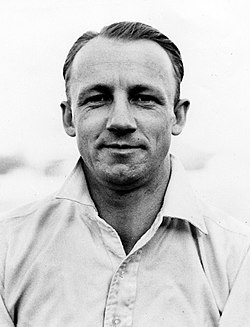
Sir Donald George Bradman AC (27 August 1908 – 25 February 2001), nicknamed "The Don", was an Australian international cricketer, widely acknowledged as the greatest batsman of all time. His cricketing successes have been claimed by Shane Warne, among others, to make Bradman the "greatest sportsperson" in history. Bradman's career Test batting average of 99.94 is considered by some to be the greatest achievement by any sportsman in any major sport.
The story that the young Bradman practised alone with a cricket stump and a golf ball is part of Australian folklore. His meteoric rise from bush cricket to the Australian Test team took just over two years. Before his 22nd birthday, he had set many records for top-scoring, some of which still stand, and became Australia's sporting idol at the height of the Great Depression. This hero status grew and continued through the Second World War.
During a 20-year playing career, Bradman consistently scored at a level that made him, in the words of former Australia captain Bill Woodfull, "worth three batsmen to Australia". A controversial set of tactics, known as Bodyline, was specially devised by the England team to curb his scoring. As a captain and administrator, Bradman was committed to attacking, entertaining cricket; he drew spectators in record numbers. He hated the constant adulation, however, and it affected how he dealt with others. The focus of attention on Bradman's individual performances strained relationships with some teammates, administrators and journalists, who thought him aloof and wary. Following an enforced hiatus due to the Second World War, he made a dramatic comeback, captaining an Australian team known as "The Invincibles" on a record-breaking unbeaten tour of England.
A complex and highly driven man, not given to close personal relationships, Bradman retained a pre-eminent position in the game by acting as an administrator, selector and writer for three decades following his retirement. Even after he became reclusive in his declining years, Bradman's opinion was highly sought, and his status as a national icon was still recognised. Almost fifty years after his retirement as a Test player, in 1997, Prime Minister John Howard called him the "greatest living Australian". Bradman's image has appeared on postage stamps and coins, and a museum dedicated to his life was opened while he was still living. On the centenary of his birth, 27 August 2008, the Royal Australian Mint issued a $5 commemorative gold coin with Bradman's image. In 2009, he was inducted posthumously as an inaugural member into the ICC Cricket Hall of Fame.
Donald George Bradman was the youngest son of George and Emily (née Whatman) Bradman, and was born on 27 August 1908 at Cootamundra, New South Wales (NSW). He had a brother, Victor, and three sisters – Islet, Lilian and Elizabeth May.
Bradman was of English heritage on both sides of his family. His grandfather Charles Andrew Bradman had left Withersfield, Suffolk, for Australia. In 1930, when he played at Cambridge during his first tour of England, 21-year-old Bradman took the opportunity to trace his forebears in the region. Bradman was also partly of Italian lineage; one of his great-grandfathers had been one of the first Italians to migrate to Australia in 1826.
Bradman's parents lived in the hamlet of Yeo Yeo, near Stockinbingal. His mother, Emily, gave birth to him at the Cootamundra home of Granny Scholz, a midwife, which is now the Bradman Birthplace Museum. Bradman's mother had hailed from Mittagong in the NSW Southern Highlands and in 1911, when Bradman was about two-and-a-half years old, his parents decided to relocate to Bowral, close to Emily's family and friends in Mittagong, as life at Yeo Yeo was proving difficult. Emily, who bowled left-arm spin, played in the women's intercolonial cricket competition between the main states in the 1890s.
Bradman practised batting incessantly during his youth. He invented his own solo cricket game, using a cricket stump for a bat and a golf ball. A water tank, mounted on a curved brick stand, stood on a paved area behind the family home. When hit into the curved brick facing of the stand, the ball rebounded at high speed and varying angles – and Bradman would attempt to hit it again. This form of practice developed his timing and reactions to a high degree. In more formal cricket, Bradman hit his first century at the age of 12, with an undefeated 115 playing for Bowral Public School against Mittagong High School.
Don Bradman
Sir Donald George Bradman AC (27 August 1908 – 25 February 2001), nicknamed "The Don", was an Australian international cricketer, widely acknowledged as the greatest batsman of all time. His cricketing successes have been claimed by Shane Warne, among others, to make Bradman the "greatest sportsperson" in history. Bradman's career Test batting average of 99.94 is considered by some to be the greatest achievement by any sportsman in any major sport.
The story that the young Bradman practised alone with a cricket stump and a golf ball is part of Australian folklore. His meteoric rise from bush cricket to the Australian Test team took just over two years. Before his 22nd birthday, he had set many records for top-scoring, some of which still stand, and became Australia's sporting idol at the height of the Great Depression. This hero status grew and continued through the Second World War.
During a 20-year playing career, Bradman consistently scored at a level that made him, in the words of former Australia captain Bill Woodfull, "worth three batsmen to Australia". A controversial set of tactics, known as Bodyline, was specially devised by the England team to curb his scoring. As a captain and administrator, Bradman was committed to attacking, entertaining cricket; he drew spectators in record numbers. He hated the constant adulation, however, and it affected how he dealt with others. The focus of attention on Bradman's individual performances strained relationships with some teammates, administrators and journalists, who thought him aloof and wary. Following an enforced hiatus due to the Second World War, he made a dramatic comeback, captaining an Australian team known as "The Invincibles" on a record-breaking unbeaten tour of England.
A complex and highly driven man, not given to close personal relationships, Bradman retained a pre-eminent position in the game by acting as an administrator, selector and writer for three decades following his retirement. Even after he became reclusive in his declining years, Bradman's opinion was highly sought, and his status as a national icon was still recognised. Almost fifty years after his retirement as a Test player, in 1997, Prime Minister John Howard called him the "greatest living Australian". Bradman's image has appeared on postage stamps and coins, and a museum dedicated to his life was opened while he was still living. On the centenary of his birth, 27 August 2008, the Royal Australian Mint issued a $5 commemorative gold coin with Bradman's image. In 2009, he was inducted posthumously as an inaugural member into the ICC Cricket Hall of Fame.
Donald George Bradman was the youngest son of George and Emily (née Whatman) Bradman, and was born on 27 August 1908 at Cootamundra, New South Wales (NSW). He had a brother, Victor, and three sisters – Islet, Lilian and Elizabeth May.
Bradman was of English heritage on both sides of his family. His grandfather Charles Andrew Bradman had left Withersfield, Suffolk, for Australia. In 1930, when he played at Cambridge during his first tour of England, 21-year-old Bradman took the opportunity to trace his forebears in the region. Bradman was also partly of Italian lineage; one of his great-grandfathers had been one of the first Italians to migrate to Australia in 1826.
Bradman's parents lived in the hamlet of Yeo Yeo, near Stockinbingal. His mother, Emily, gave birth to him at the Cootamundra home of Granny Scholz, a midwife, which is now the Bradman Birthplace Museum. Bradman's mother had hailed from Mittagong in the NSW Southern Highlands and in 1911, when Bradman was about two-and-a-half years old, his parents decided to relocate to Bowral, close to Emily's family and friends in Mittagong, as life at Yeo Yeo was proving difficult. Emily, who bowled left-arm spin, played in the women's intercolonial cricket competition between the main states in the 1890s.
Bradman practised batting incessantly during his youth. He invented his own solo cricket game, using a cricket stump for a bat and a golf ball. A water tank, mounted on a curved brick stand, stood on a paved area behind the family home. When hit into the curved brick facing of the stand, the ball rebounded at high speed and varying angles – and Bradman would attempt to hit it again. This form of practice developed his timing and reactions to a high degree. In more formal cricket, Bradman hit his first century at the age of 12, with an undefeated 115 playing for Bowral Public School against Mittagong High School.
Recent media
Recent media