


Community hub
Recent from talks
Contribute something
Nothing was collected or created yet.
Donald Erb
View on Wikipedia
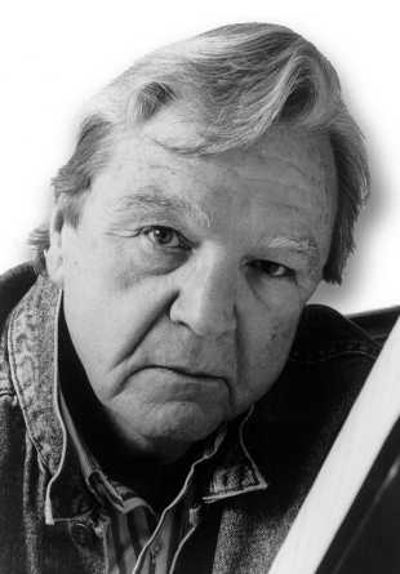
Donald Erb (January 17, 1927 – August 12, 2008) was an American composer best known for large orchestral works such as Concerto for Brass and Orchestra and Ritual Observances.
Early years
[edit]Erb was born in Youngstown, Ohio, graduated from Lakewood High School, a Cleveland suburb, and gained early recognition as a trumpet player for a local dance band.[1] Following a stint in the Navy during World War II, he continued his career as a jazz trumpeter and enrolled at Kent State University, where he earned a Bachelor of Science degree in music in 1950.[1] Three years later, he earned a Master of Music degree from the Cleveland Institute of Music.[1] In 1964, Erb earned a Doctorate in Music from Indiana University Bloomington, where he studied with Bernhard Heiden.[1][2]
Honors and awards
[edit]In the course of his career, Erb earned considerable recognition. He received the 1992 Rome Prize and was composer-in-residence with the St. Louis Symphony Orchestra. He was Distinguished Professor of Composition, Emeritus, at the Cleveland Institute of Music in Cleveland, Ohio.[1] He has received grants and fellowships from the Rockefeller, Guggenheim, Ford, Fromm, and Koussevitzky foundations.[1]
For a list of Erb's notable students, See: List of music students by teacher: C to F#Donald Erb.
He died at his home in Cleveland Heights, Ohio, on August 12, 2008, at the age of 81.[3]
Selected works
[edit]- 1966 Concerto for Solo Percussionist
- 1964 Symphony of Overtures
- 1965 Phantasma for four musicians
- 1966 Diversion For Two (other than sex) for trumpet and percussion
- 1966 String Trio for violin, electric guitar and violoncello
- 1967 Reconnaissance for instruments and electronic sounds
- 1968 In No Strange Land for instruments and electronic sounds
- 1969 The Seventh Trumpet for orchestra
- 1983 "Prismatic Variations" for orchestra
- 1986 Concerto for Brass and Orchestra
- 1994 Changes
- 1994 Remembrances
- 1994 Sonata for Solo Violin
- 1995 Sunlit Peaks and Dark Valleys
- 1995 Sonata for Solo Harp
- "Autumn Music for Orchestra"
- "Christmas Music for Orchestra"
- "Harold's Trip to the Sky" for Viola, piano and percussion
- "Klangfarbenfunk I & II" for jazz group and orchestra
- "Percussion Concerto" for percussion and orchestra
- "The Hawk" for jazz group
- "The Treasures of the Snow" for electronics and orchestra
- "Trombone Concerto"
- "2 Milosci do Warszawy" for piano, clarinet, cello, trombone and electronic sounds
- String Quartet N. 1
- String Quartet N. 2
- String Quartet N. 3
- "Music for Mother Bear" for flute alone
- "Evensong" for orchestra
References
[edit]- ^ a b c d e f "Donald Erb biography". New World Records. Retrieved 2007-03-27.
- ^ Slonimsky, Nicolas; Kuhn, Laura; McIntire, Dennis (January 1, 2001). "Erb, Donald (James)". Baker's Biographical Dictionary of Musicians. Archived from the original on January 10, 2016. Retrieved December 3, 2014 – via HighBeam Research.
- ^ Richard M. Peery, "Donald Erb: Avant-Guard [sic] Composer, Conductor Archived 2009-03-09 at the Wayback Machine", Cleveland Plain Dealer (Tuesday August 12, 2008).
External links
[edit]- Donald Erb's page at Theodore Presser Company
- Obituary from New York Times, August 15, 2008
- Donald Erb bio [permanent dead link] as listed by the Cleveland Composers Guild Archived 2011-02-10 at the Wayback Machine
- Interview with Donald Erb, February 28, 1985
Finalists: Pulitzer Prize for Music (1991–2000) | ||
|---|---|---|
| .png) | |
| ||

Donald Erb
View on GrokipediaEarly life and education
Childhood and early musical experiences
Donald Erb was born on January 17, 1927, in Youngstown, Ohio. [2] [5] [6] He was introduced to music at an early age by his great-aunt, a Kansas school teacher who provided him with trumpet lessons during summer vacations spent in Kansas. [2] [6] Erb began studying the cornet at the age of six and continued his lessons when returning home to Lakewood, Ohio. [6] [7] Erb grew up in Ohio and attended Lakewood High School in the Cleveland suburb of Lakewood. [5] During his high school years, he played trumpet in a local dance band, gaining early recognition as a jazz trumpeter. [5] In his teen years, he also arranged music for dance bands and performed as a jazz trumpeter, establishing his early immersion in jazz and popular music styles through these activities. [7]Military service and post-war jazz
Donald Erb enlisted in the United States Navy in January 1945, shortly after completing high school in December 1944, choosing naval service over awaiting a likely Army draft. He completed radar training at Pearl Harbor before assignment to the cruiser USS Baltimore in the South Pacific theater. While aboard ship, he performed with a band and later had the ship's name tattooed on his arm. [8] His duties included participation in the occupation of Japan following the atomic bombings, where he witnessed the devastation in Hiroshima shortly after the event. Erb received an honorable discharge in August 1946. Returning to Cleveland, Erb promptly resumed performing as a professional jazz trumpeter. His initial post-war work came with a local big band led by Jack Olsen, which toured the Midwest playing for dances and other regional engagements over the course of approximately one year. This period marked a continuation of his earlier jazz experience into professional civilian life. [1] [8] After about a year of steady performing, Erb shifted focus toward formal higher education, enrolling at Kent State University to pursue further studies in music.Formal education and degrees
Donald Erb received a Bachelor of Science in music from Kent State University in 1950. [2] [9] He continued his studies at the Cleveland Institute of Music, earning a Master of Music in 1953. [2] Following his master's degree, Erb pursued additional studies with Nadia Boulanger in Paris. [2] [9] He also studied with Kenneth Gaburo, whose influence contributed to his development as a composer. [10] Erb culminated his formal education with a Doctorate in Music (DMA) from Indiana University Bloomington in 1964, studying composition with Bernhard Heiden. [2]Professional career
Teaching positions and academic roles
Donald Erb taught composition for over forty years at several institutions, including Southern Methodist University, Indiana University, Bowling Green State University, and primarily the Cleveland Institute of Music.[11][3][2] He joined the faculty of the Cleveland Institute of Music in 1952, was appointed Distinguished Professor of Composition in 1987, and retired in 1996 as Distinguished Professor Emeritus.[1][12][2] Erb was widely regarded as a respected and nurturing educator whose supportive, intuitive teaching style made him a strong father figure to many students.[13] He was extremely supportive, often indulgent with students' shortcomings, and quick to apologize if his critiques were overly harsh due to his own pressures.[13] Erb maintained long-term involvement with alumni, keeping up with their careers, offering feedback on new works, and providing guidance on personal matters well beyond their time in his classes.[13] Former students described him as an encouraging mentor whose compassion, quick wit, and deep emotional engagement created a dynamic and inspiring environment for learning composition.[13][14] Many regarded him as the most supportive teacher they encountered, with his influence extending even to students of his former students.[13]Residencies and commissions
Donald Erb served as composer-in-residence with the Dallas Symphony Orchestra and the St. Louis Symphony Orchestra.[13][1] His residency with the Dallas Symphony took place in 1968 and 1969.[1] These positions allowed him to engage closely with orchestral programming and the development of new works for large ensembles. From 1981 to 1984, Erb served as president of the American Music Center.[13] In 2001, the organization awarded him its Letter of Distinction in recognition of his contributions to contemporary American music.[13][1] Erb received major commissions from leading orchestras including the Chicago Symphony, Cleveland Orchestra, St. Louis Symphony, Baltimore Symphony, Dallas Symphony, and Houston Symphony.[11][3] He also received commissions from foundations such as the Fromm Music Foundation, which supported his solo cello work Suddenly It's Evening in 1993.[15] These commissions led to prominent premieres and performances by major American orchestras and ensembles.[11][3]Musical style and innovations
Avant-garde approach and influences
Donald Erb was a prominent avant-garde composer during the 1960s and 1970s, recognized for his bold exploration of new sonic territories and his rejection of conventional compositional norms.[1] His music frequently incorporated improvisatory and aleatoric elements, reflecting his background as a professional jazz trumpeter whose early experiences as a performer continued to shape his approach.[1][4] Erb's compositions are characterized as powerful, emotional, uncompromising, and dramatic, marked by a strong sense of pacing and a physical engagement with sound that often left performers and listeners viscerally affected.[13] He composed intuitively, following his heart and an astute inner sense rather than established trends or systems, resulting in works that were controversial, outrageous, and heartrendingly expressive.[13] His emphasis on orchestral timbre and unconventional techniques—such as employing found objects or extended instrumental methods—stemmed from a commitment to sound as a primary expressive force.[4][13] A formative influence on Erb's emotional and dramatic outlook was his naval service in the aftermath of the atomic bombing of Hiroshima, where he witnessed profound human suffering that instilled lasting compassion, anger at injustice, and anguish about the world's problems.[13] This experience contributed to the deeply personal and intense emotional core of his music. Erb encouraged risk-taking as essential to artistic growth, stating, "Never be afraid to take chances, even if you fall flat! That’s how you grow as a composer and contribute to the art."[13]Integration of electronics, percussion, and jazz
Donald Erb's compositional approach prominently featured the integration of electronic sounds with acoustic instruments, marking him as a pioneer in blending technology with traditional music-making. One of the earliest examples is Reconnaissance (1965), a chamber work widely recognized as one of the first to combine a live synthesizer with acoustic instruments, premiered with Robert Moog operating the synthesizer and later performed at Expo '67 in Montreal. [3] This piece helped pioneer the acceptance of electronic sounds in conventional music circles, expanding the timbral palette beyond standard orchestral resources. [3] Erb continued incorporating electronics in later works, such as Ritual Observances (1992), which requires a synthesizer and amplified piano alongside conventional forces, contributing to the piece's intense, cataclysmic climaxes. [16] Percussion played a central and often driving role in Erb's music, frequently used to generate energy, create explosive effects, and anchor complex textures. His scores emphasize heavy percussion writing that suggests explosions, snarls, and primordial rumbles, as evident in Ritual Observances, where percussion contributes to tremendous climaxes and ethereal sonorities. [16] Erb extended percussive techniques to other instruments, requiring performers to strike piano strings with mallets or use wooden chopsticks on strings instead of bows, producing colorful, unconventional timbres that blur boundaries between pitched and unpitched sound. [3] [16] Erb's early career as a jazz trumpeter profoundly influenced his incorporation of jazz elements, informing rhythmic vitality, timbral choices, and occasional homages in his concert works. His experience playing jazz trumpet and arranging for big bands inspired compositions in that medium, including a work for jazz guitarist Jim Hall, a longtime friend. [3] Later pieces explicitly acknowledged jazz predecessors, such as Remembrances (1994) for two trumpets, which includes movements dedicated to figures like Dizzy Gillespie ("Passacaglia (almost) in Praise of A flat") and Rex Stewart (referencing his plunger mute technique in "Plungermusic"). [17] Influences from jazz appear alongside serialism and neo-classicism in much of his output, contributing to a distinctive rhythmic and expressive language. [2]Notable compositions
Orchestral and large-scale works
Donald Erb produced an extensive body of orchestral and large-scale works, establishing him as a prominent figure in American contemporary music through his innovative handling of large ensembles and bold sonorities.[18] His orchestral compositions often feature dramatic contrasts, extended techniques, and structural clarity derived from small motivic cells that unfold organically.[19] Among his notable early orchestral pieces is Symphony of Overtures (1964), a work recorded by the Dallas Symphony Orchestra under conductor Donald Johanos.[19] This was followed by The Seventh Trumpet (1969), another major orchestral composition also documented in performances and recordings with the Dallas Symphony Orchestra conducted by Johanos.[19] Other orchestral works include Autumnmusic, Christmas Music, Evensong, Prismatic Variations, and Ritual Observances, reflecting his continued engagement with symphonic forces.[20] Erb's contributions to the concerto genre form a central part of his large-scale output, with several virtuoso pieces for soloist and orchestra.[18] The Concerto for Brass and Orchestra (1986) stands out as a dramatic showpiece featuring a concertino of eleven brass instruments set against the full orchestra.[21][19] He also composed the Trombone Concerto (1976) and Percussion Concerto (listed as Concerto for Solo Percussionist), both showcasing his interest in highlighting individual instrumental virtuosity within expansive orchestral textures.[18][19][20] These works, alongside others such as concertos for various instruments, highlight Erb's command of large-scale form and timbral exploration.[19]Chamber, solo, and mixed-media pieces
Donald Erb produced a significant body of chamber, solo, and mixed-media works throughout his career, often characterized by adventurous instrumentation, extended techniques, and the integration of electronics or amplified elements into intimate settings. Many of these pieces date from the 1960s, when Erb experimented boldly with new sonorities and media. Reconnaissance (1967) stands out as a landmark in this domain, scored for violin, double bass, piano, percussion, and two Moog synthesizers performed live, representing one of the earliest chamber compositions to incorporate live electronic instruments alongside acoustic players. [22] The work exists in multiple versions, with the initial 1967 form premiered in New York and a later edition including an additional movement. [22] In No Strange Land (1968) continued Erb's exploration of electronic integration, combining traditional instruments with electronic sounds in a mixed-media format. [20] Earlier in the decade, his String Trio (1966) for violin, electric guitar, and cello innovated by inserting an electric guitar into a string trio context, creating distinctive timbral contrasts and lasting approximately seven minutes. [23] Diversion For Two (other than sex) (1966) for trumpet and percussion and Phantasma (1965) further exemplify his interest in unconventional duo pairings and percussive textures. [24] Erb's later chamber output included solo instrumental sonatas that showcase virtuosic demands and expressive depth, such as the Sonata for Solo Violin (1994) and Sonata for Solo Harp (1995). [25] He also completed three string quartets, contributing to the genre with works that reflect his evolving style, including String Quartet No. 3 (1995). [3] Other pieces like Z milosci do Warszawy (1971) blended chamber forces with electronic components. [20]Awards and honors
Donald Erb received several notable awards and honors in recognition of his contributions to contemporary music.- Guggenheim Fellowship (1965)[26]
- Cleveland Arts Prize in Music (1966)[12]
- American Academy of Arts and Letters Music Prize (1985)[27]
- Rome Prize (1992)[28]