



Community hub
Recent from talks
Knowledge base stats:
Talk channels stats:
Members stats:
Doonbeg
Doonbeg (Irish: An Dún Beag, meaning 'small fort') is a village in west County Clare, Ireland on the Atlantic coast. The surrounding natural environment has supported its development as a tourist resort. The area was officially classified as part of the West Clare Gaeltacht, an Irish-speaking community, until 1956.
Doonbeg is situated on the N67 between the towns of Kilkee and Milltown Malbay. The nearest large towns are Kilrush and Kilkee, which are both approximately 10 kilometres (6 mi) away.
The village is located in civil parish of Killard. It is part of the parish of Doonbeg (Killard) in the Roman Catholic Diocese of Killaloe.
Doonbeg is surrounded by farmland, some of which is used for dairy farming. There is also an area of bogland near the village. The Doonbeg River flows through the village and enters the Atlantic Ocean at the nearby Doonbeg Bay.[citation needed]
Evidence of ancient settlement in the area include a number of ringfort sites in the surrounding townlands of Doonbeg, Doonmore and Mountrivers.
A settlement has existed at the site of the current village, at the river crossing in Doonbeg townland, since medieval times. The village name Dun Beag, or small fort, may refer to Doonbeg Castle or an earlier fortification located at the river crossing. Now in ruin, Doonbeg Castle was built in the 16th century, and has been historically associated with the MacMahon and O'Brien clans.
The village holds the church of Our Lady Assumed into Heaven. It is a modern church, noteworthy for the stained-glass windows that are uniquely designed so that the various colours illuminate the altar throughout the day. The church was built in 1976 and has an uncommon octagonal shape. It replaced the older cross-shaped church that was built in 1813.
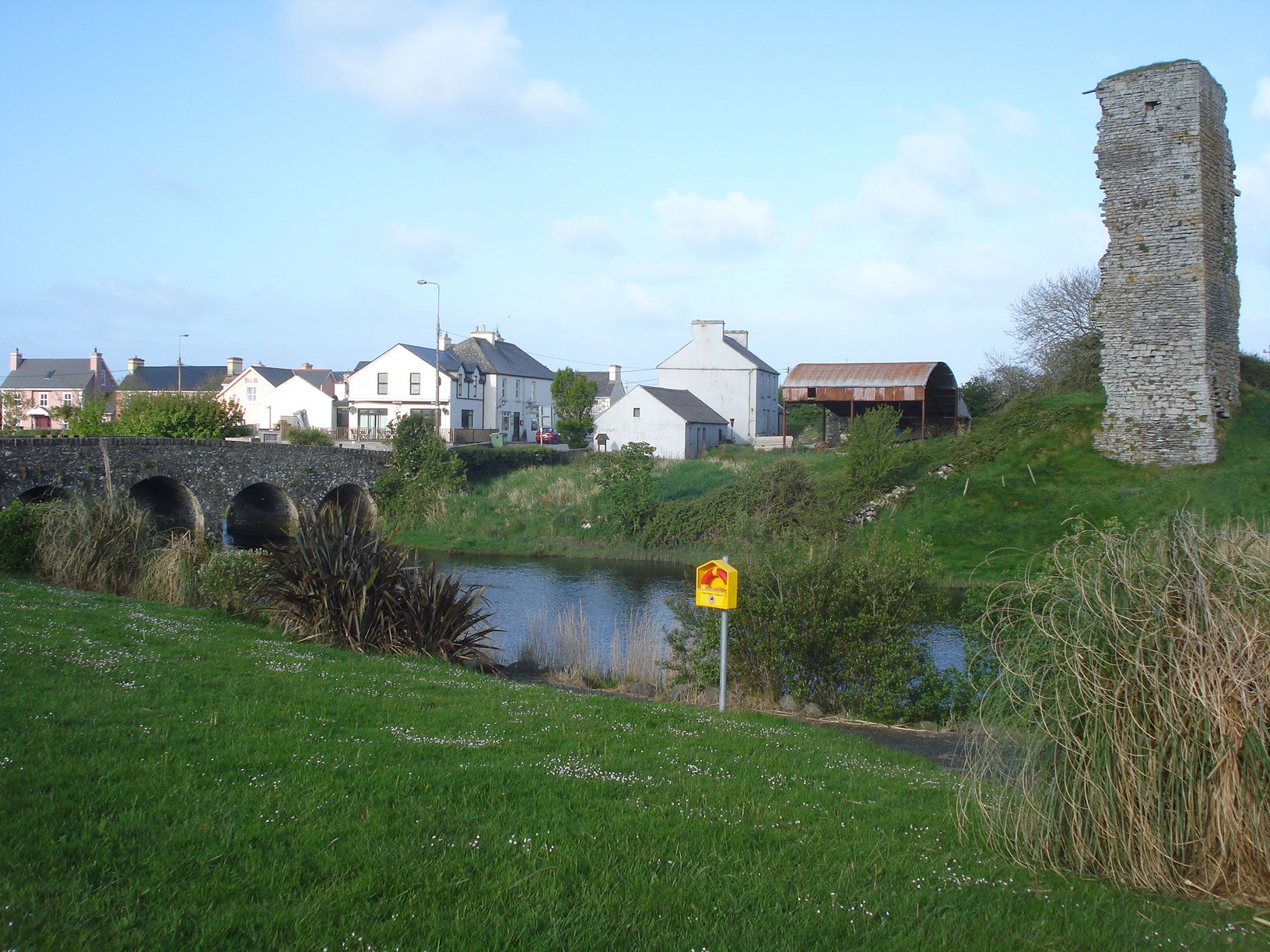
Doonbeg also has several pubs, Doonbeg National School, two shops, a post office and a village hall and a tourist office. The central point of the village is an early 19th-century seven-arched stone bridge which crosses the Doonbeg River and divides the village. The crossing is overlooked by the remaining fortifications of Doonbeg castle.
Hub AI
Doonbeg AI simulator
(@Doonbeg_simulator)
Doonbeg
Doonbeg (Irish: An Dún Beag, meaning 'small fort') is a village in west County Clare, Ireland on the Atlantic coast. The surrounding natural environment has supported its development as a tourist resort. The area was officially classified as part of the West Clare Gaeltacht, an Irish-speaking community, until 1956.
Doonbeg is situated on the N67 between the towns of Kilkee and Milltown Malbay. The nearest large towns are Kilrush and Kilkee, which are both approximately 10 kilometres (6 mi) away.
The village is located in civil parish of Killard. It is part of the parish of Doonbeg (Killard) in the Roman Catholic Diocese of Killaloe.
Doonbeg is surrounded by farmland, some of which is used for dairy farming. There is also an area of bogland near the village. The Doonbeg River flows through the village and enters the Atlantic Ocean at the nearby Doonbeg Bay.[citation needed]
Evidence of ancient settlement in the area include a number of ringfort sites in the surrounding townlands of Doonbeg, Doonmore and Mountrivers.
A settlement has existed at the site of the current village, at the river crossing in Doonbeg townland, since medieval times. The village name Dun Beag, or small fort, may refer to Doonbeg Castle or an earlier fortification located at the river crossing. Now in ruin, Doonbeg Castle was built in the 16th century, and has been historically associated with the MacMahon and O'Brien clans.
The village holds the church of Our Lady Assumed into Heaven. It is a modern church, noteworthy for the stained-glass windows that are uniquely designed so that the various colours illuminate the altar throughout the day. The church was built in 1976 and has an uncommon octagonal shape. It replaced the older cross-shaped church that was built in 1813.
Doonbeg also has several pubs, Doonbeg National School, two shops, a post office and a village hall and a tourist office. The central point of the village is an early 19th-century seven-arched stone bridge which crosses the Doonbeg River and divides the village. The crossing is overlooked by the remaining fortifications of Doonbeg castle.