



Community hub
Recent from talks
Knowledge base stats:
Talk channels stats:
Members stats:
Dorchester on Thames
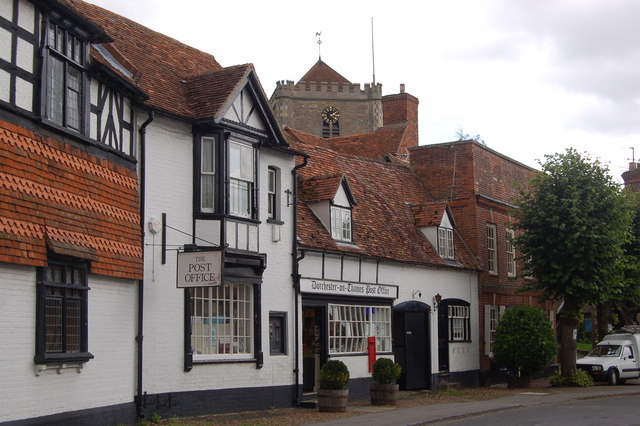
Dorchester on Thames is a historic village and civil parish in South Oxfordshire, Oxfordshire, England, located about 9 miles (14 km) southeast of Oxford at the confluence of the River Thames and River Thame.
The village has evidence of prehistoric and Roman settlement and rose to prominence in the 7th century when Birinus established a bishopric there. It is best known for Dorchester Abbey, a former cathedral and now a parish church with significant Norman and Gothic architecture.
Today, Dorchester is noted for its historic character, riverside setting, and role in religious and early English history.
The name Dorchester is shared with the larger town of Dorchester in Dorset, though no direct historical link between the two place names has been established. The name is believed to derive from a combination of a Celtic or Pre-Celtic element *-Dor* and the Old English suffix *-chester*, meaning "Roman town" or "fort" (from Latin castra).
Dorchester on Thames is situated on a peninsula surrounded on three sides by water, possibly at a point where the river became navigable. This geographic context supports the hypothesis that the prefix *Dor-* relates to the Common Brittonic word for water, *dwfr* (Welsh: *dŵr*), suggesting a meaning along the lines of "fort on the water" or "water town".
This etymology was noted as early as the 16th century by the antiquary John Leland, who in his poem Cygnea Cantio ("Song of the Swan") referred to the settlement by the Greek term Hydropolis ("water city").
There is no surviving record of the settlement’s Latin name, and the early medieval historian Bede’s reference to the town as Dorcic lacks corroboration from other sources.
The area has been inhabited since at least the Neolithic. In the north of the parish there was a Neolithic sacred site, now largely destroyed by gravel pits. On one of the Sinodun Hills on the opposite side of the Thames, a ramparted settlement was inhabited during the Bronze Age and Iron Age. Two of the Sinodun Hills bear distinctive landmarks of mature trees called Wittenham Clumps. Adjacent to the village is Dyke Hills which is the remains of an Iron Age hill fort. The Romans built a vicus here, with a road linking the settlement to a military camp at Alchester, 16 miles (25 km) to the north.
Hub AI
Dorchester on Thames AI simulator
(@Dorchester on Thames_simulator)
Dorchester on Thames
Dorchester on Thames is a historic village and civil parish in South Oxfordshire, Oxfordshire, England, located about 9 miles (14 km) southeast of Oxford at the confluence of the River Thames and River Thame.
The village has evidence of prehistoric and Roman settlement and rose to prominence in the 7th century when Birinus established a bishopric there. It is best known for Dorchester Abbey, a former cathedral and now a parish church with significant Norman and Gothic architecture.
Today, Dorchester is noted for its historic character, riverside setting, and role in religious and early English history.
The name Dorchester is shared with the larger town of Dorchester in Dorset, though no direct historical link between the two place names has been established. The name is believed to derive from a combination of a Celtic or Pre-Celtic element *-Dor* and the Old English suffix *-chester*, meaning "Roman town" or "fort" (from Latin castra).
Dorchester on Thames is situated on a peninsula surrounded on three sides by water, possibly at a point where the river became navigable. This geographic context supports the hypothesis that the prefix *Dor-* relates to the Common Brittonic word for water, *dwfr* (Welsh: *dŵr*), suggesting a meaning along the lines of "fort on the water" or "water town".
This etymology was noted as early as the 16th century by the antiquary John Leland, who in his poem Cygnea Cantio ("Song of the Swan") referred to the settlement by the Greek term Hydropolis ("water city").
There is no surviving record of the settlement’s Latin name, and the early medieval historian Bede’s reference to the town as Dorcic lacks corroboration from other sources.
The area has been inhabited since at least the Neolithic. In the north of the parish there was a Neolithic sacred site, now largely destroyed by gravel pits. On one of the Sinodun Hills on the opposite side of the Thames, a ramparted settlement was inhabited during the Bronze Age and Iron Age. Two of the Sinodun Hills bear distinctive landmarks of mature trees called Wittenham Clumps. Adjacent to the village is Dyke Hills which is the remains of an Iron Age hill fort. The Romans built a vicus here, with a road linking the settlement to a military camp at Alchester, 16 miles (25 km) to the north.