Hubbry Logo
BirinusBirinusMain
Open search
Birinus
Community hub
Birinus
logo
8 pages, 0 posts
0 subscribers
Be the first to start a discussion here.
Birinus
Birinus
from Wikipedia

Birinus (also Berin, Birin; c. 600 – 3 December 649 or 650) was the first Bishop of Dorchester[1] and was known as the "Apostle to the West Saxons" for his conversion of the Kingdom of Wessex to Christianity. He is venerated as a saint by the Roman Catholic Church, the Eastern Orthodox Church, and Anglican churches.

Key Information

Life and ministry

[edit]

After Augustine of Canterbury performed the initial conversions in England, Birinus, a Frank, came to the kingdom of Wessex in 634,[2] landing at the port of Hamwic, now in the St Mary's area of Southampton. During Birinus's brief time at Hamwic, St Mary's Church was founded.[3]

A Benedictine monk, Birinus had been made bishop by Asterius in Genoa,[4] and Pope Honorius I created the commission to convert the West Saxons.[5] In 635, he persuaded the West Saxon king Cynegils to allow him to preach. Cynegils was trying to create an alliance with Oswald of Northumbria, with whom he intended to fight the Mercians. At the final talks between kings, the sticking point was that Oswald, a Christian, would not ally himself with a pagan. Cynegils then converted and was baptised.[6][7] He gave Birinus Dorchester-on-Thames for his episcopal see.[5] Birinus's original commission entailed preaching to parts of Britain where no missionary efforts had reached and may have included instructions to reach the Mercians. But he ultimately remained in Wessex.[8]

Birinus is said to have been active in establishing churches in Wessex:[9] foundations ascribed to him include St Mary's in Reading,[10] St Peter and St Paul, Checkendon, near Reading,[11] and the first church at Ipsden, built about two miles from the present church.[12] Birinus baptised Cynegils's son Cwichelm (died 636) in 636[13] and grandson Cuthred (died 661) in 639, to whom he stood as godfather.[14]

Birinus died in Dorchester on 3 December in 649 or 650.[15]

Veneration

[edit]

Birinus' feast day is 3 December in the Roman Catholic Church and Eastern Orthodox Church,[16][17] but some churches celebrate his feast on 5 December.[15] His feast was added to the Roman Martyrology in the late 16th century.[18] In the Church of England, his feast day falls on 4 September and has the status of a commemoration.[19][20] His relics were eventually translated to Winchester after his death.[21]

A small number of Church of England parish churches are dedicated to Birinus, including those at Berinsfield in Oxfordshire and Redlynch in Wiltshire. The Catholic church in Dorchester, one of the first built after the restoration of the hierarchy[22] by Pope Pius IX, is also dedicated to Birinus.

See also

[edit]

References

[edit]

Further reading

[edit]
Revisions and contributorsEdit on WikipediaRead on Wikipedia
from Grokipedia
Birinus (died 650), also known as Berin, was a 7th-century Italian and missionary who served as the first of Dorchester in , , and is venerated as the "Apostle to the West Saxons" for his pivotal role in converting the pagan Kingdom of to . Consecrated as a bishop by Asterius of around 634 on the recommendation of , Birinus arrived in Britain that same year with the explicit mission to evangelize regions beyond the established English churches, landing in the then-pagan territory of where he focused his efforts. His most notable achievement was the of King of in 635, facilitated by the sponsorship of King , which opened the door for widespread conversions including the king's son Cwichelm in 636 and grandson Cuthred in 639, as well as the establishment of as the dominant faith in the region. Birinus founded the at Dorchester-on-Thames (now in ), where he built and consecrated numerous churches, and his missionary activities extended influence into neighboring . He died on 3 December 650 at Dorchester and was initially buried there, with his relics later translated to around 690 and enshrined in a lavish on 4 September 980, underscoring his enduring legacy in early English . Accounts from Bede's Historia Ecclesiastica Gentis Anglorum highlight Birinus's dedication and the miracles attributed to him, such as aiding in the retrieval of sacred items and performing healings that bolstered his evangelistic work.

Early Life and Vocation

Origins and Background

Birinus, also known as Berin or Birin, is believed to have been born around 600, though precise details of his early life remain scarce. Little is known about his family or personal background, with historical records primarily noting his status as a prior to his elevation to the episcopate. He died on 3 December 650, marking the end of his career. The origins of Birinus are a subject of scholarly dispute, with primary and secondary sources offering conflicting accounts of his nationality and birthplace. The Venerable , the foremost early authority, recounts in his Ecclesiastical History of the that Birinus came to Britain from , where he had pledged to to evangelize remote regions, and was subsequently consecrated bishop by Asterius, the bishop of . This connection to Genoa strongly suggests Italian origins, potentially in the Lombard-controlled territories of during the early . Alternative traditions, however, describe Birinus as a Frankish , possibly born in the Frankish kingdom that spanned parts of modern-day , , and surrounding areas, reflecting the influence of Frankish monastic networks in Roman activities. These discrepancies highlight the challenges in tracing pre-missionary biographies of early medieval figures, where details were often shaped by hagiographic or regional agendas. In the broader context of the early 7th century, Birinus emerged amid intensified Roman efforts to Christianize unconverted Germanic tribes across , building on the momentum of Pope Gregory the Great's 597 mission to under Augustine. As a drawn into this papal initiative under Honorius I, Birinus represented the expanding reach of Roman into Anglo-Saxon territories untouched by prior evangelization.

Monastic Formation and Consecration

Birinus, whose origins remain disputed between Frankish and Italian backgrounds, entered monastic life as a Benedictine , likely receiving his formation in monasteries within or during the early seventh century. Traditional accounts place him at the Benedictine Monastery of St. Andrew on the Caelian Hill in , a foundation associated with Gregory the Great that emphasized missionary zeal and adherence to the Rule of St. Benedict. This environment equipped him with the spiritual discipline and theological grounding essential for evangelization, though specific details of his early studies or travels prior to his call to mission are sparse in contemporary records. As part of his preparation for missionary work, Birinus was ordained a in before embarking on travels that led him to . There, around 634, he received episcopal consecration from Asterius, of —a prominent center in . This consecration occurred at the direct bidding of (625–638), who aligned it with broader papal directives to extend to the unconverted regions of Britain, reflecting the pope's strategic efforts to support missions following the initial conversions initiated by . While no explicit accounts of early preaching experiences by Birinus survive, his monastic training and positioned him as a suitable candidate for leading evangelization in remote areas.

Mission and Ministry in Wessex

Papal Commission and Arrival in Britain

In the mid-7th century, commissioned Birinus, a noted for his virtue and scholarly acumen, to undertake a missionary expedition to the Anglo-Saxon kingdoms of Britain, targeting those regions still immersed in . Honorius, who served as pope from 625 to 638, directed Birinus to focus on the innermost and unconverted parts of , particularly the West Saxons (Gewissae), whose territory remained untouched by prior evangelization efforts. This papal mandate, issued around 634, positioned Birinus within the ongoing Roman initiative to extend across the island, building on the groundwork laid by earlier missions while addressing the persistent pagan strongholds in the south and . Prior to embarking, Birinus was consecrated as a bishop by Asterius, the of , acting on Honorius's instructions; some accounts suggest the consecration occurred in under Asterius's authority, though specifies as the site. Equipped with this episcopal authority, Birinus set out from the continental mainland, likely departing from an Italian port, and crossed the Channel to reach Britain in 634. His arrival marked a deliberate choice of over more northerly or inland targets like , as he assessed the West Saxons' pagan state as an immediate opportunity for conversion despite the challenges of entering a society governed by King and steeped in idolatrous practices. Upon landing in the Kingdom of Wessex, Birinus encountered a population wholly devoted to traditional Germanic paganism, with no prior exposure to Christian doctrine, presenting significant cultural and linguistic barriers to his preaching. Bede records that Birinus had initially planned to venture deeper into the island's interior but, finding the West Saxons in such spiritual need, resolved to establish his mission there instead, viewing it as a divinely guided redirection. This decision underscored the adaptive nature of 7th-century Roman missions, which operated alongside parallel endeavors, such as the Celtic-influenced work of Aidan among the Northumbrians, to systematically Christianize the fragmented Anglo-Saxon heptarchy.

Evangelization and Conversion of King Cynegils

Following his arrival in Wessex in 634, Birinus focused his missionary efforts on the West Saxons, who were still entirely pagan, and soon encountered King (r. c. 611–643) in the royal city. Birinus preached the Word of salvation to the king, his earls, and thegns, emphasizing Christian doctrine despite the initial pagan context of the region. With the support of King , who was present to negotiate a political alliance, Birinus overcame linguistic barriers by having Oswald interpret his sermons for those unfamiliar with the language. Oswald's involvement proved pivotal, as he not only facilitated communication but also endorsed Birinus's message, leading Cynegils to embrace the faith. The king was baptized shortly thereafter, likely at a site near , with Oswald serving as his godfather and spiritual sponsor, an act that symbolized a fraternal bond between the two rulers. This baptism forged stronger ties between and ; Oswald rejoiced in the conversion, adopted Cynegils as a spiritual son, and later married the king's daughter to seal the alliance. Following Cynegils's conversion, Birinus extended his preaching to the West Saxon nobles and tribes, resulting in the mass of the king and his people, which established as the dominant religion in . In recognition of Birinus's role, Cynegils, jointly with Oswald, granted him the city of (Dorcic) and surrounding lands as the site for his , providing the territorial foundation for the emerging church structure. Birinus constructed a church there, consecrating it according to rites, which served as a hub for ongoing evangelization.

Establishment of the Diocese of Dorchester

Following the conversion of , which facilitated royal support for Christian institutions, Birinus selected as the site for his around 635–636. This location was strategically chosen due to its position on the River Thames, serving as a northern frontier outpost for the West Saxon kingdom against , and its historical significance as a Roman capital, aligning with papal directives to repurpose ancient sites for missionary work. The establishment was formalized through a royal grant of the city, known as Dorcic in Anglo-Saxon sources, jointly given by and his Northumbrian ally Oswald to Birinus for the purpose of founding the . Birinus, consecrated as prior to his arrival in Britain around 634 and serving until his death in 650, became the first of , with his jurisdiction encompassing the core territories of and extending influence over regions such as in subsequent decades. This see functioned as the primary ecclesiastical center for the West Saxons, enabling organized evangelization across the kingdom. Administratively, Birinus oversaw the of to staff emerging Christian communities, drawing on continental Roman practices to ensure doctrinal uniformity and validity. He initiated the establishment of early parishes, often centered on minster churches that he built and consecrated, which served as hubs for , , and instruction in the , including standardized liturgical forms and calendar observance. These efforts laid the groundwork for a hierarchical structure integrating local priests under episcopal authority, prioritizing the Roman liturgical tradition over any lingering British or Irish influences. Birinus played a key role in aligning the Wessex church with the broader English ecclesiastical framework under Canterbury, particularly through correspondence and coordination with Archbishop Honorius (r. 627–653), who held metropolitan oversight. Papal letters from Honorius I, who commissioned Birinus, reinforced this connection by emphasizing adherence to Roman customs, while early synods facilitated consensus on practices such as Easter computation, ensuring Wessex's integration into the unified church province led by Canterbury.

Later Years and Death

Key Activities, Foundations, and Miracles

Following the of King , Birinus extended Christian influence within the West Saxon royal lineage by baptizing Cynegils's son Cwichelm in 636 at , where the king had established his diocesan base. In 639, Birinus baptized Cynegils's grandson Cuthred, also at , and served as his godfather, further solidifying the faith's foothold among the . These royal baptisms facilitated broader conversions, as the king's family endorsement encouraged subjects to follow suit. Birinus actively founded churches across to support his pastoral efforts, including building and consecrating structures at his in . Traditions attribute to him the laying of foundations for in Reading and other early sites, such as St. Peter and St. Paul in Checkendon, which served as centers for worship and community gathering. These establishments marked the initial organization of Christian infrastructure in the region, aiding the transition from pagan to Christian practices. Hagiographical accounts in the Vita Birini highlight Birinus's profound Eucharistic devotion, exemplified by a miracle during his voyage to Britain where, while celebrating Mass on the ship, a corporal was blown into the sea by wind; Birinus walked across the waves to retrieve it, astonishing witnesses and leading to conversions among the pagan crew. Additional miracles attributed to him include healings among new converts in Wessex, such as restoring sight and curing illnesses, which bolstered faith during evangelization. These supernatural events, recorded in 12th-century sources, underscored Birinus's role as a divinely aided apostle. Birinus conducted extensive preaching tours throughout , proclaiming the Gospel with zeal to remote areas untouched by prior missionaries, as commissioned by . He focused on educating emerging to sustain the church's growth, training them in and to ensure doctrinal consistency. Amid challenges like potential pagan relapses following royal upheavals, Birinus worked to reinforce conversions through ongoing instruction and community reinforcement, preventing backsliding in newly Christianized territories.

Death, Burial, and Immediate Aftermath

In his final years, Birinus continued his ministry as bishop of , focusing on the construction and dedication of several churches to support the growing in . No specific illnesses or causes of death are recorded in contemporary accounts of this period. He died at in 650. The traditional date associated with his death is 3 December, which later became his principal day in Anglo-Saxon calendars. Birinus was initially interred at the church in , where his served as an early focal point for by the local faithful. Reports of miracles attributed to his intercession began to circulate soon after his burial, reinforcing his reputation for holiness. Following Birinus's death, the Diocese of passed to Agilbert, a Frankish who had previously assisted in the region and was ordained to the see that year. Agilbert maintained Birinus's reforms, including the expansion of missionary efforts among the West Saxons, though the diocese faced challenges from political shifts under King Cenwalh.

Veneration and Legacy

Development of the Cult

The cult of Birinus emerged soon after his death around 650, following his burial at Dorchester-on-Thames, the site of his episcopal see. Its early promotion came in the eighth century through Bede's Historia Ecclesiastica Gentis Anglorum (Book 3, Chapter 7), which recounts Birinus's papal commission from Honorius I in 634 to evangelize the inland regions of Britain, his arrival among the West Saxons, and his successful conversion efforts, including the baptism of King Cynegils; this portrayal established Birinus as the "Apostle to the West Saxons." By the tenth century, Birinus's had grown sufficiently to warrant inclusion in Anglo-Saxon liturgical calendars, with his name appearing in 18 of 27 surviving examples from the period. The cult flourished particularly within the monastic and episcopal communities of and , where bishops such as Hedda (c. 690) and Æthelwold (late tenth century) actively supported it through relic translations and hagiographical compositions, including eleventh-century vitae like the Vita S. Birini that expanded on Bede's account with attributed miracles. These efforts localized his sainthood, tying it to Wessex's Christian foundations despite competition from more prominent figures like at . The severely curtailed Birinus's cult in England, as monastic dissolutions led to the destruction of his shrines at in the 1530s and in 1539, suppressing public amid broader iconoclastic policies against saints' devotions. nonetheless persisted in Roman Catholic traditions abroad and among recusant communities, while the nineteenth-century Anglo-Catholic revival, influenced by the , renewed interest through new dedications such as the Church of St Birinus in (1849), integrating pre-Reformation saints into Anglican practice. In the Eastern Orthodox tradition, Birinus is honored as a holy hierarch and the Apostle of the West Saxons, with his commemoration integrated into Eastern liturgical calendars reflecting his role in early British Christianity.

Relics, Translations, and Patronage

Birinus was initially buried at Dorchester-on-Thames following his death in 650. His relics were translated to Winchester's Old Minster around 680 by Bishop Hedda, who sought to consolidate the veneration of the saint in the growing center of Wessex's ecclesiastical life. This translation was accompanied by reports of miracles, including healings attributed to the saint's intercession during the exhumation and relocation. Within Winchester, the relics underwent several subsequent translations to more prominent locations. In 980, Bishop Æthelwold moved them beside the high altar in the Old Minster. They were then transferred to the new in the late , repositioned in 1150 under Bishop Henry of Blois, and placed in a dedicated in the southeast corner of the retroquire by 1224. In 1501, the relics were removed from the chapel, which was converted into a ; they were likely destroyed or dispersed during the in 1539. A notable dispute arose in 1224 when monks at claimed to have rediscovered Birinus's relics, supported by miracles such as the healing of a mute child who spoke in English and French. contested this, citing Bede's account that the relics had been fully translated to their cathedral, and ordered an inquiry, though the conflict persisted without resolution. In the 19th century, fragments purportedly of Birinus's relics were discovered at in 1858, leading to a memorial monument erected there in 1963. Birinus is venerated as the of Berkshire, Dorchester-on-Thames, and the West Saxons, reflecting his role as their primary evangelist. He is also invoked by missionaries, given his pioneering work in converting pagan territories. Associated with his cult is "Birinus's Well" in the crypt of , believed to have been used by the saint and linked to miraculous healings. No surviving liturgical items directly attributable to Birinus are known.

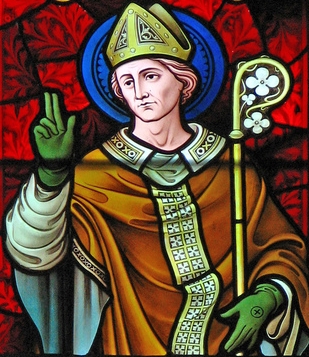
Feast Days, Depictions, and Modern Scholarship

Birinus is commemorated on 3 December in the Roman Catholic and Eastern Orthodox traditions, marking the anniversary of his death in 649 or 650. In Anglican calendars, his principal feast falls on 4 September, honoring the translation of his relics to around 690, with variations arising from local liturgical customs and the emphasis on either his death or posthumous veneration. Artistic depictions of Birinus emphasize his missionary role, often portraying him in the act of baptizing or preaching to King of . A prominent medieval example is the stained-glass panel in the Great East Window of (ca. 1225), which shows Birinus addressing and his court. Another early stained-glass image, dating to around 1250, illustrates Birinus receiving episcopal consecration from Archbishop Asterius of before departing for Britain. Statues of the appear at key sites linked to his legacy; a carved figure of Birinus stands under a canopy on the west wall of St Birinus Church in Dorchester-on-Thames (19th century), while a statue on the West Front of is identified as depicting him as a . Common hagiographic motifs include his episcopal vestments and a staff symbolizing his apostolic authority in . Modern scholarship relies heavily on Bede's Ecclesiastical History of the English People (completed c. 731) as the for Birinus's life, though it notes Bede's account is selective and shaped by Northumbrian perspectives, potentially underemphasizing Wessex-specific miracles and regional impacts. Debates persist over Birinus's origins, with Bede describing him as arriving from via , leading some scholars to propose an Italian (Lombard) background, while others argue for Frankish roots based on continental missionary patterns. Archaeological investigations at -on-Thames have uncovered 7th-century artifacts, including evidence of early Christian activity consistent with the establishment of Birinus's , though no direct traces of his remain above ground due to later constructions. Assessments of his role highlight Birinus as a pivotal figure in Wessex's , bridging Roman papal missions and local royal conversions, though his efforts are seen as part of a broader, uneven process amid ongoing pagan influences. Recent post-2000 studies, including analyses of relic translations, question the authenticity of some medieval claims about Birinus's remains, such as contested 10th-century texts and rival assertions between and , viewing them as products of monastic competition rather than historical fact.

References

Add your contribution
Related Hubs
User Avatar
No comments yet.