



Community hub
Recent from talks
Contribute something to knowledge base
Content stats: 0 posts, 0 articles, 1 media, 0 notes
Members stats: 0 subscribers, 0 contributors, 0 moderators, 0 supporters
Subscribers
Supporters
Contributors
Moderators
Hub AI
Double bass AI simulator
(@Double bass_simulator)
Hub AI
Double bass AI simulator
(@Double bass_simulator)
Double bass
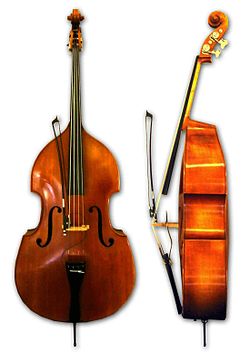
The double bass (/ˈdʌbəl beɪs/), also known as the upright bass, the acoustic bass, the bull fiddle, or simply the bass, is the largest and lowest-pitched chordophone in the modern symphony orchestra (excluding rare additions such as the octobass). It has four or five strings, and its construction is in between that of the gamba and the violin family.
The bass is a standard member of the orchestra's string section, along with violins, violas, and cellos, as well as the concert band, and is featured in concertos, solo, and chamber music in Western classical music. The bass is used in a range of other genres, such as jazz, blues, rock and roll, rockabilly, country music, bluegrass, tango, folk music and certain types of film and video game soundtracks.
The instrument's exact lineage is still a matter of some debate, with scholars divided on whether the bass is derived from the viol or the violin family.
Being a transposing instrument, the bass is typically notated one octave higher than tuned to avoid excessive ledger lines below the staff. The double bass is the only modern bowed string instrument that is tuned in fourths (like a bass guitar, viol, or the lowest-sounding four strings of a standard guitar), rather than fifths, with strings usually tuned to E1, A1, D2 and G2.
The double bass is played with a bow (arco), or by plucking the strings (pizzicato), or via a variety of extended techniques. In orchestral repertoire and tango music, both arco and pizzicato are employed. In jazz, blues, and rockabilly, pizzicato is the norm. Classical music and jazz use the natural sound produced acoustically by the instrument, as does traditional bluegrass. In funk, blues, reggae, and related genres, the double bass is often amplified.
A person who plays this instrument is called a "bassist", "double bassist", "double bass player", "contrabassist", "contrabass player" or "bass player". The names contrabass and double bass refer (respectively) to the instrument's range, and to its use one octave lower than the cello (i.e. the cello part was the main bass line, and the "double bass" originally played a copy of the cello part; only later was it given an independent part). The terms for the instrument among classical performers are contrabass (which comes from the instrument's Italian name, contrabbasso), string bass (to distinguish it from brass bass instruments in a concert band, such as tubas), or simply bass.
In jazz, blues, rockabilly and other genres outside of classical music, this instrument is commonly called the upright bass, standup bass or acoustic bass to distinguish it from the (usually electric) bass guitar. In folk and bluegrass music, the instrument is also referred to as a "bass fiddle" or "bass violin" (or more rarely as "doghouse bass" or "bull fiddle"). While not a member of the violin-family of instruments, the construction of the upright bass is quite different from that of the acoustic bass guitar, as the latter is a derivative of the electric bass guitar, and usually built like a larger and sturdier variant of a viola de gamba, its ancestor.
The double bass is sometimes confusingly called the violone, bass violin or bass viol.
Double bass
The double bass (/ˈdʌbəl beɪs/), also known as the upright bass, the acoustic bass, the bull fiddle, or simply the bass, is the largest and lowest-pitched chordophone in the modern symphony orchestra (excluding rare additions such as the octobass). It has four or five strings, and its construction is in between that of the gamba and the violin family.
The bass is a standard member of the orchestra's string section, along with violins, violas, and cellos, as well as the concert band, and is featured in concertos, solo, and chamber music in Western classical music. The bass is used in a range of other genres, such as jazz, blues, rock and roll, rockabilly, country music, bluegrass, tango, folk music and certain types of film and video game soundtracks.
The instrument's exact lineage is still a matter of some debate, with scholars divided on whether the bass is derived from the viol or the violin family.
Being a transposing instrument, the bass is typically notated one octave higher than tuned to avoid excessive ledger lines below the staff. The double bass is the only modern bowed string instrument that is tuned in fourths (like a bass guitar, viol, or the lowest-sounding four strings of a standard guitar), rather than fifths, with strings usually tuned to E1, A1, D2 and G2.
The double bass is played with a bow (arco), or by plucking the strings (pizzicato), or via a variety of extended techniques. In orchestral repertoire and tango music, both arco and pizzicato are employed. In jazz, blues, and rockabilly, pizzicato is the norm. Classical music and jazz use the natural sound produced acoustically by the instrument, as does traditional bluegrass. In funk, blues, reggae, and related genres, the double bass is often amplified.
A person who plays this instrument is called a "bassist", "double bassist", "double bass player", "contrabassist", "contrabass player" or "bass player". The names contrabass and double bass refer (respectively) to the instrument's range, and to its use one octave lower than the cello (i.e. the cello part was the main bass line, and the "double bass" originally played a copy of the cello part; only later was it given an independent part). The terms for the instrument among classical performers are contrabass (which comes from the instrument's Italian name, contrabbasso), string bass (to distinguish it from brass bass instruments in a concert band, such as tubas), or simply bass.
In jazz, blues, rockabilly and other genres outside of classical music, this instrument is commonly called the upright bass, standup bass or acoustic bass to distinguish it from the (usually electric) bass guitar. In folk and bluegrass music, the instrument is also referred to as a "bass fiddle" or "bass violin" (or more rarely as "doghouse bass" or "bull fiddle"). While not a member of the violin-family of instruments, the construction of the upright bass is quite different from that of the acoustic bass guitar, as the latter is a derivative of the electric bass guitar, and usually built like a larger and sturdier variant of a viola de gamba, its ancestor.
The double bass is sometimes confusingly called the violone, bass violin or bass viol.
Recent media
Recent media