


Community hub
Recent from talks
Contribute something
Nothing was collected or created yet.
Scientific pitch notation
View on Wikipedia
Scientific pitch notation (SPN), also known as American standard pitch notation (ASPN) and international pitch notation (IPN), is a method of specifying musical pitch by combining a musical note name (with accidental if needed) and a number identifying the pitch's octave.[1][2]
Although scientific pitch notation was originally designed as a companion to scientific pitch (see below), the two are not synonymous. Scientific pitch is a pitch standard—a system that defines the specific frequencies of particular pitches (see below). Scientific pitch notation concerns only how pitch names are notated, that is, how they are designated in printed and written text, and does not inherently specify actual frequencies. Thus, the use of scientific pitch notation to distinguish octaves does not depend on the pitch standard used.
Nomenclature
[edit]The notation makes use of the traditional tone names (A to G) which are followed by numbers showing which octave they are part of.
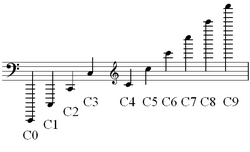
For standard A440 pitch equal temperament, the system begins at a frequency of 16.35160 Hz, which is assigned the value C0.
The octave 0 of the scientific pitch notation is traditionally called the sub-contra octave, and the tone marked C0 in SPN is written as ,,C or C,, or CCC in traditional systems, such as Helmholtz notation. Octave 0 of SPN marks the low end of what humans can actually perceive, with the average person being able to hear frequencies no lower than 20 Hz as pitches.
The octave number increases by 1 upon an ascension from B to C. Thus, A0 refers to the first A above C0 and middle C (the one-line octave's C or simply c′) is denoted as C4 in SPN. For example, C4 is one note above B3, and A5 is one note above G5.
The octave number is tied to the alphabetic character used to describe the pitch, with the division between note letters 'B' and 'C', thus:
- "B3" and all of its possible variants (B
 , B♭, B, B♯, B
 ) would properly be designated as being in octave "3".
 - "C4" and all of its possible variants (C, C♭, C, C♯, C) would properly be designated as being in octave "4".
- In equal temperament "C♭4" is same frequency as "B3".
- "B3" and all of its possible variants (B


Use
[edit]Scientific pitch notation is often used to specify the range of an instrument. It provides an unambiguous means of identifying a note in terms of textual notation rather than frequency, while at the same time avoiding the transposition conventions that are used in writing the music for instruments such as the clarinet and guitar. It is also easily translated into staff notation, as needed. In describing musical pitches, nominally enharmonic spellings can give rise to anomalies where, for example in Pythagorean intonation C♭4 is a lower frequency than B3; but such paradoxes usually do not arise in a scientific context.
Scientific pitch notation avoids possible confusion between various derivatives of Helmholtz notation which use similar symbols to refer to different notes. For example, "C" in Helmholtz's original notation[3] refers to the C two octaves below middle C, whereas "C" in ABC Notation refers to middle C itself. With scientific pitch notation, middle C is always C4, and C4 is never any note but middle C. This notation system also avoids the "fussiness" of having to visually distinguish between four and five primes, as well as the typographic issues involved in producing acceptable subscripts or substitutes for them. C7 is much easier to quickly distinguish visually from C8, than is, for example, c′′′′ from c′′′′′, and the use of simple integers (e.g. C7 and C8) makes subscripts unnecessary altogether.
Although pitch notation is intended to describe sounds audibly perceptible as pitches, it can also be used to specify the frequency of non-pitch phenomena. Notes below E0 or higher than E♭10 are outside most humans' hearing range, although notes slightly outside the hearing range on the low end may still be indirectly perceptible as pitches due to their overtones falling within the hearing range. For an example of truly inaudible frequencies, when the Chandra X-ray Observatory observed the waves of pressure fronts propagating away from a black hole, their one oscillation every 10 million years was described by NASA as corresponding to the B♭ fifty-seven octaves below middle C (B♭−53) or 3.235 fHz).[4]
The notation is sometimes used in the context of meantone temperament, and does not always assume equal temperament nor the standard concert A4 of 440 Hz; this is particularly the case in connection with earlier music.
The standard proposed to the Acoustical Society of America[5] explicitly states a logarithmic scale for frequency, which excludes meantone temperament, and the base frequency it uses gives A4 a frequency of exactly 440 Hz. However, when dealing with earlier music that did not use equal temperament, it is understandably easier to simply refer to notes by their closest modern equivalent, as opposed to specifying the difference using cents every time.[a]
Table of note frequencies
[edit]
The table below gives notation for pitches based on standard piano key frequencies: standard concert pitch and twelve-tone equal temperament. When a piano is tuned to just intonation, C4 refers to the same key on the keyboard, but a slightly different frequency. Notes not produced by any piano are highlighted in medium gray, and those produced only by an extended 108-key piano, light gray.
Octave Note |
−1 | 0 | 1 | 2 | 3 | 4 | 5 | 6 | 7 | 8 | 9 | 10 |
|---|---|---|---|---|---|---|---|---|---|---|---|---|
| C | 8.175799 (0) | 16.35160 (12) | 32.70320 (24) | 65.40639 (36) | 130.8128 (48) | 261.6256 (60) | 523.2511 (72) | 1046.502 (84) | 2093.005 (96) | 4186.009 (108) | 8372.018 (120) | 16744.04 |
| C♯/D♭ | 8.661957 (1) | 17.32391 (13) | 34.64783 (25) | 69.29566 (37) | 138.5913 (49) | 277.1826 (61) | 554.3653 (73) | 1108.731 (85) | 2217.461 (97) | 4434.922 (109) | 8869.844 (121) | 17739.69 |
| D | 9.177024 (2) | 18.35405 (14) | 36.70810 (26) | 73.41619 (38) | 146.8324 (50) | 293.6648 (62) | 587.3295 (74) | 1174.659 (86) | 2349.318 (98) | 4698.636 (110) | 9397.273 (122) | 18794.55 |
| E♭/D♯ | 9.722718 (3) | 19.44544 (15) | 38.89087 (27) | 77.78175 (39) | 155.5635 (51) | 311.1270 (63) | 622.2540 (75) | 1244.508 (87) | 2489.016 (99) | 4978.032 (111) | 9956.063 (123) | 19912.13 |
| E | 10.30086 (4) | 20.60172 (16) | 41.20344 (28) | 82.40689 (40) | 164.8138 (52) | 329.6276 (64) | 659.2551 (76) | 1318.510 (88) | 2637.020 (100) | 5274.041 (112) | 10548.08 (124) | 21096.16 |
| F | 10.91338 (5) | 21.82676 (17) | 43.65353 (29) | 87.30706 (41) | 174.6141 (53) | 349.2282 (65) | 698.4565 (77) | 1396.913 (89) | 2793.826 (101) | 5587.652 (113) | 11175.30 (125) | 22350.61 |
| F♯/G♭ | 11.56233 (6) | 23.12465 (18) | 46.24930 (30) | 92.49861 (42) | 184.9972 (54) | 369.9944 (66) | 739.9888 (78) | 1479.978 (90) | 2959.955 (102) | 5919.911 (114) | 11839.82 (126) | 23679.64 |
| G | 12.24986 (7) | 24.49971 (19) | 48.99943 (31) | 97.99886 (43) | 195.9977 (55) | 391.9954 (67) | 783.9909 (79) | 1567.982 (91) | 3135.963 (103) | 6271.927 (115) | 12543.85 (127) | 25087.71 |
| A♭/G♯ | 12.97827 (8) | 25.95654 (20) | 51.91309 (32) | 103.8262 (44) | 207.6523 (56) | 415.3047 (68) | 830.6094 (80) | 1661.219 (92) | 3322.438 (104) | 6644.875 (116) | 13289.75 | 26579.50 |
| A | 13.75000 (9) | 27.50000 (21) | 55.00000 (33) | 110.0000 (45) | 220.0000 (57) | 440.0000 (69) | 880.0000 (81) | 1760.000 (93) | 3520.000 (105) | 7040.000 (117) | 14080.00 | 28160.00 |
| B♭/A♯ | 14.56762 (10) | 29.13524 (22) | 58.27047 (34) | 116.5409 (46) | 233.0819 (58) | 466.1638 (70) | 932.3275 (82) | 1864.655 (94) | 3729.310 (106) | 7458.620 (118) | 14917.24 | 29834.48 |
| B | 15.43385 (11) | 30.86771 (23) | 61.73541 (35) | 123.4708 (47) | 246.9417 (59) | 493.8833 (71) | 987.7666 (83) | 1975.533 (95) | 3951.066 (107) | 7902.133 (119) | 15804.27 | 31608.53 |
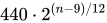
Mathematically, given the number n of semitones above middle C, the fundamental frequency in hertz is given by (see twelfth root of two). Given the MIDI NoteOn number m, the frequency of the note is normally Hz, using standard tuning.

Scientific pitch versus scientific pitch notation
[edit]Scientific pitch is an absolute pitch standard, first proposed in 1713 by French physicist Joseph Sauveur. It was defined so that all Cs are integer powers of 2, with middle C (C4) at 256 hertz. As already noted, it is not dependent upon, nor a part of scientific pitch notation described here. To avoid the confusion in names, scientific pitch is sometimes also called "Verdi tuning" or "philosophical pitch".
The current international pitch standard, using A4 as exactly 440 Hz, had been informally adopted by the music industry as far back as 1926, and A440 became the official international pitch standard in 1955. SPN is routinely used to designate pitch in this system. A4 may be tuned to other frequencies under different tuning standards, and SPN octave designations still apply (ISO 16).[6]
With changes in concert pitch and the widespread adoption of A440 as a musical standard, new scientific frequency tables were published by the Acoustical Society of America in 1939, and adopted by the International Organization for Standardization in 1955. C0, which was exactly 16 Hz under the scientific pitch standard, is now 16.35160 Hz under the current international standard system.[5]
See also
[edit]Footnotes
[edit]- ^ The conventions of musical pitch notation require the use of sharps and flats on the circle of fifths closest to the key currently in use, and forbid substitution of notes with the same frequency in equal temperament, such as A♯ and B♭. These rules have the effect of (usually) producing more nearly consonant pitches when using meantone systems, and other non-equal temperaments. In almost all meantone temperaments, the so-called enharmonic notes, such as A♯ and B♭, are a different pitch, with A♯ at a lower frequency than the enharmonic B♭. With the single exception of equal temperament (which fits in among meantone systems as a special case) enharmonic notes always have slightly different frequencies.
References
[edit]- ^ International Pitch Notation
- ^ Robert W. Young. "Terminology for Logarithmic Frequency Units". Journal of the Acoustical Society of America. 1 July 1939; 11 (1): 134–139.
- ^ von Helmholtz, Hermann (1912) [1870]. Die Lehre von den Tonempfindungen als physiologische Grundlage für die Theorie der Musik [On the Sensations of Tone as a Physiological Basis for the Theory of Music]. Translated by Ellis, A.J. (4 ed.). Whitefish, MT. Kellinger. ISBN 978-1-4191-7893-1 – via Internet Archive.
{{cite book}}: ISBN / Date incompatibility (help) - ^ "Black hole sound waves" (Press release). NASA. Archived from the original on 2021-05-05. Retrieved 2017-07-12.
Sound waves 57 octaves lower than middle-C are rumbling away from a supermassive black hole in the Perseus cluster.
- ^ a b Young, Robert W. (1939). "Terminology for Logarithmic Frequency Units". Journal of the Acoustical Society of America. 11 (1): 134–000. Bibcode:1939ASAJ...11..134Y. doi:10.1121/1.1916017.
- ^ ISO 16:1975 Acoustics – Standard tuning frequency (Standard musical pitch). International Organization for Standardization. 1975.
External links
[edit]- English Octave-Naming Convention – Dolmetsch Music Theory Online
- Notefreqs – A complete table of note frequencies and ratios for midi, piano, guitar, bass, and violin. Includes fret measurements (in cm and inches) for building instruments.
| Staff | |
|---|---|
| Musical notes | |
| Articulation | |
| Sheet music | |
| Other systems | |
| Related | |


Scientific pitch notation
View on GrokipediaFundamentals
Definition and Purpose
Scientific pitch notation (SPN), also known as American standard pitch notation (ASPN), is a system for designating specific musical pitches by combining a letter name from A through G (with accidentals if needed) and an integer to indicate the octave.[6][7] This bipartite labeling, such as C4 for middle C, allows precise identification of pitches across the audible range, distinguishing them from general pitch classes like C.[8] Under the A440 tuning standard, C4 corresponds to a frequency of approximately 261.63 Hz.[9] The primary purpose of SPN is to provide an unambiguous method for specifying pitches in textual descriptions, avoiding confusion from varying national or pedagogical conventions, such as different placements of middle C on the staff.[7] It facilitates clear communication in defining instrument ranges, preventing errors in transposition, and supporting cross-cultural exchange in music theory and performance.[6] By standardizing pitch references, SPN aligns with international norms like ISO 16, which sets A4—the reference pitch in octave 4—at exactly 440 Hz.[5][9] SPN offers key advantages in simplicity for digital and scientific contexts, where letter-only systems might lack precision, and it integrates seamlessly with standards like MIDI, where note number 60 corresponds to C4.[7][10] This alignment enhances its utility in software, electronic music production, and acoustic analysis, promoting consistent pitch representation without the need for complex subscript formatting in plain text.[8]Octave Numbering Convention
In scientific pitch notation, octaves are numbered sequentially starting from C₀, which begins the sub-contra octave, and each octave includes the pitches from C through B, providing a consistent grouping of twelve semitones.[6] Middle C, the reference pitch commonly used in musical contexts, is specifically designated as C₄, positioning it in the fourth octave above C₀.[6] The numbering progresses upward such that the octave number increments at each ascending C; for instance, the pitch B₃ directly precedes C₄, ensuring that all notes from Cₙ to Bₙ share the same octave designation.[11] Below C₀, negative numbers denote lower octaves, as in C₋₁ for the C one octave below C₀.[11] This system prioritizes scientific utility by aligning with the logarithmic scaling of frequencies in acoustic analysis, which facilitates precise pitch relationships in research and measurement, unlike numbering schemes tied to piano keys that start from the instrument's lowest note. For edge cases, practical ranges extend beyond standard instruments; while a typical 88-key piano covers A₀ to C₈—spanning portions of octaves 0 through 8—pitches like C₀ and C₋₁ fall below this keyboard but appear in extended instruments such as large pipe organs.[12] Similarly, C₈ marks the upper boundary for piano but can be exceeded on synthesizers or other electronic devices capable of higher registers.[12]Historical Development
Origins of Scientific Pitch
The concept of scientific pitch originated in the early 18th century as an attempt to establish a mathematically precise frequency standard for musical tones, independent of varying regional practices. In 1713, French physicist Joseph Sauveur proposed a system where the pitch of middle C (now denoted as C4) was set at exactly 256 Hz, derived from 28 Hz to ensure that each octave represented a pure doubling of frequency, facilitating harmonic calculations.[13] This "philosophical pitch" emphasized acoustic purity over practical performance needs, marking an early shift toward viewing pitch through a scientific lens rather than empirical tuning traditions.[14] By the 19th century, growing interest in acoustics drove further advancements in measuring and standardizing pitch frequencies. In 1834, German physicist Johann Heinrich Scheibler developed the tonometer, a device comprising 56 tuning forks spanning a wide range, which enabled precise frequency comparisons and led to his proposal of A=440 Hz as a balanced standard at the Stuttgart Conference of Physicists.[15] Building on such innovations, British mathematician and philologist Alexander J. Ellis contributed significantly; he had introduced the cent system—a logarithmic scale dividing the octave into 1200 units—in 1875, and in his 1880 essay "The History of Musical Pitch," he used it to systematically document historical pitch variations across Europe and quantify deviations from reference frequencies with greater accuracy.[16] A pivotal moment came in 1859 when the Académie des Beaux-Arts in Paris endorsed a provisional standard of approximately 435 Hz for A above middle C, known as the diapason normal, to address inconsistencies in orchestral tuning and promote uniformity in instrument manufacturing.[17] This adoption reflected the era's emphasis on empirical measurement over arbitrary convention, influencing subsequent scientific discussions on pitch as a quantifiable acoustic property. These pre-20th-century efforts established scientific pitch primarily as a frequency benchmark, laying the foundation for later notations without yet formalizing symbolic representations.Evolution and Standardization
In 1939, Robert W. Young proposed scientific pitch notation to the Acoustical Society of America (ASA) as a standardized system for designating pitches using letter names followed by octave numbers, with middle C defined as C4; this built on acoustician Harvey Fletcher's suggestion for a logarithmic frequency scale using subscripts to denote octaves relative to a reference C0 at 16.35 Hz.[10][18] This proposal distinguished the notation from earlier frequency-based concepts like Sauveur's 1713 "scientific pitch" at 256 Hz for C4, emphasizing a neutral numbering system adaptable to prevailing concert pitches. By 1955, the International Organization for Standardization (ISO) formalized A4 at 440 Hz in ISO/R 16, extending scientific pitch notation globally as a consistent method for pitch identification across equal-tempered scales, independent of specific frequencies; this aligned with the concert pitch standard of A4=440 Hz, corresponding to C4 ≈261.63 Hz, distinct from the traditional scientific pitch of 256 Hz for C4.[5] This international agreement marked the notation's transition from a national acoustic proposal to a widely accepted tool in music and science. During the 1950s and 1960s, the ASA further integrated scientific pitch notation into broader music standards, clarifying its distinction from "scientific pitch" (the 256 Hz tuning) by focusing on the system's utility for logarithmic frequency representation rather than fixed tunings.[19] These efforts ensured compatibility with equal temperament and acoustic analysis, promoting adoption in educational and professional contexts. No major revisions occurred after 1955, though the 1983 MIDI 1.0 specification reinforced C4 as middle C (MIDI note 60), embedding the notation in digital music production and software for precise pitch mapping.Notation System
Pitch Designation Rules
Scientific pitch notation designates musical pitches using a combination of a letter name from A to G, an optional accidental, and an octave number, providing a clear and unambiguous method for identifying specific notes across the audible range. The letter represents the pitch class, while the octave number indicates the register, with middle C standardized as C4. This format ensures consistency in musical communication, particularly in contexts requiring precise pitch specification without reliance on staff notation.[20] Accidentals modify the pitch by altering the letter name: the sharp symbol (♯) raises the note by a semitone, the flat symbol (♭) lowers it by a semitone, the natural symbol (♮) cancels any previous modification to return to the natural pitch, the double sharp (♯♯ or x) raises by two semitones, and the double flat (♭♭ or bb) lowers by two semitones. These symbols or their textual equivalents (e.g., # for sharp, b for flat) are placed immediately after the letter, followed by the octave number, as in A♯4 or E♭3. The octave number remains unchanged by the accidental, as it is determined by the position of the natural note relative to the nearest lower C.[1][20] Enharmonic equivalents, which produce the same pitch in equal temperament but differ in notation, are designated with the appropriate letter and accidental within their respective octaves; for example, C♯4 and D♭4 both refer to the same pitch in the fourth octave. At octave boundaries, this convention can lead to designations in adjacent octaves for enharmonic notes, such as B♯3 equating to C4 in pitch but labeled in the third octave due to the natural B's position. This approach prioritizes the letter name's natural octave assignment over pitch frequency equivalence.[20][1] Ranges for instruments or vocal parts are expressed using the lowest and highest designated pitches, such as the standard piano spanning from A0 to C8, encompassing approximately seven full octaves plus additional notes. This notation facilitates quick identification of an instrument's capabilities without visual reference to a keyboard or staff.[21] While scientific pitch notation is primarily designed for 12-tone equal temperament, extensions for microtonal or non-tempered systems may involve additional accidental symbols or fractional notations, though these are not part of the core standard and vary by context.[1]Frequency Relationships
Scientific pitch notation maps musical pitches to specific acoustic frequencies based on the equal-tempered 12-tone scale, where each successive semitone corresponds to a frequency multiplication factor of .[22] This logarithmic scaling ensures that the interval of an octave spans exactly 12 semitones, with the frequency doubling from one octave to the next.[22] The reference frequency for the system is defined by the international standard A4 = 440 Hz, as specified in ISO 16:1975.[5] From this anchor, the frequency in hertz for a note semitones above or below A4—where corresponds to C−1 in scientific pitch notation—can be calculated using the formula: This equation derives from the equal-temperament principle, positioning A4 at MIDI note number 69 (or 69 semitones above C−1).[19] For example, applying it to C4 (n = 60, or 9 semitones below A4) yields approximately 261.63 Hz.[19] A fundamental relationship in the notation is octave doubling: the frequency of a note one octave higher is exactly twice that of the note below, such as C5 at 523.25 Hz being the frequency of C4 at 261.63 Hz.[22] This holds across all octaves, reinforcing the binary structure of pitch perception in Western music. While scientific pitch notation primarily aligns with equal temperament and the ISO 16 standard of A4 = 440 Hz, alternative tunings like just intonation exist, which use rational frequency ratios (e.g., 3:2 for a perfect fifth) for purer intervals in specific contexts.[22] However, these are not part of the standard mapping, which emphasizes equal temperament for versatility. Notably, the term "scientific pitch" historically referred to a distinct standard setting C4 at 256 Hz (proposed by Joseph Sauveur in 1713), but this differs from the modern scientific pitch notation system.[19]Applications
In Music Theory and Education
Scientific pitch notation (SPN) facilitates precise analysis of chord structures, scales, and intervals in music theory by assigning unambiguous labels to specific pitches, enabling theorists to describe harmonic and melodic relationships without ambiguity across octaves. For example, the perfect fifth interval is clearly designated as the distance from C4 to G4, which supports detailed examinations of consonance and dissonance in compositions. This system distinguishes individual pitches from pitch classes, allowing for accurate transcription and comparison in theoretical exercises.[6] In educational contexts, SPN is widely incorporated into music theory textbooks and curricula to enhance sight-reading and ear training skills, where students practice identifying and notating pitches on staff systems in various clefs. Open-access resources like Open Music Theory employ SPN in assignments that integrate keyboard mapping and staff notation, promoting memorization of pitch locations such as middle C as C4. Similarly, The Musician’s Guide to Theory and Analysis utilizes SPN to teach pitch recognition and interval construction, reinforcing foundational theory concepts through practical worksheets.[6][6] A key advantage of SPN in pedagogy is its provision of absolute pitch references, which minimizes confusion in instruction involving transposing instruments by focusing on the sounding pitch rather than the notated one, thereby streamlining ensemble coordination and score study. When combined with relative pitch methods like solfège, SPN offers fixed anchors for scale degrees, aiding transitions between movable-do and fixed-do approaches in vocal training.[6][23] Contemporary digital tools further embed SPN in interactive learning environments; for instance, applications use SPN to label pitches in ear training modules, where users identify intervals and scales relative to benchmarks like C4, and in sight-singing exercises that display octave-specific notations on virtual staves. Online platforms extend this to scalable lessons on chord progressions and key signatures, making abstract concepts tangible through audio-visual feedback.In Acoustics and Instrument Specification
In acoustics, scientific pitch notation facilitates precise specification of pitches during spectrogram analysis, where frequency components are labeled to identify harmonic structures in recorded sounds. It is also integral to sound synthesis and waveform generation, enabling researchers to define target frequencies unambiguously; for instance, synthesizing C4 at 261.63 Hz allows controlled experimentation on auditory perception. This notation's adoption stems from its standardization by the Acoustical Society of America, providing a textual method for denoting pitches that aligns with logarithmic frequency scales used in acoustic measurements. For instrument specification, scientific pitch notation catalogs the playable ranges of orchestral instruments, supporting manufacturing standards and tuning protocols. The violin, for example, typically spans from G3 (approximately 196 Hz) to A7 (approximately 3520 Hz), a range that informs acoustic design and performance expectations in ensemble settings. Such notations aid in documenting instrument capabilities in acoustic literature, ensuring consistency across empirical studies of timbre and resonance.[24][25] In scientific contexts, scientific pitch notation integrates into phonetics for analyzing vocal formants associated with pitch variations, psychoacoustics for studying perceptual pitch salience in chord profiles, and audio engineering software where it standardizes pitch inputs. Tools like MATLAB employ it indirectly through frequency mappings in signal processing toolboxes for waveform simulation. Similarly, in Audacity, users reference it for pitch detection and correction in spectral analyses.[26] Modern extensions of scientific pitch notation address gaps in electronic instruments and virtual reality audio design, where it specifies extended ranges for synthesizers (e.g., input notes from C0 to C8 in FPGA-based systems) and immersive soundscapes. In VR environments, it denotes pitches for cross-modal studies, such as associating C4 with visual colors to explore perceptual mappings. These applications enhance precision in digital audio prototyping and spatial sound rendering.[27][28]Comparisons
With Helmholtz Pitch Notation
The Helmholtz pitch notation system, developed by the German physicist and music theorist Hermann von Helmholtz in his 1863 treatise Die Lehre von den Tonempfindungen als physiologische Grundlage für die Theorie der Musik, employs a combination of uppercase and lowercase letters along with subscript or superscript primes (apostrophes) and ledger lines to designate pitches.[3] In this system, notes are grouped into octaves starting from C, with uppercase letters (e.g., C–B) indicating the great octave below middle C, lowercase letters (e.g., c–b) for the small octave just below, and successive primes (e.g., c'–b' for the one-line octave) for higher ranges; middle C, for instance, is denoted as c' or c with a line above it in the original German convention.[3] This approach originated in 19th-century Germany to provide precise acoustic descriptions, particularly for scientific analysis of tone sensations, and it uses relative positioning centered on the human voice range rather than absolute numerical octaves.[3] In contrast to scientific pitch notation (SPN), which assigns integer numbers to octaves starting from C0 in the sub-contra range and designates middle C as C4, Helmholtz notation relies on typographic symbols for relative octave placement, with the great octave (C–B) serving as the lowest commonly notated level and no fixed zero point equivalent to SPN's C0.[10] SPN's sequential numbering (e.g., C3 for the octave below middle C, C5 above) offers a linear, absolute scale that aligns with modern frequency calculations, whereas Helmholtz's system positions octaves contextually around middle C (c'), making it more intuitive for traditional score reading but prone to variations in symbol interpretation across notations.[7] For example, the lowest C in SPN (C0) corresponds to C,, or C with two sub-primes in Helmholtz, highlighting SPN's extension to infrasonic ranges absent in standard Helmholtz usage.[10] SPN provides advantages in compactness and digital compatibility, as its alphanumeric format (e.g., C4) is easier to type, search, and implement in software compared to Helmholtz's reliance on special characters like primes and lines, which can lead to typographic inconsistencies.[29] Conversely, Helmholtz notation excels in vocal pedagogy due to its visual alignment with staff positions and relative voicing—lowercase for chest voice, uppercase primes for head voice—facilitating intuitive teaching in choral and solfège contexts without numerical abstraction.[3] Direct mappings between the systems illustrate these differences: SPN's C4 equates to Helmholtz's c' (middle C), C3 to c (small octave C), and C5 to c'' (two-line octave C), allowing seamless translation in mixed educational materials.[29] Historically, this has reflected a transatlantic divide, with Helmholtz persisting in European music texts for its pedagogical roots in 19th-century acoustics, while SPN gained prominence in American publications from the mid-20th century onward, driven by standardization needs in orchestration and recording industries.[3]With Other Pitch Notations
Scientific pitch notation (SPN) contrasts with various European systems that employ alternative letter or syllable assignments while often retaining similar octave numbering. In the French solfège tradition, pitches are designated using fixed-do syllables—do for C, ré for D, mi for E, fa for F, sol for G, la for A, and si for B—with octave numbers appended, such that middle C is notated as do4. This system aligns octave boundaries with SPN but replaces letter names with solfège terms for pedagogical emphasis on tonal relationships. Similarly, the German Tonhöhe system uses letters A through G, with H denoting B natural and B reserved for B flat; accidentals are indicated by suffixes like "is" for sharps (e.g., Cis for C-sharp) and "es" for flats (e.g., Des for D-flat), while middle C remains C4, facilitating compatibility with SPN in international scores despite the B/H distinction rooted in historical scribal practices.[30] In Asian musical contexts, SPN appears in modern adaptations, particularly where Western influences intersect with traditional systems, though local notations predominate. Japanese music education and MIDI implementations frequently adopt SPN's letter-plus-octave format (e.g., C4 for middle C) alongside indigenous heptatonic solfège syllables such as ha (do/C), ni (re/D), ho (mi/E), he (fa/F), to (sol/G), i (la/A), and ro (ti/B), allowing seamless integration in electronic music production. For the Chinese guqin, a seven-string zither, traditional jianzi pu (reduced-character tablature) uses abbreviated symbols to specify finger positions and techniques rather than pitches directly, but contemporary hybrids incorporate Western staff notation with SPN elements, such as numbering octaves from C4 equivalents, to bridge guqin repertoire with global ensembles and facilitate transcription.[31][32] Beyond regional variants, SPN interfaces with text-based and digital notations prevalent in software and computing. ABC notation, a plain-text format for encoding folk tunes, represents pitches with letters where uppercase (C, D, etc.) denotes the octave starting from middle C (e.g., C for C4), lowercase (c, d, etc.) for the octave above (c for C5), and apostrophes or commas for higher or lower octaves (e.g., C' for C5, C, for C3), offering a compact alternative to SPN's explicit octave numbering but requiring contextual interpretation for precise pitch identification. In electronic music, MIDI note numbers provide a numerical mapping aligned with SPN, assigning 60 to middle C (C4), 72 to middle C's octave above (C5), and scaling chromatically from 0 (C−1) to 127 (G9), enabling universal interoperability in synthesizers and digital audio workstations without reliance on letter names.[33][34] SPN's international scope stems from its endorsement in ISO standards for acoustics and its prevalence in global music theory, contrasting with regional preferences that persist in cultural education; for instance, while European systems like French solfège dominate Romance-language conservatories and German H/B conventions endure in Central European publishing, SPN underpins ISO 16's reference to A4=440 Hz and is the default in English-language academia and software, promoting cross-cultural precision despite incomplete harmonization in non-Western traditions.[5][35]Reference Data
Table of Standard Note Frequencies
The following table provides a reference for the frequencies of musical notes in scientific pitch notation, using the equal-tempered scale with A4 set to 440.0000 Hz as defined by ISO 16. Frequencies are calculated to four decimal places using the formula , where is the MIDI note number, and include the full chromatic scale across octaves −1 to 9.[36] MIDI note numbers range from 0 (C−1) to 127 (G9). This standard assumes twelve-tone equal temperament with no cents deviation from the tuning reference.| Octave | Note | Frequency (Hz) | MIDI Number |
|---|---|---|---|
| −1 | C−1 | 8.1758 | 0 |
| −1 | C♯−1/D♭−1 | 8.6610 | 1 |
| −1 | D−1 | 9.1770 | 2 |
| −1 | D♯−1/E♭−1 | 9.7227 | 3 |
| −1 | E−1 | 10.3009 | 4 |
| −1 | F−1 | 10.9130 | 5 |
| −1 | F♯−1/G♭−1 | 11.5623 | 6 |
| −1 | G−1 | 12.2498 | 7 |
| −1 | G♯−1/A♭−1 | 12.9783 | 8 |
| −1 | A−1 | 13.7477 | 9 |
| −1 | A♯−1/B♭−1 | 14.5676 | 10 |
| −1 | B−1 | 15.4339 | 11 |
| 0 | C0 | 16.3516 | 12 |
| 0 | C♯0/D♭0 | 17.3239 | 13 |
| 0 | D0 | 18.3540 | 14 |
| 0 | D♯0/E♭0 | 19.4454 | 15 |
| 0 | E0 | 20.6017 | 16 |
| 0 | F0 | 21.8268 | 17 |
| 0 | F♯0/G♭0 | 23.1247 | 18 |
| 0 | G0 | 24.4997 | 19 |
| 0 | G♯0/A♭0 | 25.9650 | 20 |
| 0 | A0 | 27.5000 | 21 |
| 0 | A♯0/B♭0 | 29.1353 | 22 |
| 0 | B0 | 30.8677 | 23 |
| 1 | C1 | 32.7032 | 24 |
| 1 | C♯1/D♭1 | 34.6478 | 25 |
| 1 | D1 | 36.7081 | 26 |
| 1 | D♯1/E♭1 | 38.8909 | 27 |
| 1 | E1 | 41.2034 | 28 |
| 1 | F1 | 43.6535 | 29 |
| 1 | F♯1/G♭1 | 46.2493 | 30 |
| 1 | G1 | 48.9994 | 31 |
| 1 | G♯1/A♭1 | 51.9301 | 32 |
| 1 | A1 | 55.0000 | 33 |
| 1 | A♯1/B♭1 | 58.2705 | 34 |
| 1 | B1 | 61.7354 | 35 |
| 2 | C2 | 65.4064 | 36 |
| 2 | C♯2/D♭2 | 69.2957 | 37 |
| 2 | D2 | 73.4162 | 38 |
| 2 | D♯2/E♭2 | 77.7817 | 39 |
| 2 | E2 | 82.4069 | 40 |
| 2 | F2 | 87.3071 | 41 |
| 2 | F♯2/G♭2 | 92.4986 | 42 |
| 2 | G2 | 97.9989 | 43 |
| 2 | G♯2/A♭2 | 103.8602 | 44 |
| 2 | A2 | 110.0000 | 45 |
| 2 | A♯2/B♭2 | 116.5410 | 46 |
| 2 | B2 | 123.4708 | 47 |
| 3 | C3 | 130.8128 | 48 |
| 3 | C♯3/D♭3 | 138.5914 | 49 |
| 3 | D3 | 146.8324 | 50 |
| 3 | D♯3/E♭3 | 155.5635 | 51 |
| 3 | E3 | 164.8137 | 52 |
| 3 | F3 | 174.6141 | 53 |
| 3 | F♯3/G♭3 | 184.9971 | 54 |
| 3 | G3 | 195.9977 | 55 |
| 3 | G♯3/A♭3 | 207.7204 | 56 |
| 3 | A3 | 220.0000 | 57 |
| 3 | A♯3/B♭3 | 233.0821 | 58 |
| 3 | B3 | 246.9416 | 59 |
| 4 | C4 | 261.6256 | 60 |
| 4 | C♯4/D♭4 | 277.1826 | 61 |
| 4 | D4 | 293.6648 | 62 |
| 4 | D♯4/E♭4 | 311.1270 | 63 |
| 4 | E4 | 329.6276 | 64 |
| 4 | F4 | 349.2282 | 65 |
| 4 | F♯4/G♭4 | 369.9944 | 66 |
| 4 | G4 | 391.9954 | 67 |
| 4 | G♯4/A♭4 | 415.3047 | 68 |
| 4 | A4 | 440.0000 | 69 |
| 4 | A♯4/B♭4 | 466.1638 | 70 |
| 4 | B4 | 493.8833 | 71 |
| 5 | C5 | 523.2511 | 72 |
| 5 | C♯5/D♭5 | 554.3652 | 73 |
| 5 | D5 | 587.3295 | 74 |
| 5 | D♯5/E♭5 | 622.2540 | 75 |
| 5 | E5 | 659.2551 | 76 |
| 5 | F5 | 698.4564 | 77 |
| 5 | F♯5/G♭5 | 739.9889 | 78 |
| 5 | G5 | 783.9909 | 79 |
| 5 | G♯5/A♭5 | 830.6094 | 80 |
| 5 | A5 | 880.0000 | 81 |
| 5 | A♯5/B♭5 | 932.3275 | 82 |
| 5 | B5 | 987.7666 | 83 |
| 6 | C6 | 1046.5023 | 84 |
| 6 | C♯6/D♭6 | 1108.7305 | 85 |
| 6 | D6 | 1174.6591 | 86 |
| 6 | D♯6/E♭6 | 1244.5079 | 87 |
| 6 | E6 | 1319.5103 | 88 |
| 6 | F6 | 1396.9128 | 89 |
| 6 | F♯6/G♭6 | 1479.9777 | 90 |
| 6 | G6 | 1567.9817 | 91 |
| 6 | G♯6/A♭6 | 1661.2188 | 92 |
| 6 | A6 | 1760.0000 | 93 |
| 6 | A♯6/B♭6 | 1864.6550 | 94 |
| 6 | B6 | 1975.5332 | 95 |
| 7 | C7 | 2093.0045 | 96 |
| 7 | C♯7/D♭7 | 2217.4610 | 97 |
| 7 | D7 | 2349.3182 | 98 |
| 7 | D♯7/E♭7 | 2489.0159 | 99 |
| 7 | E7 | 2639.0206 | 100 |
| 7 | F7 | 2793.8256 | 101 |
| 7 | F♯7/G♭7 | 2959.9555 | 102 |
| 7 | G7 | 3135.9635 | 103 |
| 7 | G♯7/A♭7 | 3322.4376 | 104 |
| 7 | A7 | 3520.0000 | 105 |
| 7 | A♯7/B♭7 | 3729.3101 | 106 |
| 7 | B7 | 3951.0664 | 107 |
| 8 | C8 | 4186.0090 | 108 |
| 8 | C♯8/D♭8 | 4434.9220 | 109 |
| 8 | D8 | 4698.6364 | 110 |
| 8 | D♯8/E♭8 | 4978.0317 | 111 |
| 8 | E8 | 5278.0412 | 112 |
| 8 | F8 | 5587.6512 | 113 |
| 8 | F♯8/G♭8 | 5919.9110 | 114 |
| 8 | G8 | 6271.9270 | 115 |
| 8 | G♯8/A♭8 | 6644.8752 | 116 |
| 8 | A8 | 7040.0000 | 117 |
| 8 | A♯8/B♭8 | 7458.6201 | 118 |
| 8 | B8 | 7902.1328 | 119 |
| 9 | C9 | 8372.0181 | 120 |
| 9 | C♯9/D♭9 | 8869.8440 | 121 |
| 9 | D9 | 9397.2727 | 122 |
| 9 | D♯9/E♭9 | 9956.0635 | 123 |
| 9 | E9 | 10556.0825 | 124 |
| 9 | F9 | 11175.3024 | 125 |
| 9 | F♯9/G♭9 | 11839.8220 | 126 |
| 9 | G9 | 12543.8540 | 127 |