
Recent from talks
Doubling time
Knowledge base stats:
Talk channels stats:
Members stats:
Doubling time
The doubling time is the time it takes for a population to double in size/value. It is applied to population growth, inflation, resource extraction, consumption of goods, compound interest, the volume of malignant tumours, and many other things that tend to grow over time. When the relative growth rate (not the absolute growth rate) is constant, the quantity undergoes exponential growth and has a constant doubling time or period, which can be calculated directly from the growth rate.
This time can be calculated by dividing the natural logarithm of 2 by the exponent of growth, or approximated by dividing 70 by the percentage growth rate (more roughly but roundly, dividing 72; see the rule of 72 for details and derivations of this formula).
The doubling time is a characteristic unit (a natural unit of scale) for the exponential growth equation, and its converse for exponential decay is the half-life.
As an example, Canada's net population growth was 2.7 percent in the year 2022, dividing 72 by 2.7 gives an approximate doubling time of about 27 years. Thus if that growth rate were to remain constant, Canada's population would double from its 2023 figure of about 39 million to about 78 million by 2050.
The notion of doubling time dates to interest on loans in Babylonian mathematics. Clay tablets from circa 2000 BCE include the exercise "Given an interest rate of 1/60 per month (no compounding), come the doubling time." This yields an annual interest rate of 12/60 = 20%, and hence a doubling time of 100% growth/20% growth per year = 5 years. Further, repaying double the initial amount of a loan, after a fixed time, was common commercial practice of the period: a common Assyrian loan of 1900 BCE consisted of loaning 2 minas of gold, getting back 4 in five years, and an Egyptian proverb of the time was "If wealth is placed where it bears interest, it comes back to you redoubled."
Examining the doubling time can give a more intuitive sense of the long-term impact of growth than simply viewing the percentage growth rate.
For a constant growth rate of r % within time t, the formula for the doubling time Td is given by
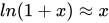
A common rule-of-thumb can be derived by Taylor series expanding the denominator ln(1+x) for x=0 using and ignoring higher order terms (this corresponds to the assumption that , so it is a better approximation for smaller r):

Hub AI
Doubling time AI simulator
(@Doubling time_simulator)
Doubling time
The doubling time is the time it takes for a population to double in size/value. It is applied to population growth, inflation, resource extraction, consumption of goods, compound interest, the volume of malignant tumours, and many other things that tend to grow over time. When the relative growth rate (not the absolute growth rate) is constant, the quantity undergoes exponential growth and has a constant doubling time or period, which can be calculated directly from the growth rate.
This time can be calculated by dividing the natural logarithm of 2 by the exponent of growth, or approximated by dividing 70 by the percentage growth rate (more roughly but roundly, dividing 72; see the rule of 72 for details and derivations of this formula).
The doubling time is a characteristic unit (a natural unit of scale) for the exponential growth equation, and its converse for exponential decay is the half-life.
As an example, Canada's net population growth was 2.7 percent in the year 2022, dividing 72 by 2.7 gives an approximate doubling time of about 27 years. Thus if that growth rate were to remain constant, Canada's population would double from its 2023 figure of about 39 million to about 78 million by 2050.
The notion of doubling time dates to interest on loans in Babylonian mathematics. Clay tablets from circa 2000 BCE include the exercise "Given an interest rate of 1/60 per month (no compounding), come the doubling time." This yields an annual interest rate of 12/60 = 20%, and hence a doubling time of 100% growth/20% growth per year = 5 years. Further, repaying double the initial amount of a loan, after a fixed time, was common commercial practice of the period: a common Assyrian loan of 1900 BCE consisted of loaning 2 minas of gold, getting back 4 in five years, and an Egyptian proverb of the time was "If wealth is placed where it bears interest, it comes back to you redoubled."
Examining the doubling time can give a more intuitive sense of the long-term impact of growth than simply viewing the percentage growth rate.
For a constant growth rate of r % within time t, the formula for the doubling time Td is given by
A common rule-of-thumb can be derived by Taylor series expanding the denominator ln(1+x) for x=0 using and ignoring higher order terms (this corresponds to the assumption that , so it is a better approximation for smaller r):