Hubbry Logo
Dower houseDower houseMain
Open search
Dower house
Community hub
Dower house
logo
8 pages, 0 posts
0 subscribers
Be the first to start a discussion here.
Dower house
Dower house
from Wikipedia
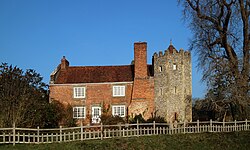
The Dower House at Greys Court, Oxfordshire
The Dower House at Dean Castle in Kilmarnock, Ayrshire

A dower house is usually a moderately large house available for use by the widow of the previous owner of an English, Scottish, Welsh or Irish estate. The widow, often known as the "dowager", usually moves into the dower house from the larger family house on the death of her husband if the heir is married, and upon his marriage if he was single at his succession. The new heir then occupies the vacated principal house.

The dower house might also be occupied by an elder son after his marriage, or simply rented to a tenant.[1]

Examples

[edit]
Byfleet Manor

The British royal family maintains a dower house in London as well as one in the country. Well-known royal dower-houses in London have included Clarence House, Marlborough House, and (for a time during the 18th century) Buckingham Palace (then known as "Buckingham House").[2] Frogmore House has served as Windsor Castle's dower house.

The Dukes of Devonshire kept Hardwick Hall in Derbyshire as a dower house from time to time after the 1st Duke moved the family seat to nearby Chatsworth House. It was being so used by the widow of the 9th Duke when it was transferred to the National Trust in satisfaction of death duties upon the unexpected death of the 10th Duke in 1950.

Byfleet Manor in Surrey served as the filming location of the dower house in the ITV series Downton Abbey.

See also

[edit]

References

[edit]
Revisions and contributorsEdit on WikipediaRead on Wikipedia
from Grokipedia
A dower house is a moderately large secondary residence on a country estate in , , or , traditionally provided for the —often referred to as the —of the estate's previous owner to ensure her independent accommodation after her husband's death. This arrangement allowed the to remain on the estate while the primary house passed to the heir, preserving family continuity and social structures within the . The practice stemmed from the English concept of , which granted a a life in one-third of her husband's inheritable , with the dower house serving as a practical provision to fulfill or supplement this right without fragmenting the main estate. Historically, houses emerged prominently in the 17th and 18th centuries amid the expansion of English country estates, reflecting the socio-legal framework that prioritized male while safeguarding widows from destitution. By the , they had become a standard feature of aristocratic and properties, often built or adapted from existing structures to accommodate the dowager's household, including servants and sometimes younger family members. The custom began to wane in the early due to legal reforms abolishing or modifying rights—such as the UK's Dower Act of 1833 and subsequent property laws—and socioeconomic changes like estate sales and inheritance taxes following . Today, many surviving dower houses function as private homes, hotels, or cultural sites, exemplifying Georgian or Victorian architectural styles with features like symmetrical facades, sash windows, and landscaped gardens that underscore their status as elegant yet subordinate to the main manor.

Definition and Origins

Definition

A dower house is a moderately sized residence located on a landed estate, specifically reserved for the lifetime use of the , known as the , of the estate's deceased owner. This arrangement allowed the to maintain a dignified separate from the main , which would pass to the heir upon the owner's death. The term "" refers to the legal provision under English that entitled a to a in one-third of her husband's , including lands and associated income, to ensure her support after his death. The house formed a key component of this system, often assigned as part of the lands to provide secure housing without alienating the permanently from the estate. The primary purpose of the dower house was to secure the widow's and housing through dower rights, derived from estate revenues, while preserving the integrity of the main for the heir and his . This setup prevented conflicts by relocating the dowager to a distinct on the estate, allowing her to draw from dower-assigned portions without interfering with the primary succession. Unlike general estate cottages intended for workers or tenants, or monetary "widow's portions" that might substitute for land-based in some cases, the dower house was exclusively designated for the of the estate owner, emphasizing its role in upholding traditional widow's entitlements. The concept of in emerged as a customary provision during the medieval period, granting a a life in typically one-third of her deceased husband's to ensure her financial support without alienating the estate permanently from the heirs. This right, known as the widow's , was well-established by the 12th and 13th centuries, evolving from Anglo-Saxon and Norman influences into a formalized element of feudal tenure that protected widows from destitution while aligning with the patriarchal structure of landholding. Early legal protections for this right were reinforced by the of 1215, particularly in Chapter 7, which prohibited compelling widows to pay for their or marriage portion and allowed them to remain in the marital home for 40 days post-husband's death, thereby safeguarding their immediate security and affirming as an inherent entitlement rather than a negotiable favor. The Dower Act of 1833 further standardized these provisions in by restricting a widow's to lands not disposed of by her husband during his lifetime or by will, enabling families to bar on principal estates more readily and often leading to the construction of dedicated dower houses as a practical alternative to fulfill the widow's life interest without encumbering the core . This legal framework intertwined closely with the practice of , under which the eldest son inherited the entirety of the family's to maintain estate unity and economic viability; houses facilitated compliance by assigning the widow a self-contained residence and stream from non-essential portions, thus preserving the heir's unfragmented control over the main lands and avoiding disputes or subdivisions that could diminish the family's social and financial status. Legal parallels existed in other regions influenced by English common law, though with variations; in Scotland, the widow's equivalent right was the terce, a liferent over one-third of the deceased husband's heritage, which similarly provided lifelong use but was more integrated into Scots property law without the strict feudal bars of English dower. In Ireland, jointures emerged as a common contractual alternative to the rigid common law dower, allowing spouses to agree on a specified life interest in lieu of the automatic one-third claim, often through marriage settlements that offered greater flexibility in property allocation.

Historical Context

Development in England

The concept of the dower house emerged in during the 16th and 17th centuries, paralleling the growth of large country estates under the Tudor and Stuart dynasties, when landowners increasingly sought dedicated residences for widows to avoid disrupting the heir's occupation of the principal house. This practice built upon longstanding dower rights, which entitled widows to a life interest in a portion of their husband's property, but adapted to the expanding scale of estates by providing physically separate accommodations. Construction of dower houses reached its height in the Georgian era of the 18th century, with numerous examples adapted or newly built to house dowagers amid the era's architectural and social shifts, continuing into the Victorian period of the 19th century as estate management practices evolved. Social influences, including Enlightenment philosophies that promoted individual rights and began to highlight women's economic independence, contributed to the design of these houses as discreet yet dignified retreats, allowing widows to maintain social standing without interfering in family dynamics. Economically, dower houses played a crucial role in preserving estate integrity by enabling the transfer of the main to male heirs while securing the widow's through attached lands, such as gardens or modest farms, often sustained by estate revenues without fragmenting the core holdings. This arrangement mitigated potential disputes and supported widows' financial under dower provisions, reflecting broader patterns of aristocratic strategy during periods of agricultural and commercial prosperity.

Use in Other Regions

In Scotland, the dower house concept was adapted through the legal framework of , where a widow's entitlement was known as "," granting her a liferent—a life interest—in one-third of her deceased husband's heritable estate. This provision often included the right to occupy a specific residence on the estate, such as a dedicated dower house, to ensure her maintenance without alienating the property from the heirs. Examples from 18th-century Highland estates illustrate this practice; for instance, on estates like those managed under systems, liferent arrangements secured widows' occupancy of secondary houses amid the region's turbulent social structures, reflecting the integration of feudal customs with legal protections for spousal support. In Wales and Ireland, parallels to the English dower house emerged but were shaped by local customs and legal integrations, resulting in fewer standalone structures due to generally smaller estate sizes compared to southern England. Welsh estates, influenced by the 1536 Laws in Wales Acts that aligned property rights with English common law, occasionally featured dower provisions in larger holdings, though traditional Welsh customs emphasized communal family support over isolated widow's residences. In Ireland, the 1634 Statute of Uses formalized jointure as a contractual alternative to common-law dower, allowing widows a life interest in specified lands or annuities, often manifested as jointure houses on Anglo-Irish estates; this act barred claims to both dower and jointure simultaneously, streamlining inheritance while integrating with Gaelic traditions like Brehon law's emphasis on marital portions. Fewer dedicated buildings arose in Gaelic areas, where estates were fragmented and inheritance favored elected tanists over strict primogeniture. Cultural adaptations in Ireland were further modified by 17th- and 18th-century religious tensions, as Penal Laws restricted Catholic land ownership and transmission, limiting jointure access for Catholic widows on estates controlled by the Protestant ascendancy. The dower house model spread internationally through British colonial influence, adapting to local inheritance systems. In colonial America, particularly Virginia from the 17th century onward, English common law imported dower rights entitling widows to a life estate in one-third of their husband's real property, sometimes including residence in a widow's portion of the family home or a separate structure on plantations; this provision supported widows amid frontier conditions but often required court-assigned allotments to enforce. In 19th-century Australia, British settlers in New South Wales and other colonies initially applied dower principles under received English law, but these were gradually eroded by statutes favoring settler land grants and jointures over rigid dower claims, with dedicated houses rare on expansive pastoral properties due to the emphasis on freehold sales and male-dominated inheritance. Local laws, such as New South Wales' 1836-1863 reforms, prioritized economic development, modifying the model to align with colonial realities rather than aristocratic estates.

Architectural Characteristics

Design Features

Dower houses were typically constructed on a moderately large scale to suit the needs of a and her small household, providing ample space without the opulence of the main estate house. They often adopted Georgian or Gothic Revival architectural styles prevalent in 18th- and 19th-century , characterized by symmetrical facades, multi-pane sash windows for natural light, and pitched roofs that contributed to their elegant yet restrained appearance. Interiors of dower houses featured functional layouts designed for comfort and practicality, including drawing rooms for social gatherings, multiple bedrooms for family and staff, and well-equipped kitchens to support daily living. Key elements such as open fireplaces in principal rooms provided essential heating, while modest ornamentation—like period cornices and paneling—added a touch of refinement without excess, aligning with the widow's more subdued lifestyle following the historical provision of dower rights for her security. These arrangements emphasized efficiency for a smaller household, with service areas discreetly separated from living spaces. Construction materials for dower houses commonly included local brick or stone, chosen for their durability and availability, which allowed the buildings to withstand centuries of use while maintaining a harmonious integration with the surrounding landscape. Brick examples were laid in period patterns for structural strength, whereas stone variants provided a more rustic solidity, both executed with simpler detailing than the grander main residences to reflect their secondary status. To promote self-sufficiency for the widowed occupant, dower houses frequently incorporated adaptations such as enclosed private gardens or small orchards, enabling the cultivation of produce and flowers to supplement household needs and offer a measure of independence. These outdoor spaces were typically walled or hedged for privacy, supporting light horticultural activities that complemented the interior's focus on domestic comfort.

Site and Layout

Dower houses were typically positioned a short distance from the main manor house, often in wooded or secluded areas of the estate to afford the dowager privacy while ensuring convenient access to shared resources such as farmland and staff services. For instance, at Bayham Abbey in East Sussex, the Dower House occupies a secluded spot near the abbey ruins within the broader Camden estate, allowing scenic views and estate integration without direct proximity to the primary residence. The layout of a dower house was carefully integrated into the estate to maintain operational independence, featuring separate entrance drives, enclosed walled gardens, and close proximity to productive lands like farmland, thereby minimizing interference with the main house's activities. Representative examples include the Dower House at Knowlton Court in Kent, which benefits from its own private gardens and a dedicated approach within the estate grounds, and properties like the one in Hampshire's Candover Valley, accessed via a long private drive that preserves seclusion. This arrangement supported self-sufficiency, with outbuildings often attached for staff quarters or livestock management. Spatial planning emphasized autonomy and discretion, with ground-floor public rooms oriented away from the manor to reduce visibility and interaction, while upper floors provided private family quarters overlooking enclosed grounds. Security was enhanced through enclosed grounds and boundary features like walls, enabling the to manage her household independently within the estate's protective framework.

Notable Examples

Prominent Dower Houses in the UK

Hardwick Hall in Derbyshire, England, served as a dower house for the Cavendish family, Dukes of Devonshire, from the late 17th century after the family seat moved to Chatsworth House. Built in the 1590s by Bess of Hardwick in Elizabethan style with its famous "more glass than wall" design, it provided a grand residence for dowagers, reflecting the wealth and status of the family while allowing the heir to inherit the primary estate. Now managed by the National Trust, it preserves Renaissance architecture and collections, highlighting the adaptation of major houses as dower provisions. In Midlothian, Scotland, Kirkhill House functioned as the dower house for the Arniston Estate, built in the 1700s by Henry Dundas for the family's liferent traditions, granting widows lifelong rights to estate portions. This Georgian structure with local stonework offered a self-sufficient home distinct from English dower practices, ensuring security for Scottish noblewomen. It exemplifies regional variations in widow provisions within expansive estates. In Anglesey, Wales, Château Rhianfa was constructed in 1849 by Sir John Hay-Williams as a dower house for his wife, Lady Sarah, overlooking the Menai Strait. Inspired by Loire Valley châteaux, this Grade II*-listed French-style mansion featured Victorian Gothic elements, providing a secure refuge for widows during the industrial era on Welsh estates. Now a luxury hotel, it demonstrates the extension of dower customs to Welsh gentry. An Irish example is Butler House in Kilkenny, County Kilkenny, built around 1786 as the dower house for Kilkenny Castle and the Butler family, Earls and Dukes of Ormonde. This elegant Georgian townhouse accommodated dowagers near the main castle, maintaining family ties and social status amid Irish estate traditions. Restored as a four-star guesthouse, it preserves 18th-century interiors and gardens, illustrating dower houses' role in Irish aristocratic continuity.

International Examples

Australia's colonial settlements similarly incorporated dower houses, influenced by British legal and architectural models on pastoral estates during the 19th century. The Dower House in Edgecliff, New South Wales, built in 1842 as a Victorian Rustic Gothic sandstone manor, was specifically constructed for Penelope Whistler Smith, the widow of merchant Thomas Smith, reflecting the era's emphasis on securing widow's rights in burgeoning colonial properties. Although not tied to a sheep station, this example illustrates the adaptation of dower provisions in New South Wales' expanding rural and urban estates, where such houses ensured financial independence for widows in a frontier context. Currently preserved as part of the Ascham School campus, it continues to function as an educational and residential space. European parallels to dower houses are rarer and less formalized, often manifesting as designated widow's accommodations within larger estates rather than independent structures. In 18th-century France, the legal douaire—equivalent to the English dower—entitled widows to a portion of their husband's property, sometimes including residences in chateaus of the Loire Valley. The Château de Chenonceau, for instance, served as a residence for notable widows such as Louise Dupin, who occupied and preserved the estate after her husband's death in 1769, embodying a cultural adaptation of widow's security amid aristocratic holdings. Unlike strict British dower houses, these arrangements integrated widows into the main property but provided similar protective intent. Many such Loire Valley chateaus, including Chenonceau, are now preserved as museums, attracting visitors to their historical roles in women's estate management.

Decline and Modern Usage

Factors Leading to Decline

The Dower Act 1833 altered the legal framework for dower in England by allowing it to be barred by a simple deed, restricting it to realty not devised by will, which made the traditional dower right more flexible and reduced its automatic application, thereby diminishing the necessity for dedicated provisions like dower houses to fulfill widows' entitlements. Subsequent reforms, including the Married Women's Property Acts of 1870 and 1882, further empowered women to own and manage property independently during marriage, aligning with alternatives like jointures and marriage settlements that provided for widows without relying on dower. The Administration of Estates Act 1925 formally abolished dower in the United Kingdom. These changes reduced reliance on posthumous dower allocations and the associated infrastructure such as dedicated dower houses. Social transformations in the late 19th and early 20th centuries further eroded the tradition of dower houses. Industrialization and urbanization drew families away from rural estates toward urban opportunities, fragmenting the extended family structures that had sustained the dowager's role on the land and rendering isolated country residences less viable for aging widows. Concurrently, evolving inheritance practices shifted from rigid primogeniture toward greater use of wills, which allowed estate owners to devise property more flexibly and often excluded automatic dower claims in favor of tailored provisions like annuities or urban investments. These changes reflected broader societal moves toward nuclear families and personal financial independence, making the construction and maintenance of dower houses on sprawling estates impractical by the early 20th century. Economic strains intensified the decline, particularly following the World Wars, when soaring estate taxes and death duties—reaching up to 80% on large inheritances—compelled many landowners to liquidate assets, including ancillary buildings like dower houses, to settle liabilities. The agricultural depression of the late 19th century had already weakened estate incomes, but the fiscal burdens of wartime reconstruction and interwar policies accelerated sales and demolitions, with estimates indicating that one in six English country houses was lost in the 20th century alone. By the 1930s, these pressures had rendered the upkeep of secondary residences untenable for most families, marking the effective end of new dower house builds after around 1920.

Contemporary Adaptations

In the 21st century, many surviving dower houses in the UK have been repurposed as bed-and-breakfasts, private residences, or event venues to ensure their viability. For instance, the Dower House at Coworth Park, part of the Dorchester Collection, has been restored as a luxury three-bedroom cottage with modern amenities like private gardens and a chef service, catering to high-end guests. Similarly, the Dower House at Beaverbrook estate functions as an inviting hotel accommodation featuring vibrant interiors and facilities such as a private pool. The National Trust has also adapted properties like Quatt's Dower House on the Dudmaston Estate into rental apartments, blending preservation with contemporary housing needs. Preservation efforts have emphasized the role of dower houses in heritage tourism, with organizations like Historic England providing grants for post-2000 restorations to maintain their architectural integrity. These initiatives, including the Heritage at Risk Capital Fund launched in recent years, support repairs for listed buildings, enabling sites such as Greys Court's Dower House to remain accessible to visitors while funding conservation work. Such efforts not only safeguard structural elements but also integrate dower houses into local economies through guided tours and events. Culturally, dower houses endure as symbols of historical women's property rights under English common law, where the dower provision ensured widows' lifelong support from one-third of their husband's estate, a legacy reflected in these dedicated residences. This significance occasionally inspires modern designs, as seen in luxury estates like Templeton West, where new accommodations evoke dower house aesthetics with period-inspired features amid contemporary comforts. Despite these adaptations, challenges persist in the 21st century, including high maintenance costs for energy retrofitting and navigating strict zoning regulations for historic properties. Custodians face barriers such as skilled labor shortages and compliance with net-zero standards, which complicate updates without compromising heritage value.

References

Add your contribution
Related Hubs
User Avatar
No comments yet.