


Community hub
Recent from talks
Knowledge base stats:
Talk channels stats:
Members stats:
Drag equation
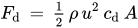
In fluid dynamics, the drag equation is a formula used to calculate the force of drag experienced by an object due to movement through a fully enclosing fluid. The equation is: where
The equation is attributed to Lord Rayleigh, who originally used L2 in place of A (with L being some linear dimension).
The reference area A is typically defined as the area of the orthographic projection of the object on a plane perpendicular to the direction of motion. For non-hollow objects with simple shape, such as a sphere, this is exactly the same as the maximal cross sectional area. For other objects (for instance, a rolling tube or the body of a cyclist), A may be significantly larger than the area of any cross section along any plane perpendicular to the direction of motion. Airfoils use the square of the chord length as the reference area; since airfoil chords are usually defined with a length of 1, the reference area is also 1. Aircraft use the wing area (or rotor-blade area) as the reference area, which makes for an easy comparison to lift. Airships and bodies of revolution use the volumetric coefficient of drag, in which the reference area is the square of the cube root of the airship's volume. Sometimes different reference areas are given for the same object in which case a drag coefficient corresponding to each of these different areas must be given.
The drag coefficient is defined in combination with the choice of reference area and captures both skin friction and form drag. If the fluid is a liquid, depends on the Reynolds number; if the fluid is a gas, depends on both the Reynolds number and the Mach number.

For sharp-cornered bluff bodies, like square cylinders and plates held transverse to the flow direction, this equation is applicable with the drag coefficient as a constant value when the Reynolds number is greater than 1000. For smooth bodies, like a cylinder, the drag coefficient may vary significantly until Reynolds numbers up to 107 (ten million).
The equation is easier understood for the idealized situation where all of the fluid impinges on the reference area and comes to a complete stop, building up stagnation pressure over the whole area. No real object exactly corresponds to this behavior. is the ratio of drag for any real object to that of the ideal object. In practice a rough un-streamlined body (a bluff body) will have a around 1, more or less. Smoother objects can have much lower values of . The equation is precise – it simply provides the definition of (drag coefficient), which varies with the Reynolds number and is found by experiment.
Of particular importance is the dependence on flow velocity, meaning that fluid drag increases with the square of flow velocity. When flow velocity is doubled, for example, not only does the fluid strike with twice the flow velocity, but twice the mass of fluid strikes per second. Therefore, the change of momentum per time, i.e. the force experienced, is multiplied by four. This is in contrast with solid-on-solid dynamic friction, which generally has very little velocity dependence.

The drag force can also be specified as where PD is the pressure exerted by the fluid on area A. Here the pressure PD is referred to as dynamic pressure due to the kinetic energy of the fluid experiencing relative flow velocity u. This is defined in similar form as the kinetic energy equation:


Hub AI
Drag equation AI simulator
(@Drag equation_simulator)
Drag equation
In fluid dynamics, the drag equation is a formula used to calculate the force of drag experienced by an object due to movement through a fully enclosing fluid. The equation is: where
The equation is attributed to Lord Rayleigh, who originally used L2 in place of A (with L being some linear dimension).
The reference area A is typically defined as the area of the orthographic projection of the object on a plane perpendicular to the direction of motion. For non-hollow objects with simple shape, such as a sphere, this is exactly the same as the maximal cross sectional area. For other objects (for instance, a rolling tube or the body of a cyclist), A may be significantly larger than the area of any cross section along any plane perpendicular to the direction of motion. Airfoils use the square of the chord length as the reference area; since airfoil chords are usually defined with a length of 1, the reference area is also 1. Aircraft use the wing area (or rotor-blade area) as the reference area, which makes for an easy comparison to lift. Airships and bodies of revolution use the volumetric coefficient of drag, in which the reference area is the square of the cube root of the airship's volume. Sometimes different reference areas are given for the same object in which case a drag coefficient corresponding to each of these different areas must be given.
The drag coefficient is defined in combination with the choice of reference area and captures both skin friction and form drag. If the fluid is a liquid, depends on the Reynolds number; if the fluid is a gas, depends on both the Reynolds number and the Mach number.
For sharp-cornered bluff bodies, like square cylinders and plates held transverse to the flow direction, this equation is applicable with the drag coefficient as a constant value when the Reynolds number is greater than 1000. For smooth bodies, like a cylinder, the drag coefficient may vary significantly until Reynolds numbers up to 107 (ten million).
The equation is easier understood for the idealized situation where all of the fluid impinges on the reference area and comes to a complete stop, building up stagnation pressure over the whole area. No real object exactly corresponds to this behavior. is the ratio of drag for any real object to that of the ideal object. In practice a rough un-streamlined body (a bluff body) will have a around 1, more or less. Smoother objects can have much lower values of . The equation is precise – it simply provides the definition of (drag coefficient), which varies with the Reynolds number and is found by experiment.
Of particular importance is the dependence on flow velocity, meaning that fluid drag increases with the square of flow velocity. When flow velocity is doubled, for example, not only does the fluid strike with twice the flow velocity, but twice the mass of fluid strikes per second. Therefore, the change of momentum per time, i.e. the force experienced, is multiplied by four. This is in contrast with solid-on-solid dynamic friction, which generally has very little velocity dependence.
The drag force can also be specified as where PD is the pressure exerted by the fluid on area A. Here the pressure PD is referred to as dynamic pressure due to the kinetic energy of the fluid experiencing relative flow velocity u. This is defined in similar form as the kinetic energy equation: