Hubbry Logo
Drew WeatherfordDrew WeatherfordMain
Open search
Drew Weatherford
Community hub
Drew Weatherford
logo
8 pages, 0 posts
0 subscribers
Be the first to start a discussion here.
Drew Weatherford
Drew Weatherford
from Wikipedia

Andrew Skillern Weatherford (born June 22, 1985)[1] is an American former football quarterback. He played college football at Florida State University from 2004 to 2008.

Key Information

Early life

[edit]

Weatherford attended Land O' Lakes High School in Pasco County, Florida. He led the Fighting Gators to a 32–14 (4–4 in the state playoffs) record in four years as the starting quarterback. Weatherford set both school and county records for season and career passing yards as well as touchdown passes. In his freshman season, Weatherford had the opportunity to play football with his older brother, Sam. The tandem played to a 7–3 regular-season record and traveled to Southlake High School for the playoffs. Andrew threw a touchdown to his tight end sibling in a losing effort.

In the 2002 season, Weatherford had his most prolific stats, leading the state in passing touchdowns (ahead of future FSU backup Xavier Lee). His Gators won the second playoff game in school history against Ocala Vanguard. Weatherford did not throw an interception through eight games. This was the season he would set Pasco's single-season passing yardage record. Land O' Lakes would set school scoring records for points in a game (60) as well as points for a season (423). Weatherford guided his team to a perfect regular season, and two playoff wins. His season ended when they lost to eventual state champion Palm Bay High School, which featured future NFL players Reggie Nelson and Joe Cohen. The Palm Bay game was by far Weatherford's most struggling performance being sacked and intercepted four times (making the season total six). He finished the season with a 12–1 record.

Coached by John Benedetto, Weatherford started every game of his high school career behind center. In his senior year he also started on defense as the team's safety. After a superb junior year,[citation needed] the Gators started the year with a state ranking of No. 5. They quickly fell from the state's elite when they lost the first two games of the season. While Weatherford put up modest numbers himself, the lack of another standout player and the loss of focus on the running game, the team finished 6–4. Weatherford and his team would gain composure in the playoffs defeating Auburndale and Ocala Forest. Drew Weatherford played his final game in a shootout with Lakeland Lake Gibson High School, losing to the Braves (who were led by USF's eventual star quarterback Matt Grothe), 44–35.

College career

[edit]

2005

[edit]

After the career of Wyatt Sexton was cut short by Lyme disease, Weatherford won the starting job over fellow redshirt freshman Xavier Lee during fall practice.[2]

Weatherford, as a redshirt freshman, led the Seminoles to an Orange Bowl berth in 2005, but his #22 Seminoles lost to #3 Penn State in triple overtime. After that game, he underwent surgery for a torn tendon in his right ankle and healed fully.[citation needed]

2006

[edit]

In the Spring of 2006, he won FSU camp awards for Most Dependable Quarterback and Top Offensive Leadership. Weatherford missed the Maryland game on October 28, 2006, due to injury, which gave Xavier Lee his shot at the starting job, escalating the quarterback controversy which had been hotly debated all season. Eventually Weatherford won the starting position over Lee.

2007

[edit]
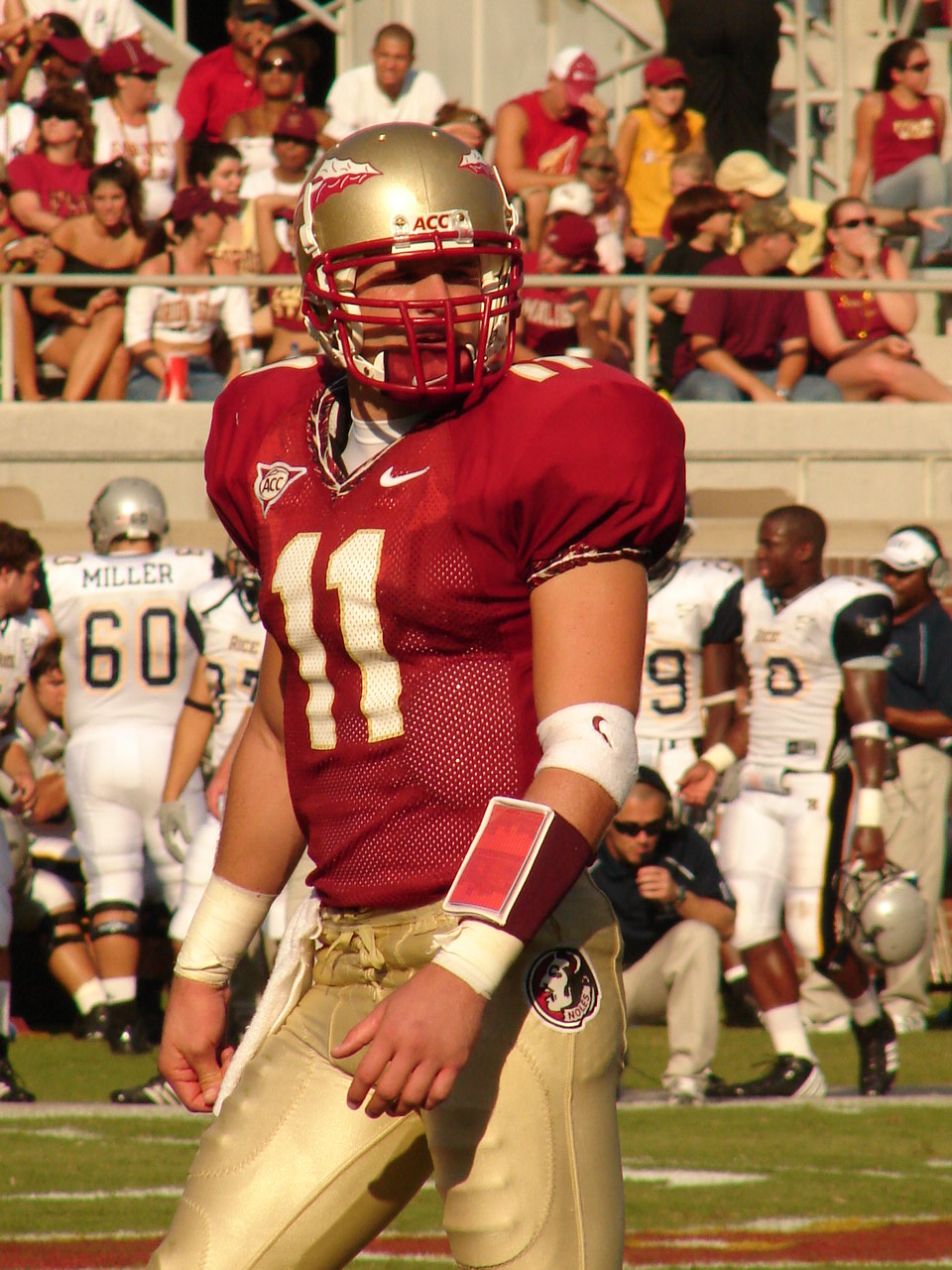
Weatherford rolls out to pass against the Virginia Tech Hokies

Following FSU's Emerald Bowl victory against UCLA, a heated quarterback competition between Lee and Weatherford came to a resolution on August 23, 2007, when Weatherford was named the starter for the opener against Clemson.

2008

[edit]

Weatherford sat out of spring practice after a slight tear in the lateral meniscus in his right knee required surgery. He was expected to be the starter headed into fall camp, but he faced fierce competition from redshirt sophomores D'Vontrey Richardson and Christian Ponder.

On August 3, after two and half scrimmages, Jimbo Fisher, Florida State's quarterbacks coach and offensive coordinator, announced that Christian Ponder would start the Seminoles' game against Western Carolina on September 6. Weatherford was moved down to third string on the depth chart and played in only one series late in the fourth quarter during FSU's 69–0 blowout of Western Carolina.

He also split snaps with Richardson during FSU's 45–15 loss to the Florida Gators, as Ponder left the game at halftime after aggravating a back injury inflicted during FSU's 37–3 rout of Maryland.

Professional career

[edit]

2009

[edit]

Weatherford was invited to participate in the Chicago Bears three-day mini camp. He also worked out with the New Orleans Saints and the New England Patriots.[citation needed]

Weatherford participated in an open tryout on August 22 for the Orlando Tuskers of the newly formed United Football League. Following this tryout, Weatherford was film-interviewed by reporter Donnie Paschal.[3]

2010

[edit]

In 2010, Weatherford played in the Arena Football League with the Tampa Bay Storm.[4] He was the backup behind starting QB Brett Dietz,[citation needed] and was on kickoff coverage.

Post-football career

[edit]

Weatherford founded private equity firm Weatherford Capital with his brothers, Sam Weatherford and Will Weatherford, the former Speaker of the Florida House of Representatives. He also sits on the FSU Board of Trustees.[5]

References

[edit]
[edit]
Revisions and contributorsEdit on WikipediaRead on Wikipedia
from Grokipedia
Andrew Skillern Weatherford (born June 22, 1985), commonly known as Drew Weatherford, is an American former college football quarterback, business executive, and philanthropist best known for his tenure as the starting quarterback for the Florida State Seminoles from 2005 to 2007. During his college career at Florida State University, he appeared in 41 games, completing 644 of 1,128 passes for 7,567 yards and 39 touchdowns while leading the Atlantic Coast Conference (ACC) in passing yards (3,208) and touchdowns (18) as a redshirt freshman in 2005. After a brief professional stint in arena football with the Tampa Bay Storm in 2010, where he threw for 64 yards and one touchdown in limited action, Weatherford shifted to the business world, earning a Bachelor of Science in Finance and Real Estate from Florida State and an MBA from Northwestern University's Kellogg School of Management. Weatherford co-founded Strategos Group, a Florida-based business consultancy and advocacy firm, and serves as a founding partner of Weatherford Capital, a Tampa-headquartered private investment firm managing over $1 billion in assets with a focus on growth equity in and regulated industries; the firm's portfolio includes notable investments such as and . He also co-founded Collegiate Athletic Solutions, the first committed capital fund dedicated to the collegiate athletic ecosystem. In addition to his investment roles, Weatherford holds board positions with organizations including Summit Broadband, the Venture Forum, Accelerator 111, and Family First, and was appointed by Governor to the board of the Florida Opportunity Fund, Inc. A lifelong Seminoles supporter, he serves on the Board of Trustees and its Investment Committee, reflecting his commitment to his where he played under legendary coach . In October 2025, Weatherford joined the ownership group of Major League Baseball's as a limited partner, alongside his brother Will Weatherford, expanding his influence in sports and community advocacy. Residing in Tampa with his wife Morgan and their three children—Kennedy, Emerson, and Truett—Weatherford is actively involved in philanthropy, including founding the Tampa-based nonprofit Onbikes.

Early life

Upbringing and family

Drew Weatherford was born on June 22, 1985, in . He grew up in a large family in the , primarily in the community. His parents, Bill Weatherford—a former quarterback at —and Cathy Weatherford, raised eight children in a close-knit, faith-centered household that emphasized resilience amid challenges, including the tragic loss of their youngest son, Peter, to a in 1995 at 20 months old. Weatherford's brothers included Sam and Will; the latter later served as Speaker of the from 2012 to 2014. The family initially homeschooled their children, fostering a strong sense of unity and personal development in the suburban environment. This educational approach, combined with the supportive local community, provided early non-athletic influences that shaped Weatherford's character before his enrollment at Pine View Middle School. The Weatherfords' experiences in the area, marked by family bonding, laid a foundational emphasis on perseverance that extended into his later pursuits.

High school career

Drew Weatherford attended Land O' Lakes High School in , where he developed as a under coach John Benedetto. As the starting for four seasons from 2000 to 2003, Weatherford led the Gators to an overall record of 34–14, including three playoff appearances and two district championships in 2002 and 2003. The team achieved a school-best 12–1 mark in his junior year of 2002, advancing to the regional finals. Weatherford set multiple school and Pasco County passing records during his career, culminating in 7,657 total yards and 79 passes from 2000 to 2003. In 2002, he threw for 2,645 yards and 39 passes, setting county records. His senior season in 2003 earned him first-team All-State honors as he guided the team to an 8–5 record and another district title. A highly touted pro-style recruit, Weatherford committed to on October 1, 2003, after drawing interest from multiple Division I programs. His family background in football provided key encouragement that motivated his development on the field.

College career

2004 season

Drew Weatherford enrolled at in the fall of 2004 as a true quarterback, following a standout high school career at Land O' Lakes High School in that drew recruitment from multiple programs. He was one of two highly touted signal-callers, alongside Xavier Lee, and the coaching staff, led by head coach , planned to redshirt both to preserve their eligibility while allowing them to develop through practices. As a redshirt player, Weatherford did not see significant action during the season, focusing instead on adjusting to the rigors of , including the increased speed, complexity of defenses, and physical demands compared to high school. He participated in team practices and scrimmages, competing for future reps behind senior starter Chris Rix, which helped him build familiarity with the Seminoles' offensive system amid a deep position group. The 2004 Florida State team, in its inaugural season in the Atlantic Coast Conference (ACC) after departing the Big East, finished with a 9-3 overall record and 6-2 in conference play, securing second place in the ACC standings under Bowden's guidance. Highlights included a narrow loss to rival (10-16) and a 41-22 victory over Clemson, though the season ended with a 30-24 win over . Weatherford's only on-field moment came late in a 14-13 win over on October 2, when he entered for one snap on a bootleg play but sprained his ankle, limiting him further and reinforcing his redshirt status. This brief exposure underscored the challenges of transitioning to college-level competition, yet it did not impact his preserved year of eligibility.

2005 season

As a redshirt in 2005, Drew Weatherford emerged as Florida State's starting quarterback after winning a competitive preseason battle, taking over the role ahead of the season opener against on September 5. His preparation during the 2004 redshirt season, where he learned behind veterans like Chris Rix, enabled his readiness for the starting duties. Weatherford started all 13 games, leading the Seminoles to an 8-5 record, an ACC , and an berth while throwing for 3,208 yards on 276 of 469 completions (58.8 percent) with 18 touchdowns and 18 interceptions; he also contributed three rushing touchdowns on 67 carries for a net loss of 28 yards. Weatherford's season featured a mix of promising outings and growing pains, as he adjusted to the demands of leading a high-profile program. In his debut against , he struggled with accuracy, completing just 7 of 24 passes for 67 yards and one interception, but Florida State secured a narrow 10-7 on defense and special teams. He showed improvement in a 55-24 rout of on , where he went 24 of 32 for 276 yards and two s with one interception, helping orchestrate a dominant offensive performance. However, challenges arose in a 20-15 upset loss to NC State on November 5, as Weatherford completed 19 of 38 passes for 181 yards, one , and three interceptions, contributing to the Seminoles' three-game skid that dropped them from the rankings. Weatherford rebounded in the postseason, solidifying his role as a clutch performer. In the against on December 3, he completed 21 of 35 passes for 225 yards and one with no interceptions, guiding Florida State to a 27-22 victory and earning honors for his poise under pressure. This win clinched the Seminoles' conference title and a spot in the . There, Weatherford demonstrated leadership in a thrilling triple-overtime battle against Penn State on January 3, 2006, completing 24 of 43 passes for 258 yards, one —including a pivotal 57-yard scoring strike to in the first overtime—and one interception, but Florida State fell 26-23 after a failed extra-point attempt in the third overtime. Teammates credited his composure in the extended game as a turning point in his development as a .

2006 season

Entering the 2006 preseason, Drew Weatherford retained the starting quarterback position at Florida State over sophomore Xavier Lee, despite recovering from an offseason ankle injury that had limited his summer preparations. Coach announced Weatherford as the starter on August 12, citing his experience from 23 prior starts, including the momentum gained from the appearance. Weatherford started the first seven games, leading the Seminoles to a 4-3 record, highlighted by a narrow 13-10 victory over in the season opener where he threw for 175 yards. Weatherford suffered a mid-season ankle that caused him to miss the October 28 game against , a 24-27 loss that dropped Florida State to 4-4 overall and 2-3 in the ACC. Returning for the final regular-season games with limited mobility, he appeared in a backup role against (2 completions for 41 yards in a 33-0 win) and struggled against Wake Forest (4-for-15, 52 yards, 2 interceptions in a 30-0 loss), contributing to the team's 6-6 regular-season finish but securing . In ACC play, standout performances included a career-high four passes for 231 yards in a 51-24 rout of and 326 yards with one against in a 24-19 defeat. For the season, Weatherford completed 177 of 318 passes (55.7%) for 2,154 yards, 12 , and 11 interceptions, achieving a of 118.1 while ranking fifth in the ACC in passing yards and total offense (2,140 yards). He added 57 rushing attempts for -14 yards and one , often hampered by the Seminoles' offensive line struggles. In the Emerald Bowl against UCLA on December 27, Weatherford threw for 325 yards and a in a 44-27 victory, helping Florida State finish 7-6 overall.

2007 season

Following Florida State's 44–27 victory over UCLA in the 2006 Emerald Bowl, where Weatherford completed 21 of 43 passes for 325 yards and a , he entered the preseason as one of two primary candidates for the starting role alongside Xavier Lee. On August 24, 2007, head coach named Weatherford the starter for the season opener, citing his consistency during training camp. As a senior leader, Weatherford guided the Seminoles to a 7–6 overall record and 4–4 mark in (ACC) play, demonstrating improved decision-making after recovering from a 2006 preseason ankle injury that had hampered his mobility the prior year. His regular-season performances in ACC contests highlighted his command of the offense, including a career-best 354 passing yards and two touchdowns on 29-of-45 attempts in a 27–17 upset win over No. 2 on November 3, where he connected with for a key 23-yard scoring strike. Another standout effort came against on October 27, as he threw for 339 yards on 35-of-47 passing with no interceptions in a 25–6 victory, efficiently distributing the ball to multiple receivers while protecting the football. Weatherford's 2007 season marked career highs in completion percentage at 56.9% and efficiency metrics, with only three interceptions across 318 attempts—his lowest turnover rate in a full starting year—while amassing 2,049 passing yards and nine to anchor the Seminoles' aerial attack. In the Music City Bowl against on December 31, Weatherford contributed significantly in a 35–28 loss, completing 22 of 48 passes for 276 yards and a while adding 48 rushing yards and two rushing scores in his final collegiate appearance.

2008 season

Weatherford entered his fifth and final year at Florida State as the presumptive starter following a 2007 season in which he had reclaimed the role midway through, starting 11 games and throwing for 2,049 yards and 9 touchdowns, but was unexpectedly demoted to third-string quarterback behind sophomore and redshirt freshman D'Vontrey Richardson just three days before the season opener, as new prioritized developing younger talent. This shift severely limited his on-field contributions, with Weatherford appearing in just four games, primarily in relief roles early on. In blowout wins over FCS teams Western Carolina (69-0) and Chattanooga (46-7), he entered late in mop-up duty, completing 1 of 2 passes for 18 yards against the former and adding a single rush for minus-1 yard against the latter. Weatherford received unexpected starting assignments later in the year, first in the rivalry matchup against on November 29, where he struggled in a 45-15 loss, completing 4 of 15 passes for 61 yards while taking three sacks and rushing three times for minus-31 yards before being pulled early for Ponder; he then started the Champs Sports Bowl against on December 27, going 5 for 6 for 77 yards on the opening drive before yielding to Ponder in the 42-13 victory. For the season, Weatherford recorded 10 completions on 23 attempts for 156 passing yards with no touchdowns or interceptions, alongside five rushes for minus-26 yards, marking a sharp decline from his prior contributions. The Seminoles compiled a 9-4 overall record and went 5-3 in play, finishing second in the Atlantic Division and earning their first bowl appearance since 2006, which they capped with the bowl win to end the campaign on a high note. Weatherford graduated from Florida State University in 2009 with a Bachelor of Science degree in finance and real estate from the College of Business.

Professional career

2009

Following his senior season at Florida State, where he passed for 2,540 yards and 14 touchdowns, Weatherford went undrafted in the 2009 NFL Draft but received invitations to rookie minicamps with the Chicago Bears and New Orleans Saints. At the Bears' minicamp in early May, the 6-foot-3, 220-pound quarterback participated in non-contact drills, though he was not offered a contract. Similarly, during the Saints' rookie minicamp later that month, Weatherford saw significant reps with the second-team offense but again failed to earn a roster spot. Scouting reports highlighted concerns over his 4.83-second 40-yard dash time as a factor in teams' decisions. In August 2009, Weatherford attended an open tryout for the Florida Tuskers of the United Football League (UFL) at the in Orlando, competing among over 1,200 hopefuls for a chance to join the expansion franchise. Despite the opportunity to showcase his skills in a pro setting closer to home, he was not selected for the Tuskers' roster, which ultimately featured veteran quarterback as the starter. With no openings in the or UFL, Weatherford began exploring alternative professional paths, including , as a means to continue his career and gain visibility for potential future opportunities.

2010

In 2010, Drew Weatherford signed with the of the as a backup , following unsuccessful tryouts with teams the previous year. He served primarily behind starter Brett Dietz, appearing in limited action during the regular season while also contributing significantly on special teams, where he recorded 14 tackles by midseason, leading the team in that category. Weatherford's passing stats reflected his backup role, completing 4 of 8 attempts for 64 yards, 1 , and no interceptions across four regular-season games, earning a quarterback rating of 108.3. Representative examples include a perfect 2-for-2 for 26 yards against the in Week 12 and a 2-for-4 effort for 38 yards with a pass versus the Bossier-Shreveport Battle Wings in Week 13; he also attempted 2 passes for no yards in Week 17 against the Vipers but saw no action in the Week 18 matchup with the . Defensively, he tallied 12 tackles and 6 assists on special teams throughout the season. The Storm finished the 2010 regular season with an 11-5 record, securing second place in the National Conference's South Division and advancing to ArenaBowl XXIII, where they fell to the Spokane Shock. Weatherford did not record statistics in the playoff loss to Spokane but had appeared briefly in the divisional playoff win over the Tulsa Talons. After the season concluded, Weatherford retired from professional football, ending his playing career after this single AFL campaign to pursue business opportunities.

Post-football career

Business ventures

After retiring from professional football, Drew Weatherford co-founded Weatherford Capital in 2015 alongside his brothers, Sam and Will, establishing it as a family-owned private investment firm headquartered in , with an additional office in , . The firm specializes in growth equity investments targeting rapidly expanding companies in technology and tech-enabled services sectors, such as business services, , and government technology, with a portfolio that includes seven platform investments in the latter area. In May 2024, Weatherford co-founded Collegiate Athletic Solutions (CAS) in partnership with RedBird Capital Partners, creating the first dedicated capital fund focused exclusively on investments in college athletics. This sports platform aims to provide university athletic departments with $50 million to $200 million in committed capital per investment, in exchange for a share of future revenues, while offering strategic business-building support to navigate evolving challenges like and name, image, and likeness (NIL) opportunities. As a former , Weatherford's background in college athletics has informed CAS's mission to foster sustainable growth in the sector. In October 2025, Weatherford joined the ownership group as a limited partner following the team's sale to a group led by Dream Finders Homes CEO Patrick Zalupski. He expressed strong commitment to the franchise's winning culture and the development of a new , stating that the ownership aims to enhance the team's competitiveness and community ties in the region.

Public service and affiliations

In September 2021, Drew Weatherford was appointed by the to the Board of Trustees, where he serves as a focused on advancing the university's academic and athletic programs as a proud alumnus. His role involves oversight of FSU's strategic initiatives, drawing on his background as a former Seminoles and graduate to support the institution's growth in higher education and intercollegiate athletics. Weatherford's educational pursuits post-graduation have informed his public service, including earning an MBA from the at in 2019, which complements his undergraduate degree in finance and real estate from FSU. This advanced business education has equipped him for governance roles emphasizing economic development and community impact. Beyond his trusteeship, Weatherford has engaged in and community affiliations primarily in the , including co-founding onbikes in 2011, a nonprofit that provides bicycles and promotes programs for at-risk and foster children to foster and independence. He also serves on the boards of several organizations, such as the Florida Medical Clinic Foundation of Caring, Take Stock in Children of —which mentors low-income students toward college graduation—and the Dream Center of , supporting youth development and family services since 2014. Additionally, Weatherford was appointed by Governor to the of the Florida Opportunity Fund, Inc., focusing on economic opportunities, as well as Enterprise and Space , which promote business growth and innovation in the state. These efforts reflect his commitment to local sports initiatives and , often intersecting with his FSU alumni network.

References

Add your contribution
Related Hubs
User Avatar
No comments yet.