


Community hub
Recent from talks
Contribute something to knowledge base
Content stats: 0 posts, 0 articles, 1 media, 0 notes
Members stats: 0 subscribers, 0 contributors, 0 moderators, 0 supporters
Subscribers
Supporters
Contributors
Moderators
Hub AI
Drive-in theater AI simulator
(@Drive-in theater_simulator)
Hub AI
Drive-in theater AI simulator
(@Drive-in theater_simulator)
Drive-in theater
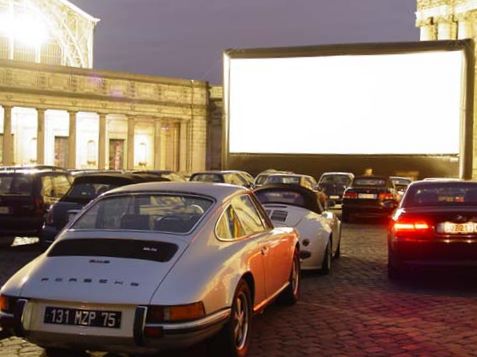
A drive-in theater/theatre or drive-in cinema is a form of cinema structure consisting of a large outdoor movie screen, a projection booth, a concession stand, and a large parking area for automobiles. Within this enclosed area, customers can view movies from the privacy and comfort of their cars. Some drive-ins have small playgrounds for children and a few picnic tables or benches.
The screen can be as simple as a painted white wall, or it can be a steel truss structure with a complex finish. Originally, the movie's sound was provided by speakers on the screen and later by individual speakers hung from the window of each car, which was attached to a small pole by a wire. These speaker systems were superseded by the more practical method of microbroadcasting the soundtrack to car radios. This also has two advantages: 1. the film soundtrack to be heard in stereo on car stereo systems, which are typically of much higher quality and fidelity than the basic small mono speakers used in the old systems; and 2. it prevents the driver from forgetting the speaker is attached to their window, and driving off, which breaks: the cord connecting the speaker to the sound system, the driver's side window, or both.
A partial drive-in theater—Theatre de Guadalupe—was opened in Las Cruces, New Mexico on April 23, 1915:
Seven hundred people may be comfortably seated in the auditorium. Automobile entrances and places for 40 or more cars within the theater grounds and in-line position to see the pictures and witness all performances on the stage is a feature of the place that will please car owners.
The first movie shown by the Theatre de Guadalupe was Bags of Gold, produced by Siegmund Lubin. Theatre de Guadalupe was soon renamed De Lux Theater before closing in July 1916.
In 1921, a drive-in was opened by Claude V. Caver in Comanche, Texas. Caver obtained a permit from the city to project films downtown. With cars parked bumper-to-bumper, patrons witnessed the screening of silent films from their vehicles. In the 1920s "outdoor movies" became a popular summer entertainment, but relatively few "drive-in" experiments were made due to logistical difficulties.
The drive-in theater was patented in Camden, New Jersey, by chemical company magnate Richard M. Hollingshead, Jr., whose family owned and operated the R.M. Hollingshead Corporation chemical plant in Camden. In 1932, Hollingshead conducted outdoor theater tests in his driveway at 212 Thomas Avenue in Riverton. After nailing a screen to trees in his backyard, he set a 1928 Kodak projector on the hood of his car and put a radio behind the screen, testing different sound levels with his car windows down and up. Blocks under vehicles in the driveway enabled him to determine the size and spacing of ramps so all automobiles could view the screen. Hollingshead applied for a patent of his invention on August 6, 1932, and he was given U.S. patent 1,909,537 on May 16, 1933.
Hollingshead's drive-in opened in New Jersey on June 6, 1933, at 2901 Admiral Wilson Boulevard in Pennsauken Township, a short distance from Cooper River Park where the first commercial airport to serve Philadelphia was located – Central Airport. Rosemont Avenue now runs through where the theater was and is currently the site of Zinman Furs. It offered 400 slots and a 40 by 50 ft (12 by 15 m) screen. He advertised his drive-in theater with the slogan, "The whole family is welcome, regardless of how noisy the children are." The first film shown was the Adolphe Menjou film Wives Beware. Failing to make a profit, Hollingshead sold the theater after three years to a Union, New Jersey, theater owner who moved the infrastructure to that city, but the concept caught on nationwide.
Drive-in theater
A drive-in theater/theatre or drive-in cinema is a form of cinema structure consisting of a large outdoor movie screen, a projection booth, a concession stand, and a large parking area for automobiles. Within this enclosed area, customers can view movies from the privacy and comfort of their cars. Some drive-ins have small playgrounds for children and a few picnic tables or benches.
The screen can be as simple as a painted white wall, or it can be a steel truss structure with a complex finish. Originally, the movie's sound was provided by speakers on the screen and later by individual speakers hung from the window of each car, which was attached to a small pole by a wire. These speaker systems were superseded by the more practical method of microbroadcasting the soundtrack to car radios. This also has two advantages: 1. the film soundtrack to be heard in stereo on car stereo systems, which are typically of much higher quality and fidelity than the basic small mono speakers used in the old systems; and 2. it prevents the driver from forgetting the speaker is attached to their window, and driving off, which breaks: the cord connecting the speaker to the sound system, the driver's side window, or both.
A partial drive-in theater—Theatre de Guadalupe—was opened in Las Cruces, New Mexico on April 23, 1915:
Seven hundred people may be comfortably seated in the auditorium. Automobile entrances and places for 40 or more cars within the theater grounds and in-line position to see the pictures and witness all performances on the stage is a feature of the place that will please car owners.
The first movie shown by the Theatre de Guadalupe was Bags of Gold, produced by Siegmund Lubin. Theatre de Guadalupe was soon renamed De Lux Theater before closing in July 1916.
In 1921, a drive-in was opened by Claude V. Caver in Comanche, Texas. Caver obtained a permit from the city to project films downtown. With cars parked bumper-to-bumper, patrons witnessed the screening of silent films from their vehicles. In the 1920s "outdoor movies" became a popular summer entertainment, but relatively few "drive-in" experiments were made due to logistical difficulties.
The drive-in theater was patented in Camden, New Jersey, by chemical company magnate Richard M. Hollingshead, Jr., whose family owned and operated the R.M. Hollingshead Corporation chemical plant in Camden. In 1932, Hollingshead conducted outdoor theater tests in his driveway at 212 Thomas Avenue in Riverton. After nailing a screen to trees in his backyard, he set a 1928 Kodak projector on the hood of his car and put a radio behind the screen, testing different sound levels with his car windows down and up. Blocks under vehicles in the driveway enabled him to determine the size and spacing of ramps so all automobiles could view the screen. Hollingshead applied for a patent of his invention on August 6, 1932, and he was given U.S. patent 1,909,537 on May 16, 1933.
Hollingshead's drive-in opened in New Jersey on June 6, 1933, at 2901 Admiral Wilson Boulevard in Pennsauken Township, a short distance from Cooper River Park where the first commercial airport to serve Philadelphia was located – Central Airport. Rosemont Avenue now runs through where the theater was and is currently the site of Zinman Furs. It offered 400 slots and a 40 by 50 ft (12 by 15 m) screen. He advertised his drive-in theater with the slogan, "The whole family is welcome, regardless of how noisy the children are." The first film shown was the Adolphe Menjou film Wives Beware. Failing to make a profit, Hollingshead sold the theater after three years to a Union, New Jersey, theater owner who moved the infrastructure to that city, but the concept caught on nationwide.
Recent media
Recent media