
Recent from talks
Dvaravati
Knowledge base stats:
Talk channels stats:
Members stats:
Dvaravati
Dvaravati refers to a cultural and political network of early historic polities that flourished in the present-day central Thailand from approximately the 6th to the 11th century; however, archaeological evidence suggests that the cultural developments associated with Dvaravati began several centuries earlier, often described as a Proto-Dvaravati phase. It is tentatively regarded as a successor to the polity known in Chinese sources as Lang-chia or Lang-ya-hsiu. Chinese Buddhist accounts from the mid-7th century describe a Buddhist kingdom called To-lo-po-ti, located west of Isanapura (Cambodia), east of Sri Ksetra (Burma), and north of Pan Pan. Its northern frontier bordered Jiā Luó Shě Fú (迦逻舍佛), identified with Canasapura, which covered the upper Mun-Chi basin in present-day northeastern Thailand and Si Thep in the Pa Sak basin in central Thailand. Dvaravati is recorded to have sent embassies to the Chinese court in 583, around 605–616, in 638, 640, 643, 647, and 649.
The term Dvaravati also denotes a broader cultural and artistic sphere associated with a loose conglomeration of Mon principalities rather than a centralized state. Archaeological and historical evidence suggests that Mon communities, possibly involved in maritime trade, contributed to the emergence of Dvaravati culture in the Chao Phraya valley by the early centuries CE. This development appears to have followed a transitional “Proto-Dvaravati” phase during the 2nd–5th centuries, associated with early principalities such as Chin Lin in the western plains and Tou Yuan to the east.
The location of Dvaravati’s early political center remains debated. Proposed centers include Ayojjhapura (Si Thep), Sambuka (Nakhon Pathom), and Avadhyapura (Si Mahosot). By the mid-7th century, political prominence appears to have shifted toward Lavo's Lavapura, following the incorporation of Tou Yuan in 647. Some scholars place this transition later, in the 10th–11th centuries, after the decline of Si Thep, while others regard Lavapura as a distinct polity—later known as the Lavo Kingdom—that nevertheless lay within the Dvaravati cultural and political sphere.
The decline of Dvaravati was likely the result of overlapping regional pressures rather than a single event. These included the expansion of Angkor from the lower Mekong basin between the 11th and 13th centuries, northward campaigns by Tambralinga under King Sujita in the mid-10th century, which reportedly included the seizure of Lavo, political instability and warfare within Angkor in the early 11th century that affected the Menam valley, and Pagan incursions into central Thailand during the 11th–12th centuries. According to Jean Boisselier, although Dvaravati lost influence over eastern centers such as Lavo by the 10th–11th centuries, Mon principalities in the western plains likely persisted into the early 12th century, before coming under brief Angkorian influence during the reign of Jayavarman VII (r. 1181–1218). Thereafter, the region entered the Xiān period, marked by the emergence of Suphannabhum, Phrip Phri, and Ayodhya, the latter reasserting control over Lavo by the 14th century.
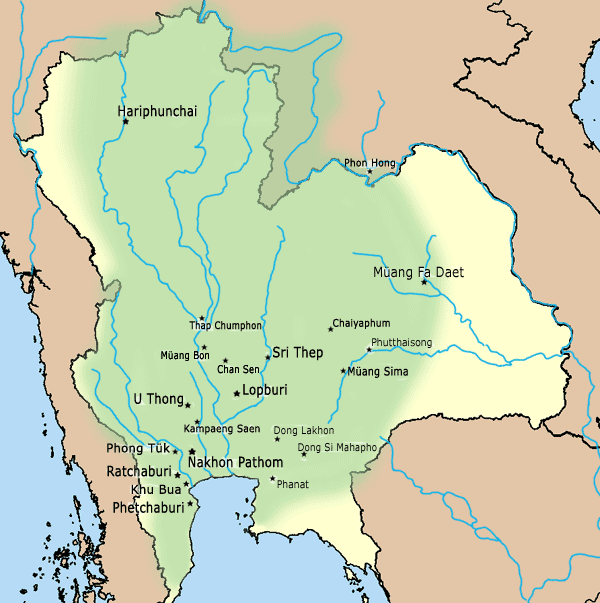
Dvaravati culture was characterized by the presence of moated urban settlements, among which U Thong, located in present-day Suphan Buri Province, is generally regarded as the earliest. Other major sites include Nakhon Pathom, Pong Tuek, Si Thep, Khu Bua, and Si Mahosot, among others. The term "Dvaravati" derives from coins bearing the Sanskrit inscription śrī dvāravatī. In Sanskrit, dvāravatī literally means "that which has gates".Further evidence for the political and geographical significance of Dvaravati is provided by the Wat Phra Ngam Inscription N.Th. 21, discovered in 2019 at Wat Phra Ngam in Nakhon Pathom province and dated to the 6th century CE. This inscription refers to three regional cities—Śrīyānaṁdimiriṅga or Śrīyānaṁdimiriṅgapratipura, Hastināpurī, and Dvāravatī—suggesting that Nakhon Pathom, where the inscription was found, likely functioned as the central place of Dvāravatī.
The traditional chronology of Dvaravati is mainly based on the Chinese textual account and stylistic comparison by art historians. However, the results from excavations in Chan Sen and Tha Muang mound at U-Thong raise questions about the traditional dating. Newly dated typical Dvaravati cultural items from the site of U-Thong indicate that the starting point of the tradition of Dvaravati culture possibly dates as far back as 200 CE. Archaeological, art historical, and epigraphic (inscriptions) evidence all indicate, however, that the main period of Dvaravati spanned the seventh to ninth centuries. Dvaravati culture and influence also spread into Isan and parts of lowland Laos from the sixth century onward. Key sites include Mueang Fa Daet in Kalasin Province, Sema in Nakhon Ratchasima Province, and many others.
The earliest known epigraphic reference to "Dvaravati" occurs in the Wat Chanthuek Inscription (K.1009), discovered in Pak Chong, Nakhon Ratchasima Province. The text is composed in Sanskrit and inscribed in the Pallava script, and is conventionally dated to the 5th century CE. It records a queen of Dvaravati who instructed her daughter to sponsor the dedication of a Buddha image.
This period predates the 6th century CE, and is generally placed between the 1st and 5th centuries CE, although some scholars argue for a narrower chronological range, extending only from the 4th to the 5th centuries. Archaeological sites associated with this phase are primarily concentrated in the western Menam valleys. These include the unmoated settlement of Pong Tuek (พงตึก), which has been suggested as one of the five capitals of Tun Sun; the moated city of Mueang Uthong, which has sometimes been identified as the center of Chin Lin; and the site of Ban Don Ta Phet.
Hub AI
Dvaravati AI simulator
(@Dvaravati_simulator)
Dvaravati
Dvaravati refers to a cultural and political network of early historic polities that flourished in the present-day central Thailand from approximately the 6th to the 11th century; however, archaeological evidence suggests that the cultural developments associated with Dvaravati began several centuries earlier, often described as a Proto-Dvaravati phase. It is tentatively regarded as a successor to the polity known in Chinese sources as Lang-chia or Lang-ya-hsiu. Chinese Buddhist accounts from the mid-7th century describe a Buddhist kingdom called To-lo-po-ti, located west of Isanapura (Cambodia), east of Sri Ksetra (Burma), and north of Pan Pan. Its northern frontier bordered Jiā Luó Shě Fú (迦逻舍佛), identified with Canasapura, which covered the upper Mun-Chi basin in present-day northeastern Thailand and Si Thep in the Pa Sak basin in central Thailand. Dvaravati is recorded to have sent embassies to the Chinese court in 583, around 605–616, in 638, 640, 643, 647, and 649.
The term Dvaravati also denotes a broader cultural and artistic sphere associated with a loose conglomeration of Mon principalities rather than a centralized state. Archaeological and historical evidence suggests that Mon communities, possibly involved in maritime trade, contributed to the emergence of Dvaravati culture in the Chao Phraya valley by the early centuries CE. This development appears to have followed a transitional “Proto-Dvaravati” phase during the 2nd–5th centuries, associated with early principalities such as Chin Lin in the western plains and Tou Yuan to the east.
The location of Dvaravati’s early political center remains debated. Proposed centers include Ayojjhapura (Si Thep), Sambuka (Nakhon Pathom), and Avadhyapura (Si Mahosot). By the mid-7th century, political prominence appears to have shifted toward Lavo's Lavapura, following the incorporation of Tou Yuan in 647. Some scholars place this transition later, in the 10th–11th centuries, after the decline of Si Thep, while others regard Lavapura as a distinct polity—later known as the Lavo Kingdom—that nevertheless lay within the Dvaravati cultural and political sphere.
The decline of Dvaravati was likely the result of overlapping regional pressures rather than a single event. These included the expansion of Angkor from the lower Mekong basin between the 11th and 13th centuries, northward campaigns by Tambralinga under King Sujita in the mid-10th century, which reportedly included the seizure of Lavo, political instability and warfare within Angkor in the early 11th century that affected the Menam valley, and Pagan incursions into central Thailand during the 11th–12th centuries. According to Jean Boisselier, although Dvaravati lost influence over eastern centers such as Lavo by the 10th–11th centuries, Mon principalities in the western plains likely persisted into the early 12th century, before coming under brief Angkorian influence during the reign of Jayavarman VII (r. 1181–1218). Thereafter, the region entered the Xiān period, marked by the emergence of Suphannabhum, Phrip Phri, and Ayodhya, the latter reasserting control over Lavo by the 14th century.
Dvaravati culture was characterized by the presence of moated urban settlements, among which U Thong, located in present-day Suphan Buri Province, is generally regarded as the earliest. Other major sites include Nakhon Pathom, Pong Tuek, Si Thep, Khu Bua, and Si Mahosot, among others. The term "Dvaravati" derives from coins bearing the Sanskrit inscription śrī dvāravatī. In Sanskrit, dvāravatī literally means "that which has gates".Further evidence for the political and geographical significance of Dvaravati is provided by the Wat Phra Ngam Inscription N.Th. 21, discovered in 2019 at Wat Phra Ngam in Nakhon Pathom province and dated to the 6th century CE. This inscription refers to three regional cities—Śrīyānaṁdimiriṅga or Śrīyānaṁdimiriṅgapratipura, Hastināpurī, and Dvāravatī—suggesting that Nakhon Pathom, where the inscription was found, likely functioned as the central place of Dvāravatī.
The traditional chronology of Dvaravati is mainly based on the Chinese textual account and stylistic comparison by art historians. However, the results from excavations in Chan Sen and Tha Muang mound at U-Thong raise questions about the traditional dating. Newly dated typical Dvaravati cultural items from the site of U-Thong indicate that the starting point of the tradition of Dvaravati culture possibly dates as far back as 200 CE. Archaeological, art historical, and epigraphic (inscriptions) evidence all indicate, however, that the main period of Dvaravati spanned the seventh to ninth centuries. Dvaravati culture and influence also spread into Isan and parts of lowland Laos from the sixth century onward. Key sites include Mueang Fa Daet in Kalasin Province, Sema in Nakhon Ratchasima Province, and many others.
The earliest known epigraphic reference to "Dvaravati" occurs in the Wat Chanthuek Inscription (K.1009), discovered in Pak Chong, Nakhon Ratchasima Province. The text is composed in Sanskrit and inscribed in the Pallava script, and is conventionally dated to the 5th century CE. It records a queen of Dvaravati who instructed her daughter to sponsor the dedication of a Buddha image.
This period predates the 6th century CE, and is generally placed between the 1st and 5th centuries CE, although some scholars argue for a narrower chronological range, extending only from the 4th to the 5th centuries. Archaeological sites associated with this phase are primarily concentrated in the western Menam valleys. These include the unmoated settlement of Pong Tuek (พงตึก), which has been suggested as one of the five capitals of Tun Sun; the moated city of Mueang Uthong, which has sometimes been identified as the center of Chin Lin; and the site of Ban Don Ta Phet.
Recent media