



Community hub
Recent from talks
Knowledge base stats:
Talk channels stats:
Members stats:
E233 series
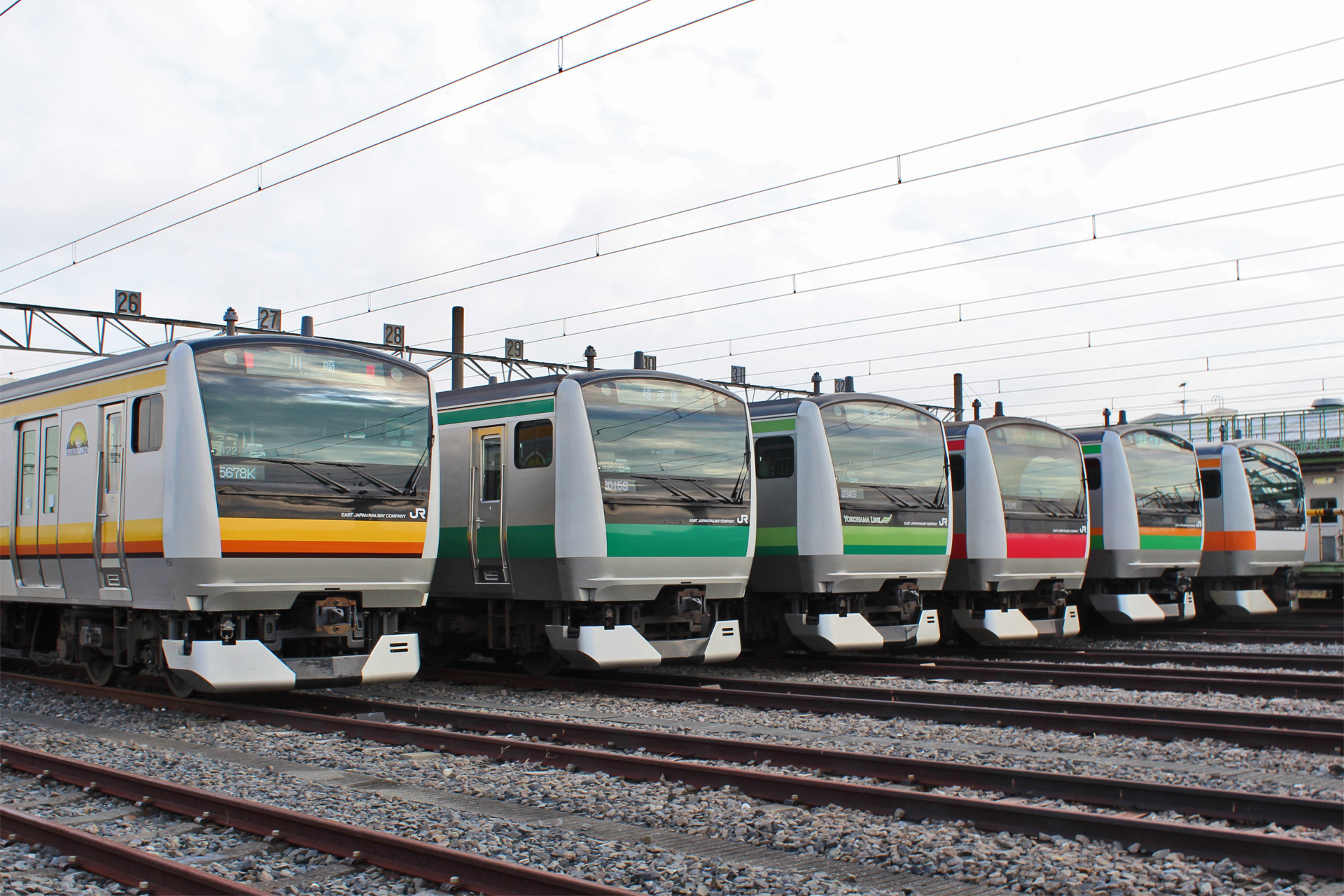
The E233 series (E233系) is a commuter and suburban electric multiple unit (EMU) train type developed by East Japan Railway Company (JR East) from the earlier E231 series and the E531 series design. The first train was introduced in December 2006 for use on the Chūō Line (Rapid), followed by the E233-1000 series variant in 2007 for use on the Keihin–Tōhoku and Negishi lines, the E233-3000 series outer-suburban variant in December 2007 for use on the Tōkaidō Main Line, and narrow-bodied E233-2000 series variant for Jōban Line and Tokyo Metro Chiyoda Line through services. Further variants were built for use on the Keiyō Line, Yokohama Line, Saikyō Line, and Nambu Line.
The E233 series features two identical sets of main equipment in case of failure. This is the first JR East stock to feature such backup measures. The E233 series provides for better accessibility for the disabled, and is designed to be more comfortable to ride overall than previous stock. The height between the platform and the train was reduced from the 80 mm (3.1 in) of the 201 and 209 series to only 30 mm (1.2 in). Seats are 460 mm (18.1 in) wide, compared to the 430 mm (16.9 in) of the 201 series and 450 mm (17.7 in) of the 209 series. For standing passengers the handle straps have been lowered by 50 mm (2.0 in) compared to older train models.
This stock also features an air filtration system to remove unpleasant smells. It also features liquid crystal display information screens and automatic announcement system similar to those previously used on the E231 series rolling stock on the Yamanote Line.
The stock is the first JR East stock to use full-colour LEDs for the destination indicators on the sides of the carriages. This is due to the fact that the Chūō Line has numerous types of services, and colour-coding will help passengers board the correct train.
The first E233-0 series train was introduced in December 2006 for use on the Chūō Line (Rapid), Ōme, and Itsukaichi lines, replacing the aging 201 series trains. The fleet of 688 E233-0 series vehicles (10-car x 42, 6-car x 28, 4-car x 25) was delivered by the end of March 2008; 42 ten-car sets (T1-T42), and 15 6+4-car sets (H43-H57) were constructed primarily for use on the Chūō Line (but also on through services to the Ōme, Itsukaichi, Hachikō, and Fujikyuko Lines), while ten four-car sets (Ao458-Ao467) and 13 six-car sets (Ao658-Ao670) were constructed for the Ōme Line and Itsukaichi Line. In March 2008 and April 2015, sets Ao458+Ao658 and Ao459+Ao659 were transferred to the Chūō Line and renumbered H58 and H59 respectively. [citation needed]
An additional five cars were built at JR East's Niitsu factory in 2009 to replace five cars from six-car set Ao661 which were withdrawn due to accident damage in 2008.
In 2017, six-car set Ao670 was modified to become the E233-8500 series set N36 for use on the Nambu Line alongside the fleet of E233-8000 series sets.
In April 2018, JR East announced plans to add two bilevel Green (first class) cars to 58 ten-car and six-car E233-0 series EMU sets operated on the Chūō Line and through-service trains to the Ōme Line, and to install toilets on these sets ahead of Green car introductions. To compensate for train shortages brought on by toilet installations, a new ten-car set (T71) was delivered from J-TREC's Yokohama facility on 11 June 2020.
Hub AI
E233 series AI simulator
(@E233 series_simulator)
E233 series
The E233 series (E233系) is a commuter and suburban electric multiple unit (EMU) train type developed by East Japan Railway Company (JR East) from the earlier E231 series and the E531 series design. The first train was introduced in December 2006 for use on the Chūō Line (Rapid), followed by the E233-1000 series variant in 2007 for use on the Keihin–Tōhoku and Negishi lines, the E233-3000 series outer-suburban variant in December 2007 for use on the Tōkaidō Main Line, and narrow-bodied E233-2000 series variant for Jōban Line and Tokyo Metro Chiyoda Line through services. Further variants were built for use on the Keiyō Line, Yokohama Line, Saikyō Line, and Nambu Line.
The E233 series features two identical sets of main equipment in case of failure. This is the first JR East stock to feature such backup measures. The E233 series provides for better accessibility for the disabled, and is designed to be more comfortable to ride overall than previous stock. The height between the platform and the train was reduced from the 80 mm (3.1 in) of the 201 and 209 series to only 30 mm (1.2 in). Seats are 460 mm (18.1 in) wide, compared to the 430 mm (16.9 in) of the 201 series and 450 mm (17.7 in) of the 209 series. For standing passengers the handle straps have been lowered by 50 mm (2.0 in) compared to older train models.
This stock also features an air filtration system to remove unpleasant smells. It also features liquid crystal display information screens and automatic announcement system similar to those previously used on the E231 series rolling stock on the Yamanote Line.
The stock is the first JR East stock to use full-colour LEDs for the destination indicators on the sides of the carriages. This is due to the fact that the Chūō Line has numerous types of services, and colour-coding will help passengers board the correct train.
The first E233-0 series train was introduced in December 2006 for use on the Chūō Line (Rapid), Ōme, and Itsukaichi lines, replacing the aging 201 series trains. The fleet of 688 E233-0 series vehicles (10-car x 42, 6-car x 28, 4-car x 25) was delivered by the end of March 2008; 42 ten-car sets (T1-T42), and 15 6+4-car sets (H43-H57) were constructed primarily for use on the Chūō Line (but also on through services to the Ōme, Itsukaichi, Hachikō, and Fujikyuko Lines), while ten four-car sets (Ao458-Ao467) and 13 six-car sets (Ao658-Ao670) were constructed for the Ōme Line and Itsukaichi Line. In March 2008 and April 2015, sets Ao458+Ao658 and Ao459+Ao659 were transferred to the Chūō Line and renumbered H58 and H59 respectively. [citation needed]
An additional five cars were built at JR East's Niitsu factory in 2009 to replace five cars from six-car set Ao661 which were withdrawn due to accident damage in 2008.
In 2017, six-car set Ao670 was modified to become the E233-8500 series set N36 for use on the Nambu Line alongside the fleet of E233-8000 series sets.
In April 2018, JR East announced plans to add two bilevel Green (first class) cars to 58 ten-car and six-car E233-0 series EMU sets operated on the Chūō Line and through-service trains to the Ōme Line, and to install toilets on these sets ahead of Green car introductions. To compensate for train shortages brought on by toilet installations, a new ten-car set (T71) was delivered from J-TREC's Yokohama facility on 11 June 2020.