


Community hub
Recent from talks
Contribute something
Nothing was collected or created yet.
Tokyo Metro Chiyoda Line
View on Wikipedia
| Tokyo Metro Chiyoda Line | ||||||||||||||||||||||||||||||||||||||||||||||||||||||||||||||||||||||||||||||||||||||||||||||||||||||||||||||||||||||||||||||||||||||||||||||||||||||||||||||||||||||||||||||||||||||||||||||||||||||||||||||||||||||||||||||||||||||||||||||||||||||||||||||||||||||||||||||||||||||||||||||||||||||||||||||||||||||||||||||||||||||||||||||||||||||||||||||||||||||||||||||||
|---|---|---|---|---|---|---|---|---|---|---|---|---|---|---|---|---|---|---|---|---|---|---|---|---|---|---|---|---|---|---|---|---|---|---|---|---|---|---|---|---|---|---|---|---|---|---|---|---|---|---|---|---|---|---|---|---|---|---|---|---|---|---|---|---|---|---|---|---|---|---|---|---|---|---|---|---|---|---|---|---|---|---|---|---|---|---|---|---|---|---|---|---|---|---|---|---|---|---|---|---|---|---|---|---|---|---|---|---|---|---|---|---|---|---|---|---|---|---|---|---|---|---|---|---|---|---|---|---|---|---|---|---|---|---|---|---|---|---|---|---|---|---|---|---|---|---|---|---|---|---|---|---|---|---|---|---|---|---|---|---|---|---|---|---|---|---|---|---|---|---|---|---|---|---|---|---|---|---|---|---|---|---|---|---|---|---|---|---|---|---|---|---|---|---|---|---|---|---|---|---|---|---|---|---|---|---|---|---|---|---|---|---|---|---|---|---|---|---|---|---|---|---|---|---|---|---|---|---|---|---|---|---|---|---|---|---|---|---|---|---|---|---|---|---|---|---|---|---|---|---|---|---|---|---|---|---|---|---|---|---|---|---|---|---|---|---|---|---|---|---|---|---|---|---|---|---|---|---|---|---|---|---|---|---|---|---|---|---|---|---|---|---|---|---|---|---|---|---|---|---|---|---|---|---|---|---|---|---|---|---|---|---|---|---|---|---|---|---|---|---|---|---|---|---|---|---|---|---|---|---|---|---|---|---|---|---|---|---|---|---|---|---|---|---|---|---|---|---|---|---|---|---|---|---|---|---|---|---|---|---|---|---|---|---|---|---|---|---|
 | ||||||||||||||||||||||||||||||||||||||||||||||||||||||||||||||||||||||||||||||||||||||||||||||||||||||||||||||||||||||||||||||||||||||||||||||||||||||||||||||||||||||||||||||||||||||||||||||||||||||||||||||||||||||||||||||||||||||||||||||||||||||||||||||||||||||||||||||||||||||||||||||||||||||||||||||||||||||||||||||||||||||||||||||||||||||||||||||||||||||||||||||||
 A Chiyoda Line 16000 series train | ||||||||||||||||||||||||||||||||||||||||||||||||||||||||||||||||||||||||||||||||||||||||||||||||||||||||||||||||||||||||||||||||||||||||||||||||||||||||||||||||||||||||||||||||||||||||||||||||||||||||||||||||||||||||||||||||||||||||||||||||||||||||||||||||||||||||||||||||||||||||||||||||||||||||||||||||||||||||||||||||||||||||||||||||||||||||||||||||||||||||||||||||
| Overview | ||||||||||||||||||||||||||||||||||||||||||||||||||||||||||||||||||||||||||||||||||||||||||||||||||||||||||||||||||||||||||||||||||||||||||||||||||||||||||||||||||||||||||||||||||||||||||||||||||||||||||||||||||||||||||||||||||||||||||||||||||||||||||||||||||||||||||||||||||||||||||||||||||||||||||||||||||||||||||||||||||||||||||||||||||||||||||||||||||||||||||||||||
| Other name | C | |||||||||||||||||||||||||||||||||||||||||||||||||||||||||||||||||||||||||||||||||||||||||||||||||||||||||||||||||||||||||||||||||||||||||||||||||||||||||||||||||||||||||||||||||||||||||||||||||||||||||||||||||||||||||||||||||||||||||||||||||||||||||||||||||||||||||||||||||||||||||||||||||||||||||||||||||||||||||||||||||||||||||||||||||||||||||||||||||||||||||||||||
| Native name | 東京メトロ千代田線 | |||||||||||||||||||||||||||||||||||||||||||||||||||||||||||||||||||||||||||||||||||||||||||||||||||||||||||||||||||||||||||||||||||||||||||||||||||||||||||||||||||||||||||||||||||||||||||||||||||||||||||||||||||||||||||||||||||||||||||||||||||||||||||||||||||||||||||||||||||||||||||||||||||||||||||||||||||||||||||||||||||||||||||||||||||||||||||||||||||||||||||||||
| Owner |  Tokyo Metro Tokyo Metro | |||||||||||||||||||||||||||||||||||||||||||||||||||||||||||||||||||||||||||||||||||||||||||||||||||||||||||||||||||||||||||||||||||||||||||||||||||||||||||||||||||||||||||||||||||||||||||||||||||||||||||||||||||||||||||||||||||||||||||||||||||||||||||||||||||||||||||||||||||||||||||||||||||||||||||||||||||||||||||||||||||||||||||||||||||||||||||||||||||||||||||||||
| Line number | 9 | |||||||||||||||||||||||||||||||||||||||||||||||||||||||||||||||||||||||||||||||||||||||||||||||||||||||||||||||||||||||||||||||||||||||||||||||||||||||||||||||||||||||||||||||||||||||||||||||||||||||||||||||||||||||||||||||||||||||||||||||||||||||||||||||||||||||||||||||||||||||||||||||||||||||||||||||||||||||||||||||||||||||||||||||||||||||||||||||||||||||||||||||
| Locale | Tokyo | |||||||||||||||||||||||||||||||||||||||||||||||||||||||||||||||||||||||||||||||||||||||||||||||||||||||||||||||||||||||||||||||||||||||||||||||||||||||||||||||||||||||||||||||||||||||||||||||||||||||||||||||||||||||||||||||||||||||||||||||||||||||||||||||||||||||||||||||||||||||||||||||||||||||||||||||||||||||||||||||||||||||||||||||||||||||||||||||||||||||||||||||
| Termini |
| |||||||||||||||||||||||||||||||||||||||||||||||||||||||||||||||||||||||||||||||||||||||||||||||||||||||||||||||||||||||||||||||||||||||||||||||||||||||||||||||||||||||||||||||||||||||||||||||||||||||||||||||||||||||||||||||||||||||||||||||||||||||||||||||||||||||||||||||||||||||||||||||||||||||||||||||||||||||||||||||||||||||||||||||||||||||||||||||||||||||||||||||
| Stations | 20 | |||||||||||||||||||||||||||||||||||||||||||||||||||||||||||||||||||||||||||||||||||||||||||||||||||||||||||||||||||||||||||||||||||||||||||||||||||||||||||||||||||||||||||||||||||||||||||||||||||||||||||||||||||||||||||||||||||||||||||||||||||||||||||||||||||||||||||||||||||||||||||||||||||||||||||||||||||||||||||||||||||||||||||||||||||||||||||||||||||||||||||||||
| Color on map | Green | |||||||||||||||||||||||||||||||||||||||||||||||||||||||||||||||||||||||||||||||||||||||||||||||||||||||||||||||||||||||||||||||||||||||||||||||||||||||||||||||||||||||||||||||||||||||||||||||||||||||||||||||||||||||||||||||||||||||||||||||||||||||||||||||||||||||||||||||||||||||||||||||||||||||||||||||||||||||||||||||||||||||||||||||||||||||||||||||||||||||||||||||
| Service | ||||||||||||||||||||||||||||||||||||||||||||||||||||||||||||||||||||||||||||||||||||||||||||||||||||||||||||||||||||||||||||||||||||||||||||||||||||||||||||||||||||||||||||||||||||||||||||||||||||||||||||||||||||||||||||||||||||||||||||||||||||||||||||||||||||||||||||||||||||||||||||||||||||||||||||||||||||||||||||||||||||||||||||||||||||||||||||||||||||||||||||||||
| Type | Heavy rail rapid transit | |||||||||||||||||||||||||||||||||||||||||||||||||||||||||||||||||||||||||||||||||||||||||||||||||||||||||||||||||||||||||||||||||||||||||||||||||||||||||||||||||||||||||||||||||||||||||||||||||||||||||||||||||||||||||||||||||||||||||||||||||||||||||||||||||||||||||||||||||||||||||||||||||||||||||||||||||||||||||||||||||||||||||||||||||||||||||||||||||||||||||||||||
| System | Tokyo subway | |||||||||||||||||||||||||||||||||||||||||||||||||||||||||||||||||||||||||||||||||||||||||||||||||||||||||||||||||||||||||||||||||||||||||||||||||||||||||||||||||||||||||||||||||||||||||||||||||||||||||||||||||||||||||||||||||||||||||||||||||||||||||||||||||||||||||||||||||||||||||||||||||||||||||||||||||||||||||||||||||||||||||||||||||||||||||||||||||||||||||||||||
| Operator(s) | Tokyo Metro | |||||||||||||||||||||||||||||||||||||||||||||||||||||||||||||||||||||||||||||||||||||||||||||||||||||||||||||||||||||||||||||||||||||||||||||||||||||||||||||||||||||||||||||||||||||||||||||||||||||||||||||||||||||||||||||||||||||||||||||||||||||||||||||||||||||||||||||||||||||||||||||||||||||||||||||||||||||||||||||||||||||||||||||||||||||||||||||||||||||||||||||||
| Depot(s) | Ayase, Yoyogi | |||||||||||||||||||||||||||||||||||||||||||||||||||||||||||||||||||||||||||||||||||||||||||||||||||||||||||||||||||||||||||||||||||||||||||||||||||||||||||||||||||||||||||||||||||||||||||||||||||||||||||||||||||||||||||||||||||||||||||||||||||||||||||||||||||||||||||||||||||||||||||||||||||||||||||||||||||||||||||||||||||||||||||||||||||||||||||||||||||||||||||||||
| Rolling stock | Tokyo Metro 16000 series Tokyo Metro 05 series (for Kita-Ayase Branch Line) Odakyu 4000 series Odakyu 60000 series MSE JR East E233-2000 series | |||||||||||||||||||||||||||||||||||||||||||||||||||||||||||||||||||||||||||||||||||||||||||||||||||||||||||||||||||||||||||||||||||||||||||||||||||||||||||||||||||||||||||||||||||||||||||||||||||||||||||||||||||||||||||||||||||||||||||||||||||||||||||||||||||||||||||||||||||||||||||||||||||||||||||||||||||||||||||||||||||||||||||||||||||||||||||||||||||||||||||||||
| Daily ridership | 1,447,730 (2017)[1] | |||||||||||||||||||||||||||||||||||||||||||||||||||||||||||||||||||||||||||||||||||||||||||||||||||||||||||||||||||||||||||||||||||||||||||||||||||||||||||||||||||||||||||||||||||||||||||||||||||||||||||||||||||||||||||||||||||||||||||||||||||||||||||||||||||||||||||||||||||||||||||||||||||||||||||||||||||||||||||||||||||||||||||||||||||||||||||||||||||||||||||||||
| History | ||||||||||||||||||||||||||||||||||||||||||||||||||||||||||||||||||||||||||||||||||||||||||||||||||||||||||||||||||||||||||||||||||||||||||||||||||||||||||||||||||||||||||||||||||||||||||||||||||||||||||||||||||||||||||||||||||||||||||||||||||||||||||||||||||||||||||||||||||||||||||||||||||||||||||||||||||||||||||||||||||||||||||||||||||||||||||||||||||||||||||||||||
| Opened | 20 December 1969 | |||||||||||||||||||||||||||||||||||||||||||||||||||||||||||||||||||||||||||||||||||||||||||||||||||||||||||||||||||||||||||||||||||||||||||||||||||||||||||||||||||||||||||||||||||||||||||||||||||||||||||||||||||||||||||||||||||||||||||||||||||||||||||||||||||||||||||||||||||||||||||||||||||||||||||||||||||||||||||||||||||||||||||||||||||||||||||||||||||||||||||||||
| Technical | ||||||||||||||||||||||||||||||||||||||||||||||||||||||||||||||||||||||||||||||||||||||||||||||||||||||||||||||||||||||||||||||||||||||||||||||||||||||||||||||||||||||||||||||||||||||||||||||||||||||||||||||||||||||||||||||||||||||||||||||||||||||||||||||||||||||||||||||||||||||||||||||||||||||||||||||||||||||||||||||||||||||||||||||||||||||||||||||||||||||||||||||||
| Line length | 24.0 km (14.9 mi) | |||||||||||||||||||||||||||||||||||||||||||||||||||||||||||||||||||||||||||||||||||||||||||||||||||||||||||||||||||||||||||||||||||||||||||||||||||||||||||||||||||||||||||||||||||||||||||||||||||||||||||||||||||||||||||||||||||||||||||||||||||||||||||||||||||||||||||||||||||||||||||||||||||||||||||||||||||||||||||||||||||||||||||||||||||||||||||||||||||||||||||||||
| Number of tracks | 2 | |||||||||||||||||||||||||||||||||||||||||||||||||||||||||||||||||||||||||||||||||||||||||||||||||||||||||||||||||||||||||||||||||||||||||||||||||||||||||||||||||||||||||||||||||||||||||||||||||||||||||||||||||||||||||||||||||||||||||||||||||||||||||||||||||||||||||||||||||||||||||||||||||||||||||||||||||||||||||||||||||||||||||||||||||||||||||||||||||||||||||||||||
| Track gauge | 1,067 mm (3 ft 6 in) | |||||||||||||||||||||||||||||||||||||||||||||||||||||||||||||||||||||||||||||||||||||||||||||||||||||||||||||||||||||||||||||||||||||||||||||||||||||||||||||||||||||||||||||||||||||||||||||||||||||||||||||||||||||||||||||||||||||||||||||||||||||||||||||||||||||||||||||||||||||||||||||||||||||||||||||||||||||||||||||||||||||||||||||||||||||||||||||||||||||||||||||||
| Minimum radius | 160.2 m (526 ft) (Main line) 143.8 m (472 ft) (Branch line) | |||||||||||||||||||||||||||||||||||||||||||||||||||||||||||||||||||||||||||||||||||||||||||||||||||||||||||||||||||||||||||||||||||||||||||||||||||||||||||||||||||||||||||||||||||||||||||||||||||||||||||||||||||||||||||||||||||||||||||||||||||||||||||||||||||||||||||||||||||||||||||||||||||||||||||||||||||||||||||||||||||||||||||||||||||||||||||||||||||||||||||||||
| Electrification | Overhead line, 1,500 V DC | |||||||||||||||||||||||||||||||||||||||||||||||||||||||||||||||||||||||||||||||||||||||||||||||||||||||||||||||||||||||||||||||||||||||||||||||||||||||||||||||||||||||||||||||||||||||||||||||||||||||||||||||||||||||||||||||||||||||||||||||||||||||||||||||||||||||||||||||||||||||||||||||||||||||||||||||||||||||||||||||||||||||||||||||||||||||||||||||||||||||||||||||
| Operating speed | 80 km/h (50 mph) (Ayase - Yoyogi-Uehara 60 km/h (37 mph) (Kita-Ayase-Ayase) | |||||||||||||||||||||||||||||||||||||||||||||||||||||||||||||||||||||||||||||||||||||||||||||||||||||||||||||||||||||||||||||||||||||||||||||||||||||||||||||||||||||||||||||||||||||||||||||||||||||||||||||||||||||||||||||||||||||||||||||||||||||||||||||||||||||||||||||||||||||||||||||||||||||||||||||||||||||||||||||||||||||||||||||||||||||||||||||||||||||||||||||||
| Signalling | Cab signalling, Closed block | |||||||||||||||||||||||||||||||||||||||||||||||||||||||||||||||||||||||||||||||||||||||||||||||||||||||||||||||||||||||||||||||||||||||||||||||||||||||||||||||||||||||||||||||||||||||||||||||||||||||||||||||||||||||||||||||||||||||||||||||||||||||||||||||||||||||||||||||||||||||||||||||||||||||||||||||||||||||||||||||||||||||||||||||||||||||||||||||||||||||||||||||
| Train protection system | New CS-ATC, ATO | |||||||||||||||||||||||||||||||||||||||||||||||||||||||||||||||||||||||||||||||||||||||||||||||||||||||||||||||||||||||||||||||||||||||||||||||||||||||||||||||||||||||||||||||||||||||||||||||||||||||||||||||||||||||||||||||||||||||||||||||||||||||||||||||||||||||||||||||||||||||||||||||||||||||||||||||||||||||||||||||||||||||||||||||||||||||||||||||||||||||||||||||
| Maximum incline | 3.5% | |||||||||||||||||||||||||||||||||||||||||||||||||||||||||||||||||||||||||||||||||||||||||||||||||||||||||||||||||||||||||||||||||||||||||||||||||||||||||||||||||||||||||||||||||||||||||||||||||||||||||||||||||||||||||||||||||||||||||||||||||||||||||||||||||||||||||||||||||||||||||||||||||||||||||||||||||||||||||||||||||||||||||||||||||||||||||||||||||||||||||||||||
| ||||||||||||||||||||||||||||||||||||||||||||||||||||||||||||||||||||||||||||||||||||||||||||||||||||||||||||||||||||||||||||||||||||||||||||||||||||||||||||||||||||||||||||||||||||||||||||||||||||||||||||||||||||||||||||||||||||||||||||||||||||||||||||||||||||||||||||||||||||||||||||||||||||||||||||||||||||||||||||||||||||||||||||||||||||||||||||||||||||||||||||||||


The Tokyo Metro Chiyoda Line (東京メトロ千代田線, Tōkyō Metoro Chiyoda-sen) is a subway line owned and operated by Tokyo Metro in Tokyo, Japan. On average, the line carries 1,447,730 passengers daily (2017), the second highest of the Tokyo Metro network, behind the Tozai Line (1,642,378).[1]
The line was named after the Chiyoda ward, under which it passes. On maps, diagrams and signboards, the line is shown using the color green, and its stations are given numbers using the letter "C".
Overview
[edit]The 24.0 km (14.91 mi) line serves the wards of Adachi, Arakawa, Bunkyō, Chiyoda, Minato and Shibuya, and a short stretch of tunnel in Taitō with no station. Its official name, rarely used, is Line 9 Chiyoda Line (9号線千代田線, kyūgō sen Chiyoda-sen). The Chiyoda Line was built as a bypass for the older Hibiya Line, with both lines following a similar route and having direct interchanges at three stations. Trains have through running onto other railway lines on both ends. More than half of these are trains to the northeast beyond Ayase onto the East Japan Railway Company (JR East) Joban Line to Abiko (Toride during the rush hour). The rest run to the southwest beyond Yoyogi-Uehara onto the Odakyu Odawara Line to Isehara.
Services on the Kita-Ayase branch consist of a combination of shuttle services to Ayase and through services to Yoyogi-Uehara.[2]
The Chiyoda Line has direct interchanges with all other Tokyo Metro and Toei lines with the exception of the Toei Oedo Line. However, Yushima Station is located relatively close to Ueno-okachimachi Station on the Oedo Line without being marked as an official transfer between the lines.
According to the Tokyo Metropolitan Bureau of Transportation, as of June 2009 the Chiyoda Line was the second most crowded subway line in Tokyo, at its peak running at 181%[a] capacity between Machiya and Nishi-Nippori stations.[3] In 2016 congestion was reported at 178%.[4] In both fiscal years 2021[5] & 2022[6] the congestion rate had dropped to 139%, as a consequence of the COVID-19 pandemic.
Basic data
[edit]- Distance: 24.0 km (14.91 mi)
- Double-tracking: Entire line
- Railway signalling: New CS-ATC
Metro Morning Way, Metro Homeway and Metro Hakone
[edit]Metro Morning Way and Metro Homeway and are fully reserved seat commuter trains operating between Hon Atsugi on the Odakyu Odawara Line and Kita-Senju on the Chiyoda Line using 60000 series MSE Romancecar trains. These services require a seat reservation as well as payment of the Limited Express fee. Tickets can be purchased online or at ticket vending machines or ticket counters at Odakyu stations.[7][8] Travel wholly within the Chiyoda Line is not permitted.[9]
As of July 2024, on weekdays there are 2 Metro Morning Way services to Kita-Senju arriving 07:53 & 09:40, and there are 5 Metro Homeway services departing Otemachi hourly between 17:30 & 21:30 of which only the 18:30 departure commences from Kita-Senju at 18:14.[8] On weekends and holidays there is one Metro Morning Way service to Kita-Senju arriving 09:46[7][9] and 2 Metro Homeway services departing Kita-Senju at 19:35 & 20:35.[8][9]
Metro Hakone is a similar service operating in the counter-peak direction between Kita-Senju and Hakone-Yumoto on the Hakone Tozan Line to serve visitors to Hakone, with a travel time of approximately 2 hours. On weekdays there is 1 trip in each direction, departing Kita-Senju at 09:47 and arriving back at Kita-Senju at 16:46. On weekends and holidays there are 3 trips in each direction: departing Kita-Senju at 08:33, 10:37 & 15:22, arriving back at Kita-Senju at 12:47, 18:21 & 19:53.[9]
Station list
[edit]- All stations are located in Tokyo.
- Stopping patterns:
- Commuter Semi Express, Local, Semi Express, and Express trains stop at every station.
- Odakyu Romancecar Metro Morning Way and Metro Homeway limited express services stop at stations marked "●" and does not stop at those marked "|".
| Station | Japanese | Distance (km) | Limited Express |
Transfers | Location | ||
|---|---|---|---|---|---|---|---|
| Between stations |
From C-01 | ||||||
| ↑ Through-services to/from Isehara via the OH Odakyu Odawara Line ; limited express Metro Morning Way/Metro Home Way to/from Hon-Atsugi via the OH Odakyu Odawara Line ; limited express Metro Hakone to/from Hakone-Yumoto via the OH Hakone Tozan Line ; limited express Metro Enoshima to Katase-Enoshima via the OE Odakyū Enoshima Line ↑ | |||||||
| C01 | Yoyogi-Uehara | 代々木上原[* 1] | - | 0.0 | ※[* 2] |  Odakyu Odawara Line Odakyu Odawara Line
|
Shibuya |
| C02 | Yoyogi-koen | 代々木公園 | 1.0 | 1.0 | | | Odakyu Odawara Line (Yoyogi-Hachiman)
| |
| C03 | Meiji-jingumae (Harajuku) | 明治神宮前 | 1.2 | 2.2 | | |
| |
| C04 | Omotesandō | 表参道 | 0.9 | 3.1 | ● |
|
Minato |
| C05 | Nogizaka | 乃木坂 | 1.4 | 4.5 | | | ||
| C06 | Akasaka | 赤坂 | 1.1 | 5.6 | | | ||
| C07 | Kokkai-gijidō-mae | 国会議事堂前 | 0.8 | 6.4 | | |
|
Chiyoda |
| C08 | Kasumigaseki | 霞ケ関 | 0.8 | 7.2 | ● |
| |
| C09 | Hibiya | 日比谷 | 0.8 | 8.0 | | |
| |
| C10 | Nijūbashimae | 二重橋前 | 0.7 | 8.7 | | |
| |
| C11 | Ōtemachi | 大手町 | 0.7 | 9.4 | ● |
| |
| C12 | Shin-ochanomizu | 新御茶ノ水 | 1.3 | 10.7 | | |
| |
| C13 | Yushima | 湯島 | 1.2 | 11.9 | | |
|
Bunkyō |
| C14 | Nezu | 根津 | 1.2 | 13.1 | | | ||
| C15 | Sendagi | 千駄木 | 1.0 | 14.1 | | | ||
| C16 | Nishi-Nippori | 西日暮里 | 0.9 | 15.0 | | |
|
Arakawa |
| C17 | Machiya | 町屋 | 1.7 | 16.7 | | | ||
| C18 | Kita-Senju | 北千住[* 3][* 4] | 2.6 | 19.3 | ● |
|
Adachi |
| C19 | Ayase | 綾瀬[* 3] | 2.6 | 21.9 |
| ||
| ↓ Through-services to/from Kashiwa, Abiko and Toride via the JL Joban Line (Local) ↓ | |||||||
| C20 | Kita-Ayase | 北綾瀬 | 2.1 | 24.0 | Adachi | ||


- ^ Yoyogi-Uehara is shared by both Odakyu Electric Railway and Tokyo Metro; Odakyu Electric Railway manages the station.
- ^ Limited express services stop at Yoyogi-Uehara to change drivers and conductors, but passengers may not board or disembark at this station.
- ^ a b Kita-senju and Ayase are shared by both JR East and Tokyo Metro; Tokyo Metro manages both stations.
- ^ Between Kita-senju Station and Ayase Station, the Chiyoda Line uses JR East's Joban Line (Local) fare system.
Rolling stock
[edit]As of 1 January 2019[update], the following train types are used on the line, all running as ten-car formations unless otherwise indicated.[10]
Tokyo Metro
[edit]- 16000 series (x37) (since November 2010)[11]
- 05 series 3-car trains (x4) (since April 2014, used on Kita-Ayase Branch)[12]
-
 16000 series 10-car set in September 2011
 -
 05 series 3-car set in March 2014


Odakyu
[edit]- 4000 series (since September 2007)[13]
- 60000 series MSE (since spring 2008, used on Metro Morning Way, Metro Homeway & Metro Hakone services)[14]
-
 An Odakyu 4000 series set in April 2016
 -
 An Odakyu 60000 series MSE Romancecar EMU on a Metro Hakone service in April 2012


JR East
[edit]- E233-2000 series (x19) (since summer 2009)
-
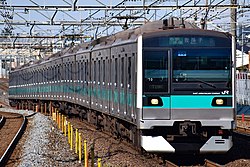 A Jōban Line/Tokyo Metro Chiyoda Line E233-2000 series set in April 2019

Former rolling stock
[edit]- 6000 series (x35) (from 1971 until November 2018)
- JNR 103-1000 series (x16) (from 1971 until April 1986)
- JR East 203 series (x17) (from August 27, 1982 until September 26, 2011)[15]
- JR East 209-1000 series (x2) (from 1999 until October 13, 2018)
- JNR 207–900 series (x1) (from 1986 until December 2009)
- 5000 series 3-car trains (x2) (from 1969 until 2014, later used on branch line)
- 6000 series 3-car train (x1) (prototype of the series built in 1968 until 2014, used on branch line)
- 06 series (x1) (from 1993 until January 2015)[16]
- 07 series (x1) (September 2008 – December 2008)
- Odakyu 1000 series (1988–2010)
- Odakyu 9000 series (1978–1990)
-
 5000 series (Aluminum prototype)
 -
 A Tokyo Metro 6000 series set in December 2014
 -
 An 07 series set in December 2008
 -
 An Odakyu 9000 series set in October 1977


History
[edit] |
The Chiyoda Line was originally proposed in 1962 as a line from Setagaya in Tokyo to Matsudo, Chiba; the initial name was "Line 8". In 1964, the plan was changed slightly so that through service would be offered on the Joban Line north of Tokyo, and the number was changed to "Line 9".
Line 9 was designed to pass through built-up areas in Chiyoda, and also intended to relieve the busy Ginza Line and Hibiya Line, which follow a roughly similar route through central Tokyo.

The first stretch was opened on December 20, 1969 between Kita-Senju and Ōtemachi. The line was almost completed by October 10, 1972 when it reached Yoyogi-Kōen, although the 1 km (0.62 mi) section to Yoyogi-Uehara was not completed until March 31, 1978.
The branch line to Kita-Ayase was opened on December 20, 1979. This branch primarily serves as a connection to Ayase Depot, but also serves Kita-Ayase Station constructed in the area. A three-car shuttle service operated between Ayase and Kita-Ayase.
The Chiyoda Line was one of the lines targeted in the Aum sarin gas attack on March 20, 1995.
On May 15, 2006, women-only cars were introduced on early-morning trains from Toride on the Joban Line to Yoyogi-Uehara.
On March 18, 2008, the Chiyoda Line became the first subway line in Japan with operations by reserved-seating trains when Odakyu Romancecar limited express services began running between Kita-Senju and Hakone-Yumoto (on the Hakone Tozan Line) and Karakida (on the Odakyu Tama Line). Trains also run from/to Shin-Kiba using tracks connecting to the Yurakucho Line.
On March 16, 2019, 10-car trains commenced operation on the branch line to Kita-Ayase station after platforms were lengthened by 135m, allowing direct services from Kita-Ayase to Yoyogi-Uehara.[17]
Notes
[edit]a. ^ Crowding levels defined by the Ministry of Land, Infrastructure, Transport and Tourism:[18][19]
- 100% — Commuters have enough personal space and are able to take a seat or stand while holding onto the straps or hand rails.
- 150% — Commuters have enough personal space to read a newspaper.
- 180% — Commuters must fold newspapers to read.
- 200% — Commuters are pressed against each other in each compartment but can still read small magazines.
- 250% — Commuters are pressed against each other, unable to move.
References
[edit]
- Shaw, Dennis; Morioka, Hisashi (1992). Tokyo Subways. Hoikusha Publishing.
- ^ a b Tokyo Metro station ridership in 2010 Train Media (sourced from Tokyo Metro) Retrieved July 23, 2018.
- ^ "Timetable". Tokyo Metro. July 23, 2024. Retrieved July 23, 2024.
- ^ "Commute". Metropolis: 7. June 12, 2009. Archived from the original on October 9, 2011. Retrieved March 9, 2011. Capacity is defined as all passengers having a seat or a strap or door railing to hold on to.
- ^ "So You Think Your Commute Is Tough? Check Out Japan's Top 10 Most Crowded Commuter Trains! | LIVE JAPAN travel guide". LIVE JAPAN. Retrieved July 23, 2024.
- ^ "Japan: busiest main railway lines in Tokyo 2021". Statista. Retrieved July 23, 2024.
- ^ "Japan: busiest railway lines 2022". Statista. Retrieved July 23, 2024.
- ^ a b "モーニングウェイ&メトロモーニングウェイ|ロマンスカー|小田急電鉄" [Morning Way & Metro Morning Way]. www.odakyu.jp. Retrieved July 24, 2024.
- ^ a b c "ホームウェイ&メトロホームウェイ|ロマンスカー|小田急電鉄" [Home Way & Metro Home Way|Romance Car|Odakyu Electric Railway]. www.odakyu.jp. Retrieved July 24, 2024.
- ^ a b c d "Romancecar Timetables - Odakyu Railway: Connecting Shinjuku, Hakone and Enoshima". Odakyu Railway: Connecting Shinjuku, Hakone and Enoshima -. Retrieved July 26, 2024.
- ^ 私鉄車両編成表 2015 [Private Railway Rolling Stock Formations – 2015] (in Japanese). Japan: Kotsu Shimbunsha. July 23, 2015. pp. 74–75. ISBN 978-4-330-58415-7.
- ^ Tokyo Metro (December 21, 2009). "環境配慮型の新型車両16000系 千代田線に導入決定!!" [Environmentally friendly new 16000 series trains to be introduced on Chiyoda Line] (Press release) (in Japanese). Retrieved December 22, 2009.
- ^ "東京地下鉄千代田線用05系" [Tokyo Metro Chiyoda Line 05 series]. Japan Railfan Magazine. Vol. 54, no. 640. Japan: Koyusha Co., Ltd. August 2014. pp. 67–70.
- ^ "東京メトロ千代田線への新たな直通運転用車両 新型通勤車両「4000形」 2007年9月デビュー" [New direct drive vehicle to Tokyo Metro Chiyoda Line New model commuter vehicle "4000 form" Debuted in September 2007] (PDF) (in Japanese). February 5, 2007. Archived from the original (PDF) on February 7, 2007.
- ^ "新型ロマンスカー・MSEの製造を決定 2008年春 東京メトロ線内初の座席指定制特急の乗り入れを開始" [Decided to manufacture the new Romance car · MSE; Initiation of the first seating designation express train in the Tokyo Metro line in the spring of 2008] (PDF) (in Japanese). September 20, 2006. Archived from the original (PDF) on February 18, 2007.
- ^ 203系が営業運転から離脱 [203 series withdrawn from revenue service]. Japan Railfan Magazine Online (in Japanese). Japan: Koyusha Co., Ltd. September 28, 2011. Retrieved September 28, 2011.
- ^ 東京地下鉄06系、新木場へ [Tokyo Metro 06 series moved to Shinkiba]. RM News (in Japanese). Japan: Neko Publishing Co., Ltd. August 13, 2015. Archived from the original on July 21, 2020. Retrieved September 28, 2015.
- ^ Metro Report International (March 25, 2019). "Chiyoda Line branch runs through". Railway Gazette International. Retrieved July 23, 2024.
- ^ "混雑率の推移".
- ^ Kikuchi, Daisuke (July 6, 2017). "Tokyo plans new effort to ease commuter hell on rush-hour trains". The Japan Times. Archived from the original on July 6, 2017.
External links
[edit]


_symbol.svg)
_symbol.svg)
_symbol.svg)
_symbol.svg)
_symbol.svg)


Tokyo Metro Chiyoda Line
View on GrokipediaRoute and Infrastructure
Line Description and Alignment
The Tokyo Metro Chiyoda Line spans 24.0 kilometers, connecting Yoyogi-Uehara Station in Shibuya Ward with Kita-Ayase Station in Adachi Ward via 20 stations.[6][2] The route originates at the elevated Yoyogi-Uehara terminus, shared with the Odakyu Odawara Line, before transitioning to an underground alignment that constitutes the entirety of the remaining track.[4] From Yoyogi-Uehara (C01), the line proceeds northeast through Yoyogi-Koen (C02), Meiji-Jingumae (C03, serving Harajuku), Omote-Sando (C04), Nogizaka (C05), Akasaka (C06), and reaches the governmental district at Kokkai-Gijidomae (C07) and Kasumigaseki (C08).[2] It then shifts eastward to Hibiya (C09) and Nijubashimae (C10, near Marunouchi), followed by the Otemachi business area (C11), before curving north to Shin-Ochanomizu (C12), Yushima (C13), Nezu (C14), Sendagi (C15), Nishi-Nippori (C16), Machiya (C17), Kita-Senju (C18), Ayase (C19), and the branch terminus Kita-Ayase (C20).[2] This double-tracked configuration supports rapid transit through densely urbanized zones, with the alignment enabling through services to the Odakyu Odawara Line southwest and JR Joban Line northeast, though the core Tokyo Metro segment remains fully segregated underground except at the southwest end.[6][4]Technical Specifications and Engineering Features
The Tokyo Metro Chiyoda Line spans 24.0 kilometers and consists of double tracks along its entire alignment.[9] It utilizes a narrow track gauge of 1,067 mm and is electrified at 1,500 V DC through overhead catenary systems.[10] The line employs a Continuous Speed Automatic Train Control (CS-ATC) signaling system throughout, implemented in 1999 to enhance safety and operational efficiency by continuously monitoring train speeds and enforcing speed restrictions.[11] Portions of the route, particularly those interfacing with through services on the JR East Jōban Line, incorporate Automatic Train Operation (ATO) capabilities, introduced around 2018 to automate acceleration, braking, and stopping while maintaining driver oversight.[12] Predominantly underground, the Chiyoda Line's infrastructure relies on cut-and-cover construction in shallower urban sections and shield tunneling for deeper alignments to accommodate geological challenges in Tokyo's sedimentary basin.[13] These methods facilitate the line's passage beneath densely built areas, with tunnels typically featuring concrete linings for structural integrity. Engineering designs prioritize minimal surface disruption during construction, reflecting Japan's emphasis on integrating rapid transit into existing cityscapes without compromising stability. Seismic resilience forms a core engineering feature, with tunnels and associated structures reinforced using base isolation, viscous dampers, and flexible joints to absorb and dissipate energy from earthquakes exceeding magnitude 7.0.[14] Post-1995 Hanshin earthquake assessments prompted Tokyo Metro to retrofit vulnerable segments, including enhanced pillar strengthening and track fastening systems to prevent derailments or collapses during strong ground motion.[15] These measures, verified through shake-table testing and historical performance data, ensure operational continuity and passenger safety in a seismically active region.Operations and Services
Daily Service Patterns
The Tokyo Metro Chiyoda Line operates daily from approximately 5:00 a.m. to midnight, with first trains departing terminal stations such as Yoyogi-Uehara and Ayase around 5:00–5:10 a.m. and last trains arriving at terminals by about 12:00 a.m.[16][17] Weekday services ramp up progressively from early morning, peaking during commuter rush hours of 7:00–9:00 a.m. toward central Tokyo and 5:00–7:00 p.m. away from the center, before tapering off in the late evening. Weekend and holiday schedules feature reduced frequencies overall, starting later (around 5:30 a.m.) and ending similarly, with no rush-hour surges. Within the core Yoyogi-Uehara to Ayase segment, all Tokyo Metro-operated trains function as local services, stopping at every station regardless of time or day. Frequencies during weekday peak periods achieve headways as short as 2 minutes on the main line to manage high demand, reflecting Tokyo Metro's capacity for intense commuter volumes. Off-peak weekday intervals extend to 4–6 minutes, while weekends maintain roughly 5–10 minute headways throughout operating hours. These patterns support through-running with the Odakyu Line southward from Yoyogi-Uehara and the JR Jōban Line northward from Ayase, where stopping patterns may vary on the extended segments but remain all-stops within Tokyo Metro limits.[18][19] The Kita-Ayase branch, a 1.5 km shuttle extension from Ayase, operates independently with lower frequencies: approximately 8–9 trains per hour (6–7 minute headways) toward Ayase during weekday morning peaks, reducing off-peak and on weekends. This branch connects directly to the main line at Ayase without through services, serving local residential demand in Adachi Ward.[19] Service reliability is high, with normal operations reported consistently, though minor adjustments like frequency tweaks have occurred post-2022 to optimize energy use during peaks.[2]Through Services and Interconnections
The Tokyo Metro Chiyoda Line operates through services with the Odakyu Electric Railway at Yoyogi-Uehara station, enabling select trains to continue directly onto the Odakyu Odawara Line toward Hon-Atsugi and onto the Tama Line toward Karakida. These operations integrate Tokyo's central subway network with Kanagawa Prefecture's suburban rail system, primarily serving peak-hour commuters by reducing transfer needs. Through-running to the Tama Line resumed in March 2025 after a suspension since 2022, reflecting adjustments to demand patterns on Odakyu routes.[7][20][21] At Ayase station, the Chiyoda Line interconnects with JR East's Jōban Line via through services on local trains, extending northeast to stations including Matsudo, Abiko, and Toride in Chiba Prefecture. This linkage, operational since the line's extension to Ayase in 1969, supports high-volume commuter flows from Chiba's satellite towns into central Tokyo, with trains maintaining compatibility in voltage, signaling, and platform lengths for seamless integration. Daily timetables confirm regular through patterns, such as local services to Abiko during weekdays.[22][23][24] These through services utilize shared rolling stock standards, with Tokyo Metro's 16000-series trains and compatible Odakyu and JR vehicles operating interchangeably under mutual agreements, though platform screen doors and automatic train control systems ensure safety across operators. Interconnections at intermediate stations, such as Otemachi for transfers to the Marunouchi and Toei Mita lines or Kita-Senju for the Hibiya and Tsukuba Express lines, provide additional cross-network access but rely on passenger changes rather than direct through-running. The Kita-Ayase branch, however, functions solely as a shuttle to Ayase without extensions or through services.[2][25]Ridership and Performance Metrics
The Tokyo Metro Chiyoda Line contributes substantially to the operator's overall passenger volume, part of the network's average daily ridership of 6.84 million passengers in fiscal year 2024 (April 2023 to March 2024).[6] Individual station data underscores the line's intensity, with Kita-Senju Station recording 241,001 average daily passengers and Nishi-Nippori Station at 154,330 in the same period, reflecting heavy commuter flows through northeastern and central Tokyo interchanges.[26] Other notable stations include Kasumigaseki (132,884 daily passengers) and Akasaka (77,718), highlighting the line's role in serving government districts and business areas.[27][26]| Station | Line | Daily Average Passengers (FY2024) | Year-on-Year Change (%) |
|---|---|---|---|
| Kita-Senju | Chiyoda Line | 241,001 | +3.8 |
| Nishi-Nippori | Chiyoda Line | 154,330 | +2.2 |
| Kasumigaseki | Chiyoda Line (shared) | 132,884 | N/A |
| Akasaka | Chiyoda Line | 77,718 | +4.8 |
Stations
Main Line Stations
The main line of the Tokyo Metro Chiyoda Line consists of 19 stations spanning approximately 21.9 km from Yoyogi-Uehara in Shibuya ward to Ayase in Adachi ward, traversing wards including Shibuya, Minato, Chiyoda, Bunkyō, Taito (briefly without station), Arakawa, and Adachi.[2][31] Yoyogi-Uehara station at the western terminus interchanges with the Odakyu Odawara Line, facilitating through services, while Ayase at the eastern end connects to the JR Jōban Line.[32] The route primarily runs underground, serving business districts, government areas, and residential neighborhoods with key interchanges to other Tokyo Metro lines and JR lines at stations such as Omote-Sando, Otemachi, and Kita-Senju.[2]| Station No. | Station Name | Code |
|---|---|---|
| 1 | Yoyogi-Uehara | C01 |
| 2 | Yoyogi-Koen | C02 |
| 3 | Meiji-Jingumae (<Harajuku>) | C03 |
| 4 | Omote-Sando | C04 |
| 5 | Nogizaka | C05 |
| 6 | Akasaka | C06 |
| 7 | Kokkai-Gijidomae | C07 |
| 8 | Kasumigaseki | C08 |
| 9 | Hibiya | C09 |
| 10 | Nijubashimae (<Marunouchi>) | C10 |
| 11 | Otemachi | C11 |
| 12 | Shin-Ochanomizu | C12 |
| 13 | Yushima | C13 |
| 14 | Nezu | C14 |
| 15 | Sendagi | C15 |
| 16 | Nishi-Nippori | C16 |
| 17 | Machiya | C17 |
| 18 | Kita-Senju | C18 |
| 19 | Ayase | C19 |
Branch Line and Kita-Ayase Extension
The Chiyoda Line's branch line extends 2.1 km north from Ayase station to Kita-Ayase station, primarily providing access to the Ayase depot.[3] Opened on December 20, 1979, alongside the depot, the branch initially operated as a shuttle service using 3-car trains to serve the developing residential area in Adachi ward.[3][34] Kita-Ayase station, the branch's sole passenger stop, featured a platform designed for 3-car formations upon opening, limiting service to short shuttle runs from Ayase without direct connections to the main line.[3] This configuration persisted for nearly four decades, with operations separated from the primary Yoyogi-Uehara to Ayase route despite shared infrastructure at Ayase.[3] On March 16, 2019, Tokyo Metro implemented through services on the branch, enabling direct runs from Kita-Ayase to Yoyogi-Uehara using 10-car 16000 series trains, interspersed with existing Jōban Line extensions from Toride.[3] To support longer consists, the Kita-Ayase platform was extended by 135 meters, and a new entrance with elevators was added to enhance accessibility.[3] This upgrade replaced the prior shuttle operations and four retained 05 series 3-car sets, aligning branch capacity with main line standards while retaining operational separation in peak patterns.[3]Rolling Stock
Current Active Fleet
The primary rolling stock for the main Tokyo Metro Chiyoda Line consists of the 16000 series electric multiple units, which entered service on November 10, 2010, to replace older 6000 and 06 series trains.[35] These trains operate in 10-car formations, with a total of 37 sets in service as of recent fleet overviews.[35] Designed for high-capacity urban commuting, the 16000 series features variable voltage variable frequency (VVVF) inverter control for efficient traction and regenerative braking, along with static inverters for auxiliary power supply.[10] For the Kita-Ayase Branch Line, operations utilize four 3-car formations of the 05 series, transferred from the Tozai Line and introduced in April 2014 to replace the 5000 series on this short shuttle service.[36] These sets, specifically 05-101, 05-103, 05-106, and 05-113, maintain compatibility with the branch's infrastructure, including its 1,067 mm gauge and 1,500 V DC overhead electrification.[36] The 05 series employs gate turn-off thyristor (GTO) control systems, reflecting technology from their original 1988 deployment era, though refurbished for continued reliability.[36]| Series | Formation | Number of Sets | Introduction Date | Primary Use |
|---|---|---|---|---|
| 16000 | 10 cars | 37 | November 2010 | Main line |
| 05 | 3 cars | 4 | April 2014 | Kita-Ayase Branch |