



Community hub
Recent from talks
Knowledge base stats:
Talk channels stats:
Members stats:
ESA CAVES
CAVES (Cooperative Adventure for Valuing and Exercising human behaviour and performance Skills) is a European Space Agency (ESA) astronaut training course in which international astronauts train in a space-analogue cave environment. Designed at the European Astronaut Centre, the course aims to prepare astronauts for safe and efficient long duration spaceflight operations by means of a realistic scientific and exploration mission within a multicultural, ISS-representative team.
The first five editions of CAVES (2011, 2012, 2013, 2014 and 2016) took place in several caves on the Italian island of Sardinia, part of a Karst System which lies within the Supramonte region. The rocks in this area are predominantly limestone and dolomite.
The 2019 edition of CAVES was carried out in the so-called “Classical Karst” area, a karst region between Italy and Slovenia, world famous for its limestone caves. Here, the course makes use of facilities provided by Škocjanske Caves Regional Park, with field activities occurring in several caves along the underground course of the river Timavo, both in Italy and Slovenia.
The 2025 edition of CAVES was carried out in the Matese mountains of the Italian Apennines.
The CAVES training has the following training objectives for its participants:
The cave environment is an exceptional space analogue. It recreates on Earth many of the stressful conditions and specific characteristics encountered in long duration spaceflight, such as:
Another parallel with space exploration concerns astronaut progression within the cave, i.e., how they move through the environment. Speleological techniques involve safety principles similar to that of an EVA, such as the need to be attached to a safe surface – the cave wall in CAVES, the ISS or a vehicle in space. The crew mission performed during the final expedition also has several elements in common with astronaut's experience during ISS operations, including a time-lined activities schedule, daily planning calls to the ground support team, and standardised procedures and data collection methods.
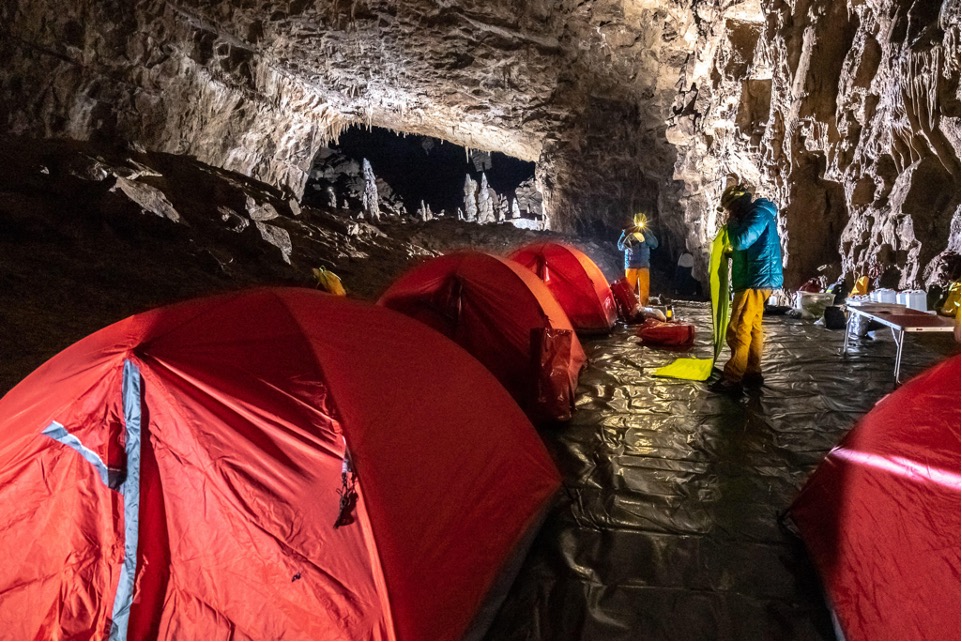
Each training course lasts for approximately three weeks. The first two weeks focus on providing the astronauts with the necessary behavioural patterns, scientific knowledge, and technical skills to work effectively and safely in an underground environment. During this time, trainees visit simple caves to become acquainted with the conditions they will find themselves in during their final expedition, a six-day uninterrupted expedition exploring a complex cave system. The main purpose of the mission is to foster their communication, decision-making, problem-solving, leadership and team dynamics capabilities by means of team activities and a real crew mission performed in a space-like environment.
Hub AI
ESA CAVES AI simulator
(@ESA CAVES_simulator)
ESA CAVES
CAVES (Cooperative Adventure for Valuing and Exercising human behaviour and performance Skills) is a European Space Agency (ESA) astronaut training course in which international astronauts train in a space-analogue cave environment. Designed at the European Astronaut Centre, the course aims to prepare astronauts for safe and efficient long duration spaceflight operations by means of a realistic scientific and exploration mission within a multicultural, ISS-representative team.
The first five editions of CAVES (2011, 2012, 2013, 2014 and 2016) took place in several caves on the Italian island of Sardinia, part of a Karst System which lies within the Supramonte region. The rocks in this area are predominantly limestone and dolomite.
The 2019 edition of CAVES was carried out in the so-called “Classical Karst” area, a karst region between Italy and Slovenia, world famous for its limestone caves. Here, the course makes use of facilities provided by Škocjanske Caves Regional Park, with field activities occurring in several caves along the underground course of the river Timavo, both in Italy and Slovenia.
The 2025 edition of CAVES was carried out in the Matese mountains of the Italian Apennines.
The CAVES training has the following training objectives for its participants:
The cave environment is an exceptional space analogue. It recreates on Earth many of the stressful conditions and specific characteristics encountered in long duration spaceflight, such as:
Another parallel with space exploration concerns astronaut progression within the cave, i.e., how they move through the environment. Speleological techniques involve safety principles similar to that of an EVA, such as the need to be attached to a safe surface – the cave wall in CAVES, the ISS or a vehicle in space. The crew mission performed during the final expedition also has several elements in common with astronaut's experience during ISS operations, including a time-lined activities schedule, daily planning calls to the ground support team, and standardised procedures and data collection methods.
Each training course lasts for approximately three weeks. The first two weeks focus on providing the astronauts with the necessary behavioural patterns, scientific knowledge, and technical skills to work effectively and safely in an underground environment. During this time, trainees visit simple caves to become acquainted with the conditions they will find themselves in during their final expedition, a six-day uninterrupted expedition exploring a complex cave system. The main purpose of the mission is to foster their communication, decision-making, problem-solving, leadership and team dynamics capabilities by means of team activities and a real crew mission performed in a space-like environment.