
Recent from talks
Cubic surface
Knowledge base stats:
Talk channels stats:
Members stats:
Cubic surface
In mathematics, a cubic surface is a surface in 3-dimensional space defined by one polynomial equation of degree 3. Cubic surfaces are fundamental examples in algebraic geometry. The theory is simplified by working in projective space rather than affine space, and so cubic surfaces are generally considered in projective 3-space . The theory also becomes more uniform by focusing on surfaces over the complex numbers rather than the real numbers; note that a complex surface has real dimension 4. A simple example is the Fermat cubic surface

in . Many properties of cubic surfaces hold more generally for del Pezzo surfaces.
A central feature of smooth cubic surfaces X over an algebraically closed field is that they are all rational, as shown by Alfred Clebsch in 1866. That is, there is a one-to-one correspondence defined by rational functions between the projective plane minus a lower-dimensional subset and X minus a lower-dimensional subset. More generally, every irreducible cubic surface (possibly singular) over an algebraically closed field is rational unless it is the projective cone over a cubic curve. In this respect, cubic surfaces are much simpler than smooth surfaces of degree at least 4 in , which are never rational. In characteristic zero, smooth surfaces of degree at least 4 in are not even uniruled.

More strongly, Clebsch showed that every smooth cubic surface in over an algebraically closed field is isomorphic to the blow-up of at 6 points. As a result, every smooth cubic surface over the complex numbers is diffeomorphic to the connected sum , where the minus sign refers to a change of orientation. Conversely, the blow-up of at 6 points is isomorphic to a cubic surface if and only if the points are in general position, meaning that no three points lie on a line and all 6 do not lie on a conic. As a complex manifold (or an algebraic variety), the surface depends on the arrangement of those 6 points.

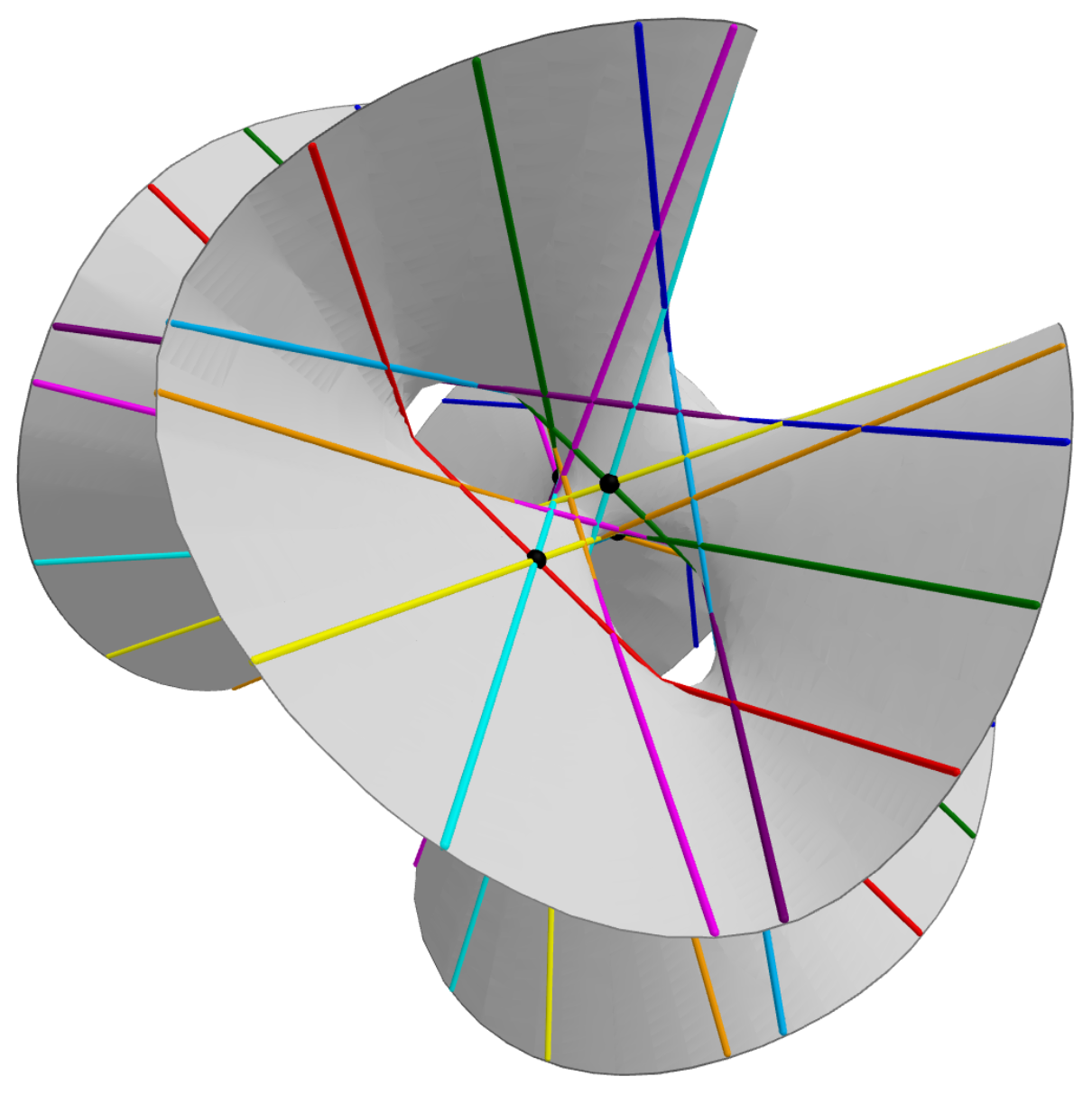
Most proofs of rationality for cubic surfaces start by finding a line on the surface. (In the context of projective geometry, a line in is isomorphic to .) More precisely, Arthur Cayley and George Salmon showed in 1849 that every smooth cubic surface over an algebraically closed field contains exactly 27 lines. This is a distinctive feature of cubics: a smooth quadric (degree 2) surface is covered by a continuous family of lines, while most surfaces of degree at least 4 in contain no lines. Another useful technique for finding the 27 lines involves Schubert calculus which computes the number of lines using the intersection theory of the Grassmannian of lines on .

As the coefficients of a smooth complex cubic surface are varied, the 27 lines move continuously. As a result, a closed loop in the family of smooth cubic surfaces determines a permutation of the 27 lines. The group of permutations of the 27 lines arising this way is called the monodromy group of the family of cubic surfaces. A remarkable 19th-century discovery was that the monodromy group is neither trivial nor the whole symmetric group ; it is a group of order 51840, acting transitively on the set of lines. This group was gradually recognized (by Élie Cartan (1896), Arthur Coble (1915–17), and Patrick du Val (1936)) as the Weyl group of type , a group generated by reflections on a 6-dimensional real vector space, related to the Lie group of dimension 78.


The same group of order 51840 can be described in combinatorial terms, as the automorphism group of the graph of the 27 lines, with a vertex for each line and an edge whenever two lines meet. This graph was analyzed in the 19th century using subgraphs such as the Schläfli double six configuration. The complementary graph (with an edge whenever two lines are disjoint) is known as the Schläfli graph.
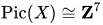
Many problems about cubic surfaces can be solved using the combinatorics of the root system. For example, the 27 lines can be identified with the weights of the fundamental representation of the Lie group . The possible sets of singularities that can occur on a cubic surface can be described in terms of subsystems of the root system. One explanation for this connection is that the lattice arises as the orthogonal complement to the anticanonical class in the Picard group , with its intersection form (coming from the intersection theory of curves on a surface). For a smooth complex cubic surface, the Picard lattice can also be identified with the cohomology group .


Hub AI
Cubic surface AI simulator
(@Cubic surface_simulator)
Cubic surface
In mathematics, a cubic surface is a surface in 3-dimensional space defined by one polynomial equation of degree 3. Cubic surfaces are fundamental examples in algebraic geometry. The theory is simplified by working in projective space rather than affine space, and so cubic surfaces are generally considered in projective 3-space . The theory also becomes more uniform by focusing on surfaces over the complex numbers rather than the real numbers; note that a complex surface has real dimension 4. A simple example is the Fermat cubic surface
in . Many properties of cubic surfaces hold more generally for del Pezzo surfaces.
A central feature of smooth cubic surfaces X over an algebraically closed field is that they are all rational, as shown by Alfred Clebsch in 1866. That is, there is a one-to-one correspondence defined by rational functions between the projective plane minus a lower-dimensional subset and X minus a lower-dimensional subset. More generally, every irreducible cubic surface (possibly singular) over an algebraically closed field is rational unless it is the projective cone over a cubic curve. In this respect, cubic surfaces are much simpler than smooth surfaces of degree at least 4 in , which are never rational. In characteristic zero, smooth surfaces of degree at least 4 in are not even uniruled.
More strongly, Clebsch showed that every smooth cubic surface in over an algebraically closed field is isomorphic to the blow-up of at 6 points. As a result, every smooth cubic surface over the complex numbers is diffeomorphic to the connected sum , where the minus sign refers to a change of orientation. Conversely, the blow-up of at 6 points is isomorphic to a cubic surface if and only if the points are in general position, meaning that no three points lie on a line and all 6 do not lie on a conic. As a complex manifold (or an algebraic variety), the surface depends on the arrangement of those 6 points.
Most proofs of rationality for cubic surfaces start by finding a line on the surface. (In the context of projective geometry, a line in is isomorphic to .) More precisely, Arthur Cayley and George Salmon showed in 1849 that every smooth cubic surface over an algebraically closed field contains exactly 27 lines. This is a distinctive feature of cubics: a smooth quadric (degree 2) surface is covered by a continuous family of lines, while most surfaces of degree at least 4 in contain no lines. Another useful technique for finding the 27 lines involves Schubert calculus which computes the number of lines using the intersection theory of the Grassmannian of lines on .
As the coefficients of a smooth complex cubic surface are varied, the 27 lines move continuously. As a result, a closed loop in the family of smooth cubic surfaces determines a permutation of the 27 lines. The group of permutations of the 27 lines arising this way is called the monodromy group of the family of cubic surfaces. A remarkable 19th-century discovery was that the monodromy group is neither trivial nor the whole symmetric group ; it is a group of order 51840, acting transitively on the set of lines. This group was gradually recognized (by Élie Cartan (1896), Arthur Coble (1915–17), and Patrick du Val (1936)) as the Weyl group of type , a group generated by reflections on a 6-dimensional real vector space, related to the Lie group of dimension 78.
The same group of order 51840 can be described in combinatorial terms, as the automorphism group of the graph of the 27 lines, with a vertex for each line and an edge whenever two lines meet. This graph was analyzed in the 19th century using subgraphs such as the Schläfli double six configuration. The complementary graph (with an edge whenever two lines are disjoint) is known as the Schläfli graph.
Many problems about cubic surfaces can be solved using the combinatorics of the root system. For example, the 27 lines can be identified with the weights of the fundamental representation of the Lie group . The possible sets of singularities that can occur on a cubic surface can be described in terms of subsystems of the root system. One explanation for this connection is that the lattice arises as the orthogonal complement to the anticanonical class in the Picard group , with its intersection form (coming from the intersection theory of curves on a surface). For a smooth complex cubic surface, the Picard lattice can also be identified with the cohomology group .
Recent media